

AI inventory management is mature enough to evaluate seriously now, but not mature enough to buy casually. The strongest case is not that every warehouse suddenly needs an autonomous planning layer. It is that several outcome ranges have become too consistent to ignore: lower forecast error, lower inventory, fewer stockouts, lower logistics cost, and more disciplined procurement spend when the use case is scoped and the data is usable.
For budget conversations, the benchmark band matters more than the slogan. McKinsey’s distribution-specific analysis reports demand forecast error reductions of 20% to 50%, lost sales from stockouts cut by up to 65%, inventory reductions of 20% to 30%, logistics cost reductions of 5% to 20%, and procurement spend reductions of 5% to 15% in AI-enabled distribution operations.[1] Those are serious numbers, but the word “distribution” is doing work. They should not be lifted into a board deck as a universal promise for every manufacturing, retail, or spare-parts environment.
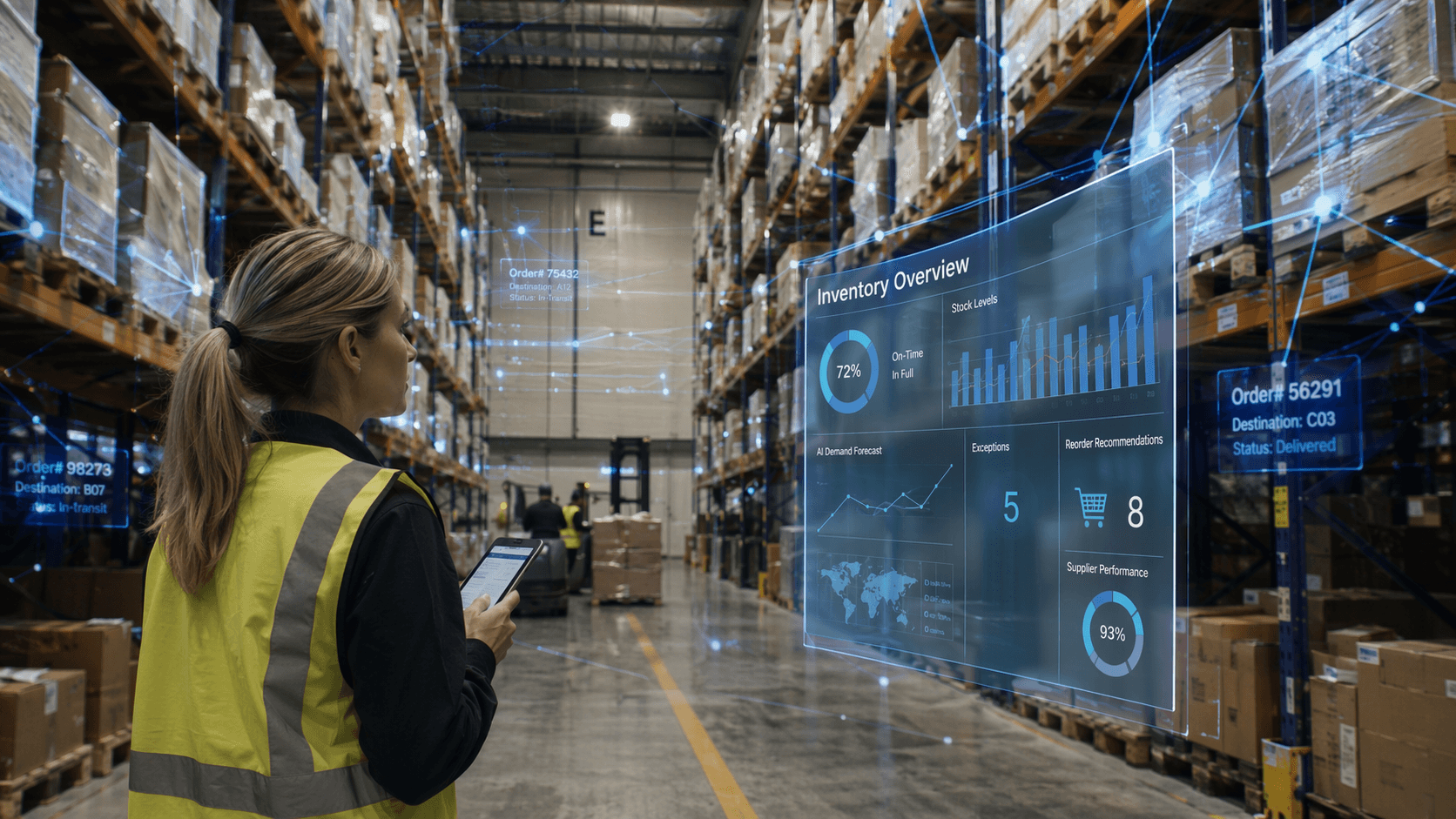
The adoption signal is just as strong, and less comforting. ABI Research’s 2025 survey of 490 professionals found that 94% of supply chain companies plan AI or generative AI deployment within two years, while Gartner’s 2025 survey of 120 supply chain leaders who had already deployed AI found that only 23% had a formal AI strategy.[2] That is the gap many teams are walking into: high deployment intent, low strategic scaffolding.
Payback claims need the same discipline. CMARIX describes 200% to 400% ROI over three years and 6- to 18-month payback for many businesses, while ToolsGroup publishes similar inventory optimization ROI framing.[3][4] Those figures can be useful for scenario modeling, but they should sit beside the more conservative finding attributed to Deloitte: only 6% of organizations see ROI in under one year, with two to four years being more realistic for most.[2] Anyone who has watched “inventory reduction” turn into premium freight knows why finance should see both timelines before approving the project.
| Outcome area | Benchmark to use carefully | Scope and caution |
|---|---|---|
| Demand forecast error | 20% to 50% reduction | McKinsey distribution operations analysis; strongest when historical demand, promotion, and supply signals are clean.[1] |
| Lost sales from stockouts | Up to 65% reduction | McKinsey distribution context; do not treat as a guaranteed service-level gain across all networks.[1] |
| Inventory reduction | 20% to 30% reduction | McKinsey distribution-specific estimate; compare against current excess, safety stock policy, and supplier lead-time variability.[1] |
| Logistics cost | 5% to 20% reduction | McKinsey distribution context; savings depend on replenishment cadence, load planning, and emergency freight baseline.[1] |
| Procurement spend | 5% to 15% reduction | McKinsey distribution context; more relevant where purchasing decisions can respond to demand and inventory signals.[1] |
| Payback | 6 to 18 months in optimistic vendor-side framing; two to four years for most in Deloitte-attributed summaries | Use the shorter range for tightly scoped use cases with clean data, not enterprise transformation assumptions.[2][3][4] |
What AI Inventory Management Actually Changes
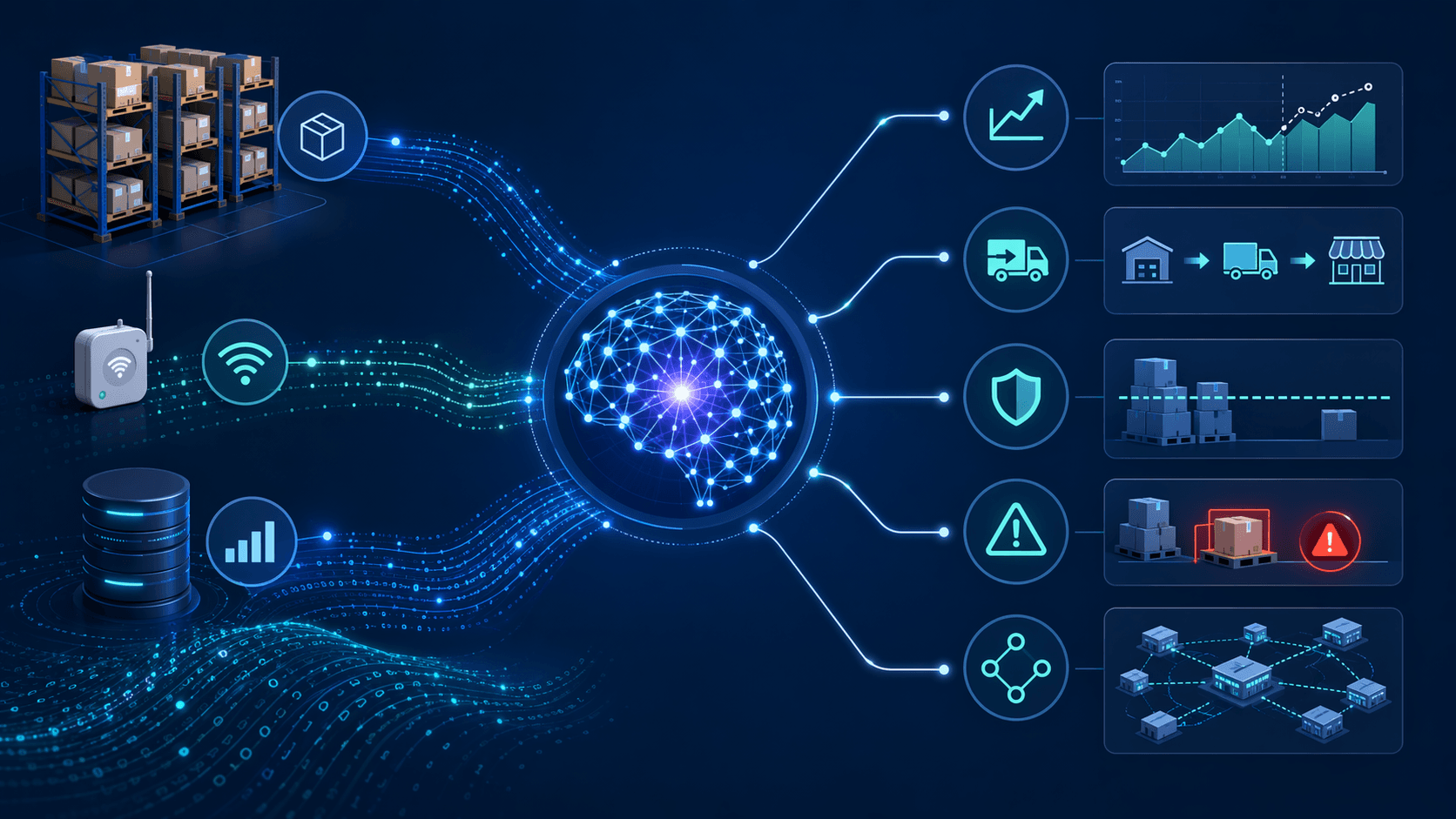
AI inventory management uses machine learning, optimization, and related analytics to improve decisions about what to stock, where to stock it, when to replenish it, and how to respond when demand or supply behaves differently than the plan. IBM frames it around improving inventory tracking, demand forecasting, replenishment, and operational decision-making with AI techniques.[5]
That definition is serviceable, but the planning-room version is plainer: AI changes which signals get considered before a human or system commits inventory. A traditional reorder point may look mostly at average demand, lead time, and safety stock. An AI-enabled approach can absorb more demand patterns, detect exceptions earlier, adjust replenishment recommendations more frequently, and help planners see where a service-risk decision is moving cost from one pocket to another.
The market context explains why the topic is now landing in capital planning rather than innovation theater. The Business Research Company estimate cited by Open Sky Group places the AI inventory management market at $7.38 billion in 2024 and $12.36 billion in 2026, implying roughly 30% CAGR.[2] Market size is not proof of effectiveness, but it does explain why vendor noise has increased and why leaders need sharper filters.
The Use Cases That Carry the Business Case
Most AI inventory management programs are sold as a bundle, but the business case is usually earned by a few use cases. The rest may be useful, but they do not all deserve equal weight in the first investment recommendation. A leader shortlisting platforms should separate the use cases that directly touch forecast accuracy, inventory reduction, and stockout prevention from the broader automation features that make a demo feel complete.
For a narrower comparison of use-case economics, see the related guide to AI inventory management use cases. The overview here stays focused on which capabilities deserve early attention and why.
Demand Forecasting
Demand forecasting is usually the first serious candidate because forecast error contaminates everything downstream. If the forecast misses a promotion, a weather pattern, a channel shift, or a regional demand break, the replenishment engine does not merely make a small math error. It can put inventory in the wrong building, trigger short shipments, inflate safety stock, or create the appearance that operations failed when the demand signal was the first failure.
The McKinsey range of 20% to 50% forecast error reduction is the benchmark that belongs in early business-case work, with the distribution-specific caveat attached.[1] A company with stable demand and clean master data may not see the same lift as one still forecasting at a blunt category level. A company with chaotic promotion coding may not deserve the range at all until planners stop keeping half the truth in spreadsheets.
AI helps most when it can read demand at the level where decisions are actually made: SKU-location, customer segment, channel, or fulfillment node. It can also incorporate external or semi-structured signals where available. But the planning team still has to decide which events are exceptions, which demand is repeatable, and which history should be excluded because the business could not supply the product in the first place.
For teams comparing forecasting approaches rather than inventory platforms, the related guides on AI demand forecasting in CPG and retail and time-series versus relational forecasting tools go deeper than this overview should.
Replenishment and Safety Stock
Replenishment is where forecast improvement either becomes service improvement or disappears into workflow friction. AI can recommend order quantities, timing, and location-level replenishment priorities based on demand patterns, inventory position, lead-time variability, supplier performance, and service targets. The operational value is not that it generates a prettier suggested order. It is that it can recalculate more often than a planner can, while flagging the exceptions that deserve human review.
Safety stock optimization is the more sensitive cousin. Reducing safety stock looks good in a working-capital deck until the first stockout lands on a customer-facing team. AI can help distinguish where buffer is genuinely excessive from where it is quietly covering supplier unreliability, demand volatility, or system latency. That distinction matters because inventory is often blamed for problems created elsewhere.
This is where the 20% to 30% inventory reduction benchmark should be handled with care.[1] A network with bloated slow-moving inventory has more room to improve than a lean operation already protected by tight service-level agreements. The better pilot metric is not simply “inventory down.” It is inventory down while service, stockout, and expedite metrics are visible at the same time.
Multi-Echelon Inventory Optimization
Multi-echelon inventory optimization, or MEIO, is where AI inventory management starts to look less like a planning screen and more like a network decision engine. Instead of optimizing each node separately, MEIO considers how inventory should be positioned across suppliers, plants, distribution centers, stores, and fulfillment points. That matters because one node’s “excess” may be another node’s insurance policy.
In practical terms, MEIO helps answer questions that single-location planning cannot handle well: Should scarce inventory sit upstream or downstream? Which DC should carry the buffer for a volatile region? When should inventory be postponed centrally rather than pre-positioned? How much service risk is created when finance asks for a working-capital reduction across the whole network?
The related MEIO glossary covers the concept in more detail. For this article, the main point is that MEIO is often where inventory reduction and service protection can be discussed in the same model instead of in separate meetings.
Predictive Stockout Prevention
Predictive stockout prevention is not just an alert that a SKU is running low. Good systems look at current inventory, open orders, supplier lead time, demand velocity, allocation rules, and network alternatives before the service failure becomes visible to the customer. The planner needs enough warning to do something other than apologize.
McKinsey’s reported reduction of lost sales from stockouts by up to 65% gives this use case real weight, again within the distribution context.[1] The result depends on whether the organization can act on the prediction. If the system flags a risk but purchasing cannot expedite, transportation cannot re-route, and allocation rules are locked until Friday’s meeting, the model has produced awareness rather than prevention.
Inventory Visibility and Allocation
Inventory visibility sounds basic until a team tries to reconcile ERP inventory, WMS inventory, in-transit stock, store counts, supplier commits, and spreadsheet reservations. AI does not fix inventory accuracy by magic. It becomes useful when the underlying systems expose enough timely data for anomaly detection, exception handling, and confidence scoring.
Allocation is where visibility turns into a commercial decision. When supply is constrained, AI can help decide which customer, channel, store, or region should receive inventory first. That is rarely a purely mathematical question. Service agreements, margin, substitution options, customer priority, and future replenishment timing all matter. A model can rank tradeoffs, but governance has to decide which tradeoffs are allowed.
Where the Proof Is Strongest
Real-world examples help, but they are not all equal evidence. A named deployment in an internal case-study archive carries different weight from a vendor blog description. A retailer’s public operating model carries different weight from a claim that has not been tied to primary reporting. The examples are useful as pattern recognition, not as copy-and-paste ROI.
Amazon is the easiest illustration to understand: predictive placement tries to position inventory closer to expected demand before the customer orders, while robotics and fulfillment automation reduce the lag between inventory decision and physical movement. CMARIX and IBM both discuss Amazon-style predictive inventory placement and AI-enabled operations as examples of AI inventory management in practice.[3][5]
Lowe’s is a different kind of example. CBC describes the company using digital twins for store-level inventory simulation, a useful pattern for leaders who need to test inventory decisions before they become store execution problems.[6] Digital twins are not a substitute for clean on-hand data, but they can make the consequence of a policy change visible before the field has to absorb it.
Starbucks and Zara are worth treating more lightly. CMARIX describes Starbucks using computer vision for inventory counting at eight times the prior frequency and Zara operating around a one-week design-to-store cycle.[3] Those examples are directionally relevant, but because the available evidence is vendor-blog sourced, they should not carry the same confidence as analyst benchmarks or stronger deployment records.
For readers who need a broader deployment archive, the related collection of AI in supply chain examples is a better place to compare patterns across companies.
Vendor Landscape Without Pretending There Is One Best Tool
The AI inventory management vendor landscape is crowded enough that a ranked list can create false precision. The better first pass is to sort vendors by buyer need, architecture fit, planning maturity, and integration reality. Kanerika’s 2026 inventory management tools overview names several representative platforms, including Blue Yonder, o9 Solutions, Kinaxis, RELEX, IBM, C3 AI, ToolsGroup, Peak AI, and SAP IBP across the broader market.[7]
| Vendor or platform | Typical buyer relevance | Evaluation note |
|---|---|---|
| Blue Yonder | Large retail, manufacturing, and distribution organizations looking for advanced planning and autonomous execution direction | Evaluate fit for planning architecture, execution integration, and the organization’s tolerance for more autonomous workflows. |
| o9 Solutions | Enterprises seeking integrated business planning, scenario planning, and cross-functional decision support | Strong candidate when inventory decisions need to connect with demand, supply, finance, and commercial planning. |
| Kinaxis | Organizations prioritizing concurrent planning and rapid scenario response | Useful where planners need to understand network consequences quickly rather than wait for sequential planning cycles. |
| RELEX | Retail and consumer-facing businesses with store, assortment, replenishment, and demand-planning complexity | Assess against store-level execution needs and replenishment process maturity. |
| IBM | Enterprises needing AI, consulting, and systems integration support around inventory and supply chain decisioning | Relevant where the problem spans data architecture, AI governance, and operational workflow design. |
| C3 AI | Large enterprises exploring AI application layers across operations and supply chain | Best evaluated against existing enterprise AI architecture and integration strategy. |
| ToolsGroup | Companies focused on service-driven inventory optimization and planning performance | Useful to assess where service levels, safety stock, and inventory optimization are central to the business case. |
| Peak AI | Businesses looking for AI decision intelligence around inventory, pricing, and supply chain decisions | Evaluate against the specificity of inventory workflows and required planning-system integration. |
| SAP IBP | SAP-centered enterprises seeking inventory optimization within a broader planning environment | Often strongest when SAP data and process governance are already mature. |
A vendor shortlist should start with architecture questions before feature preference. Is the company trying to improve demand sensing, replenishment recommendations, MEIO, allocation, or exception management? Will the platform sit on top of SAP, Oracle, NetSuite, Microsoft Dynamics, or a mixed ERP/WMS estate? Who owns the middleware? Who signs off when the model recommends a service-risk tradeoff?
For deeper vendor work, use the related AI supply chain vendor architecture analysis, the Blue Yonder agentic AI profile, and the Blue Yonder versus Kinaxis comparison.
The Readiness Gap That Decides Whether the Pilot Survives
The uncomfortable part of AI inventory management is that adoption intent is running ahead of operating readiness. Put the numbers together: 94% of supply chain companies plan AI or generative AI deployment within two years, but only 23% of surveyed supply chain leaders who had already deployed AI reported having a formal AI strategy.[2] That is not a small documentation gap. It affects use-case selection, data ownership, model governance, integration funding, and how results are explained when the first pilot produces mixed outcomes.

The same source roundup cites PwC’s 2025 finding that 57% of operations leaders have integrated AI into selected functions and ActivTrak’s 2025 finding that 72% of logistics employees already use AI tools.[2] Those figures describe adoption and usage, not necessarily durable inventory performance. A planner using an AI assistant is not the same as an inventory policy governed by trusted data, integrated execution systems, and measurable service outcomes.
This is why the ROI timeline matters so much. The short payback story can be true for a bounded use case with a clear baseline, clean data, and limited integration complexity. It becomes dangerous when it is used to sell an enterprise-wide transformation that has not priced data remediation, middleware, process redesign, exception governance, and planner adoption. The related CFO business case guide is the better place to pressure-test that financial model.
Data Quality Is the First Constraint, Not a Cleanup Task
Across the implementation material in the research base, data quality is the primary barrier. AI inventory systems need clean, consistent historical data, with 12 to 24 months of usable history treated as a practical minimum in implementation guidance. That history needs to include enough demand, inventory, replenishment, lead-time, and exception context for the model to learn something useful.
The problem is rarely that the company has no data. It is that the data was created for transactions, not learning. Promotion codes changed. Stockouts were not marked cleanly. Substitutions were handled outside the system. Supplier commits were overwritten. Store counts were corrected late. The model then sees demand that did not happen, inventory that was not available, or lead times that were administratively convenient rather than operationally true.
Before a pilot starts, the team should define which history is trusted, which fields are mandatory, which exceptions must be excluded, and which master data problems will block go-live. That is not bureaucracy. It is the difference between a model that earns planner trust and one that becomes another dashboard nobody wants to defend in S&OP.
Integration Ownership Has to Be Named
Most organizations are not replacing ERP and WMS foundations just to adopt AI inventory management. The more realistic pattern is API-based middleware connecting planning applications with systems such as SAP, Oracle, NetSuite, Microsoft Dynamics, and warehouse platforms. That architecture can work, but only if ownership is explicit.
Someone has to own data latency, exception synchronization, write-back rules, user permissions, and failure handling. If the AI layer recommends an order change, does it write into the ERP, create a planner task, or remain advisory? If the WMS inventory position changes after the model runs, does the recommendation update? If the model disagrees with a planner override, which record is authoritative?
These details decide whether AI becomes embedded work or a parallel planning ritual. The related AI inventory management implementation playbook goes deeper on sequencing those decisions.
Governance Determines How Much Autonomy Is Safe
Not every AI inventory recommendation should be automated on day one. Low-risk replenishment suggestions for stable items may move quickly toward touchless execution. Allocation decisions during constrained supply, supplier substitutions, or safety stock reductions for critical SKUs deserve more review. The governance model should define where the system recommends, where it acts within thresholds, and where a human decision is required.
The useful question is not whether the organization “trusts AI.” It is which decisions have enough data quality, business rules, auditability, and downside protection to allow more autonomy. The related piece on the confidence-autonomy gap in supply chain AI is a helpful companion for that discussion.
A Defensible Starting Point
The strongest starting point is a scoped use case with a visible operational pain, a credible benchmark range, and a clean enough data set to measure before and after. Demand forecasting for a defined business unit, replenishment for a category with frequent stockouts, safety stock optimization for a network segment, or MEIO for a constrained distribution network can all work. A vague enterprise AI inventory initiative is harder to defend and easier to disappoint.
- Start with a baseline: forecast error, inventory value, service level, stockout rate, expedite cost, logistics cost, and planner intervention rate.
- Confirm data readiness: 12 to 24 months of usable history, stable item-location master data, clean stockout flags, and known promotion or event history.
- Name integration ownership: ERP, WMS, planning system, middleware, write-back rules, exception workflows, and support model.
- Define governance: which recommendations are advisory, which can be automated within thresholds, and which require planner or leadership approval.
- Use a finance-safe ROI timeline: model an optimistic 6- to 18-month case only for narrow pilots, and keep a two- to four-year enterprise return scenario visible.
AI inventory management is proven enough to justify evaluation and pilots now. The case is strongest where forecast error, stockouts, excess inventory, and emergency freight are already measurable. The purchase becomes risky when the organization wants benchmark outcomes without the less glamorous work: clean data, integrated systems, named governance, and a payback story finance will still recognize a year later.
References
- Harnessing the power of AI in distribution operations, McKinsey, 2024
- Supply Chain AI Statistics: 18+ Statistics You Should Know for 2026, Open Sky Group
- AI in Inventory Management: Strategies, Benefits, and Real-World Use Cases, CMARIX
- Maximize Inventory Optimization ROI with AI, ToolsGroup
- What is AI Inventory Management?, IBM
- Inside the AI-Powered Supply Chain: Scaling Inventory Optimization at Global Enterprises, CBC
- 5 Leading AI Inventory Management Tools in 2026, Kanerika
Comments
Join the discussion with an anonymous comment.