
Why This Comparison Matters in 2026
The supply chain planning software market has narrowed considerably. A handful of enterprise-grade platforms now dominate the shortlists of large manufacturers, retailers, and consumer goods companies — and Blue Yonder and Kinaxis consistently appear as the final two candidates for organizations prioritizing AI-native planning capabilities.
Both platforms earned Leader recognition in the 2026 Gartner Magic Quadrant for Supply Chain Planning Solutions — published as separate reports for Discrete Industries (March 18, 2026) and Process Industries (March 17, 2026). That shared recognition confirms both as credible enterprise choices. It does not tell you which one fits your organization.
The competitive landscape has also shifted materially. Blue Yonder's $839 million acquisition of One Network Enterprises (closed 2024) and its earlier acquisition of flexis AG for constraint-based production scheduling have meaningfully expanded its platform scope. Kinaxis, meanwhile, completed the rebranding of RapidResponse to Maestro and has continued building out its AI decision intelligence and agentic automation layer. These are not the same platforms that appeared in 2022 analyst reports.
Quick-Reference Comparison Snapshot
| Dimension | Blue Yonder (Cognitive Planning) | Kinaxis (Maestro) |
|---|---|---|
| Core Planning Architecture | LP optimization + constraint-based supply and production planning | Concurrent planning — simultaneous cross-functional recalculation across all horizons |
| Primary AI Approach | Demand sensing with ML, agentic AI for autonomous workflows, exception-based management | Decision Intelligence (prescriptive recommendations, post-game learning), unlimited scenario engine, planning automation |
| Suite Breadth | End-to-end: demand, supply, inventory, production scheduling, TMS, WMS, OMS, network orchestration (One Network) | Planning-centric orchestration layer; integrates with ERPs and execution systems without replacing them |
| Target Industries (Primary Strength) | Retail, omnichannel, discrete manufacturing, multi-enterprise automotive | Aerospace & defense, high-tech/electronics, life sciences/pharma, consumer products |
| Deployment Model | Cloud SaaS (Luminate platform) | Cloud SaaS |
| Ownership | Panasonic subsidiary | Publicly traded (TSX: KXS) |
| 2026 Gartner MQ: Discrete Industries | Leader | Leader — highest on Ability to Execute, furthest on Completeness of Vision |
| 2026 Gartner MQ: Process Industries | Visionary | Leader |
| Gartner Peer Insights Score | 4.6 / 5 (284 reviews) | 4.4 / 5 (277 reviews) |
| Approximate Customer Count | 1,800+ | ~936 enterprise customers |
Platform Backgrounds
Blue Yonder
Founded in 1985 and acquired by Panasonic in 2021, Blue Yonder operates as an independent subsidiary with its own product roadmap. The company's planning platform — marketed as Cognitive Planning within the Luminate suite — spans demand forecasting, supply planning, inventory optimization, production scheduling, and integrated business planning.
Two recent acquisitions have significantly altered its competitive profile. The acquisition of flexis AG added constraint-based production scheduling capabilities with particular depth in automotive and discrete manufacturing. The $839M acquisition of One Network Enterprises brought a multi-enterprise network platform hosting over 150,000 trading partners — extending Blue Yonder's reach from internal planning into multi-party supply chain orchestration. These were Blue Yonder's second and third acquisitions in five quarters, representing over $1 billion in total M&A investment.
Kinaxis
Founded in 1995 and publicly traded on the Toronto Stock Exchange, Kinaxis built its reputation on a single architectural bet: concurrent planning. The platform, originally known as RapidResponse (a name readers familiar with the legacy brand will recognize), was rebranded to Maestro to reflect its expanded AI and orchestration capabilities. The product has appeared in the Gartner Magic Quadrant for over a decade.
Kinaxis serves approximately 936 enterprise customers with a model that prioritizes planning depth over execution breadth. It integrates with ERPs, data lakes, and execution systems rather than replacing them — positioning Maestro as the intelligence and orchestration layer that sits above existing infrastructure.
Core Planning Architecture: Concurrent Planning vs. LP Optimization
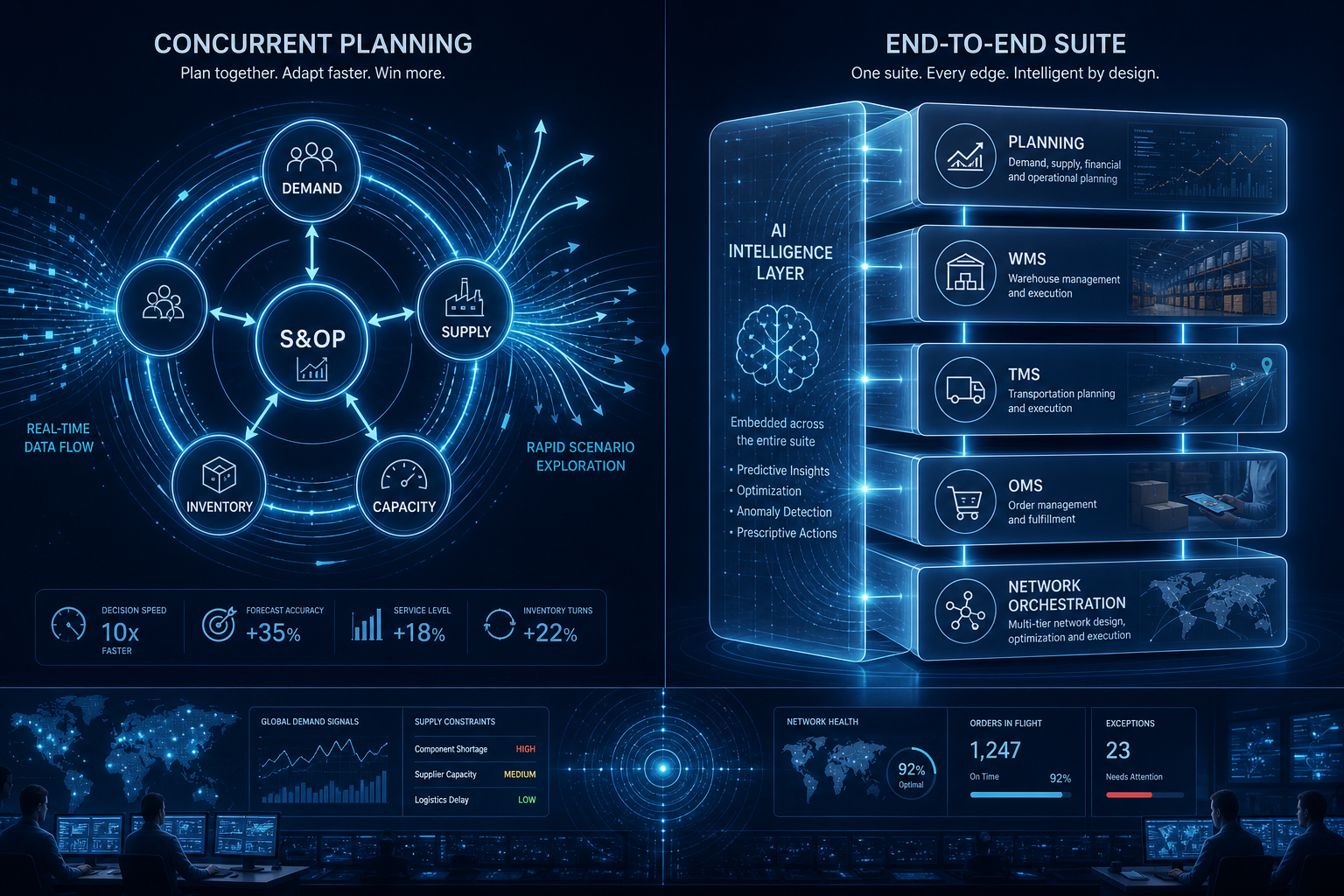
The most consequential difference between these two platforms is not a feature — it is an architectural philosophy that shapes how planners experience the software every day.
What Concurrent Planning Means Operationally
In a traditional sequential (cascaded) planning environment, demand planning runs first, supply planning consumes that output, production scheduling runs next, and so on. Each step compounds the misalignment introduced by the previous one. A demand signal change on Monday may not propagate through to a revised production schedule until Thursday — or later.
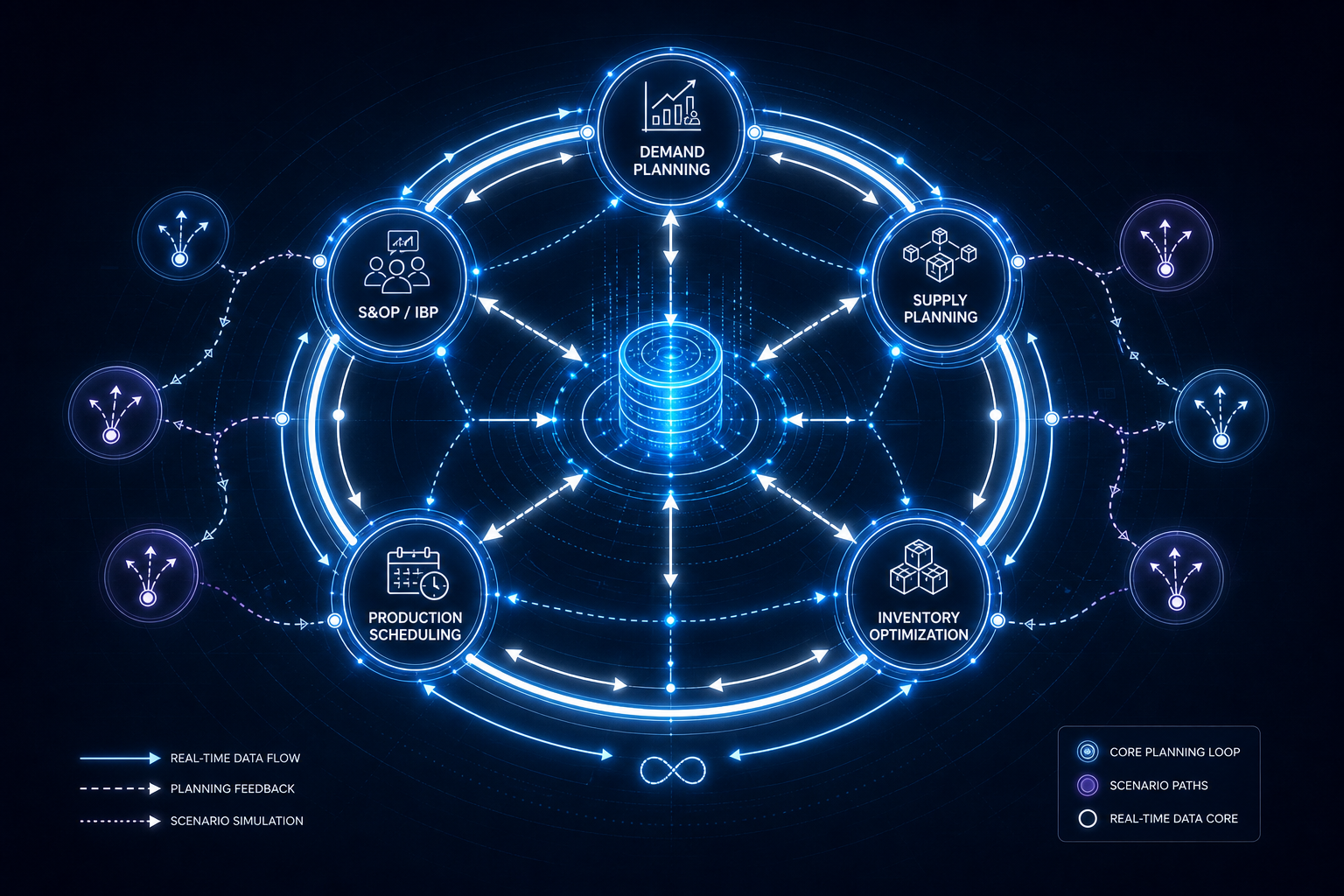
Kinaxis's concurrent planning model works differently. A change in one part of the supply chain — a supplier lead time extension, a demand spike, a capacity constraint — triggers corresponding recalculations across all other planning functions simultaneously, in near-real time. Demand, supply, inventory, S&OP, and capacity plans are held in a unified data model and recalculated together, not in sequence.
For a planner, this means that when a disruption occurs, the full downstream impact — across functions and time horizons — is visible within minutes rather than days. Scenario branching is fast enough to be part of a daily workflow rather than a periodic exercise.
The operational impact is documented. Nucleus Research (April 2026, Research 26060) reported, based on end-user interviews, that organizations deploying Maestro as a concurrent planning layer achieved planning time reductions of up to 99%, $50M in procurement cost avoidance, and multimillion-dollar labor savings. These are customer-reported best-case outcomes from a vendor-commissioned study — they represent what high-performing deployments have achieved, not guaranteed results.
What LP Optimization Means Operationally
Blue Yonder's planning engine is built around linear programming (LP) optimization and constraint-based planning. In practice, this means the platform solves for the mathematically optimal allocation of supply across a network given a defined set of constraints — capacity limits, service-level targets, cost parameters, lead times — rather than propagating changes in real time across a unified model.
For planners, LP optimization is well-suited to environments where the planning problem is complex and constraint-rich — such as multi-echelon inventory optimization across a large retail network, or production scheduling in a discrete manufacturing facility with tight capacity constraints. The flexis AG acquisition deepened Blue Yonder's constraint-based production scheduling capabilities, particularly for automotive and complex discrete manufacturing environments.
The tradeoff is that LP-based optimization typically runs as a batch solve rather than a continuous recalculation. The plan is optimized within a planning run; real-time disruption propagation across all functions simultaneously is not the native operating mode.
AI and Agentic Capabilities
Both platforms have deployed agentic AI capabilities as of 2025–2026. Neither has a monopoly on this area, and vendor marketing from both sides has outpaced what is verifiable in production deployments. The more useful distinction is in how each platform's AI layer is architecturally integrated.
| AI Capability Area | Blue Yonder Cognitive Planning | Kinaxis Maestro |
|---|---|---|
| Demand Forecasting AI | Demand sensing with ML, statistical forecasting, uplift modeling | Demand-integrated concurrent recalculation; AI-assisted signal ingestion |
| Prescriptive Recommendations | Exception-based management with AI-assisted prioritization | Decision Intelligence: prescriptive KPI-driven recommendations surfaced to planners |
| Scenario Planning | Real-time scenario modeling for supply and network design | Unlimited scenario creation and execution in seconds across all planning horizons |
| Agentic / Autonomous Planning | Agentic AI for autonomous planning workflows; exception-based task routing | Automation of repetitive planning tasks; post-game learning from past resolutions |
| Learning / Adaptation | AI model refinement through ongoing demand signal ingestion | Post-game analysis: system learns from how planners resolved past exceptions |
| Multi-enterprise AI | AI across Blue Yonder Network (One Network integration) | AI layer operates within Maestro's planning scope; external network via integrations |
Kinaxis's Decision Intelligence capability is architecturally embedded in the concurrent planning model — recommendations are generated in the context of a live, continuously recalculated plan, which means prescriptive guidance reflects the current state of the entire supply chain, not a snapshot from the last planning run. The post-game learning mechanism, which analyzes how planners resolved past exceptions to improve future recommendations, is a distinguishing feature that has no direct equivalent in Blue Yonder's current published capability set.
Blue Yonder's agentic AI layer is positioned around autonomous exception handling and workflow routing — reducing the manual intervention required when plans breach thresholds. Combined with the One Network integration, this extends AI-assisted orchestration beyond internal planning into multi-party supply chain execution, which is a capability Kinaxis does not replicate natively.
Functional Coverage Breadth
Suite breadth is where the two platforms diverge most visibly — and where the buyer's organizational strategy matters as much as the platform's capabilities.
Blue Yonder: Platform Consolidation Play
Blue Yonder's current portfolio spans the full supply chain stack:
- Demand planning and sensing (statistical forecasting, ML, uplift modeling)
- Supply planning and inventory optimization (LP-based, constraint-aware)
- Production scheduling (constraint-based, deepened by flexis AG acquisition)
- Network design (scenario-based cost and service tradeoffs)
- Integrated business planning (cross-functional S&OP/IBP)
- Transportation management (TMS)
- Warehouse management (WMS)
- Order management (OMS)
- Multi-enterprise network orchestration (Blue Yonder Network, powered by One Network)
For organizations that want to consolidate planning and execution onto fewer vendors — or that are already running Blue Yonder WMS or TMS and want to extend into planning — this breadth is a genuine advantage. The One Network integration specifically addresses the multi-enterprise coordination problem that pure planning platforms cannot solve.
Kinaxis: Best-of-Breed Planning Layer
Kinaxis Maestro is explicitly not a suite consolidation play. It covers:
- Demand planning and sensing
- Supply planning and S&OP/IBP
- Inventory optimization
- Scenario planning and concurrent recalculation
- Enterprise scheduling (production-level, per Maestro Enterprise Scheduling)
It does not replace TMS, WMS, or OMS. Instead, it integrates with existing ERPs, data lakes, and execution systems — treating them as data sources and execution endpoints while Maestro handles the planning intelligence layer. This ERP-agnostic positioning is a strength for organizations that have made significant investments in SAP or Oracle execution infrastructure and are not prepared to replace it.
Industry and Customer Profile Fit
| Industry Vertical | Blue Yonder Fit | Kinaxis Fit |
|---|---|---|
| Retail / Omnichannel | Strong — deep WMS/TMS/OMS integration, demand sensing for high-SKU environments | Limited — planning strength present but no native WMS/OMS layer |
| Discrete Manufacturing | Strong — constraint-based production scheduling (flexis AG), Gartner MQ Leader in Discrete | Strong — Gartner MQ Leader in Discrete, highest on Ability to Execute |
| Automotive (Multi-enterprise) | Strong — One Network multi-party orchestration, flexis AG scheduling depth | Moderate — planning agility is strong; multi-enterprise execution requires third-party integration |
| Aerospace & Defense | Moderate — planning capabilities present; less documented A&D depth | Strong — documented deployments, high-complexity BOM and long-lead-time planning |
| High-Tech / Electronics | Moderate — present in market; less dominant than in retail | Strong — documented customer base, well-suited to volatile demand and complex supply networks |
| Life Sciences / Pharma | Moderate — capabilities present; compliance-specific depth varies | Strong — documented deployments, regulatory traceability needs well-addressed |
| Consumer Products (CPG) | Moderate — retail adjacency; strong demand sensing | Strong — P&G (North America supply chain), Reckitt (enterprise scheduling) are documented deployments |
The Lenovo deployment illustrates Blue Yonder's strength in complex discrete manufacturing at global scale. Across 30 manufacturing facilities and 180 markets, Lenovo reported a 5% improvement in forecast accuracy, a 4% improvement in on-time delivery, and a 10% gain in delivery accuracy after deploying Blue Yonder for demand, supply, and factory planning. These figures are reported in Manufacturing Digital (May 2026) and represent vendor-reported outcomes attributed to a named customer.
"Blue Yonder have the deepest experience to understand our business… I don't think you'll find any other company that can match the experience in planning that you'll find at Blue Yonder." — Jack Fiedler, VP of Digital Transformation, Lenovo
For Kinaxis, the P&G and Reckitt deployments illustrate its consumer products and CPG strength. Procter & Gamble uses Maestro to manage its North America supply chain with continuous supply and demand planning, adjusting shipping and manufacturing daily. Reckitt deployed Maestro Enterprise Scheduling to reduce manual schedule-building time and shift planner focus toward scenario analysis and strategic decisions.
"With Maestro Enterprise Scheduling, our schedulers are spending less time manually building schedules and more time analysing scenarios and making strategic decisions." — Vivek Bhat, Global Process and Technology Director, E2E Supply Planning & Analytics, Reckitt
Analyst and Peer Review Positioning
The 2026 Gartner Magic Quadrant is the most widely cited analyst reference for this category, but it should not be the only input in an enterprise evaluation. The two MQ reports — Discrete Industries and Process Industries — tell meaningfully different stories about each platform's positioning.
| Source | Blue Yonder | Kinaxis | Notes |
|---|---|---|---|
| 2026 Gartner MQ: Discrete Industries | Leader | Leader — highest Ability to Execute, furthest Completeness of Vision | Published March 18, 2026 |
| 2026 Gartner MQ: Process Industries | Visionary | Leader | Published March 17, 2026 |
| Gartner Peer Insights (via RFP.wiki) | 4.6 / 5 (284 reviews) | 4.4 / 5 (277 reviews) | Scores via RFP.wiki aggregation; verify on Gartner Peer Insights directly |
| SoftwareReviews Composite Score | 7.0 / 10 | 7.1 / 10 | Based on 15 reviews each — small sample, treat as directional only |
| SoftwareReviews: Value for Money | 85% satisfied | 72% satisfied | Blue Yonder scores notably higher on perceived value relative to cost |
| SoftwareReviews: Plan to Renew | 100% | 100% | Both platforms show high retention in this sample |
| CSAT / Willingness to Recommend | Lower than Kinaxis in SoftwareReviews data | Higher in SoftwareReviews data | RFP.wiki: Blue Yonder CSAT 4.0, Kinaxis 4.4 |
| Nucleus Research (April 2026) | Not evaluated in this report | Up to 99% planning cycle reduction, $50M procurement cost avoidance | Vendor-commissioned; customer-reported best-case outcomes |
The Gartner MQ split between Discrete and Process Industries is worth examining carefully. Kinaxis holds Leader status in both reports and is specifically positioned highest on Ability to Execute in the Discrete Industries MQ — a signal that Gartner's evaluation panel views Kinaxis as the most operationally capable platform in that category. Blue Yonder's Visionary positioning in the Process Industries MQ (rather than Leader) suggests that Gartner evaluators see a gap between Blue Yonder's vision and current execution capability in process manufacturing contexts.
Implementation, TCO, and Ecosystem Considerations
Both platforms have high plan-to-renew rates — 100% in the SoftwareReviews sample — which suggests that once deployed, neither platform generates significant buyer regret. The implementation experience getting to that point, however, differs in important ways.
Kinaxis: Integration Complexity as the Primary Risk
- ERP and data-lake integration is the primary heavy lift. Because Kinaxis is ERP-agnostic and does not replace execution systems, the integration burden — connecting Maestro to SAP, Oracle, or other ERPs, plus data lakes and external signals — falls on the buyer's IT team. This is well-documented in peer reviews as the most significant implementation challenge.
- Performance on very large, MLS-heavy supply plans is a noted concern in peer review data. Organizations with extremely complex multi-level scheduling models should validate performance benchmarks against their specific data volumes during proof-of-concept.
- The ERP-agnostic positioning is both a strength and a risk. It means Kinaxis can sit on top of any ERP stack, but it also means there is no pre-built, maintained integration to a specific ERP that reduces implementation complexity the way an embedded or certified integration would.
Blue Yonder: Customization Debt and Services Intensity
- Customization and upgrade friction is the most frequently cited negative in Blue Yonder peer reviews. Organizations that have heavily customized their Blue Yonder deployments report difficulty upgrading to new platform versions without regression risk. This is a common enterprise SaaS challenge but appears with higher frequency in Blue Yonder reviews than in Kinaxis reviews.
- Services intensity and training costs are recurring concerns. Blue Yonder's platform breadth means implementations often require significant professional services engagement, and the total cost of ownership can exceed initial license estimates when services and training are factored in.
- Snowflake ecosystem integration is a noted strength. For organizations with Snowflake as a central data platform, Blue Yonder's integration is well-regarded and reduces data pipeline complexity.
Decision Framework: When to Choose Blue Yonder vs. Kinaxis
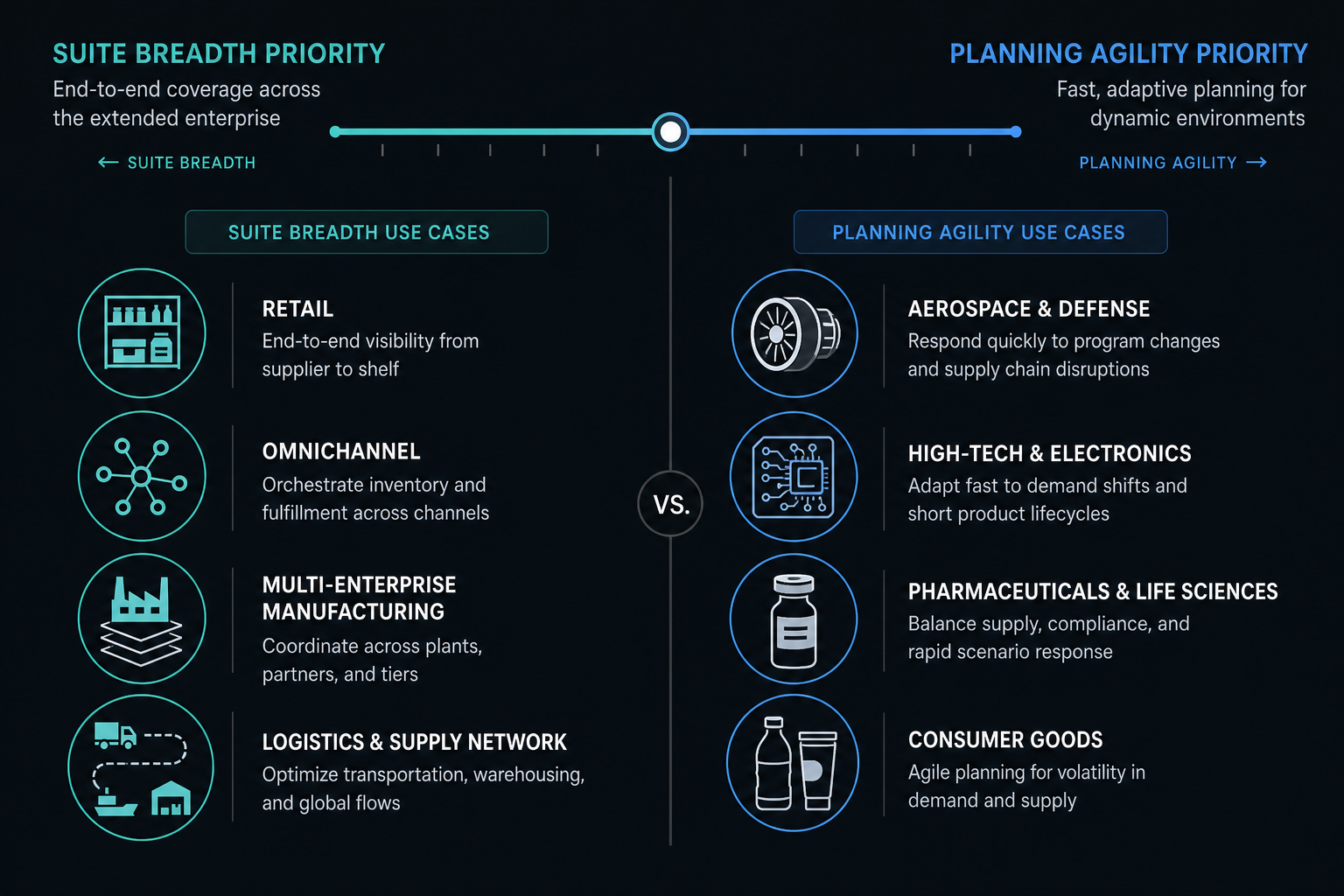
The framework below is organized by buyer profile and architectural priority — not by feature count. Both platforms will satisfy a generic feature checklist. The question is which architecture fits your operational reality.
| Buyer Situation | Stronger Fit |
|---|---|
| Unified end-to-end platform is a strategic priority — you want planning, WMS, TMS, and OMS on fewer vendors | Blue Yonder |
| Retail or omnichannel operations with high-SKU demand variability and execution integration requirements | Blue Yonder |
| Multi-enterprise discrete manufacturing or automotive with complex multi-party coordination needs | Blue Yonder |
| Snowflake is your central data platform and you want pre-built, maintained integration | Blue Yonder |
| You are already running Blue Yonder WMS or TMS and want to extend into planning without a new vendor relationship | Blue Yonder |
| Best-in-class concurrent planning agility is the primary requirement — you need cross-functional recalculation in near-real time | Kinaxis |
| Aerospace & defense, high-tech/electronics, or life sciences verticals with complex supply networks and volatile demand | Kinaxis |
| ERP-agnostic planning layer needed — you have significant investment in SAP or Oracle and are not replacing it | Kinaxis |
| Scenario planning speed is operationally critical — planners need to evaluate trade-offs in minutes, not days | Kinaxis |
| Consumer products or CPG with continuous supply and demand replanning requirements | Kinaxis |
| You are in process manufacturing (chemicals, food & beverage, pharma) and need a Gartner MQ Leader in that specific category | Kinaxis |
Summary and Evaluation Next Steps
The core thesis of this comparison is architectural, not feature-based. Blue Yonder and Kinaxis are both credible 2026 Gartner Magic Quadrant Leaders, and both have deployed meaningful AI capabilities. The decision between them turns on a single primary question: does your organization need a unified platform spanning planning through execution, or a best-in-class concurrent planning layer that integrates with existing infrastructure?
Blue Yonder's LP optimization engine, combined with the One Network multi-enterprise orchestration capability and the flexis AG production scheduling depth, makes it the stronger choice for organizations that want to consolidate vendors, operate complex multi-party supply chains, or run retail and omnichannel execution on the same platform as planning. Kinaxis Maestro's concurrent planning architecture, proven scenario speed, and Decision Intelligence layer make it the stronger choice for organizations where planning agility and real-time cross-functional recalculation are the primary operational requirements — particularly in high-tech, aerospace and defense, life sciences, and consumer products.
For teams in active evaluation, three practical next steps will yield more reliable differentiation than any comparison article:
- Request a scenario-specific proof of concept from both vendors using your own data. Generic demos will not surface the integration complexity or performance characteristics that matter for your specific supply chain structure. Kinaxis's concurrent recalculation speed and Blue Yonder's constraint-based optimization both require your actual data volumes and model complexity to evaluate meaningfully.
- Validate ERP integration requirements against your current stack before finalizing a shortlist. Kinaxis's ERP-agnostic model means integration complexity falls on your IT team. Blue Yonder's suite breadth means integration is more pre-built but customization debt is a documented risk. Both require honest scoping before contract.
- Use the 2026 Gartner MQ reports (Discrete Industries, March 18; Process Industries, March 17) and the Nucleus Research report (April 2026, Research 26060) as primary analyst inputs. Supplement with direct Gartner Peer Insights reviews filtered to your industry vertical — the aggregate scores are less useful than the qualitative review content from organizations in your sector.
Comments
Join the discussion with an anonymous comment.