

Why a Structured Playbook Matters: The Readiness Gap
The technology behind AI-driven inventory optimization is not the bottleneck. Machine learning models for demand forecasting, automated replenishment, and anomaly detection have been proven in production environments across retail, distribution, and manufacturing. The bottleneck is organizational readiness — and the data that feeds the models.
Consider two data points that define the problem. A McKinsey survey from September 2024 (n=40) found that roughly 95% of distributors are actively exploring AI use cases, yet fewer than 10% have developed a prioritized AI roadmap. Meanwhile, an ECR Loss research study covering roughly 1 million products across 100 stores found that 60% of inventory records are inaccurate. These two facts are causally connected: organizations jump into AI without first fixing the data foundation, and the projects stall or fail.
This playbook exists to close that gap. It is not a catalog of AI use cases or a high-level strategy argument — those angles are already covered in our analysis of the AI inventory optimization strategy gap. Instead, it is a phase-by-phase operational roadmap for operations managers, supply chain planners, and implementation leads who need to move from intent to deployment. The core thesis is counterintuitive: the AI models work. The failure mode is skipping the readiness fundamentals — data hygiene, pilot scoping, and change management.

Phase 0: Readiness Assessment — Data, Baseline, and Organizational Capability
Before any AI model is trained or any vendor demo is scheduled, the organization must complete a structured readiness audit. This phase determines whether the deployment will build on a solid foundation or on sand. According to the AI Strategy Path implementation guide, data quality drives 60–70% of AI effectiveness — meaning that if the input data is unreliable, the model outputs will be unreliable regardless of algorithmic sophistication.
Data Quality Assessment
The readiness audit must evaluate three dimensions of data quality across the inventory and transaction datasets that will feed the AI system:
- Accuracy: Do physical counts match system records? The ECR Loss study cited above found that 60% of inventory records contain errors. Run a cycle count comparison on a representative sample of SKUs before proceeding.
- Completeness: Are historical sales, returns, and lead time records available for at least 24–36 months? Gaps in historical data will degrade forecast model training.
- Timeliness: How frequently are inventory records updated? Daily batch updates may be sufficient for slow-moving categories, but fast-moving SKUs require near-real-time data feeds.
Baseline Metric Collection
Without a pre-deployment baseline, it is impossible to measure ROI. Collect at least 12 months of historical data for the following metrics before any AI system goes live:
- Forecast accuracy (MAPE or WAPE) at the SKU-location level
- Inventory turnover ratio by product category
- Stockout rate (percentage of SKU-days with zero available inventory)
- Excess and obsolete inventory value
- Service level (fill rate or line-item fill rate)
- Planner hours spent on manual replenishment and exception handling
ERP/WMS Integration Mapping
Map the data flow from source systems (ERP, WMS, POS, demand planning spreadsheets) to the target AI platform. Identify which fields are available, which are manually entered, and where the integration touchpoints exist. ToolsGroup, for example, integrates with SAP, Oracle, and Microsoft Dynamics and sits on top of existing systems rather than replacing them. Most AI inventory platforms follow a similar pattern — they are additive, not disruptive, to the existing tech stack.
Organizational Capability Evaluation
Assess whether the team has the skills to manage an AI deployment. The McKinsey survey found that only about 30% of distributors say they have sufficient talent to scale AI. If the internal team lacks data engineering or data science capability, factor in external support or a managed platform during the vendor selection process. For readers who need to build the financial business case for executive approval at this stage, our CFO-ready ROI framework for AI inventory management provides the structured justification.
Phase 1: Pilot Selection — Scoping for Quick Wins
The single most common mistake in AI inventory deployments is trying to boil the ocean. Organizations that attempt to deploy AI across their entire SKU catalog in one wave almost always fail. The recommended approach, supported by both McKinsey and the AI Strategy Path guide, is to start with a tightly scoped pilot that can demonstrate measurable value within 3–4 months.
McKinsey recommends selecting 1–2 low-risk, high-value use cases deliverable within 3–4 months. For inventory management, this typically means focusing on a single function — such as demand forecasting or automated replenishment — for a controlled subset of products.
Pilot Scoping Criteria
| Dimension | Recommended Scope | Rationale |
|---|---|---|
| SKU count | 500–2,000 SKUs | Large enough to generate statistically meaningful results, small enough to manage manually |
| Revenue coverage | 30–40% of total revenue | Focus on high-impact products that justify the investment |
| Product category | Low complexity, stable demand | Avoid seasonal, promotional, or new-product SKUs in the first pilot |
| Geographic scope | 1–2 distribution centers or stores | Limit integration complexity and change management surface area |
| Timeframe | 3–4 months to measurable results | Aligns with McKinsey recommendation for quick-win delivery |
| Win conditions | ≥15% forecast error reduction, ≥50% reduction in repeat anomalies | Clear, measurable targets that the team can rally around |
The Tailor playbook provides concrete win conditions for specific pilot types. For an AI Forecast Tune-Up pilot, the win condition is a ≥15% reduction in forecast error for pilot products over 5 days. For an Anomaly Alert Audit, the target is a ≥50% reduction in repeat unusual events within 2 weeks. These are not aspirational goals — they are achievable targets that build organizational confidence in the AI system.
Phase 2: Data Integration and Model Training — Where 40% of Effort Goes
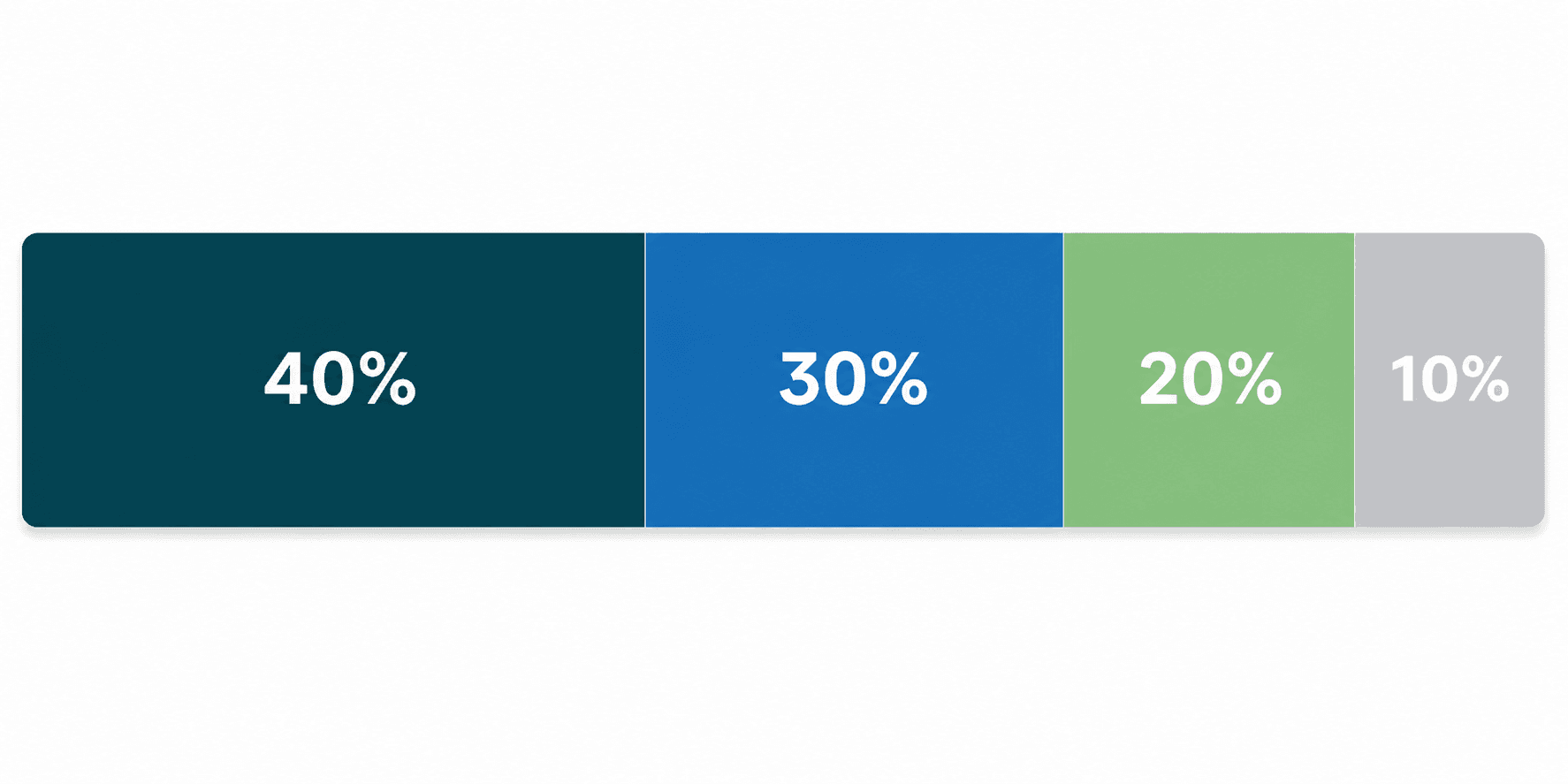
Data preparation and integration is the largest single cost center in any AI inventory deployment. The AI Strategy Path guide breaks down implementation resource allocation as follows: 40% technical (data integration, system configuration), 30% business process (workflow design, testing, validation), 20% change management (training, communication, adoption), and 10% project management. The technical portion is dominated by data work.
What Data Integration Involves
The AI platform needs to consume data from multiple source systems and normalize it into a consistent schema. The typical data integration scope includes:
- Historical sales data: Daily or weekly sales by SKU-location for at least 24 months. Include returns and cancellations.
- Inventory transaction logs: Receipts, adjustments, transfers, and write-offs. These are often the dirtiest datasets.
- Lead time records: Supplier lead times by SKU and location, including variability data.
- Promotional and event calendars: Marketing promotions, holidays, and known demand-shaping events.
- Product master data: SKU attributes (category, supplier, cost, weight, dimensions) that the model may use for clustering.
Model Training Considerations
Most commercial AI inventory platforms use pre-built models that are fine-tuned on the organization's data rather than trained from scratch. This reduces the data volume required. However, the platform still needs clean, normalized historical data to calibrate its parameters. The Intellias implementation guide emphasizes that data governance and scalable architecture are critical for successful AI deployment — meaning that the data pipelines built during Phase 2 must be designed for ongoing operation, not just the initial model training.
Phase 3: Parallel Run and Validation — Building Trust in the Model
The parallel run is the most critical phase for building organizational trust in the AI system. During this 4–8 week period, the AI model generates recommendations that run alongside the existing planning process, but human planners retain final decision authority. No purchase orders are generated automatically. No inventory is moved based on AI output alone.
Validation Methodology
The parallel run serves two purposes: validating the model's accuracy in the organization's specific operational context, and giving planners hands-on experience with the AI system. The validation framework should include:
- Daily comparison: AI-generated forecast vs. planner-generated forecast for the same SKU-location. Track the variance and investigate outliers.
- Weekly review meetings: Planners and data scientists review the model's performance, discuss edge cases, and flag data quality issues.
- Anomaly log: Every time the AI recommendation differs significantly from the planner's judgment, log the reason. This builds a corpus of edge cases for model refinement.
- Model explainability: The AI system should provide a clear rationale for each recommendation — which demand signals drove the forecast, what confidence interval applies, and what assumptions were made about lead time or seasonality.
Planner Feedback Loops
Planner trust is earned, not granted. The parallel run is where trust is built or broken. The Tailor playbook identifies a critical mindset shift that must occur during this phase: moving from "Automation is risky" to "Manual decision-making is risky and slow." This shift does not happen automatically — it requires structured exposure to the AI system's performance over time.
Establish a human-in-the-loop review process where planners can override AI recommendations with a documented reason. Each override becomes a training signal for the model. Over time, as the override rate decreases and the model's accuracy improves, the organization can move toward automated decision execution.
Phase 4: Scale and Expand — From Pilot to Enterprise
Once the pilot has demonstrated measurable value and the organization has built confidence in the AI system, the next step is phased expansion. The AI Strategy Path guide provides typical timelines: enterprise-wide deployment typically takes 12–24 months; mid-market specialized platforms can deploy in 6–12 months. The key is to expand methodically rather than attempting a full rollout.
Expansion Dimensions
| Expansion Path | Description | Typical Timeline |
|---|---|---|
| By product category | Add new categories one at a time, starting with those most similar to the pilot category | 2–4 months per category |
| By geographic location | Roll out to additional DCs or stores, applying lessons from the first location | 3–6 months per location |
| By channel | Extend from wholesale to direct-to-consumer or retail, each with different demand patterns | 3–6 months per channel |
| By function | Move from demand forecasting to automated replenishment, then to safety stock optimization | 4–8 months per function |
McKinsey emphasizes a critical financial principle during the scale phase: make AI self-funding by reinvesting returns from initial use cases. The inventory reduction and stockout savings from the pilot should fund the infrastructure and headcount needed for expansion. This creates a virtuous cycle where each phase of expansion is financed by the savings from the previous phase.
For readers planning beyond the initial deployment, our AI maturity roadmap for supply chain leaders provides a framework for the longer-term journey from pilot to P&L impact.
Change Management: Overcoming Planner Distrust and Organizational Inertia
Change management is not a soft skill — it is a hard requirement that consumes 20% of implementation resources according to the AI Strategy Path resource allocation model. Organizations that neglect this phase consistently underperform on ROI, regardless of how good their AI models are.
The Intellias implementation guide identifies change management as a major challenge often overlooked by retailers. The resistance typically comes from experienced planners who have spent years developing intuition about demand patterns and inventory policies. Asking them to trust a machine over their own judgment is a significant psychological shift.
The Mindset Shifts Required
The Tailor playbook identifies three specific mindset shifts that teams must make for AI adoption to succeed:
- From "I need more data" to "I need better signals." More data does not automatically improve forecasts. The focus should be on data quality and signal extraction.
- From "Extra stock protects us" to "Too much stock hides the real problem." Excess inventory masks demand signal issues, supplier reliability problems, and forecast inaccuracies.
- From "Automation is risky" to "Manual decision-making is risky and slow." Human planners cannot process the volume of data that AI systems can, and manual processes introduce latency and inconsistency.
Practical Change Management Tactics
- Involve planners in the pilot design: Planners who help select pilot SKUs and define win conditions are more likely to trust the results.
- Communicate early wins visibly: When the AI model correctly predicts a demand spike that the planner missed, make that a story. Celebrate the model's successes publicly.
- Provide hands-on training: Planners need to interact with the AI system during the parallel run, not just receive reports about it.
- Create a feedback channel: Planners should be able to flag model errors and suggest improvements. When they see their input leading to model refinements, trust accelerates.
- Redefine the planner role: Shift from manual data entry and spreadsheet management to exception handling and strategic analysis. This makes the job more valuable, not less.
Success Metrics Framework: What to Measure and When
A clear metrics framework ensures that every phase of the deployment has defined success criteria. Without this, teams cannot distinguish between a model that is working and a model that is producing plausible-looking but incorrect outputs.
| Metric | Phase Measured | Benchmark Range | Source |
|---|---|---|---|
| Forecast accuracy (MAPE) | Pilot (Phase 1–3) | Improvement from 60–70% to 85–95% | AI Strategy Path (citing Kovench) |
| Inventory reduction | Scale (Phase 4) | 15–30% reduction | ToolsGroup vendor-reported benchmarks |
| Stockout reduction | Pilot + Scale | 20–50% fewer stockouts | ToolsGroup vendor-reported benchmarks |
| Service level improvement | Scale (Phase 4) | 5–10 percentage point improvement | ToolsGroup vendor-reported benchmarks |
| Manual order creation reduction | Scale (Phase 4) | 70–90% reduction | N-iX vendor-reported benchmarks |
| Payback period | Post-deployment | 6–12 months | ToolsGroup, AI Strategy Path |
| Planner time savings | Scale (Phase 4) | 4–8 hours per week per planner | Industry pattern (not source-attributed) |
The ToolsGroup ROI guide provides a worked example: a company with $10M in inventory value reduced it to $7.5M (a $2.5M gain), cut stockouts from $500K to $200K (a $300K gain), and reduced write-offs from $300K to $150K (a $150K gain), for a total annual benefit of $2.95M against a $750K solution cost — a 293% ROI. These are vendor-reported results from a single case, not independently verified industry averages.
For a broader benchmark comparison across AI/ML supply chain applications, our 2026 ROI benchmarks and readiness gaps analysis provides cross-functional context.
Common Pitfalls and How to Avoid Them
The failure modes for AI inventory deployments are well documented. Our analysis of predictive analytics failure root causes provides deeper analysis, but the following five pitfalls are the most common in inventory-specific deployments.
- Data quality neglect: Skipping the Phase 0 readiness assessment is the single most common cause of failure. The 60% inventory record inaccuracy finding means that most organizations have significant data quality issues that will degrade model performance.
- Black box syndrome: If planners cannot understand why the AI made a recommendation, they will not trust it. Choose platforms that provide explainable outputs — feature importance scores, confidence intervals, and scenario comparisons.
- Scope creep: Expanding the pilot beyond 2,000 SKUs or adding too many use cases at once. The McKinsey recommendation of 1–2 low-risk, high-value use cases deliverable within 3–4 months exists for a reason.
- Insufficient change management: Allocating less than 20% of the implementation budget to training, communication, and organizational alignment. The Intellias guide explicitly calls this out as a major overlooked challenge.
- Unrealistic timeline expectations: Expecting enterprise-wide ROI in 3 months. The AI Strategy Path guide notes that enterprise deployments take 12–24 months, and mid-market deployments take 6–12 months. Quick wins happen in 3–4 months, but full ROI takes longer.
Build vs. Buy vs. Partner: A Decision Framework
Organizations deploying AI inventory management must decide whether to build an in-house solution, buy a commercial platform, or partner with a systems integrator. The right choice depends on internal capability, timeline, budget, and integration complexity.
| Decision | Best For | Timeline | Cost Range | Key Risk |
|---|---|---|---|---|
| Build in-house | Organizations with strong internal data science and engineering teams, unique operational requirements | 18–36 months | $500K–$5M+ | High ongoing maintenance cost, talent retention risk |
| Buy commercial platform | Mid-market to enterprise organizations with standard inventory management processes | 6–12 months (mid-market), 12–24 months (enterprise) | $100K–$5M+ | Vendor lock-in, integration complexity with legacy systems |
| Partner with systems integrator | Organizations that lack internal AI expertise but have clear requirements | 12–18 months | $200K–$2M+ | Dependency on external partner, knowledge transfer challenges |
The AI Strategy Path guide provides specific cost ranges: SMB investment of $10K–$100K with 1–6 month timelines; mid-market investment of $100K–$5M over 6–18 months; enterprise investment of $5M+ over 18–36 months. These are broad estimates and actual costs vary significantly based on scope and complexity.
For readers evaluating specific vendors, our 2026 AI supply chain software comparison provides a detailed side-by-side analysis of platform architectures, agentic AI capabilities, and decision execution features.
Comments
Join the discussion with an anonymous comment.