
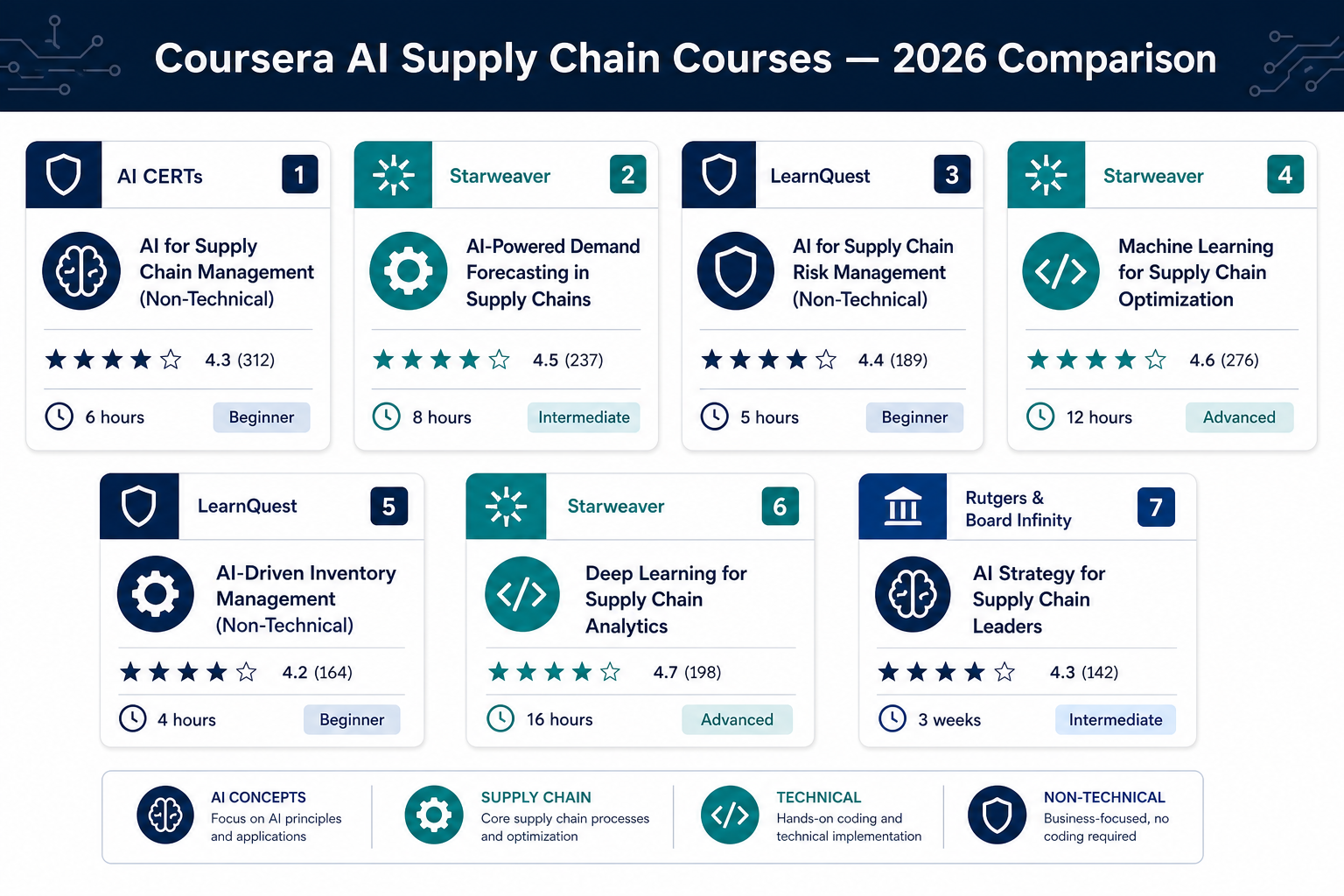
Why AI Skills Matter for Supply Chain Professionals in 2026
The supply chain function has entered a phase where AI literacy is no longer a differentiator — it is becoming a baseline expectation for mid-career and senior professionals. Demand planners are expected to understand probabilistic forecasting models. Procurement leads are asked to evaluate AI-driven supplier risk scoring tools. Warehouse operations managers are overseeing deployments of computer vision and autonomous mobile robots. The question is no longer whether AI will affect supply chain roles, but how quickly professionals can close the capability gap.
Coursera has become a primary platform for this upskilling, offering at least seven distinct AI-in-supply-chain learning paths from five different providers as of mid-2026. The options range from four-hour beginner overviews that require no technical background to thirteen-week specializations that demand Python proficiency and a working knowledge of statistics. For a supply chain manager with no prior machine learning experience, choosing the wrong path means either investing weeks in material that is too technical, or completing a course that is too shallow to change how they work.
This comparison is designed for that exact decision. It covers every AI-relevant supply chain course and specialization on Coursera as of June 2026, organized by provider, depth, technical requirement, and target role. The goal is to help you map your current position — operations manager, procurement analyst, demand planner, or supply chain director — to the learning path that actually fits.
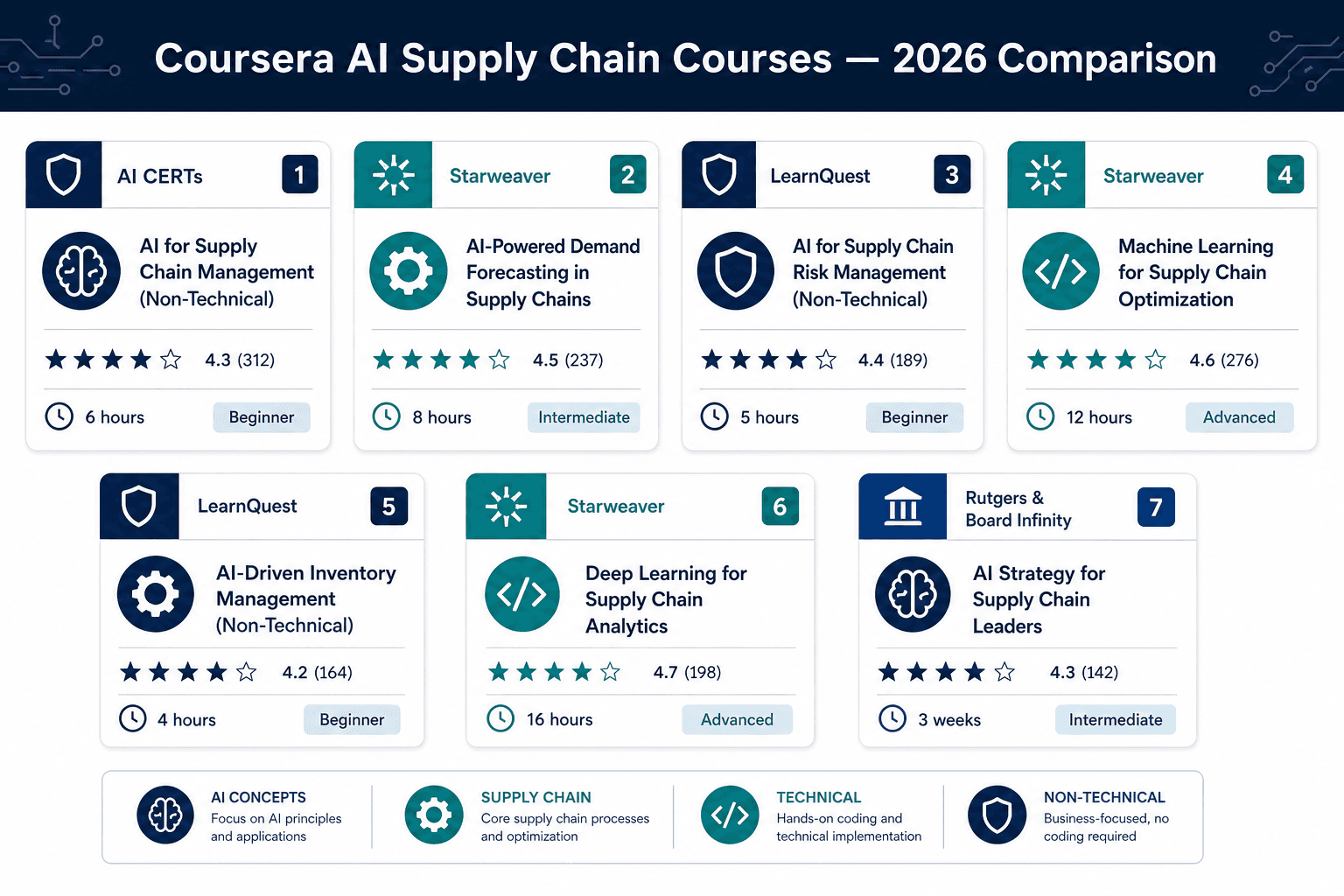
At a Glance: All Coursera AI Supply Chain Courses Compared
The table below summarizes every course and specialization covered in this comparison. Use it as a quick filter: identify your comfort level with coding, the time you can commit, and the depth of AI knowledge you need, then scan the right column for the best match.
| Course / Specialization | Provider | Level | Duration | Rating | Enrolled | Coding Required | Best For |
|---|---|---|---|---|---|---|---|
| AI in Supply Chain | AI CERTs | Intermediate | 3 weeks (30 hrs) | Not rated | 2,102 | No | Broad AI overview for non-technical managers |
| AI in Supply Chain Forecasting & Risk Management | Starweaver | Beginner | 4 hours | 4.2★ (18 reviews) | 3,010 | No | Quick intro to AI for forecasting and risk |
| GenAI for Supply Chain Optimization | Starweaver | Beginner | 4 hours | 4.8★ (16 reviews) | 2,505 | No | Hands-on GenAI application with LLMs |
| Advanced AI Techniques for the Supply Chain | LearnQuest | Intermediate | 2 weeks (20 hrs) | 3.2★ (15 reviews) | 2,829 | Yes (Python) | Technical deep dive into neural networks and NLP |
| Machine Learning for Supply Chains (Specialization) | LearnQuest | Intermediate | 13 weeks (130 hrs) | 3.4★ (86 reviews) | 4,288 | Yes (Python) | Full ML pipeline from ARIMA to CNNs |
| AI & Automation for Supply Chain Resilience | Board Infinity | Beginner | 6 hours | Not rated | Not disclosed | No | Disruption management with real case studies |
| Supply Chain Analytics (Specialization) | Rutgers | Beginner | 2 months (80 hrs) | 4.6★ (2,345 reviews) | 71,603 | No (Excel) | Analytics foundation for data-driven decision making |
Detailed Course Profiles
AI in Supply Chain — AI CERTs
This is the broadest single course in the comparison. AI CERTs designed it as an eight-module survey covering the full landscape: demand planning, inventory management, logistics, risk management, generative AI (transformer architectures, LSTM), supply chain digitization, prompt engineering, and even tangential technologies like blockchain and quantum computing. The course requires no coding and delivers content through videos, eBooks, audiobooks, and podcasts.
At 30 hours spread over three weeks, it demands a meaningful time commitment for a non-technical course. The breadth is both its strength and its weakness: you will leave with a vocabulary that lets you participate in strategic conversations about AI adoption, but you will not develop any hands-on capability. This course is best suited for supply chain directors or VP-level leaders who need to evaluate AI initiatives and communicate with technical teams, not for analysts who need to build models.
AI in Supply Chain Forecasting & Risk Management — Starweaver
Starweaver offers two short, beginner-friendly courses, and this is the more traditional of the pair. It covers the integration of AI in supply chain management, fundamental demand forecasting methods (independent vs. dependent demand), applying AI for demand forecasting using ChatGPT and large language models, common supply chain risks, and designing an automation strategy with AI.
The course is four hours long and includes 14 videos (72 minutes), 5 readings, 1 graded quiz, and 4 peer-reviewed projects. Learners use ChatGPT directly for forecasting, risk review, and automation scenario design. The 4.2★ rating from 18 reviews suggests a solid but not exceptional experience. For a procurement analyst or operations coordinator who wants to understand how LLMs can be applied to their daily work without any coding, this is a low-risk starting point.
GenAI for Supply Chain Optimization — Starweaver
This is the highest-rated option among all courses compared, with a 4.8★ from 16 reviews. Also four hours long, it focuses specifically on generative AI: foundations of GenAI and its role in supply chain management, common SCM challenges, inventory optimization case studies (including Amazon's AI-powered inventory control), and implementation, scaling, and governance of GenAI solutions.
The course includes 14 videos (80 minutes), 5 readings, 3 graded assignments, and one peer-reviewed project. The governance module — covering readiness evaluation, integration roadmap design, adoption challenges, and ethical considerations — is a differentiator. Most short courses skip governance entirely. For a supply chain professional who already understands basic AI concepts and wants to focus specifically on generative AI applications and responsible deployment, this is the strongest short option.
Advanced AI Techniques for the Supply Chain — LearnQuest
This is where the technical barrier rises sharply. Part of the Machine Learning for Supply Chains specialization, this intermediate-level course requires Python coding and covers ML paradigms (regression and classification), neural networks for product demand prediction, model selection and bias-variance tradeoff, loss functions and stochastic gradient descent, hyperparameter tuning, NLP methods for text analysis, and convolutional neural networks for image analysis — including a final project that applies image classification to detect faulty products from a machine.
The 3.2★ rating from 15 reviews is the lowest in this comparison, which may reflect the difficulty of the material or the quality of instruction relative to the technical demands. The course includes 12 videos (39 minutes), 13 readings (140 minutes), 4 graded assignments, 1 programming assignment, and 6 ungraded labs totaling 760 minutes — a significant hands-on component. This course is appropriate only for supply chain professionals who already code in Python and want to apply neural networks and NLP to supply chain problems.
Machine Learning for Supply Chains Specialization — LearnQuest
This is the only specialization in the comparison that teaches hands-on Python coding for supply chain use cases from the ground up. It consists of four courses totaling approximately 13 weeks at 10 hours per week:
- Course 1 — Fundamentals of Machine Learning for Supply Chain (13 hours): Python and Jupyter basics, data manipulation with Numpy and Pandas, linear programming with PuLP.
- Course 2 — Demand Forecasting Using Time Series (9 hours): ARIMA models in Python, autocorrelation, autoregressive models.
- Course 3 — Advanced AI Techniques for the Supply Chain (22 hours): neural networks, CNNs, NLP, image classification (the course profiled above).
- Course 4 — Capstone: Predicting Safety Stock (10 hours): SARIMA predictions, safety stock calculation.
The specialization requires general statistics and calculus knowledge. With 4,288 enrolled and a 3.4★ aggregate rating from 86 reviews, it has the most learner feedback of any technical option. The rating suggests that learners find the material valuable but challenging. For a demand planning analyst or supply chain data analyst who wants to build production-ready forecasting models in Python, this is the most comprehensive path available on Coursera.
AI & Automation for Supply Chain Resilience — Board Infinity
Updated in December 2025, this is the newest offering in the comparison. It is a beginner-level, six-hour course covering the foundations of AI and automation in supply chains, key technologies, historical disruptions, AI tools in logistics, inventory, and forecasting, and building resilience through intelligent systems — predictive analytics, real-time dashboards, automation frameworks, and adaptive decision-making.
The course includes case studies from global leaders like Maersk and Unilever, which adds practical context that most other short courses lack. No coding is required. For a supply chain resilience manager or procurement lead focused on disruption management, this course offers a focused, current perspective that the broader overview courses do not.
Supply Chain Analytics Specialization — Rutgers
The Rutgers Supply Chain Analytics specialization is the most popular analytics-focused option on Coursera, with 71,603 enrolled and a 4.6★ rating from 2,345 reviews. It consists of six courses covering supply chain analytics essentials, business intelligence and competitive analysis, demand analytics (regression models, forecasting with trend, seasonality, and price elasticity), inventory analytics, supply chain analytics, and sourcing analytics.
This specialization is Excel-based and requires no coding. It does not teach AI or ML techniques directly — it builds the analytical foundation that makes AI adoption more effective. The instructor, Yao Zhao from Rutgers, incorporates salary and job data sourced from Lightcast covering 2024–2026. For a supply chain professional who wants to strengthen their data analysis skills before moving into AI-specific coursework, this is the logical starting point.
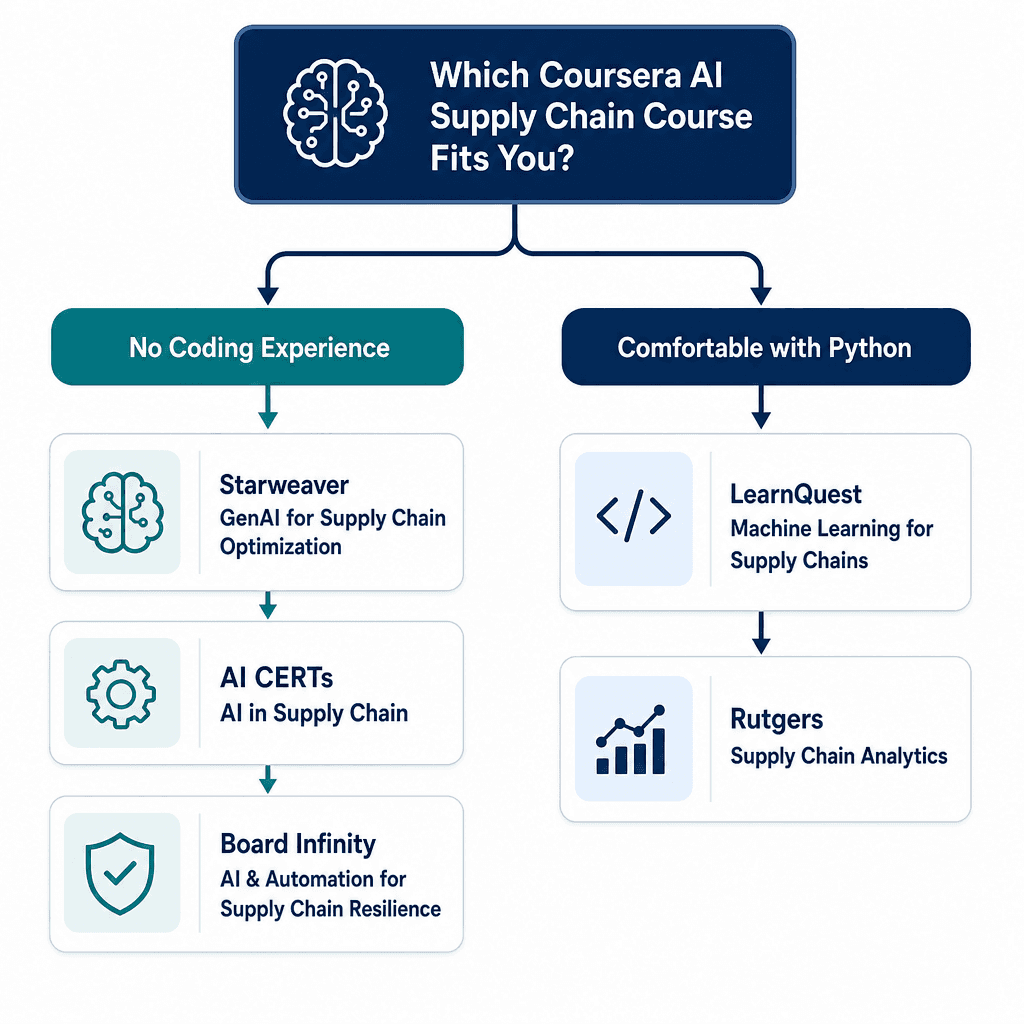
Who Should Choose What? A Decision Matrix
The right course depends on three variables: your current role, your technical comfort, and your learning objective. The matrix below maps each course to specific reader profiles.
| Reader Profile | Recommended Course | Why This Fits |
|---|---|---|
| Supply chain director / VP — needs AI vocabulary for strategic decisions, no coding | AI in Supply Chain (AI CERTs) | Broadest coverage of AI, GenAI, automation, and governance — builds conversational fluency without technical depth |
| Procurement analyst / operations coordinator — wants practical AI application with LLMs, no coding | GenAI for Supply Chain Optimization (Starweaver) | Highest-rated short course; hands-on GenAI projects with ChatGPT; includes governance module |
| Demand planner — wants to improve forecasting with AI, no coding | AI in Supply Chain Forecasting & Risk Management (Starweaver) | Focused on demand forecasting methods and risk mitigation using LLMs; 4 hours to complete |
| Supply chain resilience manager — focused on disruption management, no coding | AI & Automation for Supply Chain Resilience (Board Infinity) | Case studies from Maersk and Unilever; updated Dec 2025; covers predictive analytics and automation frameworks |
| Demand planning analyst / supply chain data analyst — comfortable with Python, wants to build models | Machine Learning for Supply Chains (LearnQuest) | Only specialization teaching Python (Numpy, Pandas, ARIMA, neural networks) for supply chain; 13 weeks |
| Supply chain professional — wants to strengthen analytics foundation before AI, no coding | Supply Chain Analytics (Rutgers) | Excel-based; 71K+ enrolled; covers regression, forecasting, inventory analytics; builds data literacy |
| Technical supply chain professional — wants neural networks and NLP specifically | Advanced AI Techniques for the Supply Chain (LearnQuest) | Covers CNNs, NLP, hyperparameter tuning; requires Python; part of the LearnQuest specialization |
Frequently Asked Questions
How much do these courses cost?
Coursera offers two purchasing models. Individual courses can be purchased standalone — typically $49 to $79 for the certificate track, with audit access available for free (no certificate). Coursera Plus, the subscription model, was priced at $199 per year at the time of research (promotional 50% off the standard $399 per year). Coursera Plus grants access to all courses and specializations in this comparison, making it the most cost-effective option if you plan to take more than two courses.
Do I need to know how to code?
Five of the seven options require no coding at all: both Starweaver courses, the AI CERTs course, the Board Infinity course, and the Rutgers specialization. Only the LearnQuest courses (Advanced AI Techniques and the Machine Learning for Supply Chains specialization) require Python programming. If you are a non-technical manager, you have ample options. If you are an analyst who wants to build models, the LearnQuest path is the only one that teaches coding from the ground up.
Are these university credentials or training certificates?
Only the Rutgers specialization carries a university brand (Rutgers University). The AI CERTs, Starweaver, LearnQuest, and Board Infinity courses are offered by training and certification organizations, not accredited universities. If your employer requires university-branded credentials for tuition reimbursement or professional development credit, verify eligibility before enrolling. The Rutgers specialization is the safest choice for that scenario.
How much time do I need to commit?
- Short courses (4–6 hours): Starweaver courses and Board Infinity course — can be completed in a weekend.
- Medium-length course (30 hours): AI CERTs course — requires 3 weeks at 10 hours per week.
- Specializations (80–130 hours): Rutgers Supply Chain Analytics (2 months at 10 hrs/week) and LearnQuest Machine Learning for Supply Chains (13 weeks at 10 hrs/week).
Which Course Should You Start With?
The choice comes down to a single question: do you need to understand AI, or do you need to build with AI?
If your role requires you to evaluate AI proposals, communicate with technical teams, and make strategic decisions about AI adoption — but not write code — start with the AI CERTs course for breadth, then take the Starweaver GenAI course for hands-on LLM experience. That combination covers the full AI landscape and gives you practical exposure to generative AI without requiring any programming.
If your role requires you to build forecasting models, optimize inventory policies, or develop AI-driven supply chain applications, start with the Rutgers Supply Chain Analytics specialization to build your data analysis foundation, then move to the LearnQuest Machine Learning for Supply Chains specialization for Python-based modeling. This path is longer — roughly five months total — but it builds genuine technical capability that changes how you work.
The worst outcome is choosing a course that does not match your starting point. A non-technical manager who enrolls in the LearnQuest specialization will spend weeks struggling with Python syntax instead of learning AI concepts. A Python-savvy analyst who takes the Starweaver course will finish in four hours without learning anything new. Use the decision matrix above, be honest about your current skills, and pick the path that stretches you without overwhelming you.
Comments
Join the discussion with an anonymous comment.