
Why Real Examples Matter More Than Vendor Claims in 2026
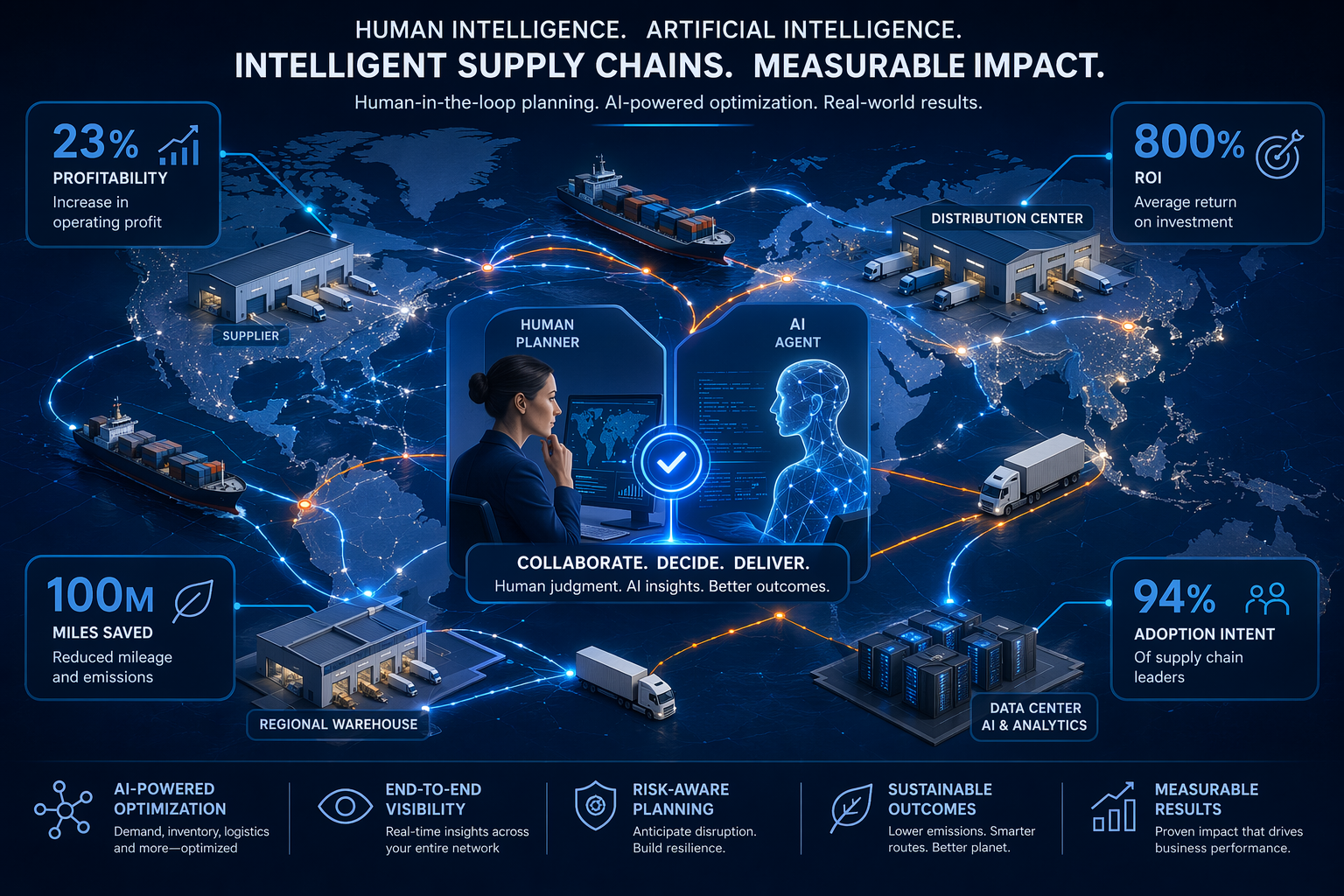
Every supply chain leader evaluating AI investment has seen the slide decks: generic promises of "10–20% cost reduction" or "30% inventory optimization" with no company name, no methodology, and no source. In 2026, with 94% of supply chain organizations planning to use AI or generative AI for decision support within two years (ABI Research, 2025 survey of 490 professionals), the gap between vendor rhetoric and verifiable deployment outcomes is the single biggest obstacle to executive buy-in.
This article takes a different approach. Instead of listing theoretical use cases or aggregating analyst projections, it profiles 13 named companies — Amazon, Walmart, UPS, Ocado, Frito-Lay, Lenovo, Maersk, GXO, JD Logistics, Metro Shipping, Zara, Unilever, and DHL — that have deployed AI across seven distinct supply chain functions. Each profile documents the operational problem, the AI solution applied, and the quantified, source-attributed outcome. The goal is to give supply chain directors, VPs of operations, and procurement leaders the peer-validated evidence they need to build business cases and vendor shortlists.
Company Profiles: AI Deployments Across the Supply Chain
Demand Forecasting and Inventory Optimization
Demand forecasting is the most mature AI application in supply chain, with documented forecast error reductions of 20–50% (McKinsey). The following companies demonstrate what that looks like at scale.
Amazon: AI-Driven Demand Forecasting Across 400M+ Products
Amazon's AI-powered demand forecasting system operates across more than 400 million products with minimal human input, automatically reordering low-stock items based on predictive models (citing Forbes via Intellias). The system ingests historical sales data, seasonal patterns, promotional calendars, and external factors such as weather and local events to generate SKU-level forecasts. Amazon has not publicly disclosed a single forecast-error reduction figure for the system as a whole, but the scale — 400M+ SKUs managed with minimal manual intervention — is itself a benchmark for what AI-driven demand planning can achieve at enterprise scale.
Zara: AI-Powered Demand Sensing for Fast Fashion
Zara uses AI to monitor fashion trends and social media activity for demand sensing, informing design decisions and enabling rapid restocking of best-selling items (CCO Consulting). The system analyzes real-time signals from point-of-sale data, social media sentiment, and runway trends to adjust production and allocation. While Zara does not publish specific forecast accuracy metrics, the company's ability to move from design to store shelf in as little as two weeks — versus the industry average of six months — is widely attributed to its AI-driven demand sensing and agile supply chain model.
Unilever: AI Across 20 Supply Chain Control Towers
Unilever has integrated AI across 20 supply chain control towers worldwide, enabling real-time visibility and decision support across its global network (CCO Consulting). The control towers aggregate data from demand signals, inventory levels, production schedules, and logistics events, using machine learning to flag anomalies and recommend corrective actions. Unilever has not released a single aggregate ROI figure for the program, but the breadth of deployment — 20 control towers spanning multiple continents and product categories — signals a mature, production-grade AI infrastructure.
Route Optimization and Last-Mile Delivery
Route optimization consistently shows the fastest payback among supply chain AI applications. The Thinking Company reports a 2–4 month payback period and 800–1,200% three-year ROI for a 500-vehicle fleet, with an investment of EUR 80,000–150,000 yielding annual savings of EUR 1.5–3 million. The following company examples confirm that pattern at massive scale.
Walmart: Route Optimization Eliminating 30 Million Driver Miles
Walmart's proprietary AI/ML route optimization system has eliminated 30 million driver miles and 94 million pounds of CO2 emissions (Walmart, 2024, via Intellias). The system optimizes delivery routes across Walmart's private fleet, considering factors such as traffic patterns, delivery windows, vehicle capacity, and fuel efficiency. The 30-million-mile reduction is one of the largest publicly documented routing savings from a single AI deployment in retail logistics.
UPS ORION: 100 Million Miles Saved Annually
UPS's ORION (On-Road Integrated Optimization and Navigation) system uses advanced algorithms to optimize delivery routes, saving up to 100 million miles annually (CCO Consulting; consistent across multiple sources). ORION analyzes package volume, delivery sequence, traffic conditions, and driver preferences to generate optimized route plans. The 100-million-mile figure has been cited consistently across multiple years, making ORION one of the longest-running and most thoroughly documented AI routing deployments in logistics.
DHL: AI-Powered Logistics Agents for Real-Time Routing
DHL has deployed AI-powered logistics agents for real-time shipment monitoring and alternative route suggestions (Unframe AI). The system uses machine learning to detect disruptions — weather events, port delays, capacity constraints — and automatically recommends rerouting options to minimize service impact. DHL has not published a specific miles-saved or cost-reduction figure for this deployment, but the agentic approach represents the next generation of routing AI, moving from static optimization to dynamic, event-driven rerouting.
Warehouse Automation and Robotics
Warehouse AI deployments range from robotic picking and packing to AI-powered inventory counting and storage optimization. The Thinking Company reports a 4–8 month payback and 250–400% three-year ROI for AI-directed picking systems. The following companies demonstrate the upper end of what is achievable.
Ocado: Fully Automated Warehouses Handling 50,000+ Orders Per Week
Ocado operates fully automated warehouses where AI-powered robotic arms can complete a 50-item grocery order in minutes (Ocado Group, via Intellias). The system uses computer vision and machine learning to identify, pick, and pack individual items from a dense grid of product totes. Ocado's warehouses handle over 50,000 orders per week (Unframe AI), with the entire process — from order receipt to pallet staging — managed by AI with minimal human intervention. The 50-item-in-minutes metric is a benchmark for what AI-driven warehouse automation can achieve in high-variety, high-volume grocery fulfillment.
JD Logistics: 300% Efficiency Increase and 3.5x Storage Density
JD Logistics used AI to increase warehouse storage units from 10,000 to 35,000 — a 3.5x improvement — while boosting operational efficiency by 300% (JD corporate blog, via Intellias). The system combines AI-driven slotting optimization, autonomous mobile robots (AMRs), and computer vision for inventory tracking. The 300% efficiency figure reflects improvements in order picking speed, inventory accuracy, and labor productivity across JD's automated warehouses.
GXO: AI-Powered Inventory Counting at 10,000 Pallets Per Hour
GXO, one of the world's largest contract logistics providers, uses AI-powered automated inventory counting to scan up to 10,000 pallets per hour (Intellias). The system employs computer vision and machine learning to identify and count inventory without manual scanning, dramatically reducing cycle count time and improving accuracy. GXO has not published a specific accuracy improvement percentage, but the 10,000-pallets-per-hour throughput — orders of magnitude faster than manual counting — illustrates the productivity gains achievable with AI-driven warehouse automation.
Predictive Maintenance
Predictive maintenance is one of the highest-ROI AI applications in supply chain, with McKinsey reporting 30–50% reduction in unplanned downtime and 10–40% lower maintenance costs. The Thinking Company estimates 300–500% three-year ROI for predictive fleet maintenance. The following example demonstrates what that looks like in practice.
Frito-Lay: Zero Unexpected Breakdowns in Year One
Frito-Lay achieved zero unexpected equipment breakdowns in the first year of deploying AI-powered predictive maintenance (PepsiCo story, via Intellias). The system uses machine learning to analyze vibration patterns, temperature, and usage history from sensors on manufacturing and packaging equipment, predicting failures before they occur. The "zero unexpected breakdowns" outcome is particularly notable because Frito-Lay operates high-speed production lines where unplanned downtime can cost tens of thousands of dollars per hour.
Siemens: AI for Machine Failure Prediction
Siemens uses AI to predict machine failures by analyzing vibration patterns, temperature, and usage history across its industrial equipment (CCO Consulting). The system provides early warnings of potential failures, enabling maintenance teams to intervene before breakdowns occur. Siemens has not published a specific downtime-reduction figure for this deployment, but the approach — sensor data + ML models for anomaly detection — is the same pattern used by Frito-Lay and other manufacturers achieving 30–50% unplanned downtime reduction.
Supplier Risk Management and Procurement Automation
AI in procurement and supplier management is one of the fastest-growing application areas. A 2025 survey by AI at Wharton and the Hackett Group found that 94% of procurement executives use generative AI tools at least weekly, up 44 percentage points year over year. The following examples show how leading companies are applying AI to supplier risk and negotiation.
Lenovo: AI-Powered Delivery Prediction Across 2,000+ Suppliers
Lenovo uses AI to predict delivery dates and identify potential delays across its network of more than 2,000 suppliers (Intellias). The system ingests data from supplier production schedules, shipping status, customs clearance events, and historical performance to generate probabilistic delivery windows. By flagging at-risk shipments weeks in advance, Lenovo's supply chain team can adjust manufacturing capacity, prioritize alternative suppliers, or expedite shipments before delays become critical. Lenovo has not published a specific cost-savings figure, but the ability to manage 2,000+ supplier relationships with AI-driven visibility is a benchmark for procurement AI maturity.
Maersk: AI Chat Negotiations with Suppliers
Maersk automates supplier negotiations via an AI chat interface that combines natural language processing (NLP) and generative AI (Intellias). The system handles routine rate negotiations, contract renewals, and spot-booking inquiries, freeing procurement teams to focus on strategic supplier relationships and complex contract structures. Maersk has not disclosed specific time savings or cost reduction figures, but the deployment of generative AI for direct supplier interaction represents a significant step toward autonomous procurement.
Unilever (Supplier Risk): AI for Ethical Sourcing and ESG Compliance
Beyond its control towers, Unilever applies AI to supplier selection and ethical sourcing, using machine learning to identify suppliers that align with ESG criteria (GEP). The system analyzes supplier data including environmental certifications, labor practices, financial stability, and geopolitical risk scores. While Unilever has not published a specific metric for this application, the approach is consistent with broader industry trends: GEP notes that AI-powered supplier risk scoring is becoming a standard capability in procurement platforms.
Customs Clearance and Trade Compliance
Customs clearance is a high-volume, data-intensive process where AI can dramatically reduce manual effort and error rates. The following example demonstrates the impact.
Metro Shipping: 40% Faster Customs Clearance with 99% Data Accuracy
Metro Shipping, a UK-based logistics provider, achieved a 40% improvement in customs clearance turnaround time and 99% data accuracy by deploying machine learning for document processing and classification (WNS case study, via Intellias). The ML system automatically extracts and validates data from customs declarations, invoices, and shipping documents, flagging discrepancies for human review. The 40% time reduction and 99% accuracy rate are independently documented outcomes from a WNS case study, making this one of the most thoroughly verified AI deployments in trade compliance.
Comparative Analysis: Company by Function, Outcome, and Maturity
The following table maps all 13 companies to their primary supply chain function, the key outcome metric, the source and year of that metric, and the deployment maturity level. This enables readers to quickly identify peer examples relevant to their own function or industry.
| Company | Primary Function | Key Outcome Metric | Source & Year | Maturity |
|---|---|---|---|---|
| Amazon | Demand Forecasting | 400M+ products forecasted with minimal human input | Forbes via Intellias, 2025 | Full Production |
| Walmart | Route Optimization | 30M driver miles eliminated; 94M lbs CO2 saved | Walmart, 2024 | Full Production |
| UPS | Route Optimization | 100M miles saved annually | Multiple sources (CCO Consulting et al.) | Full Production |
| Ocado | Warehouse Automation | 50-item order completed in minutes; 50K+ orders/week | Ocado Group via Intellias; Unframe AI | Full Production |
| Frito-Lay | Predictive Maintenance | Zero unexpected breakdowns in year one | PepsiCo story via Intellias (vendor-attributed) | Full Production |
| Lenovo | Supplier Risk | Delivery prediction across 2,000+ suppliers | Intellias, 2025 | Full Production |
| Maersk | Procurement Automation | AI chat negotiations with suppliers | Intellias, 2025 | Limited Production |
| GXO | Warehouse Automation | 10,000 pallets/hour AI-powered scanning | Intellias, 2025 | Full Production |
| JD Logistics | Warehouse Automation | 300% efficiency increase; 10K to 35K storage units | JD corporate blog via Intellias | Full Production |
| Metro Shipping | Customs Clearance | 40% faster clearance; 99% data accuracy | WNS case study via Intellias | Full Production |
| Zara | Demand Sensing | 2-week design-to-shelf cycle (industry avg: 6 months) | CCO Consulting, 2025 | Full Production |
| Unilever | Supply Chain Visibility | AI across 20 control towers worldwide | CCO Consulting, 2025 | Full Production |
| DHL | Route Optimization | AI agents for real-time rerouting | Unframe AI, 2026 | Limited Production |
Key Takeaways for Building Your AI Business Case
The 13 company profiles above reveal several cross-cutting patterns that can inform your own AI investment strategy.
Route Optimization and Warehouse Automation Show the Fastest Payback
The Thinking Company's ROI analysis — 2–4 month payback and 800–1,200% three-year ROI for route optimization, 4–8 month payback and 250–400% three-year ROI for warehouse AI — is validated by the company examples above. Walmart, UPS, and DHL all demonstrate that routing AI delivers measurable savings within months, not years. Similarly, Ocado, JD Logistics, and GXO show that warehouse automation can produce step-change improvements in throughput and storage density within a single fiscal year.
Demand Forecasting and Supplier Risk Require the Most Data Maturity
Amazon's 400M+ SKU forecasting system and Lenovo's 2,000+ supplier network both required years of data infrastructure investment before AI could deliver value. If your organization lacks clean, integrated historical data across demand, inventory, and supplier performance, expect to spend 30–40% of your total project budget on data integration and cleansing (The Thinking Company). Starting with a narrower scope — a single product category or a single supplier region — can reduce risk while building the data foundation for broader deployment.
Portfolio ROI Is Higher Than Individual Use Case ROI
The Thinking Company notes that portfolio ROI is typically 40–60% higher than individual use case ROI because infrastructure investment — data pipelines, integration, model governance — is amortized across multiple applications. Unilever's 20 control towers and Maersk's combination of AI chat negotiations with broader procurement automation both illustrate this principle: the companies that see the highest returns are those that treat AI as a platform investment, not a series of point solutions.
Adoption Is Accelerating, but Most Companies Are Still Early
The broader adoption statistics provide important context for the company examples above:
- 57% of operations and supply chain leaders have integrated AI into their operations (PwC, 2025 survey of 610 US executives).
- 72% of logistics employees adopted AI tools in 2024 (ActivTrak, tracking usage across 774 companies).
- 85% of executives plan to increase AI spending in 2026, with one in five expecting a 20%+ increase (Supply Chain Brain, 2025).
- Companies with AI-mature supply chains are 23% more profitable than peers (Accenture, 2024, analyzing 1,148 companies across 10 industries in 15 countries).
- Only 23% of organizations have a formal AI strategy (Gartner, 2025 survey of 120 leaders).
The gap between intent (94% plan to use AI within two years) and formal strategy (23% have one) represents both a risk and an opportunity. Companies that invest now in data readiness, pilot design, and organizational change management will be positioned to capture the portfolio-level returns that the early adopters — Amazon, Walmart, UPS, Ocado — are already realizing.
Comments
Join the discussion with an anonymous comment.