
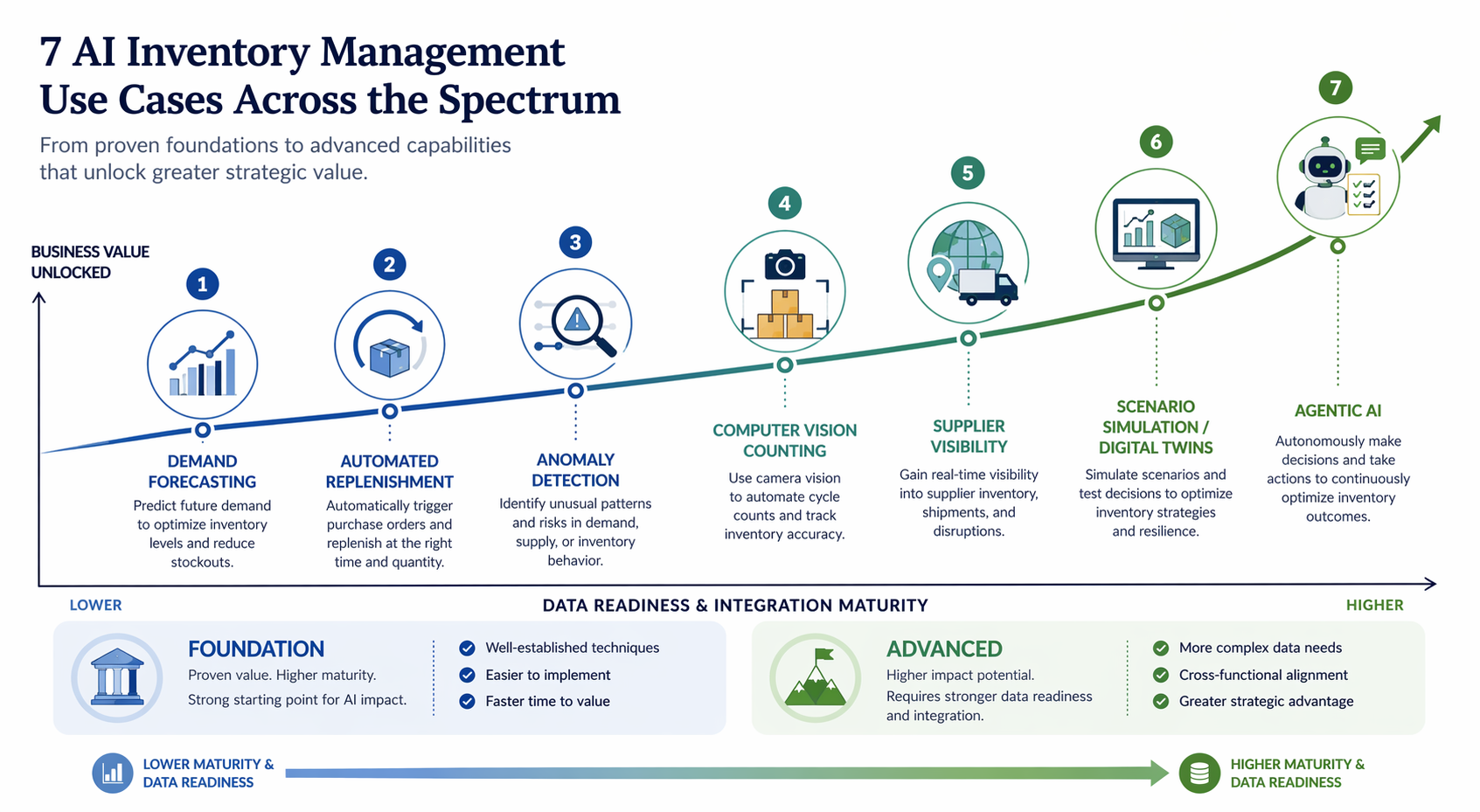
The first problem with ai for inventory management is that it is usually sold as one thing. It is not. A forecasting model that helps a planner reset safety stock is not the same investment as a camera-based counting system in a DC, a supplier-risk control tower, or an agent that proposes exception actions. They touch the same inventory balance sheet, but they fail for different reasons.
That distinction matters because the market is moving faster than most operating models. Gartner reported in 2025 that only 23% of supply chain organizations had a formal AI strategy, while 94% expected to deploy AI within two years.[1] That gap is why so many teams are being asked to compare tools before they have separated the use cases. The better starting question is not “Which AI platform has the highest ROI?” It is “Which inventory decision are we ready to improve, with the data and people we actually have?”
Compare the Use Case, Not the AI Label
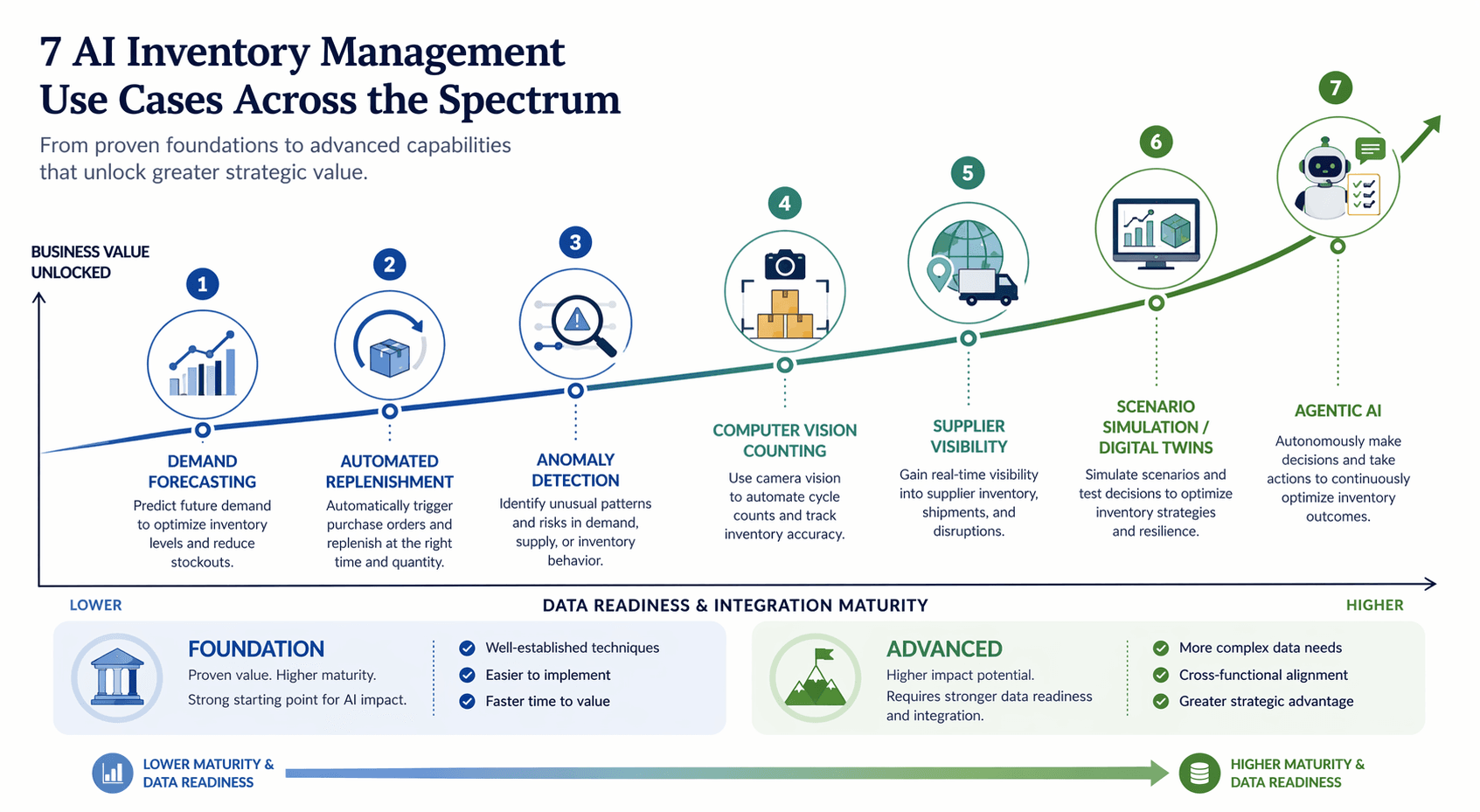
A useful comparison has to keep four questions visible: how mature the use case is, what kind of ROI evidence exists, what data it needs, and how much implementation risk the operating team inherits. A polished demo can hide all four.
| Use case | Current maturity | ROI evidence to trust most | Data readiness required | Main implementation risk |
|---|---|---|---|---|
| Demand forecasting | Established | Forecast-error reduction of 20–50%, cited by Unframe/OpenSky from McKinsey-related benchmarks.[2][4] | Clean sales history, demand signals, product hierarchy, promotions, seasonality, and exception history. | Treating a better forecast as a finished replenishment decision. |
| Automated replenishment | Established to growing | Vendor-reported 6–12 month payback benchmarks from ToolsGroup; OpenSky cites 20–30% inventory reduction and 5–20% logistics cost reduction from McKinsey-related benchmarks.[3][4] | Reliable inventory balances, lead times, service targets, order constraints, and ERP/WMS integration. | Automating bad parameters or ignoring planner overrides without learning from them. |
| Inventory anomaly detection | Established to growing | Often bundled with replenishment ROI because it shortens exception detection and correction cycles.[3] | Transaction history, cycle count results, inventory adjustments, order flows, and location-level movement data. | Alert fatigue if every variance becomes an exception. |
| Computer vision counting | Growing | CPCON says AI-enabled computer vision can reduce error rates by over 90% compared with manual methods.[5] | Camera or drone capture, SKU/location mapping, physical layout discipline, and reconciliation rules. | Counting accurately without fixing the system-of-record process. |
| Supplier visibility | Growing | Unframe reports a Fortune 500 manufacturer case with 100% visibility into supplier commitments and a 30% reduction in supply-driven stockouts.[2] | Supplier commitments, purchase orders, shipment events, lead-time history, and exception workflows. | Visibility that arrives too late or lacks authority to change the plan. |
| Scenario simulation and digital twins | Emerging to growing | OpenSky cites Accenture’s finding that AI-mature supply chains are 23% more profitable and 6x more likely to use AI/GenAI widely.[4] | Unified planning, inventory, sourcing, logistics, finance, and constraint data. | Building a simulation layer before the underlying data is trusted. |
| Agentic exception handling | Emerging | RELEX says 71% plan to invest in generative AI over 3–5 years; SAP cites Gartner’s projection that 15% of daily logistics decisions will be autonomous by 2028.[6][7] | High-quality event data, governed decision rights, approval workflows, and measurable exception outcomes. | Letting autonomy claims outrun governance, accountability, and change capacity. |
The table should make one thing uncomfortable: the highest-sounding AI use cases are not always the best first pilots. In inventory work, a modest use case that changes ordering behavior on Monday morning often beats a strategic model that cannot reconcile on-hand balances by Friday.
Demand Forecasting Is the Cleanest Entry Point When the Forecast Is the Real Bottleneck
Demand forecasting is the most familiar AI inventory use case because the planning problem is already model-shaped. The business has historical demand, forecast accuracy metrics, planner overrides, service targets, and an established process for asking whether the next forecast is better than the last one. That does not make implementation easy, but it does make the value path legible.
The strongest claim here is forecast-error reduction. Unframe cites McKinsey-related benchmarks indicating that AI demand forecasting can reduce forecast errors by 20–50%; OpenSky Group also cites a 20–50% forecast-error reduction range in its supply chain AI statistics.[2][4] That is attractive, but it measures the forecast, not the final inventory outcome. Inventory reduction, fewer expedites, or higher service levels depend on whether replenishment parameters, lead times, minimum order quantities, and planner behavior move with the forecast.
This is where vendor selection can get overweighted too early. Blue Yonder, Kinaxis, o9, and C3 AI all appear in the market conversation around AI-enabled demand planning and supply chain decisioning.[2] They do not represent the same architecture or implementation style, and they should not be treated as interchangeable just because each can be placed under an AI forecasting label. A company comparing a broad enterprise AI platform with specialized demand planning tools should pressure-test fit against its planning calendar, exception process, and integration stack; a deeper comparison belongs in a dedicated evaluation such as C3 AI vs. specialized demand forecasting tools.
A forecasting pilot is usually credible when the demand history is usable, the product hierarchy is not constantly rewritten, promotional and seasonal drivers are captured somewhere, and the planning team already tracks forecast bias or forecast value added. It is a weaker first pilot when inventory pain is mostly caused by supplier misses, warehouse accuracy gaps, frozen master data, or unmanaged substitutions. In those cases, a better forecast can become a more precise way to be disappointed.
For teams building a business case, the forecast metric should be tied to one operational consequence: lower safety stock on stable items, fewer stockouts on volatile items, fewer manual forecast touches, or shorter demand review cycles. Without that bridge, the model can win the accuracy report and still fail the inventory review. For a narrower breakdown of demand-planning ROI mechanics, see ROI of AI in demand forecasting.
Automated Replenishment Turns Planning Insight Into Inventory Movement
If demand forecasting improves the signal, automated replenishment changes the order. That is why it often creates the more convincing near-term ROI story. It touches reorder points, safety stock, order quantities, allocation rules, service levels, lead-time assumptions, and exception thresholds. The output is not a forecast line; it is a recommended buy, transfer, or release that someone has to approve or defend.
ToolsGroup reports 6–12 month payback periods for inventory optimization initiatives and cites benchmark ranges including 15–30% holding cost reduction and 20–50% stockout reduction.[3] Those are vendor-reported benchmarks and should be read as curated customer-outcome ranges, not neutral averages for every deployment. OpenSky Group cites McKinsey-related figures of 20–30% inventory reduction and 5–20% logistics cost reduction from AI in supply chain contexts.[4] Together, they support a practical conclusion: replenishment and inventory optimization can pay back quickly when the organization has enough data discipline to let recommendations affect ordering behavior.
The catch is that replenishment automation exposes every weak parameter. If lead times are aspirational, pack sizes are wrong, order calendars are out of date, or service-level targets are politically negotiated but never maintained, the AI layer inherits the mess. It may still identify better decisions than a spreadsheet, but the implementation team will spend much of the pilot proving which errors belong to the model and which were already embedded in the operating system.
A good replenishment pilot is usually narrow. Pick a product family, region, or channel where the team can measure inventory, service, stockouts, planner touches, and order changes before and after. The goal is not to replace the planner. The goal is to reduce the number of routine decisions that require planner attention and make the remaining exceptions easier to diagnose. If the pilot needs a full production sequence, the implementation path is better handled through an AI inventory management implementation playbook than through a broad platform comparison.
Where Anomaly Detection Fits
Anomaly detection is often treated as a feature inside replenishment, inventory optimization, or control-tower software, but it deserves separate attention because it changes the work queue. Instead of asking a planner or inventory analyst to scan hundreds of SKU-location combinations, the system flags unusual demand spikes, inventory adjustments, receipt mismatches, lead-time shifts, or stock movements.
The ROI is less about a glamorous model and more about time-to-detection. A stock imbalance caught before the replenishment run is different from the same imbalance discovered after a customer order fails. An unexplained inventory adjustment investigated during the week is different from a quarterly accuracy argument between the warehouse and finance. The pilot metric should therefore include exception volume, false positives, time to resolution, and the downstream impact on stockouts, excess, or manual rework.
Computer Vision Counting Solves a Different Inventory Problem
Computer vision is not a forecasting tool, and it should not be forced into that conversation. Its natural home is physical inventory accuracy: cycle counting, shelf or bin verification, pallet or case recognition, and image-assisted discrepancy detection. CPCON reported in 2025 that AI-enabled computer vision can reduce error rates by over 90% compared with manual methods.[5] That is a meaningful claim for warehouses, retail backrooms, yards, and other environments where physical counting creates labor burden or accuracy risk.
The implementation question is whether the count can be reconciled into the system of record. A camera can identify that a location appears wrong; it cannot, by itself, decide whether the ERP, WMS, open order, delayed receipt, or damaged goods process is the source of truth. If the warehouse team already distrusts the book balance, computer vision may be a better first pilot than demand forecasting. If the physical process is chaotic, though, the technology can create a faster stream of disputes rather than a cleaner inventory file.
Supplier Visibility Helps When Stockouts Start Outside the Building
Some inventory teams are blamed for stockouts that began as supplier commitment failures. In those environments, demand forecasting is not the main constraint. The missing capability is earlier visibility into whether purchase orders, promised quantities, shipment dates, and inbound logistics events still support the inventory plan.
Unframe describes a Fortune 500 manufacturer case in which AI-enabled supplier management achieved 100% visibility into supplier commitments and a 30% reduction in supply-driven stockouts.[2] That is a single reported case, not a general benchmark, but it points to a real use case: matching supplier signals against inventory risk early enough to change allocation, expedite selectively, revise customer promises, or adjust replenishment assumptions.
This is a better pilot when the organization has frequent supplier-driven shortages, meaningful inbound lead-time variability, and enough purchasing discipline to capture commitments consistently. It is a poor pilot when supplier updates live in email threads, shipment milestones arrive after the exception has already hit service, or no one has authority to change the plan once risk is detected.
Warehouse Optimization Is Useful, but It Should Not Be Confused With Inventory Optimization
Warehouse AI can improve slotting, labor planning, picking paths, dock scheduling, replenishment to forward pick locations, and exception handling inside the facility. Those improvements matter. They can reduce touches, shorten cycle times, and make inventory availability more reliable at the point of fulfillment.
But warehouse optimization and inventory optimization are not the same decision. A warehouse model can help the supervisor move product through the building more effectively; it may not decide whether the network is carrying too much of the wrong SKU. This use case is a strong starting point when the inventory problem is operationally visible in the facility: mis-slots, delayed replenishment to pick faces, recurring count discrepancies, congestion, or high manual search time. It is less compelling as the first AI inventory pilot when the pain is forecast bias, overbuying, or poor service-level policy.
Digital Twins and Scenario Simulation Need Foundations Built Over Time
Scenario simulation and digital twins become valuable when leaders need to test decisions before making them: what happens if a supplier slips, a port lane tightens, demand shifts by channel, service targets change, or working-capital pressure forces a lower inventory position. The capability is appealing because it connects inventory to broader supply chain and financial trade-offs.
The evidence should be used carefully. OpenSky Group cites Accenture’s finding that AI-mature supply chains are 23% more profitable and 6x more likely to use AI and generative AI widely.[4] That supports the value of mature AI adoption; it does not prove that a new digital twin project will generate quick inventory savings in an organization with fragmented item masters, disconnected planning systems, or inconsistent constraint data.
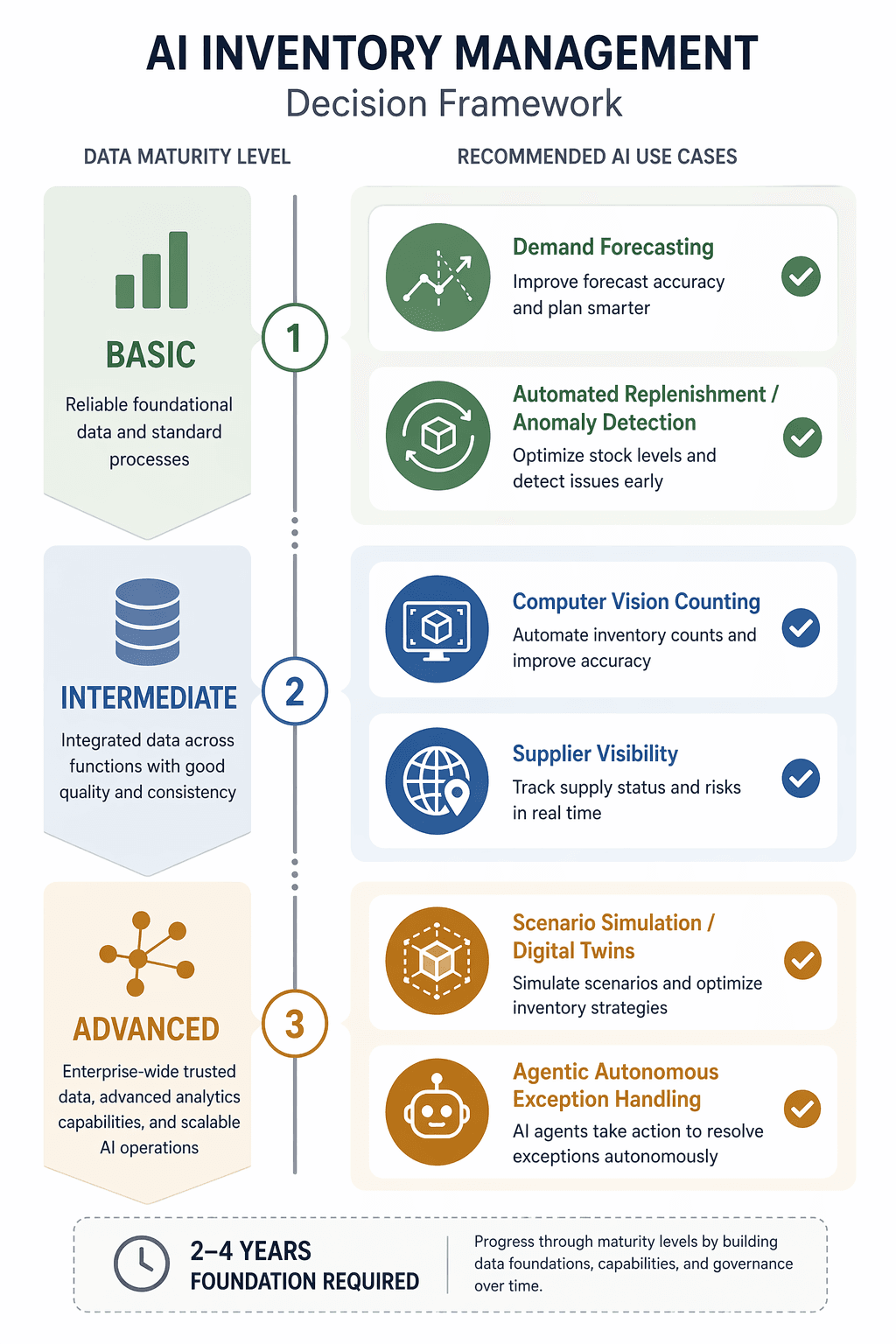
For most companies, simulation is not the first rung. It is a compounding capability that becomes more credible after the organization can trust inventory balances, planning inputs, supplier signals, and execution data. If the business case depends on a two-to-four-year maturity curve, the finance discussion should make that explicit rather than presenting digital twins as a near-term substitute for replenishment cleanup. For a fuller view of that curve, see the AI inventory optimization ROI timeline.
Agentic AI Is Coming, but Autonomy Is Not a Shortcut Around Governance
Agentic AI is the emerging layer that promises to monitor exceptions, recommend actions, trigger workflows, and eventually execute some decisions with limited human intervention. In inventory management, that could mean an agent notices a supplier delay, checks available substitutes, evaluates service impact, drafts a transfer recommendation, and routes the decision to the right planner or buyer.
The appetite is real. RELEX reported in 2026 that 71% of surveyed companies planned to invest in generative AI over the next 3–5 years.[6] SAP, discussing autonomous supply chains, cited Gartner’s projection that 15% of daily logistics decisions will be autonomous by 2028.[7] Those figures are useful signals about direction. They are not permission to hand inventory decisions to an agent before the organization defines decision rights, escalation rules, exception tolerances, and auditability.
The practical near-term use is assisted exception handling: summarize what changed, identify likely root causes, recommend options, and show the expected consequence. That is different from full autonomy. The planner still needs to know whether the system is recommending an expedite because demand truly shifted, because a receipt was posted late, or because a supplier update failed to load.
Which AI Inventory Use Case Should You Pilot First?
The best first pilot is usually the one with the shortest path from model output to operational decision. That path is different by company. A retailer with clean point-of-sale history and forecast bias may start with demand forecasting. A distributor carrying too much safety stock may start with replenishment optimization. A manufacturer suffering supplier-driven misses may start with supplier visibility. A warehouse with chronic book-to-floor mismatches may start with computer vision counting or anomaly detection.
- Start with demand forecasting if forecast accuracy is the main pain point, demand history is usable, and planners can connect forecast changes to inventory policy.
- Start with automated replenishment if the organization needs faster working-capital impact and has reliable lead times, inventory balances, service targets, and ordering constraints.
- Start with anomaly detection if analysts spend too much time finding variances, stock risks, or transaction errors after they have already affected service.
- Start with computer vision if the physical count is the weak link and the organization can reconcile image-based findings into ERP or WMS records.
- Start with supplier visibility if shortages are driven by inbound commitment failures rather than demand uncertainty.
- Defer digital twins and agentic exception handling until core planning, inventory, supplier, and execution data are unified enough to support governed decisions.
A CFO-ready case should not bundle all of these into one AI benefit pool. It should state the use case, the baseline metric, the decision being improved, the data dependencies, the implementation owner, and the time window for measurable impact. If the case needs to separate hard inventory outcomes from softer strategic benefits, use a dedicated CFO-ready business case framework for AI inventory management rather than relying on vendor ROI slides.
The organizations that get value from AI inventory management are not necessarily the ones that buy the most advanced capability first. They are the ones that match the use case to the operating problem, make the data requirements visible, and give planners, replenishment analysts, warehouse supervisors, suppliers, and finance partners a system they can actually run.
References
- Gartner Survey Shows Just 23% of Supply Chain Organizations Have a Formal AI Strategy, Gartner, June 11, 2025.
- Top 10 AI Use Cases in Supply Chain Management, Unframe.
- Inventory Optimization ROI Guide, ToolsGroup.
- Supply Chain AI Statistics, OpenSky Group.
- 2026 Inventory Management Trends, CPCON, 2025.
- Supply Chain AI, RELEX, 2026.
- Autonomous Supply Chain: Why Agentic AI Is Rewriting the Operating Model, SAP, June 2026.
Comments
Join the discussion with an anonymous comment.