

The cleanest read on AI in supply chain in 2026 is also the most uncomfortable one: confidence has moved faster than decision authority. In RELEX’s 2026 State of the Supply Chain report, supply chain leaders were 67% more confident in AI year over year, yet only 10% said they would trust AI to make critical decisions without human review; 54% preferred a hybrid model with humans in the loop.[1]
That split matters more than the confidence number by itself. A planner can trust a forecast recommendation enough to review it first. An operations director can fund an AI pilot without handing over replenishment exceptions, supplier allocation, or transportation trade-offs. The practical question is not whether AI is present. It is how much authority has actually shifted from people to systems.

PwC’s 2026 operations survey adds the counterweight. Among 767 US-based operations executives, 71% planned investment in generative AI, up 12 percentage points from 2025, and 60% planned investment in predictive AI, up 17 percentage points. But the operating reality is thinner: 57% had integrated AI into selected functions, while only 27% had fully embedded AI strategy across business units.[2]
Those surveys do not measure exactly the same thing. RELEX is a vendor-sponsored report based on 500-plus leaders across retail, wholesale, and manufacturing, so its confidence and autonomy findings are useful but should not be treated as a neutral census of the market.[1] PwC’s survey has a different sample and frame, focused on US operations executives.[2] Read together, they point to the same operating pattern: enthusiasm is broad, formal embedding is narrower, and trusted autonomy is still scarce.
Confidence Is Now the Easy Benchmark
A high-confidence organization in 2026 is no longer unusual. The more revealing benchmark is what happens after the model produces an answer. Does a planner inspect it? Does the system trigger a workflow? Does a manager override it? Does anyone know who is accountable if the recommendation creates excess inventory, missed service, or supplier disruption?
This is where the 10% figure earns its place near the top of the conversation. Critical supply chain decisions are not all equally reversible. A forecast adjustment can be reviewed in the next cycle. A procurement commitment may lock capital and supplier capacity. A logistics reroute may solve a service problem while raising cost elsewhere. Treating all of these as one category called “AI adoption” hides the real governance work.
| Benchmark signal | What it measures | What it does not prove |
|---|---|---|
| 67% higher confidence year over year | Greater executive and operational comfort with AI in supply chain | That AI has been given authority over critical decisions |
| 54% preference for hybrid human-in-the-loop models | Mainstream preference for reviewed AI recommendations | That organizations are stalled or anti-automation |
| 10% trust AI for solo critical decisions | Small current appetite for unreviewed autonomy | That selective autonomy is impossible or absent in lower-risk areas |
| 27% fully embedded AI strategy across business units | Limited enterprise-wide strategic integration | That selected functions have not made real progress |
The table is deliberately uneven. These are not rungs on a tidy ladder. A company may be mature in demand sensing and still conservative in procurement approvals. It may automate low-value replenishment exceptions while keeping promotion planning under close human review. The benchmark worth using is functional and decision-specific, not a single label applied to the whole enterprise.
The Hybrid Phase Is Not a Failure Mode
The 54% preference for hybrid human-in-the-loop models should not be read as timidity.[1] In many planning environments, review is part of the control system. It creates a place to challenge input data, check exceptions, weigh commercial context, and decide whether a recommendation is safe to execute.
That does not mean every human review adds value. Some reviews are accountability theater: a planner clicks through a recommendation because the system needs a sign-off, not because judgment improved the outcome. Other reviews are essential because the model cannot see a supplier negotiation, a customer escalation, a warehouse constraint, or a leadership decision to protect margin over service for a short period.
A useful hybrid design is specific about which decisions require review and why. It distinguishes between approvals for financial exposure, service risk, supplier relationship risk, regulatory exposure, and simple exception handling. Without that distinction, “human in the loop” becomes either a blanket excuse to avoid automation or a vague comfort phrase pasted over unclear operating rights.
Scaling Is Where Confidence Starts Meeting the Operating Model
RELEX reports that only 32% of organizations are actively scaling AI solutions.[1] That figure sits in the gap between confidence and embedded strategy. Scaling is the point where an AI capability stops being a promising local tool and starts asking harder questions: who owns exceptions, who changes planning parameters, who trains users, who monitors drift, who pays for integration, and who decides when a model is allowed to act.
This is also where casual workplace exposure can be misleading. ActivTrak data cited by OpenSky Group says 72% of logistics employees are already using AI tools day to day.[3] That is a useful signal that workers are becoming familiar with AI-assisted work, but it is not the same as mature supply chain AI deployment. An employee using a general-purpose AI tool to draft an email, summarize notes, or clean up a report is not equivalent to an embedded planning system making constrained recommendations inside an approved workflow.
The distinction matters for technology evaluators. If the organization counts all AI usage as adoption, it will overstate maturity. If it counts only fully automated decisioning, it will understate progress. A more honest inventory separates embedded planning capability, workflow automation, analytics augmentation, and general productivity tool use.
Why Investment Intent Has Not Become Full Embedding
Investment intent is strong enough that the market no longer needs a speech about whether AI will matter. The harder issue is conversion. PwC’s 71% planned investment in generative AI and 60% planned investment in predictive AI show budget direction, while the 57% selected-function integration figure shows that many companies have moved beyond exploration.[2] The drop to 27% fully embedded across business units is where the organizational friction appears.[2]
Embedding across business units requires more than a model and a license. It asks planning, procurement, logistics, finance, merchandising or sales, and IT to agree on shared data definitions, decision thresholds, exception ownership, and performance measures. In supply chain reviews, that is often where the abstract AI conversation becomes a fight over whose metric gets optimized.
A demand model may improve forecast accuracy while creating inventory moves finance dislikes. A transportation recommendation may lower cost while worsening a service commitment. A procurement signal may be statistically sensible but commercially awkward if a supplier relationship is under renegotiation. Strategic embedding means the organization has decided how those trade-offs are governed before the model recommendation arrives.
That is why the difference between selected-function integration and enterprise embedding is not cosmetic. Selected functions can optimize inside their own walls. Embedded strategy requires cross-functional operating structure, shared accountability, and enough trust in the data and workflow to let AI recommendations travel across boundaries.
The Data Quality Paradox Is Real, but It Cuts Both Ways
Data quality remains the most credible objection to moving too quickly. PwC found that 87% of executives said poor data quality had affected their ability to achieve value from digital initiatives.[2] In supply chain terms, that can mean inconsistent item masters, late supplier updates, duplicated location records, unreliable lead times, or transaction histories distorted by one-off disruptions.
The same PwC survey also found that 73% agreed data does not need to be perfect to drive value.[2] That is the useful tension. Bad data can make AI recommendations unsafe, expensive, or simply ignored. Waiting for perfect data can become an indefinite postponement strategy.
The practical response is not to pretend the data problem is solved. It is to match the autonomy level to the quality and consequence of the decision. Imperfect data may be acceptable for surfacing anomalies, ranking exceptions, drafting scenarios, or suggesting actions for human review. The same data may be unacceptable for unreviewed supplier commitments, inventory positioning, or customer allocation decisions where the cost of error is high.
A More Useful 2026 Maturity Map
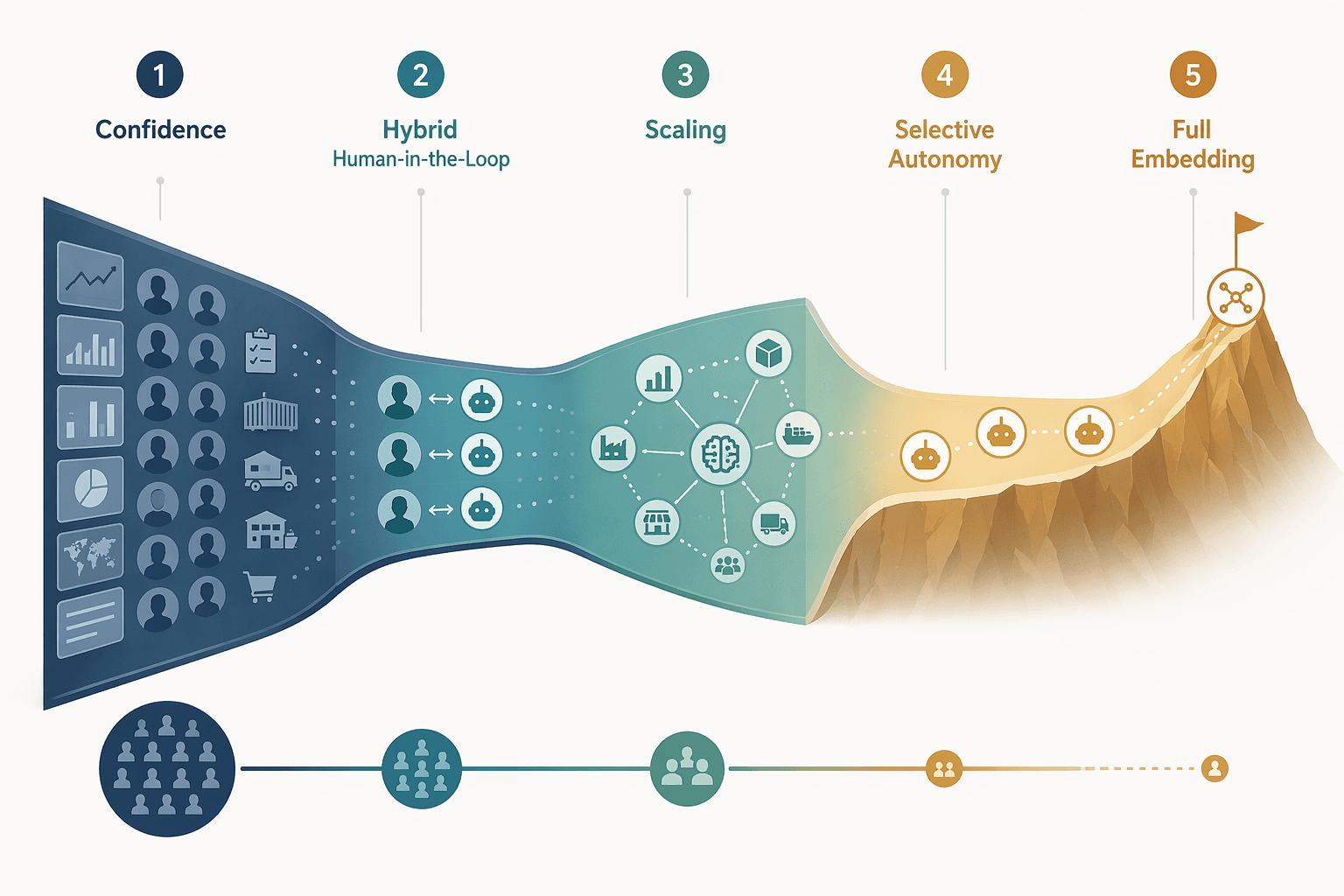
For benchmarking purposes, the supply chain AI maturity curve in 2026 is better understood as a distribution of decision rights than as a technology rollout stage. The same organization can occupy several positions at once.
| Maturity position | What it tends to look like | The benchmark question |
|---|---|---|
| Confidence | Leaders believe AI can improve planning, forecasting, operations, or productivity | Has confidence changed funding, priorities, or review behavior? |
| Augmentation | AI supports analysis, summaries, exception detection, or scenario generation | Are users changing decisions because of the output? |
| Hybrid decisioning | AI recommendations enter planning workflows but humans approve important actions | Which decisions require review, and is that review useful? |
| Scaling | AI moves beyond isolated pilots into repeatable workflows, training, monitoring, and integration | Who owns performance once the pilot leaves the lab? |
| Selective autonomy | Systems execute bounded decisions under defined thresholds and escalation rules | Are the boundaries explicit enough to protect service, cost, and accountability? |
| Full embedding | AI strategy, operating structure, governance, and ROI tracking work across business units | Can the organization govern trade-offs across functions, not just optimize one process? |
This map avoids two common mistakes. The first is assuming that any company using AI tools is far along. The second is assuming that any company keeping humans in the loop is behind. In 2026, the middle of the curve is crowded because the work has shifted from tool adoption to operating design.
What the 4% Success Cohort Actually Signals
PwC’s sharpest benchmark is not the investment number. It is the finding that only 4% of companies report success simultaneously on AI embedding, autonomous agent scaling, horizontal operating structure, and technology investment ROI.[2]
That 4% should not be used to shame everyone else. It defines how narrow the current top end is when success requires several conditions at the same time. A company may be strong at AI experimentation but weak at ROI tracking. It may have solid technology investment but still operate in functional silos. It may have automated agents in one process without a horizontal operating structure that lets those agents work across business boundaries.
The lesson for peers is blunt: if your organization is not in that small group, it is probably normal. If it claims to be in that group, ask for evidence across all four dimensions, not just a demo, a pilot count, or a budget line.
Where Organizations Should Be in Q2 2026
A credible peer benchmark for Q2 2026 is not full autonomy. For most supply chain organizations, a defensible position is active movement through hybrid AI use, selected-function integration, and disciplined scaling. That means AI recommendations are visible in planning workflows, humans still review consequential decisions, and the organization is beginning to define where bounded autonomy is safe.
The weak position is not “we have not automated critical decisions.” The weak position is vaguer: no inventory of where AI is already being used, no distinction between generic tool usage and embedded supply chain capability, no decision-rights model, no data-quality threshold by use case, and no plan to move successful pilots into governed workflows.
The stronger position is also more modest than vendor language often suggests. It looks like a defined set of AI-supported decisions, clear human review rules, selected areas where the system can act inside thresholds, monitoring for exceptions and drift, and a cross-functional process for deciding when autonomy expands. In other words, not autonomy everywhere, but autonomy where the decision is understood well enough to govern.
Supply chain AI has moved past the stage where confidence is the scarce resource. The scarce resource is trusted autonomy: the combination of data, workflow, accountability, and cross-functional agreement that lets an organization give the system more authority without losing control of the consequences.
References
- State of the Supply Chain report, RELEX, 2026.
- 2026 Digital Trends in Operations Survey, PwC, 2026.
- Supply Chain AI Statistics, OpenSky Group.
Comments
Join the discussion with an anonymous comment.