
The first useful question in a traceability incident is rarely “Do we have records?” Most companies do. The question that matters at 4:40 p.m., when a pathogen screen, supplier deviation, temperature excursion, or regulator email has turned a normal batch into a suspect batch, is whether those records can answer two lot-level questions quickly enough to protect customers and defend the decision later.
Forward traceability asks where the batch went: which finished goods, warehouses, distributors, retail locations, customers, and open orders may be in scope. Backward traceability asks where the problem came from: which supplier lots, ingredients, process lines, storage conditions, rework events, test results, and shared production windows could explain the failure. Saxon.ai draws that distinction directly and warns that most manufacturers cannot execute either query across Tier 2 and deeper suppliers in under 24 hours.[1]
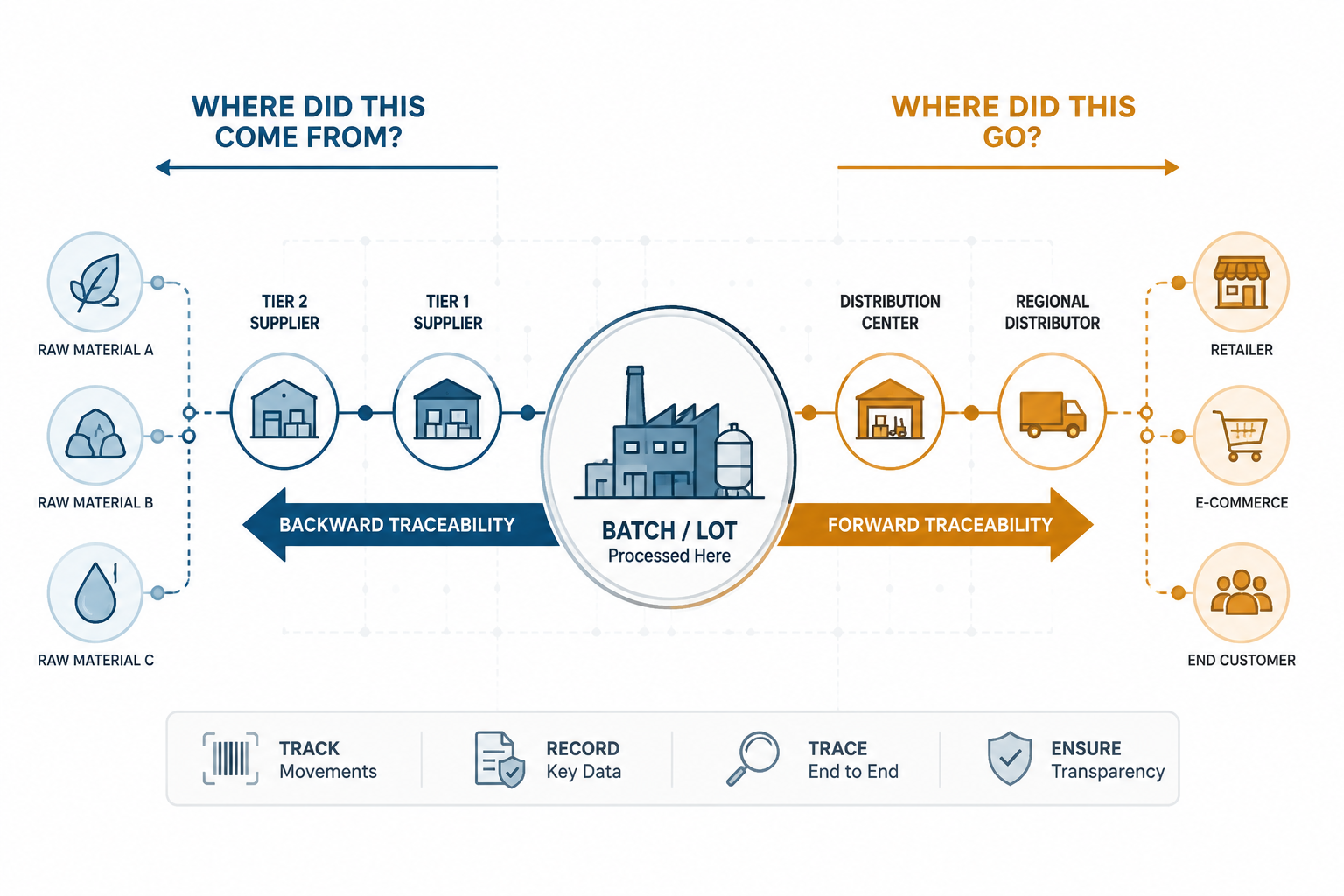
That is where AI for supply chain investigation and traceability becomes more than a visibility project. The valuable use case is not a prettier dashboard over the same fragmented files. It is an investigation layer that joins supplier lots, production runs, warehouse movements, customer shipments, exception logs, and chain-of-custody records into a batch genealogy that a response team can interrogate while the decision is still open.
A Mock Recall Is Often the First Reality Check
Saxon.ai gives a simple test: if a mock recall drill still takes four hours, the organization may have theoretical traceability but not operational traceability.[1] Four hours in a drill is not a paperwork inconvenience. It is a warning that, in a live event, the team may spend the first part of the response arguing over data joins instead of making hold, release, recall, and customer-notification decisions.
Manual traceback usually fails slowly. A QA manager requests the production batch record. Operations checks which line ran the SKU. Procurement pulls supplier certificates and inbound lot numbers. Warehouse teams search shipment history. Customer service waits for a list it can trust. Legal asks when the company first had reason to know the risk. Everyone is working, but the investigation is moving through handoffs.
AI compresses that work when it can read across systems that were not designed around the same incident question. The useful compression is specific: fewer manual reconciliations, faster lot matching, earlier exception ranking, and a smaller set of plausible causes for human review.
The Investigation Has Two Directions
Forward and backward tracing use the same underlying records, but they do not serve the same decision.
| Investigation direction | Question it answers | Decision it supports |
|---|---|---|
| Forward traceability | Where did this batch, ingredient, or finished good go? | Customer notification, product hold, recall scope, shipment stop |
| Backward traceability | Where did this problem likely come from? | Root cause analysis, supplier containment, corrective action, regulatory explanation |
In a contamination event, the forward query may begin with one positive test tied to a finished lot. The system needs to find every shipment, distribution node, and customer account touched by that lot, including split pallets, partial shipments, returns, relabeling, and inventory still sitting in a warehouse. This is where AI lot tracking for recall response earns its keep: the job is not simply to find a batch number, but to translate batch movement into a defensible scope.
The backward query moves in the other direction. It asks which supplier lots fed the affected production run, whether those inputs appeared in other runs, whether any supplier deviation, certificate anomaly, transit condition, or sanitation record aligns with the failure window, and whether the same condition appears in apparently unaffected product. For foodborne events, that backward logic is the core of contamination source traceback.
A weak traceability system treats those as separate reporting chores. An investigation-grade system keeps them connected. If the backward query identifies a supplier lot common to three production runs, the forward query must immediately show where all three runs went. If the forward query finds that only one distribution region received the suspect inventory, the team can test whether the backward evidence supports a narrower hold rather than a wider market recall.
How AI Builds Batch Genealogy Instead of a Static Archive
Batch genealogy is the practical center of AI traceability. It is the map of how a supplier lot became a production input, how that input became a work-in-process batch, how that batch became finished goods, and how those goods moved through storage, distribution, and sale. In many companies, pieces of that genealogy live in ERP, WMS, MES, QMS, transportation systems, supplier portals, lab systems, and spreadsheets.
AI helps by resolving relationships that are obvious to operators but painful for systems: a supplier lot recorded under slightly different formats, a production run split across shifts, a pallet reconfigured at a distribution center, a certificate attached to the purchase order rather than the material receipt, or a quality hold noted in the QMS but not reflected in the outbound order status.
The best result is not a single answer dropped into the room. It is an investigation graph: this supplier lot fed these batches; these batches ran on this line during this window; these finished goods moved to these locations; these exceptions occurred before, during, or after the relevant process step. That graph lets the response team test scope instead of guessing it.
- Supplier lot linkage: matching inbound materials, purchase orders, certificates, supplier deviations, and receipt inspections.
- Production linkage: connecting inputs to work orders, line runs, shift records, rework, cleaning events, and lab results.
- Inventory linkage: following splits, merges, holds, releases, repacks, substitutions, and transfers.
- Customer linkage: mapping finished lots to shipments, open orders, distributors, retail destinations, and returned product.
- Exception linkage: ranking deviations, missing records, environmental signals, and chain-of-custody breaks by relevance to the incident.
That last item matters because response teams are rarely short on alerts. They are short on relevant alerts. Saxon.ai describes AI-powered exception management as a way to surface meaningful deviations instead of flooding teams with hundreds of ignored alerts, then route those exceptions with context to the right person.[1] In an incident, that means the sanitation exception, delayed cold-chain handoff, missing supplier certificate, or abnormal test trend can arrive attached to the affected lots rather than buried in a queue.
Root Cause Analysis Still Needs a Human Owner
Automated root cause analysis is the phrase that needs the most care. AI can rank plausible causes, expose shared conditions, flag missing evidence, and show correlations that would take people much longer to assemble. It should not be treated as a fully autonomous finding of cause in complex cases.
A model may find that all affected lots used the same supplier input. That is a lead, not a verdict. The real cause may sit in receiving conditions, storage temperature, a line changeover, a lab sampling issue, or a documentation failure. The supplier lot may be common because it was widely used, not because it was defective. The system can shorten the candidate list; QA still has to evaluate evidence, rule out alternatives, and document why the chosen conclusion is defensible.
This is also where auditability separates investigation software from decision theater. A response team needs to see which records were joined, which exceptions were ranked, which lots were excluded, and which assumptions shaped the scope. If the answer cannot be explained to a regulator, customer, insurer, or opposing counsel, the speed gain may create a new problem.
Faster awareness has legal consequences. Once a company can identify risk earlier, the timeline of what it knew and when it acted becomes easier to reconstruct. That can reduce confusion in a well-run response, but it can also sharpen discovery questions if the company had information and delayed action. The legal side of faster food traceability is why lawsuit exposure from AI traceability belongs in the same conversation as recall speed.
The Payoff Is Narrower Scope, Not Just Faster Search
Speed matters because products keep moving while people investigate. But the larger operational payoff is precision. A broad recall may protect customers, but it can also pull good inventory, disrupt customers who were never exposed, and create avoidable financial and reputational damage. A narrow recall is only responsible if the traceability evidence supports the boundary.
AI supports narrower scope when it can show clean separation: affected lots share a supplier input, process window, line, storage zone, or route that unaffected lots do not share. It also supports widening the scope when the evidence shows overlap that people might miss manually. The point is not to make the recall smaller by default. The point is to make the scope match the evidence sooner.
A disciplined recall decision usually needs four views at once: what product could be unsafe, where it is now, what caused the risk, and what proof supports the boundary. Traditional recall management often handles those views sequentially. AI-assisted investigation can bring them into the same working window, which is why it pairs naturally with broader AI recall management programs.
Regulation Is Pushing Traceability Toward Investigation Readiness
Compliance pressure is not separate from incident response anymore. Rules and due-diligence regimes such as FSMA 204, the EU Forced Labour Regulation, and the EU Deforestation Regulation are pushing companies toward records that can be queried, linked, and defended rather than simply stored. For food companies, AI food traceability for FSMA 204 is ultimately about whether key data elements can be retrieved quickly enough to matter during an inquiry or recall.
Strategic Market Research characterizes an FDA drug supply chain security pilot as showing that AI-enabled traceability improved detection of compliance gaps by 40%.[2] That figure is useful as a signal, but it should be handled carefully: in this research pass, the statistic was available through the market report’s characterization, not independently verified from FDA primary documents.
Even with that caveat, the direction is consistent with what incident teams need. Compliance gaps are not abstract defects when a batch is suspect. A missing handoff record, unmatched supplier lot, incomplete certificate, or unverified custody step can slow a traceback and weaken the company’s explanation of why it held one product and released another.
Chain of Custody Extends the Same Spine Beyond Recalls
The same investigation spine applies outside contamination and quality failures. Retraced describes AI-supported chain-of-custody tracking as a way to link records from raw materials through manufacturing to retail, supporting more credible sustainability and sourcing claims in line with OECD-oriented due-diligence frameworks.[3]
The decision changes, but the mechanics are familiar. Instead of asking which customers received a suspect lot, a company may need to show which finished goods contain cotton, cocoa, timber, minerals, or other inputs tied to a sourcing claim. Instead of a pathogen result, the trigger may be a supplier-risk alert or documentation gap. Multi-tier trade compliance tools, including platforms such as Altana for trade compliance, operate in that adjacent world: not recall response, but still investigation under uncertainty.
This should not be allowed to blur the center of gravity. Sustainability and sourcing claims benefit from better chain-of-custody intelligence, but the harshest test of traceability remains the live incident, when a team must decide what to hold, what to release, who to notify, and how to defend the line it drew.
What Strong AI Traceability Looks Like in 2026
A useful AI traceability system in 2026 does not need to promise autonomous supply chain truth. It needs to perform under incident pressure. The practical standards are narrower and harder to fake.
- Time to scope: how quickly the team can identify affected and potentially affected lots, shipments, customers, and inventory positions.
- Lot-level completeness: whether the system can follow splits, merges, substitutions, rework, holds, releases, and returns without losing the genealogy.
- Tier-depth coverage: whether supplier and sub-supplier records can support backward investigation beyond direct vendors.
- Exception quality: whether alerts are ranked by relevance and routed with enough context for action.
- Auditability: whether the evidence trail shows how the system reached a scope recommendation and what records were missing or excluded.
- Human review: whether QA, operations, legal, and regulatory owners can challenge the recommendation before the company acts on it.
Cold chain illustrates the point. Sensor-driven monitoring may flag a temperature deviation, and AI cold chain monitoring can help separate routine noise from meaningful excursions. But once the alert is tied to a product risk, traceability still has to answer which lots were exposed, which customers received them, whether adjacent lots shared the condition, and whether the evidence supports release, hold, or recall.
Produce recall prevention and contamination detection work the same way. Detection is not the end of the story. Once a signal appears, the team needs lot genealogy, movement history, supplier context, and exception evidence. That is why AI fresh produce recall prevention and AI food contamination detection become more valuable when they feed an investigation workflow rather than a disconnected alert queue.
Where the Final Decision Still Belongs
AI can shorten the distance between a weak signal and an actionable scope. It can join records that would otherwise sit in separate systems, identify shared lot relationships, rank exceptions, and show where the evidence supports narrowing or widening a recall. Those are material gains because they reduce the time spent reconstructing facts while products, customers, and regulators are waiting.
The final root cause call still belongs to accountable people. So does the recall scope decision. So does the explanation of why one customer was notified, one lot was held, one supplier was contained, and another product was released. AI’s best traceability role in 2026 is to make that judgment faster, more complete, and more precise without pretending the judgment has disappeared.
References
- Supply Chain Traceability, Saxon.ai
- AI in Supply Chain Market Report, Strategic Market Research
- AI-Enabled Traceability, Retraced
Comments
Join the discussion with an anonymous comment.