
By the time an outbreak investigation becomes visible to the public, the supply chain team is already late to a very specific kind of work. Investigators are interviewing sick people, looking for foods they have in common, requesting records, and trying to connect restaurants, retailers, distributors, processors, farms, and importers into a chain that explains exposure. FDA describes traceback as the process of following distribution records back through the supply chain to identify commonalities among ill people and locate a possible contamination source.[1]
That work is not abstract. It is purchase records, invoices, bills of lading, receiving logs, lot codes, repack records, customer lists, and supplier names that may not use the same identifiers from one company to the next. A manual team can still solve the puzzle, but every handoff adds delay: one company exports a spreadsheet, another sends scanned documents, a third has the lot in an ERP field that does not match the lot on the case label. The question for AI-supported outbreak traceback is therefore not whether a model can draw a clean network map. It is whether the outbreak data exists in a form that can be queried while the investigation still has time to narrow exposure.
What AI Changes In A Traceback Investigation
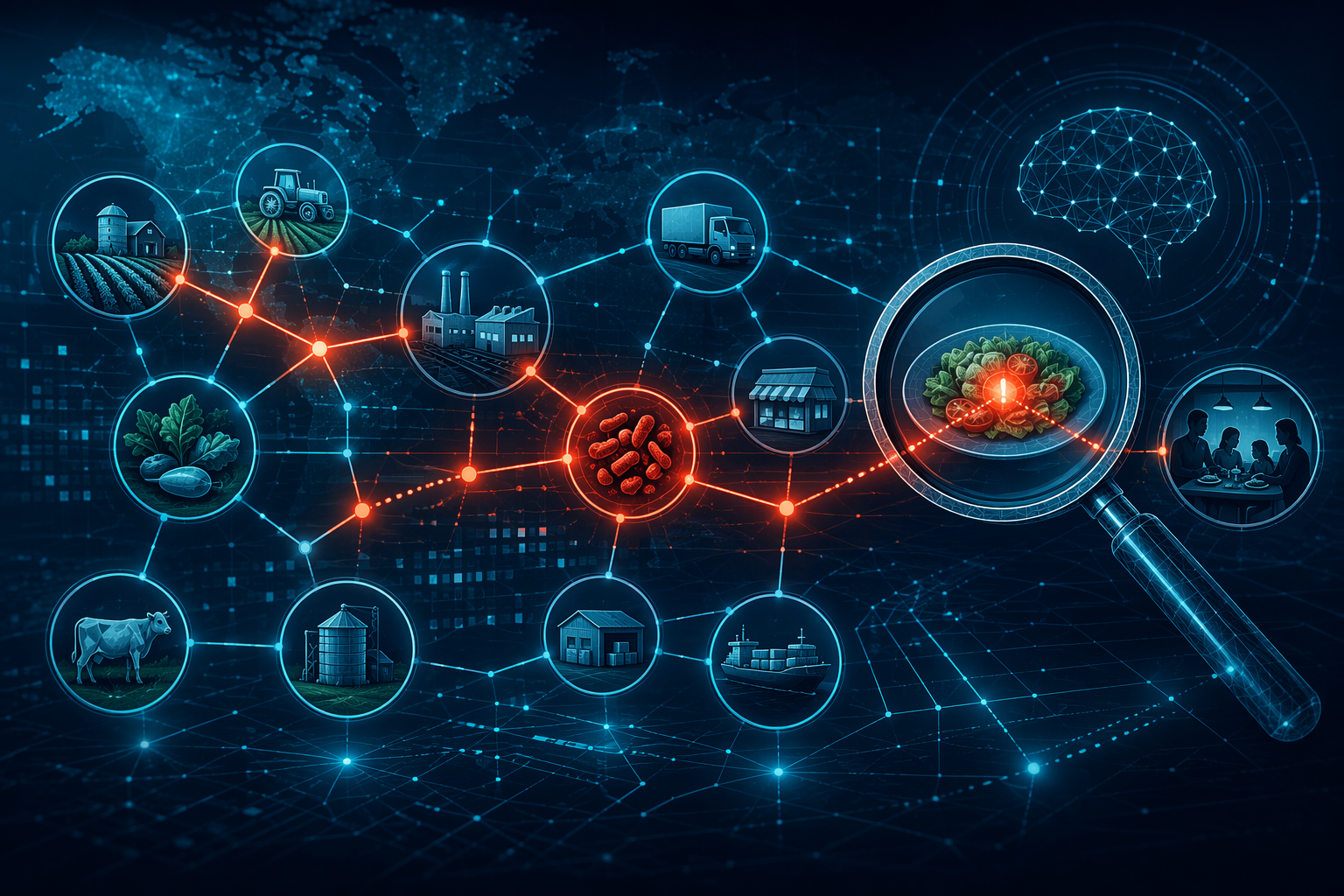
AI changes traceback by shifting part of the work from document chasing to pattern recognition. Instead of asking analysts to manually compare hundreds or thousands of shipments, receipts, locations, and exposure histories, a system can compare structured events across a network: which lot moved where, when it was transformed or repacked, which locations received overlapping product, and which nodes appear repeatedly across illness clusters.
The useful version is not magic source attribution. It is ranking, narrowing, and surfacing relationships faster than a human team can do with disconnected files. In an outbreak tied to a commodity with many suppliers and distribution paths, the practical gain may be the difference between “request records from every possible supplier” and “start with these few lots, locations, and upstream nodes because they are common to the known exposures.”
The AGES literature review describes several AI approaches relevant to foodborne disease management, including supervised learning for anomaly detection, unsupervised learning for finding unusual patterns, and machine learning methods that match consumption patterns from ill people to possible food exposure data.[2] That matters for traceback because outbreak work is often a search for a common denominator hidden inside uneven records. AI can help find that denominator, but it still has to be given the records in machine-readable form.
TraceMap Shows The Direction Of Travel
The clearest current example is the European Union’s TraceMap platform, launched in March 2026 according to coverage by Food Safety Magazine and Food Ingredients First.[3][4] Since the full European Commission press release was not directly verified, treat the operational details with that caveat. Still, the secondary coverage is consistent on the important point: TraceMap is an AI-powered traceability platform intended to help map food supply chains and support faster identification of contamination sources across EU member states.[3][4]

The part worth paying attention to is not just that the platform uses AI. It is that the platform is described as connecting with existing public-sector systems: TRACES, the EU’s trade control and expert system, and RASFF, the Rapid Alert System for Food and Feed.[3][4] That integration is the practical lesson. AI traceback becomes more useful when it sits on top of real trade, movement, and alert data rather than waiting for every organization in an investigation to assemble documents after the fact.
In a multi-country food network, the hard part is rarely a single missing data point. It is the shape of the network: an ingredient crosses borders, is processed, split, repacked, blended, shipped to different customer types, and then appears in many finished products. A platform that can map those relationships from structured records can help investigators test competing explanations quickly. If the illnesses are linked by a shared supplier, shared facility, shared lot range, or shared distribution path, the system has a chance to surface that pattern before teams have finished reconciling spreadsheets by hand.
TraceMap should not be treated as proof that any company can now buy an AI tool and collapse traceback time overnight. It is better understood as proof of architecture. It shows what becomes possible when alert data, trade data, and supply chain relationships are connected closely enough for AI to search across them. That is a different proposition from dropping a model onto PDFs, emails, and inconsistent lot fields and expecting a defensible source attribution.
The Data Foundation Is The Traceback System
For a food company, the first readiness question is blunt: can the organization reconstruct critical tracking events without a war room full of manual reconciliation? If the answer is no, the AI discussion is premature. The model may still help with document extraction or anomaly review, but it cannot trace a supply chain that the organization has not made legible to machines.

FSMA 204 is important here because it defines record discipline in operational terms. FDA’s Food Traceability Rule requires entities that manufacture, process, pack, or hold foods on the Food Traceability List to maintain key data elements associated with critical tracking events, and to provide requested traceability records to FDA within 24 hours, or within a reasonable time to which FDA has agreed.[5] As of July 2026, FDA had proposed extending the compliance date to July 20, 2028, which means many organizations are still building the foundation rather than optimizing it.[5]
Those key data elements are not regulatory trivia. They are the minimum input structure an AI traceback system needs: the lot code, the location, the event type, the time, the product identity, and the relationship between inputs and outputs. A receiving event that captures product and date but not lot is weak. A transformation event that records a finished batch but loses the ingredient lot hierarchy is weaker. A repack event that changes case identity without preserving the parent-child relationship can break the trail exactly where investigators need continuity.
| Traceback Data Element | Why It Matters During An Outbreak |
|---|---|
| Lot code | Lets investigators connect illnesses, shipments, ingredients, and finished goods to a bounded product population. |
| Location identifier | Distinguishes where product was grown, received, stored, processed, repacked, shipped, or sold. |
| Critical tracking event | Shows what happened to the product: shipping, receiving, transformation, creation, or other traceability-relevant movement. |
| Event time | Allows investigators to compare exposure windows against production, shipping, and receipt timelines. |
| Input-output relationship | Preserves the link between source lots and finished products after processing, blending, or repacking. |
This is also where GS1 EPCIS becomes more than a standards acronym. EPCIS is a standard for capturing and sharing event data about what happened to a product, where it happened, when it happened, and why it happened in a business process.[6] For AI traceback, that event structure is the difference between “we have the records somewhere” and “the system can compare events across trading partners.”
An ERP export can be useful, but it is usually written for one company’s internal operations. A PDF certificate can be necessary, but it is not a traceability graph. A scanned bill of lading may prove a shipment occurred, yet still require a person to interpret the ship-from, ship-to, product, quantity, and lot relationships. Interoperable event data gives an AI system fields it can compare consistently across companies. Without that consistency, the first “AI” task becomes cleanup, not traceback.
What The Model Actually Looks For
In outbreak traceback, AI can support several related searches. It can look for shared supply nodes among exposed consumers or retail locations. It can compare suspected product movements with illness timelines. It can flag unusual event patterns, such as a lot that passed through a location later common to multiple exposure paths. It can help rank hypotheses for investigators to test, rather than treating every supplier path as equally likely.
The AGES review’s distinction among model types is useful, as long as it is kept close to the operational problem. Supervised learning can be trained on known patterns to identify anomalies in production or distribution data. Unsupervised learning can search for unusual clusters or relationships when the investigation does not yet know what pattern it is looking for. Consumption-exposure matching can help connect what ill people report eating with candidate foods, establishments, or supply paths.[2]
None of those methods independently proves causation. A shared distribution center, common ingredient, or overlapping lot range is a lead. Investigators still need epidemiological evidence, laboratory evidence, environmental assessment, and record verification before acting as though the source is established. The better role for AI is to reduce the search space quickly enough that the human and regulatory work can focus where it matters.
Where AI Traceback Can Fail
The most obvious failure mode is missing data. If a distributor receives mixed pallets without reliable lot capture, if a processor’s transformation record does not preserve source lot relationships, or if a retailer’s location identifiers do not align with supplier shipment records, the model sees gaps. It may infer possible paths, but inference is not the same as traceability.
The second failure mode is false confidence. The AGES review notes hallucination risk in AI source attribution, which is exactly the kind of risk that should make food safety teams careful about how outputs are presented.[2] A traceback tool should show the records, event links, and confidence basis behind a suggested path. If the system cannot explain which lot, location, and event relationships led to a conclusion, it is not ready to support a high-stakes outbreak decision.
The third failure mode is confusing traceback with prevention. Cold-chain sensors, predictive quality analytics, and environmental monitoring models may help reduce risk before illnesses occur. They are adjacent to outbreak traceback, not the same job. A useful companion discussion is how AI sensors make cold chain monitoring predictive, but a traceback system is judged after exposure has already happened, when the urgent question is where the contaminated product came from and where else it went.
How To Judge Readiness Before Buying The Tool
The strongest vendor demo is the one that uses the organization’s own messy traceability records. A clean sample dataset can show interface design, but it cannot prove outbreak readiness. A more useful test is to pick a product with known complexity — for example, a product that is repacked, transformed, or distributed through multiple tiers — and ask the system to reconstruct upstream and downstream paths from actual event data.
- Can the system ingest lot-level records without manual reformatting for each trading partner?
- Does it preserve parent-child lot relationships through transformation, blending, repacking, and relabeling?
- Can it distinguish ship-from, ship-to, manufacturing, storage, and retail locations consistently?
- Does it show the evidence path behind a suggested contamination source or suspect network?
- Can records be retrieved quickly enough to satisfy the 24-hour FSMA 204 request expectation where the rule applies?
There is also a liability dimension to this. Better traceability can narrow a recall and show disciplined response, but poor data can expose the organization’s inability to substantiate where product went or did not go. That issue belongs partly to legal strategy, and is covered more directly in how AI food traceability reduces and creates lawsuit exposure. For traceback readiness, the operational point is simpler: an AI output is only as defensible as the records underneath it.
WHO estimates cited in the AGES review put the global burden of foodborne disease at 600 million cases and 400,000 deaths annually.[2] Those numbers explain why faster traceback matters, but they should not blur the practical standard. The goal is not to admire AI’s ability to find patterns. The goal is to shorten the time between reported illnesses and a credible suspect network, without losing the lot-level discipline that makes the finding usable.
AI can help trace contamination sources in hours instead of weeks when the supply chain already speaks in structured events. It needs digitized lot codes, reliable location identifiers, preserved input-output relationships, and interoperable event data. If those pieces are in place, the model can search the network faster than a manual team can assemble it. If they are incomplete, nonstandard, or trapped in documents, the model has nothing reliable to trace.
References
- Traceback Investigations, U.S. Food and Drug Administration.
- Artificial intelligence in foodborne disease management, Exploration Publishing, 2025.
- European Commission Launches AI Tool to Trace Foodborne Outbreak Sources, Food Safety Magazine, March 2026.
- EU launches AI-powered TraceMap to identify foodborne outbreak sources, Food Ingredients First, March 2026.
- FSMA Final Rule on Requirements for Additional Traceability Records for Certain Foods, U.S. Food and Drug Administration.
- EPCIS and CBV, GS1.
Comments
Join the discussion with an anonymous comment.