
The expensive part of a recall is not always the defect. It is the first decision made under uncertainty: pull one lot, pull every pallet that touched the same line, or widen the hold because nobody can prove where the suspect material went.
That is where AI lot tracking changes the economics of a supply chain recall. In a manual trace, quality and operations teams may spend 48–72 hours reconciling ERP exports, MES records, warehouse transactions, supplier lot documents, production logs, and customer shipments. In an AI-enabled trace, automated batch genealogy can assemble the same forward and backward lot path in under 2 minutes when ERP, MES, PLC, and CMMS data are connected well enough to trust the result.[1]
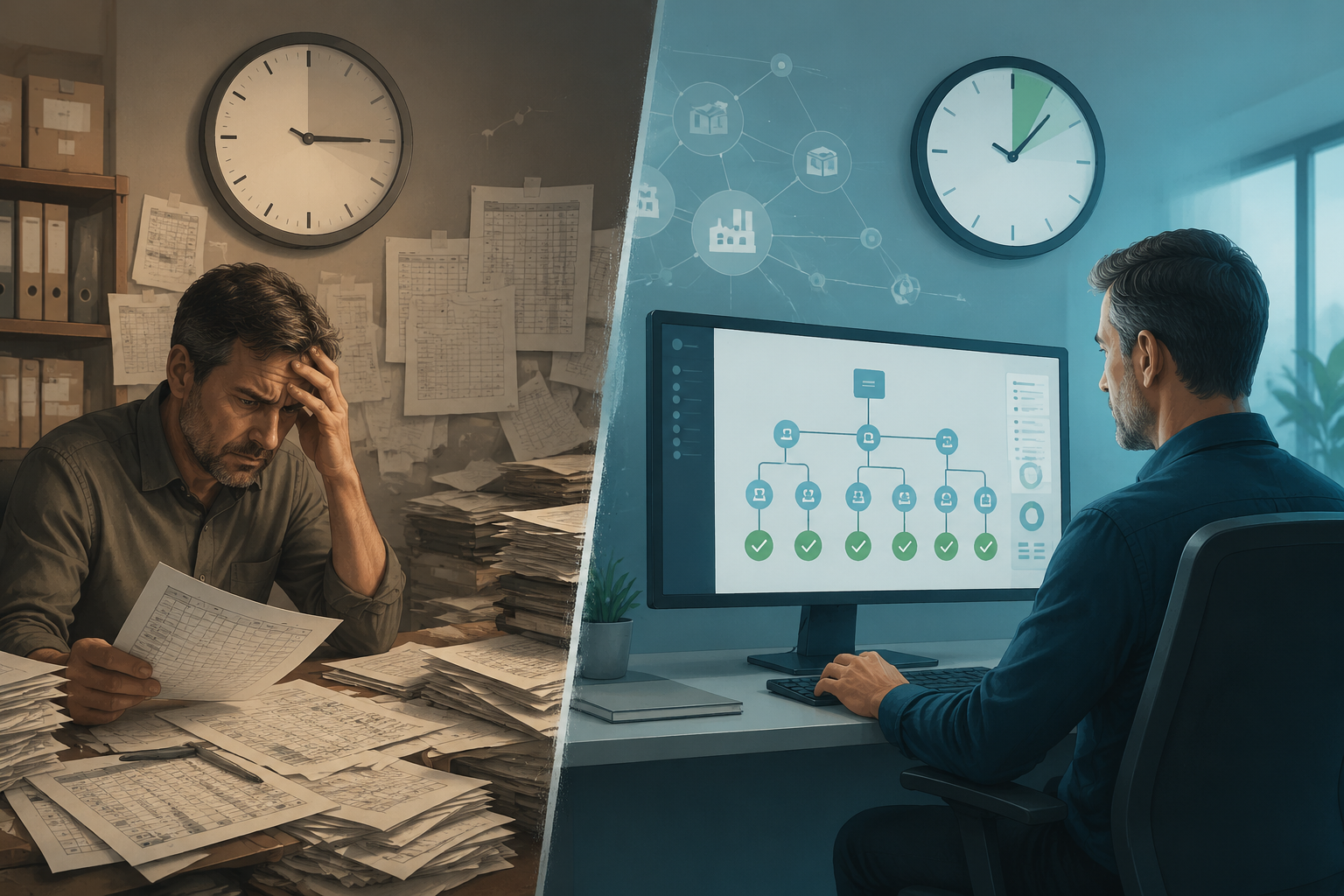
For a mid-size manufacturer, that is not a convenience metric. It determines how many customers get called, how much inventory is frozen, how long the warehouse stays in exception mode, and whether customer service is working from a confirmed lot list or a nervous best guess.
The Recall Cost Is Often a Scope Problem
Oxmaint describes a mid-size manufacturer recall that cost $4.2 million, with 72 hours spent on manual traceability work that AI traceability could have reduced to under 4 hours.[1] The number matters because it puts a familiar shape around the problem: once the team cannot quickly isolate the affected lot, the recall starts buying insurance through over-withdrawal.
Oxmaint also reports that 56% of food recalls expand because companies cannot quickly define the affected lot scope.[1] That should bother any operator who has sat through a recall drill. Expansion does not necessarily mean the original contamination or defect spread that far. Sometimes it means the records cannot prove that it did not.
| Recall Workstream | Manual Lot Trace | AI-Powered Lot Tracking |
|---|---|---|
| Trace time | 48–72 hours of record reconciliation | Under 2 minutes under strong data integration conditions |
| Main labor pattern | QA, warehouse, production, and customer service compare exports and spreadsheets | Batch genealogy is assembled from connected ERP, MES, PLC, and CMMS data |
| Scope decision | Often widened when lot movement cannot be proven | Can narrow withdrawal to identified inputs, batches, finished goods, and shipments |
| Cost impact | Higher execution cost from larger holds, returns, credits, freight, and customer communications | Direct recall cost reduction of 60–75% is supportable as a benchmark, not a guaranteed outcome |
The direct savings case rests on three linked movements: trace time collapses, recall scope shrinks, and execution cost follows. HonestAI describes up to 70% recall scope reduction from precise AI lot identification replacing blanket withdrawals.[2] That is the right way to read the benchmark: achievable when the underlying lot, production, inventory, and shipment records are connected; not a magic discount applied after software goes live.
A 60–75% direct cost reduction is plausible only when the system changes the withdrawal boundary. If the same region-wide pull still happens, faster reporting alone does not carry the ROI. The value arrives when the quality manager can show that the suspect supplier lot entered two production runs, generated defined finished goods lots, shipped to a known set of customers, and did not contaminate the rest of the inventory record.
What Actually Gets Automated
AI lot tracking is not just a prettier recall dashboard. The useful work starts earlier, at the production and inventory events that create the recall record long before anyone knows there will be a recall.
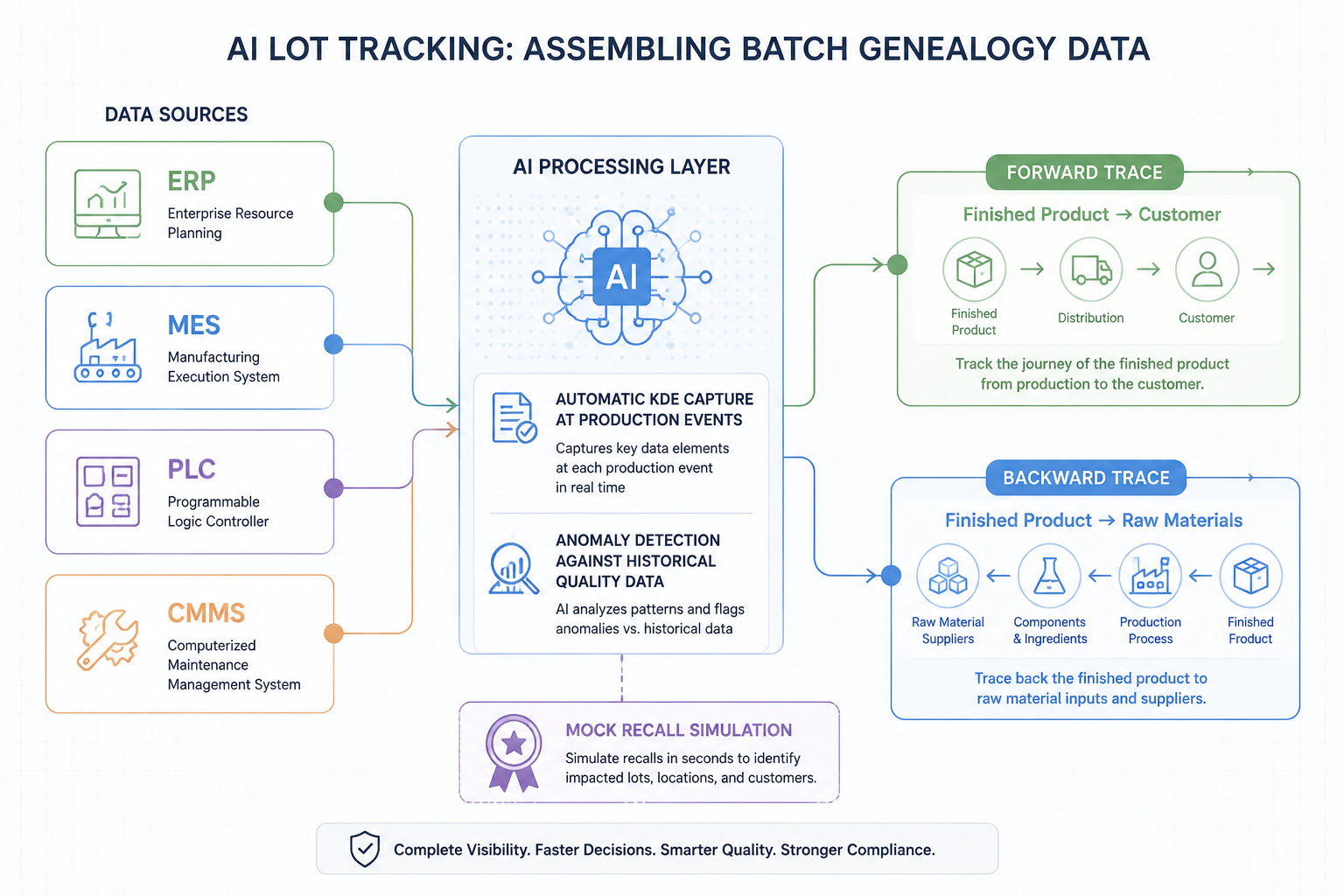
- Automatic KDE capture records key data elements at production, receiving, transformation, packing, and shipping events instead of relying on after-the-fact spreadsheet cleanup.
- Batch genealogy links raw materials, work-in-process, rework, finished goods, storage locations, and outbound shipments into one navigable chain.
- Anomaly detection compares current batch behavior with historical quality and process data, helping teams spot suspect production patterns earlier.
- Forward trace starts with a finished product or lot and identifies which customers, distributors, or facilities received it.
- Backward trace starts with a finished product and works back to source ingredients, components, supplier lots, process conditions, and equipment context.
- Mock recall simulation tests whether the records can support a real recall decision before an auditor, retailer, or regulator is waiting.
The difference in recall behavior comes from preserving relationships that manual systems usually reconstruct under pressure. A shipment record by itself is not enough. A production order by itself is not enough. A supplier certificate by itself is not enough. The recall team needs the joins: which supplier lot fed which production batch, which batch created which finished lots, which pallets moved through which warehouse transactions, and which customers received the affected units.
This is also why weak implementations disappoint. If operators override lot fields, rework is recorded outside the batch record, warehouse moves lag reality, or customer shipments are mapped at the wrong level of detail, the AI layer inherits those gaps. It may still produce a confident-looking trace, but confidence is not the same as auditability.
From 72 Hours to a Defensible Withdrawal List
In the manual version of the recall, the first day often disappears into alignment. QA asks production for the batch record. Production asks maintenance whether the line was down or cleaned between runs. Warehouse exports inventory movement. Customer service asks for the final customer list but receives shipment history by SKU instead of lot. Finance wants exposure. Legal wants language. Retailers want an answer before the team has finished proving the joins.
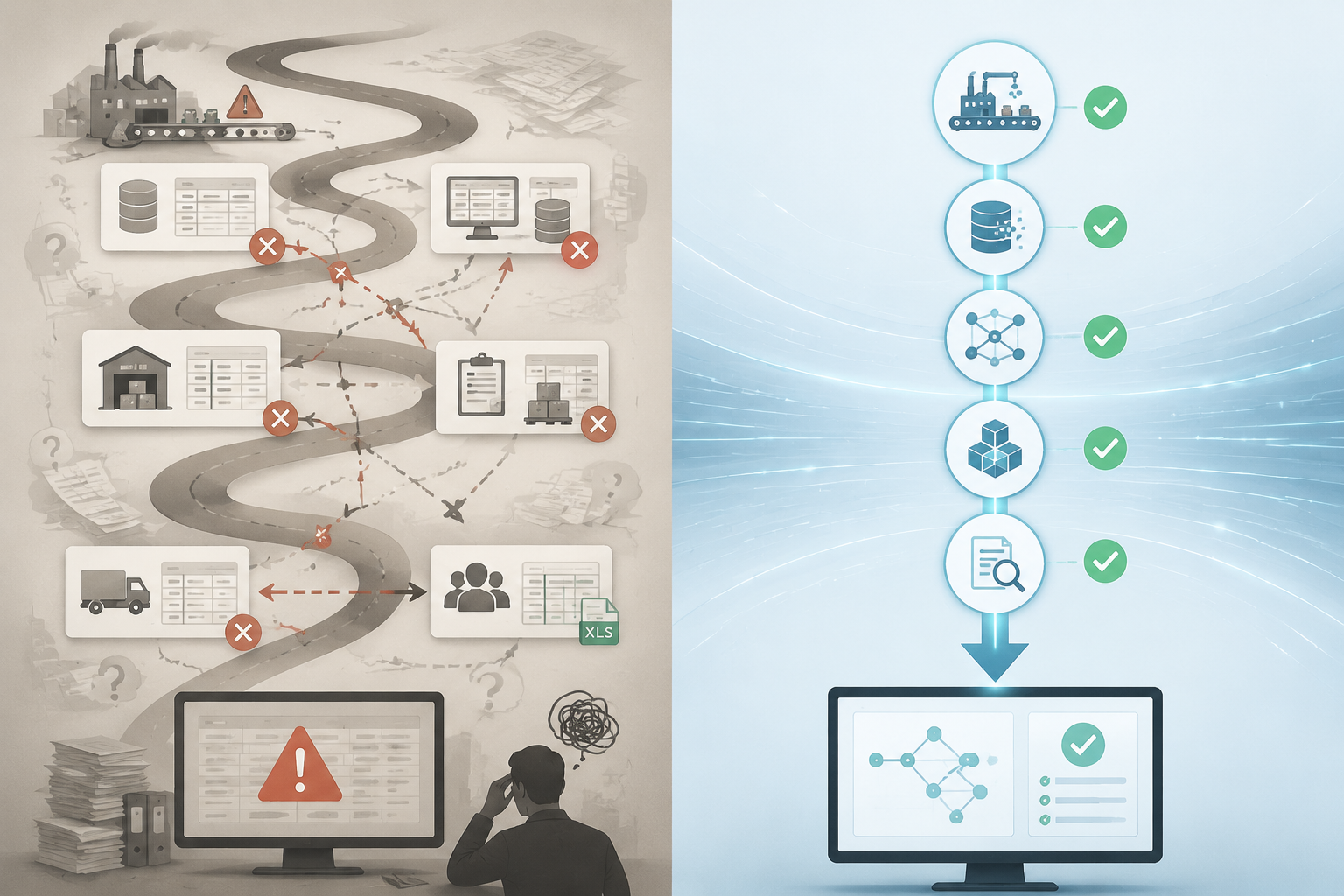
The AI-enabled version does not remove the need for judgment. Someone still has to decide whether the hazard requires a recall, market withdrawal, hold, or customer notification. What it removes is the dead time spent proving basic movement history. A connected genealogy can return the affected finished lots, upstream source inputs, downstream customer destinations, and adjacent lots that share relevant process conditions before the recall team moves into its second meeting.
That earlier list changes the decision. Instead of debating whether to pull every product made on the same line that week, the team can evaluate a narrower boundary: the specific supplier lot, the production interval it touched, the finished goods created, the pallets shipped, and the inventory still on hand. If the data supports that boundary, the warehouse does less blind holding, customer service sends fewer unnecessary notices, and retailers receive a more credible explanation.
ArionERP says manufacturers using integrated batch and lot tracking reduce time to isolate defective products by an average of 85%, based on the company’s own research.[3] That limitation is important; it is not an independently verified industry average. Still, the direction matches what recall teams experience when they stop searching across disconnected records and start querying a maintained lot graph.
The Data Integration Standard Is Higher Than the Sales Demo
AI lot tracking can make the investment sound like an analytics project. In practice, it is a data discipline project with analytics on top. The system needs to know what happened at receiving, what happened during production, what the line and equipment conditions were, where inventory moved, and which customers received the goods.
ERP normally holds purchasing, inventory, sales order, and shipment records. MES holds production execution and batch records. PLC data can show process conditions and line events. CMMS data can add maintenance, sanitation, and equipment history. The value of AI lot tracking comes from joining those records without forcing people to rebuild the story manually during a recall.
| Data Area | Recall Question It Answers |
|---|---|
| Supplier and receiving lots | Which input lots entered the plant, and when were they accepted or held? |
| Production batch records | Which inputs became which work-in-process and finished goods lots? |
| Equipment and process events | Which lots shared a line, cleaning window, downtime event, or process deviation? |
| Warehouse transactions | Where are the affected units now, and what inventory is still controllable? |
| Customer shipments | Which customers, distributors, or locations received the affected lots? |
This is where a CFO, QA director, and IT integration lead should all be allowed to be difficult. If the company cannot rely on lot-level shipment accuracy, the recall scope reduction claim should be discounted. If production records do not reliably capture rework, the genealogy has a blind spot. If equipment status is relevant to the defect but maintenance data is not connected, the model may miss the condition that separates one lot from another.
A mock recall is the cleanest way to expose this before money is spent on the wrong promise. Pick a finished lot. Trace it backward to raw materials and process conditions. Trace it forward to on-hand inventory, distributors, and customers. Time the exercise. Count the manual interventions. Then repeat with a supplier lot and ask which finished goods inherited it. The ROI case should be built from those gaps, not from a generic platform deck.
Why the Pattern Carries Beyond Food and CPG
The strongest use case is easy to see in food and CPG because lots move quickly, retailer pressure is immediate, and shelf-life makes delay expensive. But the same operating logic appears in pharma, where batch identity and distribution control are already central.
Qoblex describes an AI lot tracking case in which a contaminated antibiotic batch was isolated in 4 hours across 38 distribution centers, limiting affected inventory to 0.2% of total stock.[4] That is not proof that every manufacturer can hit the same numbers. It does show the economic mechanism clearly: when genealogy and distribution data are connected, the recall boundary can be drawn around the affected inventory instead of around fear.
For food manufacturers looking at produce-specific traceability, the same principle shows up in AI traceability work on lettuce recall time, though that use case leans more heavily on blockchain and IoT than on manufacturing system genealogy. The common question is still operational: can the organization identify affected product fast enough to avoid a wider withdrawal than the evidence requires?
Compliance and Insurance Help the Case, but They Are Not the Core Case
FSMA 204 has made traceability discussions more urgent for food companies, especially because the rule centers on traceability records and the ability to provide required information quickly. The original January 2026 compliance date has been proposed for extension to July 20, 2028, so timing should not be treated as settled.[5]
That proposed extension should not become an excuse to keep running recall readiness out of a master spreadsheet. Regulatory dates can move; retailer audits, insurance reviews, customer questionnaires, and mock recall expectations do not wait politely for a plant to clean up its lot joins.
Insurers and major customers care about the same evidence a recall team needs: documented controls, traceable product movement, drill performance, and proof that the company can limit exposure when something goes wrong. Those benefits are real, but they should sit after the direct recall math. The investment is easier to defend when the first dollars come from faster trace, smaller withdrawal scope, and lower execution cost.
Market growth is useful context, not proof. Fact.MR projects the automated recall execution platform market at $6.78 billion by 2035.[6] That suggests the category is maturing, but no manufacturer should buy because a market forecast is large. Buy only if the plant’s data can support a faster, narrower, auditable recall decision.
A Practical ROI Read
A mid-size manufacturer does not need to pretend AI lot tracking eliminates recall risk. It does not prevent every supplier defect, sanitation miss, labeling error, or process deviation. Its value is more specific: it reduces the time and uncertainty between the first signal and the withdrawal decision.
The ROI case is strongest when three conditions are already true or achievable without heroic cleanup. First, lot identity is captured consistently at receiving, production, storage, and shipment. Second, ERP, MES, PLC, CMMS, and warehouse records can be joined at the level needed for recall decisions. Third, mock recalls show that the system can produce a forward and backward trace that QA, operations, legal, and customer-facing teams are willing to stand behind.
Under those conditions, the savings are not abstract. A recall that once required 48–72 hours of manual trace can move toward minute-level identification. A withdrawal that once expanded because the lot boundary was unclear can be narrowed to the product the evidence supports. A recall budget driven by labor, freight, credits, disposal, customer communication, and lost sellable inventory can fall because fewer unaffected units are pulled into the event.
That is the defensible case for AI lot tracking in supply chain recall management. It is not valuable because it makes recall work look futuristic. It is valuable because it turns the most expensive variable in a recall, uncertainty, into a smaller and faster decision. For manufacturers with enough integration maturity to trust their lot genealogy, the direct savings from faster trace, smaller scope, and lower execution cost can justify the investment before compliance readiness, insurer confidence, and retailer reassurance are counted.
References
- AI Traceability Food FMCG, Oxmaint, https://oxmaint.com/industries/fmcg/ai-traceability-food-fmcg
- AI Lot Tracking, HonestAI, https://honestaiengine.com/magazine/ai-lot-tracking/
- Batch and Lot Tracking in Manufacturing ERP, ArionERP, https://www.arionerp.com/news/productivity/batch-and-lot-tracking-in-manufacturing-erp.html
- Lot Tracking Links Manufacturing to Supply Chains, Qoblex, https://qoblex.com/blog/lot-tracking-links-manufacturing-to-supply-chains/
- Food Supply Chain Traceability, Yenra, https://yenra.com/ai20/food-supply-chain-traceability/
- Automated Recall Execution Platform Market, Fact.MR, https://www.factmr.com/report/automated-recall-execution-platform-market
Comments
Join the discussion with an anonymous comment.