
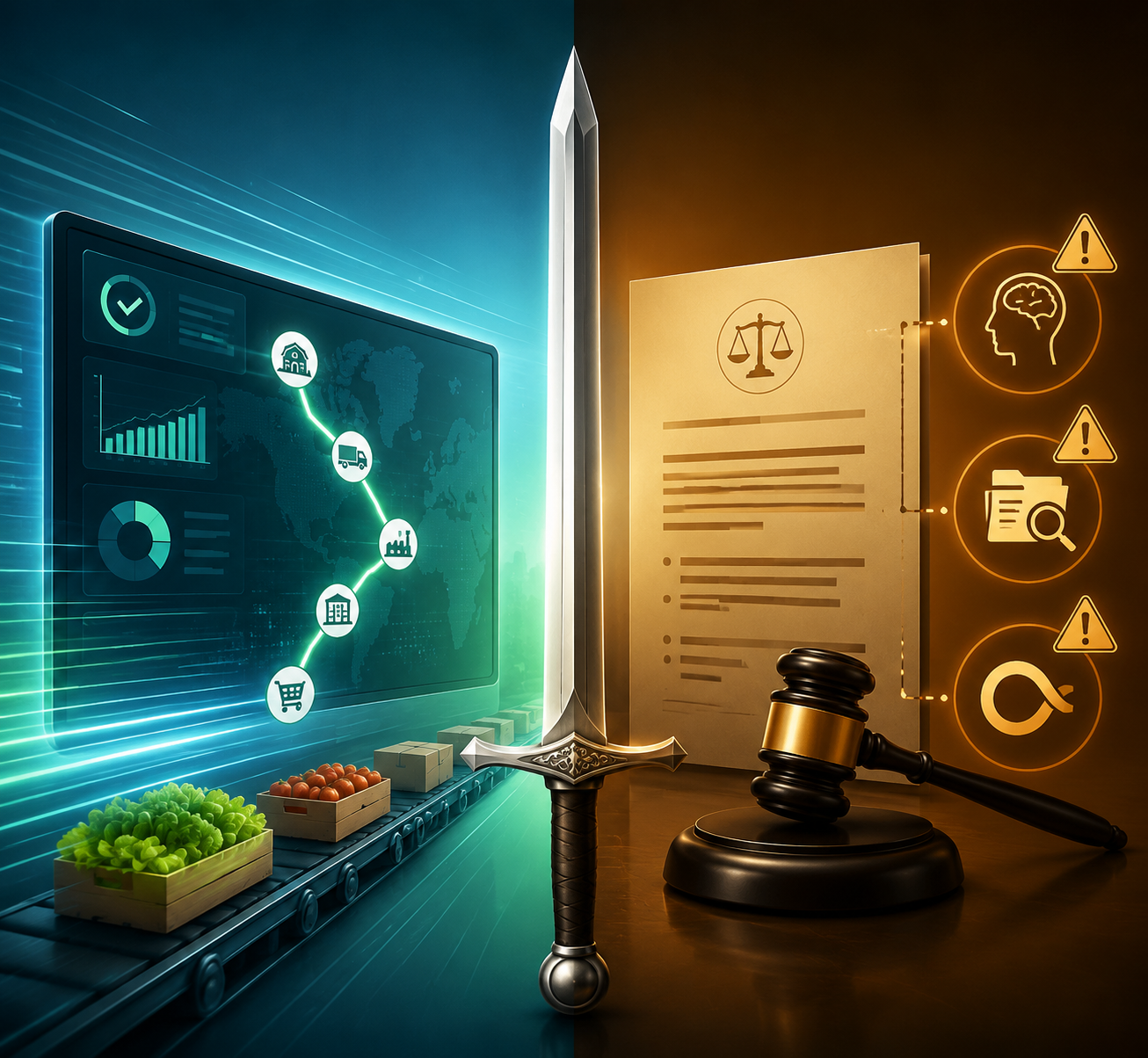
The lawsuit question around AI food supply chain traceability starts with an uncomfortable split. Faster tracing can help a company find contaminated product sooner, pull less unaffected food from commerce, and explain its decisions with better records. It can also create earlier proof that the company saw a risk signal and chose, reasonably or not, what to do next.
That split matters because foodborne-illness litigation does not begin with admiration for a traceability system. Bill Marler of Marler Clark, whose firm describes itself as having secured more than $950 million in food safety recoveries, put the strict-liability point bluntly: “I don’t need to prove whether you used AI or didn’t use AI. I just have to prove the product caused harm. Strict liability means what it says.” [1]
So the useful question is narrower than whether AI “reduces liability.” It can reduce some kinds of lawsuit exposure: delay, sloppy scope, weak source identification, and records that cannot show why one lot was recalled while another was not. It does not make contaminated food legally safe after the fact. And in negligence claims, where knowledge and reasonableness matter, the system’s own alerts may become part of the case.
What Faster Traceability Actually Removes
The strongest case for AI-enabled traceability is not a vague promise of intelligence. It is the compression of time. Walmart’s IBM Food Trust work is often cited because the operational claim is concrete: tracing the source of sliced mangoes reportedly fell from seven days to 2.2 seconds using blockchain-based traceability with analytics layered over supply-chain records. [1]
That kind of reduction changes the first hours of a recall investigation. Instead of starting with a broad withdrawal while teams reconstruct paper trails, a company can identify implicated suppliers, lots, distribution nodes, and receiving locations much earlier. The legal value is not that a plaintiff disappears. It is that fewer consumers may be exposed, fewer unaffected products may be swept into the recall, and the company has a better chance of showing why its response was proportionate to what it knew at the time.
The FDA’s own traceability rulemaking recognized the value of more precise recall execution. In its analysis of additional traceability records for certain foods, the agency identified benefits from avoiding overly broad recalls, among other public-health and economic effects. [2] That point is often treated as a compliance footnote, but in litigation it can become central. A company that can isolate the affected product may reduce both the human harm and the appearance of operational confusion.
This is where traceability records help most: not by proving nobody got sick, but by showing the chain of custody, the decision path, and the response timing. In an outbreak, the twenty minutes after an internal alert can matter as much as the seconds required to run the query. Someone still has to decide whether to hold product, expand a recall, wait for confirmatory testing, call counsel, or notify customers.
The Baseline Liability Problem Does Not Go Away
Strict liability keeps the analysis grounded. If contaminated product caused harm, the company’s traceability architecture is not the first legal question. The first question is still whether the product was defective or adulterated and whether it caused the injury. AI may affect the evidence around response, scope, warning, and reasonableness. It does not erase the underlying exposure.
Marler Clark’s public explanation of food poisoning lawsuits describes a process built around causation evidence, including medical records, lab results, public-health findings, food histories, and other proof connecting the illness to the product. [3] A defendant’s internal AI system may later sit alongside that evidence, but it is not a substitute for it.
That distinction prevents two bad readings of the technology. One is the sales-side reading, where fast traceability sounds like a liability shield. The other is the legal-panic reading, where every predictive alert is treated as a litigation trap. Both miss the same practical point: the system changes the record of what the company could know and how quickly it could act.
When an Alert Becomes Awareness
The hardest new exposure is not that AI makes a wrong prediction. It is that AI makes an early, documented prediction that later looks obvious. Shawn Stevens of Food Industry Counsel framed the issue this way: “If AI tells you there’s a heightened risk, even if there’s no finished-product contamination yet, that could be enough to establish awareness.” [1]
That sentence is more consequential than broad warnings about AI risk because it identifies the hinge. In a negligence analysis, awareness can change what reasonable conduct requires. A company that did not know about a hazard may defend its response one way. A company whose system generated a risk signal, timestamped it, routed it to a dashboard, and left it unresolved may face a different question: what should a reasonable food company have done after receiving that signal?
The answer depends on the signal. A weak anomaly in supplier paperwork is not the same as a pattern tied to pathogen positives, temperature abuse, sanitation failures, or complaints in the same product stream. But the company cannot safely decide that distinction for the first time after an outbreak. If the AI system is allowed to generate food-safety risk levels, the organization needs preexisting thresholds for investigation, escalation, hold-and-release, supplier contact, legal review, and executive notification.
| AI output | Litigation-sensitive question | Governance implication |
|---|---|---|
| Low-confidence anomaly | Was it reasonable to monitor without holding product? | Define when monitoring is enough and when repeat signals require review. |
| Pattern across lots, suppliers, or facilities | Did the company recognize a trend before consumers were exposed? | Assign a reviewer and document the basis for escalation or closure. |
| High-risk alert tied to food-safety variables | Should product have been held, tested, or recalled sooner? | Require time-bound review, decision logging, and legal or food-safety leadership involvement. |
| Ignored or unresolved alert | Who saw it, when, and why was no action taken? | Make ownership visible; do not let alerts accumulate without disposition. |
The legal problem is not solved by adding a human-in-the-loop label to the workflow. A human reviewer who receives too many noisy alerts, has no authority to hold product, and lacks a written response standard may be worse than no reviewer at all. The record will show that the company had a person in the loop. It may also show that the person had no usable loop to operate.
The Discovery Surface Gets Wider
Traditional traceability failures often leave gaps: incomplete lot links, delayed supplier responses, spreadsheets rebuilt during a crisis, emails that show confusion more clearly than control. AI traceability systems are designed to reduce those gaps. They also create a richer record for discovery.
A modern system may preserve timestamps for data ingestion, alert generation, confidence scores, reviewer access, override decisions, supplier updates, corrective actions, and product holds. Those records can help a defendant show speed and discipline. They can also help a plaintiff reconstruct delay in far more detail than an old recall file ever allowed.
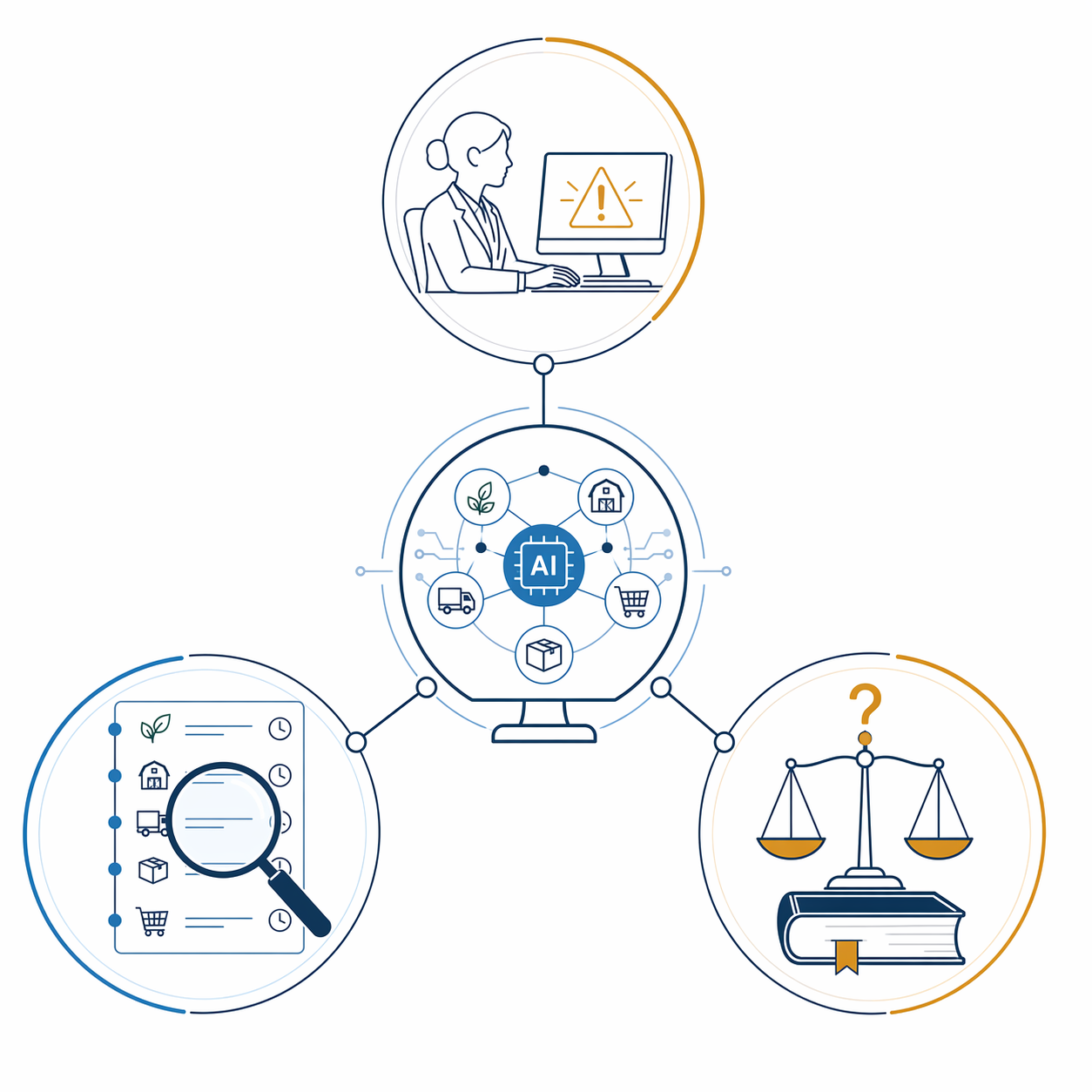
This is where record design becomes a safety issue as well as a legal one. Companies need enough documentation to prove that alerts were validated, triaged, and resolved. They do not need casual commentary, unexplained overrides, or dashboard labels that make a tentative model output sound like confirmed contamination. A record that says “heightened risk signal under review; no product hold triggered under current threshold; supplier documentation requested” is different from a record that says “possible Salmonella problem?” with no owner and no closure.
General supply-chain AI legal guidance already points to familiar pressure points: governance, contracting, data quality, accountability, and regulatory compliance. [4] Food safety sharpens those issues because the disputed event may not be a missed delivery window or a pricing error. It may be an illness, hospitalization, or death, and the system log may become the clearest map of what the company knew before anyone outside the company did.
The “Safer Not to Know” Paradox
The most unsettling evidence on this problem comes from the UC Davis-linked study “Safer not to know?,” published in Frontiers in AI in 2023. Based on interviews with 66 food-system stakeholders, the paper found that legal experts may advise companies not to adopt predictive AI technologies when the knowledge generated by those tools could increase liability costs. [5]
That finding should not be stretched into a claim that lawyers generally oppose food-safety AI, or that every company faces the same adoption disincentive. The study is interview-based, and its sample does not speak for every sector or fact pattern. Its value is more precise: it documents a plausible and perverse incentive in which a tool that could help prevent harm may look legally unattractive because it creates earlier knowledge.
Food safety policy has lived with this tension before. More testing, more monitoring, and more internal audits can create records that later hurt. The AI version is sharper because predictive systems can generate warnings before a violation, finished-product positive, outbreak cluster, or regulator call. The company may be looking at probability rather than proof, but litigation often examines probability through hindsight.
The wrong lesson is to know less. A company that treats ignorance as a safety strategy is relying on luck and hoping the record stays thin. That is neither a defensible public-health posture nor a reliable legal strategy in a system increasingly focused on sanitary controls, adulterated food, and concealed safety information. The Department of Justice’s Health & Safety Unit, established in December 2025, identified priorities including failure to maintain sanitary facilities, distributing adulterated food, and concealing safety information. [6]
The better lesson is that earlier knowledge must come with earlier discipline. If an AI system is good enough to influence food-safety decisions, it is important enough to govern before the first serious alert arrives.
FSMA 204 Adds Pressure, But It Is Not the Whole Story
FSMA 204 is part of the background, especially for foods on the Food Traceability List. The FDA’s final rule requires additional traceability records for certain foods and is built around more structured data that can support faster traceback and traceforward during an outbreak or recall. [2]
The compliance calendar has shifted: FDA states that, following a congressional directive, it does not intend to enforce the rule before July 20, 2028. [2] That delay changes timing pressure. It does not change the underlying direction of travel. Large manufacturers, retailers, and suppliers are still moving toward more granular, interoperable, timestamped supply-chain data because outbreak response increasingly depends on it.
But FSMA 204 should not become a distraction from the lawsuit issue. A company can comply with traceability record requirements and still mishandle an AI-generated safety signal. It can also lack perfect regulatory readiness and still make a defensible, timely recall decision. Compliance supports the evidence base. It does not answer every negligence question.
No Direct AI Traceability Foodborne-Illness Case Yet
One boundary has to be kept clear: there is no direct foodborne-illness case law, based on the available materials, where AI traceability outputs themselves were the central issue. The analysis is prospective. It draws from strict-liability principles, negligence concepts, food-safety litigation practice, traceability regulation, and emerging AI governance concerns rather than from a settled line of AI-specific outbreak cases.
That uncertainty cuts both ways. Defense counsel may argue that a predictive alert is not actual knowledge of contamination, especially when the system is unvalidated, low-confidence, or disconnected from a specific lot. Plaintiffs may argue that the company adopted the tool because it trusted the tool enough to find risk, then ignored the warning when acting would have been inconvenient. Both arguments become stronger or weaker depending on the governance record.
The Governance That Matters Before the Alert
The defensible path is not to slow-walk traceability AI until courts catch up. Nor is it to buy the system, admire the dashboard, and assume the audit trail will take care of itself. The work has to happen before the alert lands.
- Define reaction thresholds: specify which alerts require monitoring, investigation, supplier contact, testing, product hold, recall evaluation, legal review, or executive escalation.
- Validate alert meaning: document what the model has and has not been shown to predict, and avoid treating an unvalidated output as confirmed contamination.
- Assign accountable reviewers: make clear who receives alerts, what authority they have, and how quickly they must close or escalate them.
- Design records for decisions, not theater: capture the basis for action or non-action without casual speculation, ambiguous labels, or unexplained overrides.
- Test the workflow under pressure: run exercises that measure not only trace time, but also the time from alert to decision.
The most important metric may not be the famous 2.2-second query. It may be whether, after the query, the right person can see the implicated product, understand the confidence level, know the required threshold, document the decision, and act before more food moves. That is where AI traceability either narrows lawsuit exposure or creates the record that widens it.
Human review, documented reaction thresholds, alert validation, and disciplined records are not legal ornaments added after implementation. They are the conditions under which faster traceability is more likely to reduce total lawsuit exposure than increase it.
References
- Can AI Improve Food Safety? - IFT Food Technology Magazine, June 2026, link
- FSMA Final Rule on Requirements for Additional Traceability Records for Certain Foods - U.S. Food and Drug Administration, link
- What Does a Food Poisoning Lawsuit Actually Look Like - Marler Clark, link
- Artificial intelligence in the supply chain: Legal issues and compliance challenges - Baker McKenzie, link
- Safer not to know? Shaping liability law and policy to incentivize adoption of predictive AI technologies in the food system - Frontiers in AI, 2023, link
- 2025 Significant Settlements - FDLI, June 2026, link
Comments
Join the discussion with an anonymous comment.