
For a quality leader, the first question is not whether AI for food supply chain contamination detection works. The better question is where the contamination risk appears, what kind of signal can actually see it, and whether the evidence was produced on something close to a live operation.
A metal fragment on a conveyor, pesticide residue on produce, early microbial spoilage in a batch, and temperature abuse in transit are all food safety problems. They do not ask for the same AI system. One needs fast visual inspection. Another needs spectral information beyond normal color cameras. Another needs risk scoring from historical and environmental data. Another needs continuous exposure monitoring across time, not a single receiving temperature.
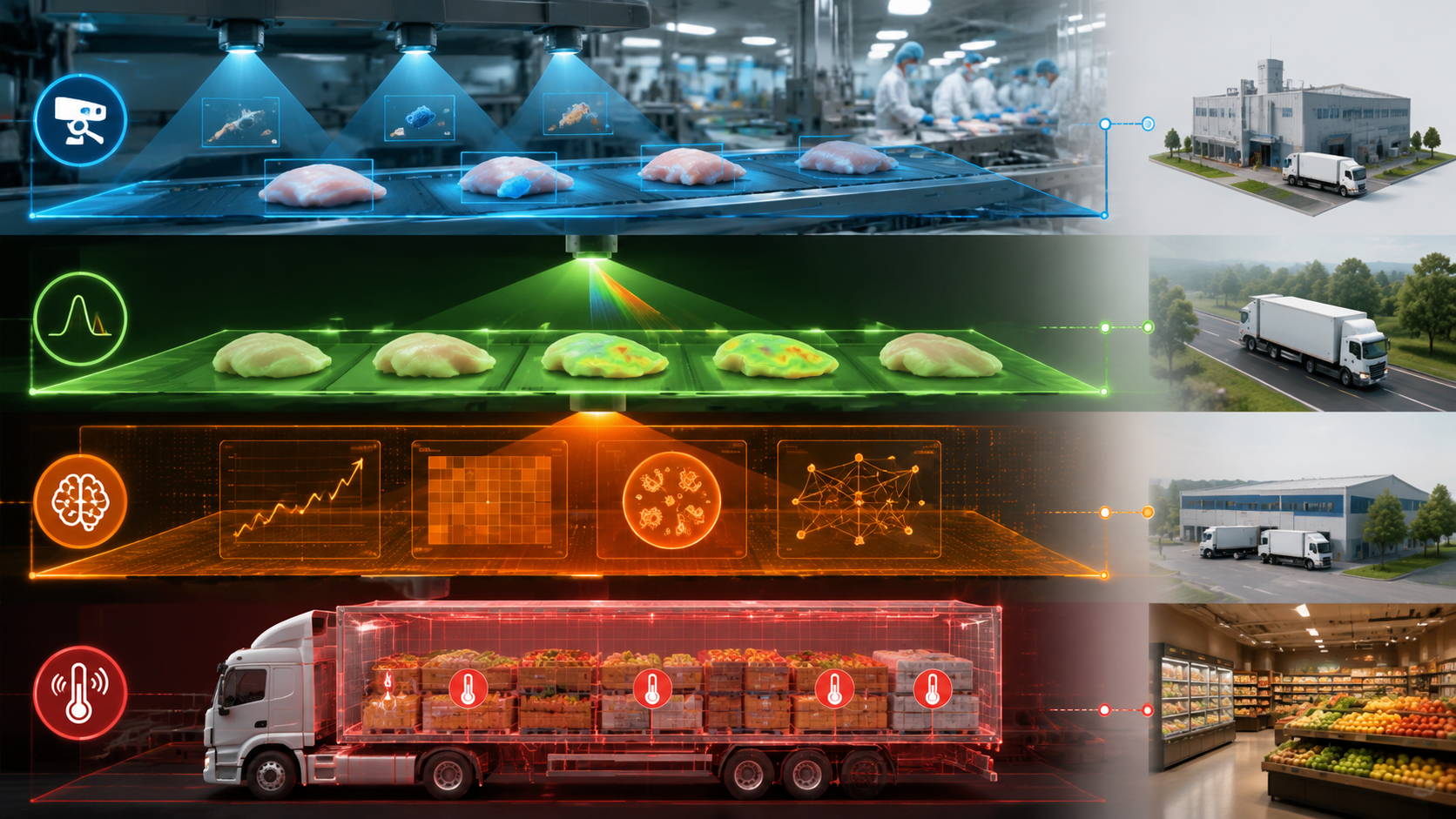
That is why the useful unit of evaluation is the sensing layer. Computer vision is the most mature layer for physical foreign-object and surface defect inspection. Hyperspectral and near-infrared analysis are more relevant to chemical residues and spoilage signals. Machine-learning pathogen risk models help prioritize where to test, inspect, or intervene. AI-enabled IoT cold-chain monitoring controls exposure conditions that can make contamination or spoilage risk worse.
The Four Sensing Layers That Matter
A layered architecture prevents a common procurement mistake: comparing a conveyor camera, a spectral scanner, a pathogen-risk dashboard, and a reefer telematics platform as if they were competing products. They sit at different points in the chain and answer different inspection questions.
| Sensing layer | Primary risk covered | Typical place in workflow | Evidence to ask for |
|---|---|---|---|
| Computer vision | Physical foreign objects, visible defects, packaging or product anomalies | High-speed production and packing lines | Line-speed detection rates, defect-size threshold, false reject rate, lighting and product-changeover performance |
| Hyperspectral / NIR | Chemical residues, composition shifts, spoilage signals not visible to RGB cameras | Raw material intake, sorting, grading, lab-adjacent or specialized inspection points | Peer-reviewed validation, product matrix tested, calibration method, production-speed evidence |
| ML pathogen risk models | Elevated biological risk based on historical, environmental, supplier, sanitation, or inspection data | Supplier management, environmental monitoring plans, regulatory risk prioritization, outbreak surveillance | Training data scope, model variables, validation method, how results change sampling or inspection decisions |
| AI + IoT cold-chain monitoring | Temperature and humidity exposure that can accelerate spoilage or increase safety risk | Storage, transport, reefer containers, distribution, receiving | Sensor reliability, excursion logic, cumulative exposure analysis, intervention workflow, documented waste reduction |
The table is deliberately practical. A system can be impressive and still be the wrong layer for the risk. A pathogen dashboard does not detect a shard of hard plastic in a sealed tray. A visible-light camera cannot confirm a pesticide residue that has no visible signature. A cold-chain platform can show that exposure risk is increasing, but it does not replace microbiological testing.
Computer Vision Is the Clearest Production-Ready Layer
For physical contamination and visible product defects, computer vision has the strongest operational claim set in the current evidence base. iFactory reports AI-powered quality control benchmarks including detection of defects down to 0.8 mm, inspection at more than 1,200 units per minute, an 80% reduction in manual checks, and vendor-reported detection rates above 99.5%.[1]
Those figures matter because they are framed in production terms. A quality director can test them against actual belt speed, product orientation, lighting conditions, package reflectivity, sanitation cycles, and acceptable false rejects. A generic “high accuracy” claim is not enough. A 0.8 mm detection threshold and a 1,200-unit-per-minute claim at least tell the plant what must be challenged during a line trial.
Computer vision systems usually sit where the plant already has a defined inspection point: after forming, cutting, filling, sealing, labeling, or before case packing. Cameras capture images, models compare what they see against trained patterns, and rejects are diverted for review. The AI contribution is not just seeing one contaminant class. It is consistent screening at speeds where human inspection gets tired, distracted, or physically impossible.
The same vendor material cites Nestlé and PepsiCo deployments, but the available source detail does not establish product category, exact scope, or independently audited accuracy under varying line conditions.[1] That distinction is important. A named deployment proves market traction. It does not, by itself, prove that the same model will perform at the same level on a different product surface, container type, lighting setup, or contaminant mix.
A serious plant trial should therefore separate three questions: whether the camera can see the defect, whether the model can classify it reliably, and whether the reject-and-review workflow can handle the volume of flags. The last part is where many “AI inspection” discussions become too clean. Someone still decides whether a hold is necessary, whether adjacent lots are implicated, whether sanitation or maintenance gets pulled in, and whether the evidence is audit-ready.
What to Verify Before Changing a Live Line
- Defect library: which foreign materials, sizes, colors, shapes, and product positions were included in training and validation.
- Line conditions: whether the benchmark was achieved at the plant’s actual belt speed, lighting, vibration, and product spacing.
- False rejects: how many good units are removed, who reviews them, and whether rework or waste increases.
- Escalation logic: when a single reject becomes a hold-and-release decision, maintenance check, or sanitation investigation.
- Audit trail: whether images, timestamps, model version, reviewer action, and disposition are retained in a usable record.
Hyperspectral and NIR See Signals That Cameras Miss
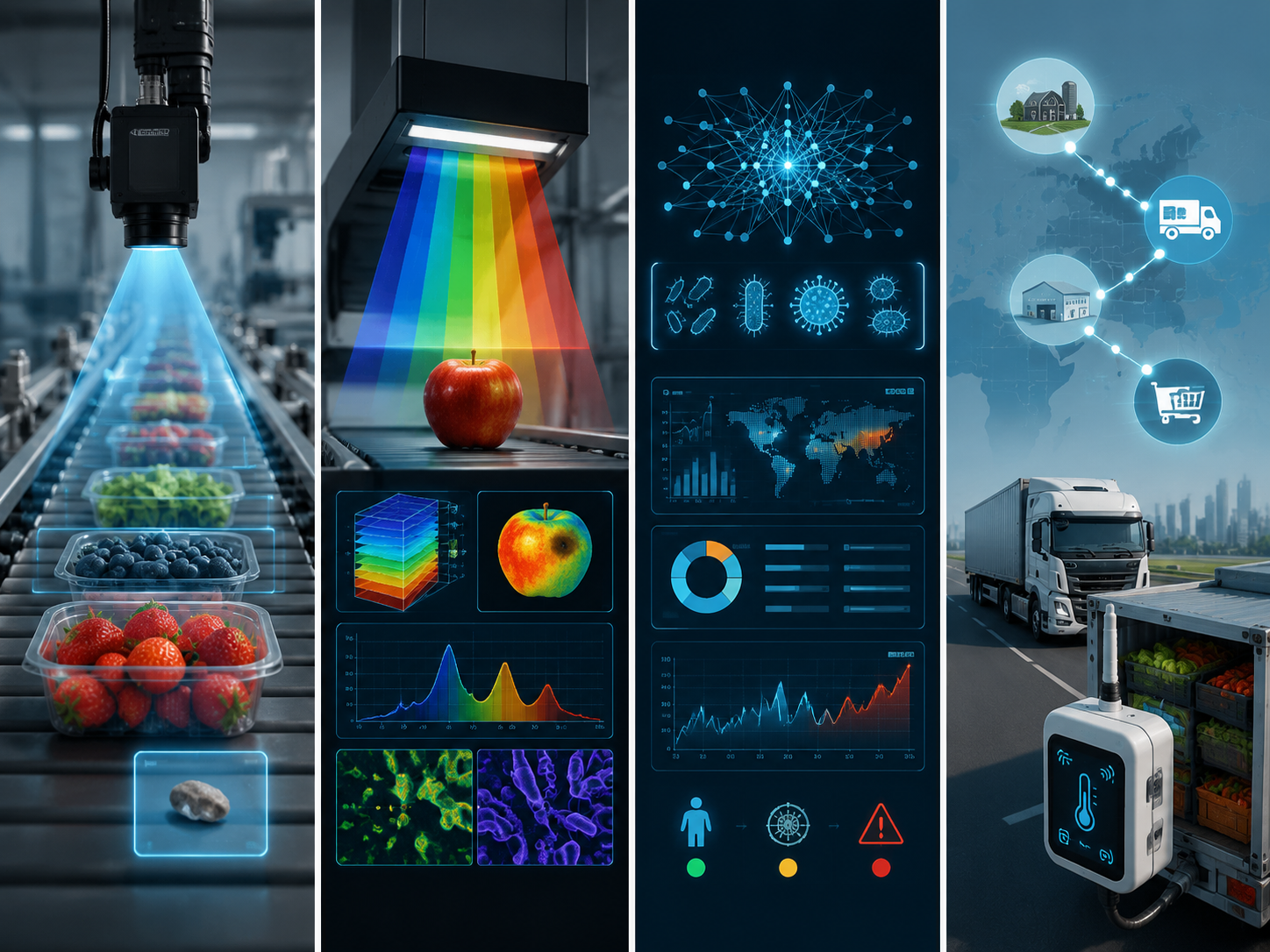
Visible-light inspection works when the contaminant or defect changes what the camera can see. Chemical residues and early spoilage often do not cooperate. Hyperspectral imaging and near-infrared spectroscopy look beyond normal RGB images by measuring spectral responses associated with composition, surface chemistry, moisture, or biological change.
A 2025 review of AI-powered food safety research summarizes peer-reviewed studies in which hyperspectral imaging combined with machine learning detected pesticide residues, veterinary drug residues, and early microbial spoilage signals that are not visible to standard RGB imaging or X-ray inspection.[2]
This is technically meaningful evidence, especially for raw material intake, produce sorting, meat and seafood quality assessment, and other points where composition matters. It also sits in a different maturity category from high-speed foreign-object vision. Many spectral models are validated on defined product matrices, controlled sample sets, or specific residue classes. That is not the same as continuous deployment across multiple suppliers, seasons, varieties, sanitation states, and production speeds.
The operating burden is different too. Spectral systems need calibration, reference methods, product-specific model maintenance, and careful interpretation when the product itself varies naturally. A camera looking for a dark foreign speck on a light product has a more direct target than a spectral model inferring chemical or microbial status from a high-dimensional signal.
That does not make hyperspectral or NIR weak. It makes the validation question sharper. The right challenge is not “does AI spectroscopy work?” It is whether the model has been validated for the same product matrix, contaminant class, detection limit, throughput, and environmental conditions that the plant intends to use.
Where Spectral AI Fits Best Today
The strongest near-term fit is where conventional inspection already struggles and where the product value justifies a more specialized sensing layer: screening incoming lots, supporting grading decisions, checking high-risk commodities, or adding a non-destructive pre-screen before destructive lab testing. It is less convincing when sold as a simple drop-in replacement for every residue or spoilage test.
For QA teams, the practical question is whether spectral AI reduces uncertainty early enough to change action. If it only produces an interesting dashboard after the batch has already moved, it may be research-grade intelligence rather than operational control. If it can flag suspect lots before they enter production or prioritize confirmatory testing, it earns a place in the food safety workflow.
Pathogen Risk Models Are Prioritization Tools, Not Detection Authorities
Machine-learning pathogen models are often discussed as contamination detection, but most should be treated as risk detection. They look for conditions associated with higher probability of contamination or outbreak risk: historical positives, supplier patterns, sanitation records, environmental monitoring, weather, facility data, inspection findings, or other signals that can move a site, product, or shipment higher on the priority list.
The FDA’s New Era of Smarter Food Safety Blueprint and FSIS Listeria risk-factor work are cited in the reviewed literature as examples of predictive frameworks that use historical contamination, sensor feeds, and environmental signals to flag risk before contamination is confirmed.[2]
That is valuable, but it should not be confused with a presumptive positive. A model can help decide where to sample, which supplier needs scrutiny, which line deserves intensified environmental monitoring, or which facility factors correlate with higher risk. It does not replace swabs, enrichment, culture, PCR, whole genome sequencing, or the plant’s corrective-action procedure.
The burden for these systems is governance. A pathogen-risk score affects where people spend scarce testing and inspection time. If the model is opaque, stale, or trained on data that does not represent the current operation, it can quietly send attention to the wrong place. QA should know which variables drive the score, how often the model is refreshed, how performance is checked, and who can override it.
For a deeper treatment of the downstream outbreak-surveillance side, the existing ChainSignal article AI for Food Supply Chain Outbreak Detection is the more natural place to follow that thread. In a contamination-control architecture, pathogen ML is best used to aim direct testing and preventive work, not to declare product safe.
Cold-Chain AI Controls Exposure, Not the Contaminant Itself
Cold-chain monitoring is already one of the more practical AI-and-IoT layers because the signal is measurable throughout storage and transit. Temperature and humidity sensors can report continuously, platforms can identify excursions, and analytics can look at cumulative exposure rather than treating every shipment as either “in range” or “out of range” at one checkpoint.
The documented waste-reduction range for AI-enabled cold-chain monitoring in the cited evidence is 15% to 49%.[1] That outcome is not the same as direct contamination detection. It is evidence that better exposure control can reduce spoilage and quality loss, and in some categories it can reduce the time product spends in conditions that increase food safety risk.
This layer becomes stronger when it stops behaving like a simple alarm. A single temperature threshold tells the receiver that something crossed a line. Cumulative exposure analysis asks how long it crossed, how severe the excursion was, where it happened, whether the product still has usable shelf life, and whether the next stop has time to intervene.
Platforms such as Hapag-Lloyd LIVE Reefer and ORBCOMM telematics are described in the source materials as examples of continuous temperature and humidity tracking that support this type of monitoring.[1] For a fuller cold-chain discussion, ChainSignal’s AI-Driven Food Safety Optimization for the Cold Chain and How AI Sensors Make Cold Chain Monitoring Predictive are better places to go deeper. In this article’s architecture, cold-chain AI is the exposure-control layer.
Why the Business Case Is Real but Still Needs Discipline
Recall economics explain why operators keep listening to AI vendors even when integration is inconvenient. The iFactory analysis cited here cites direct recall costs ranging from $500,000 to $10 million per event, with indirect brand damage often exceeding direct costs.[1] Those figures do not prove that every AI inspection project pays back. They explain why earlier detection, better holds, and fewer missed defects have executive attention.
Market growth tells a similar story, but it should stay in the background. BCC Research estimated the global AI food safety market at $2.7 billion in 2024 and projected $13.7 billion by 2030, a 30.9% CAGR, with more than 60% of adoption in real-time quality inspection and contamination detection.[3] That is useful context for budget conversations. It is not evidence that a specific model is ready for a specific line.
The plant-level business case usually turns on narrower variables: avoided manual checks, fewer escaped defects, lower scrap from better-targeted rejection, earlier supplier intervention, less product held unnecessarily, and faster disposition when an event occurs. These are measurable. They also vary sharply by product format, defect frequency, labor model, and how many false positives the operation can tolerate.
A Readiness Map for QA and Food Safety Teams
A practical readiness map starts with the contaminant class, then moves to the point in the chain, then to the evidence standard. The map below is not a vendor short list. It is a way to keep unlike claims from being treated as equivalent.
| Use case | Current maturity | How to use it |
|---|---|---|
| Physical foreign objects and visible defects | Most mature among the four layers, with production-speed vendor benchmarks for computer vision | Deploy with the most confidence after a line-specific challenge test and clear reject-review workflow |
| Chemical residues and early spoilage signals | Strong emerging layer, supported by peer-reviewed hyperspectral and NIR studies but fewer large-scale commercial deployment details | Evaluate for targeted products, incoming lots, grading, or pre-screening before confirmatory testing |
| Pathogen risk prioritization | Useful decision-support layer, supported by predictive regulatory and research frameworks | Use to focus sampling, environmental monitoring, supplier review, and inspection resources |
| Temperature and humidity exposure | Practical and widely deployable, with documented waste-reduction outcomes in the cited evidence | Use to manage cumulative exposure, shelf-life decisions, intervention timing, and shipment disposition |
The most defensible deployments are the ones that define the decision the AI is allowed to influence. A camera may be allowed to trigger an automatic reject. A spectral model may only flag a lot for confirmatory testing. A pathogen-risk model may raise sampling frequency. A cold-chain model may change receiving disposition or route a shipment for expedited review.
That boundary protects both food safety and the people accountable for it. AI contamination detection is no longer speculative, but it is not one deployable product category. Computer vision is ready for serious production use where the target is physical and visible. Cold-chain AI is already practical for exposure control. Hyperspectral and NIR deserve careful evaluation where chemical or spoilage signals matter. Pathogen-risk ML belongs in the decision-support layer until direct testing or inspection confirms what the model suspects.
References
- How AI-Powered Quality Control Prevents Contamination in Food Processing Plants, iFactory, 2026.
- AI-Powered Innovations in Food Safety from Farm to Fork, PMC, 2025.
- AI Food Safety Market, BCC Research, August 2025.
Comments
Join the discussion with an anonymous comment.