

The hard part of upstream trade compliance is not learning that a supplier has a supplier. Everyone in automotive, electronics, apparel, or medical devices already knows the risk is buried past Tier 1. The harder question is whether a system can follow a finished product backward through real supplier records: alternate legal names, language variants, components bought through intermediaries, and materials that jump tiers before they ever appear in a purchase order. That is where the Altana supply chain story is worth examining.
Altana’s strongest evidence is not a general claim about “visibility.” It is an automotive compliance case in which a global manufacturer moved from screening 80 Tier 1 suppliers to screening 900 suppliers, while tracing aluminum, steel, and electronic components for possible Xinjiang origins. The work included on-site component disassembly and cross-referencing supplier names across English and Chinese character variations, which is the sort of unglamorous matching problem that decides whether a forced labor review holds together or falls apart under customs scrutiny.[1]

The automotive case is the useful proof point
The automotive example matters because it starts where many supplier-risk tools stop. A conventional direct-supplier screen can tell a manufacturer whether a named Tier 1 entity appears on a watchlist or has an obvious adverse-media signal. That is useful, but it does not answer the question customs teams increasingly face: what is inside the finished good, who handled those inputs, and where did the relevant raw or semi-processed material originate?
In Altana’s published case, the manufacturer was not merely expanding a list from 80 to 900 names. It was connecting finished automotive products to component-level inputs, then checking whether aluminum, steel, and electronic components had linkages that needed review under forced labor due diligence processes. The case describes on-site disassembly of components, followed by entity resolution across English and Chinese name variations.[1] That detail is important. In real investigations, a supplier may appear under a translated name, a parent-company name, a local subsidiary, a Chinese-character registration, or a slightly altered English rendering. A tool that cannot reconcile those identities will either miss risk or swamp the team with false leads.
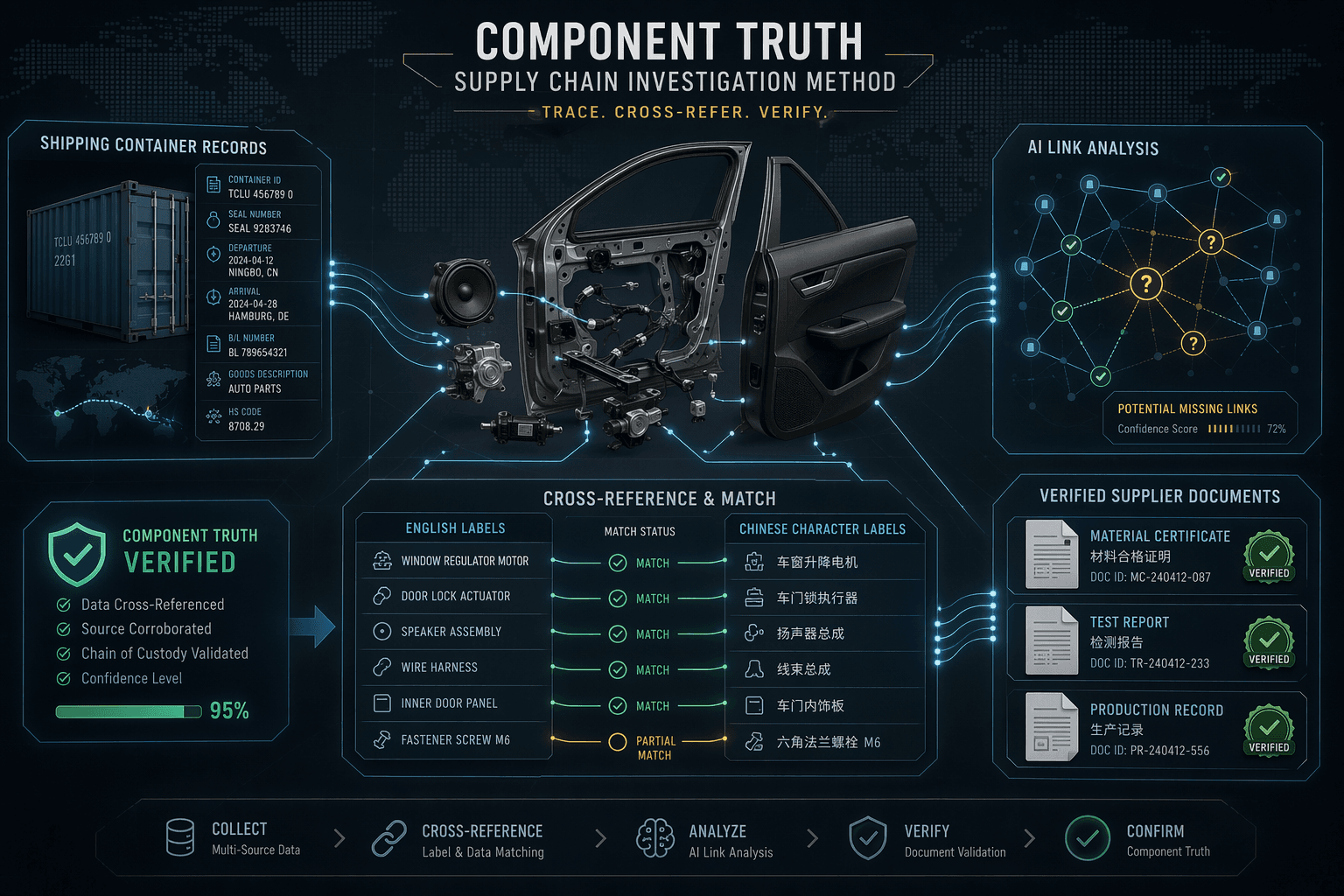
This is also where Altana’s “component truth” language becomes more concrete than the usual platform phrasing. Altana describes product value chains as being built from three types of inputs: known data from shipment records, AI-suggested missing links, and direct supplier collaboration through Product Passports. The stated goal is to trace a product to raw materials, rather than limiting the map to direct suppliers.[2]
Those three inputs each serve a different purpose. Shipment records provide observed trade activity. AI-suggested links help fill gaps where the available records do not show every commercial relationship. Supplier collaboration can confirm, correct, or document the product-specific chain. None of those, by itself, is enough for a serious compliance file. Together, they create something closer to an investigation workspace: a map, supporting evidence, unresolved assumptions, and a path for suppliers to add documentation.
| Altana input | What it contributes | What a compliance team still has to judge |
|---|---|---|
| Shipment and trade records | Observed transactions and entity relationships | Whether the records are complete enough for the product under review |
| AI-suggested links | Possible missing relationships across tiers | Whether the suggested connection is plausible, relevant, and documented |
| Supplier collaboration through Product Passports | Product-specific information and supporting documents | Whether the supplier evidence is credible and sufficient for the regulatory question |
That distinction matters for UFLPA work. AI can identify patterns, reconcile entities, and surface linkages humans might not find manually at the same speed. It cannot make the legal and evidentiary judgment disappear. A shipment held for forced labor concerns still requires a defensible record: what was reviewed, which components were in scope, which entities were linked, what documents were obtained, and why the importer concluded that the goods could or could not proceed.
The automotive case is vendor-published, not an independently audited benchmark. That limits how far it can be stretched. Still, as documented case evidence, it is stronger than a dashboard screenshot or a generic supplier-map claim because it describes the actual compliance work: expanding the supplier universe, physically identifying components, checking material categories, and resolving names across languages.[1]
Why this is more than ordinary supplier screening
The practical difference is that Altana is trying to build the chain around the product, not just around the vendor master. That sounds subtle until a procurement team has to answer a customs request about a finished good assembled from subassemblies, bought from approved suppliers, containing inputs several tiers away from the purchase contract.
A vendor-master approach starts with who the company buys from. A product-value-chain approach starts with what the company is importing or selling, then works backward through components and materials. For forced labor risk, that second view is more useful because the regulatory exposure often attaches to the origin and production history of a material or component, not merely to the reputation of the direct supplier.
In the published automotive case, aluminum, steel, and electronics were not treated as interchangeable “supplier risk” labels. They were component and material categories to be traced. The work expanded the manufacturer’s screening perimeter from Tier 1 coverage into a broader supplier network and used entity matching to deal with the naming ambiguity that often masks upstream relationships.[1] That is the part procurement and compliance leaders should pay attention to. The value is not that a platform says it can “see” deep tiers; it is that it can help build a reviewable path from the product back toward those tiers.
There is also an operational consequence. When a shipment is questioned, the people under pressure are not the people who bought the enterprise software. They are the trade compliance analysts, supplier managers, customs brokers, and legal reviewers trying to assemble a response before detention costs, production delays, or customer escalations pile up. A system that preserves the chain of reasoning is more valuable than one that only produces a risk score.
Product Passports and the CBP signal
The next important proof layer is Altana’s Product Passports work with U.S. Customs and Border Protection. In October 2025, CBP selected Altana’s AI-powered Product Passports for next-generation supply chain traceability and trusted trade, with the model enabling importers to share verified digital product records with CBP before goods arrive at the border.[3]
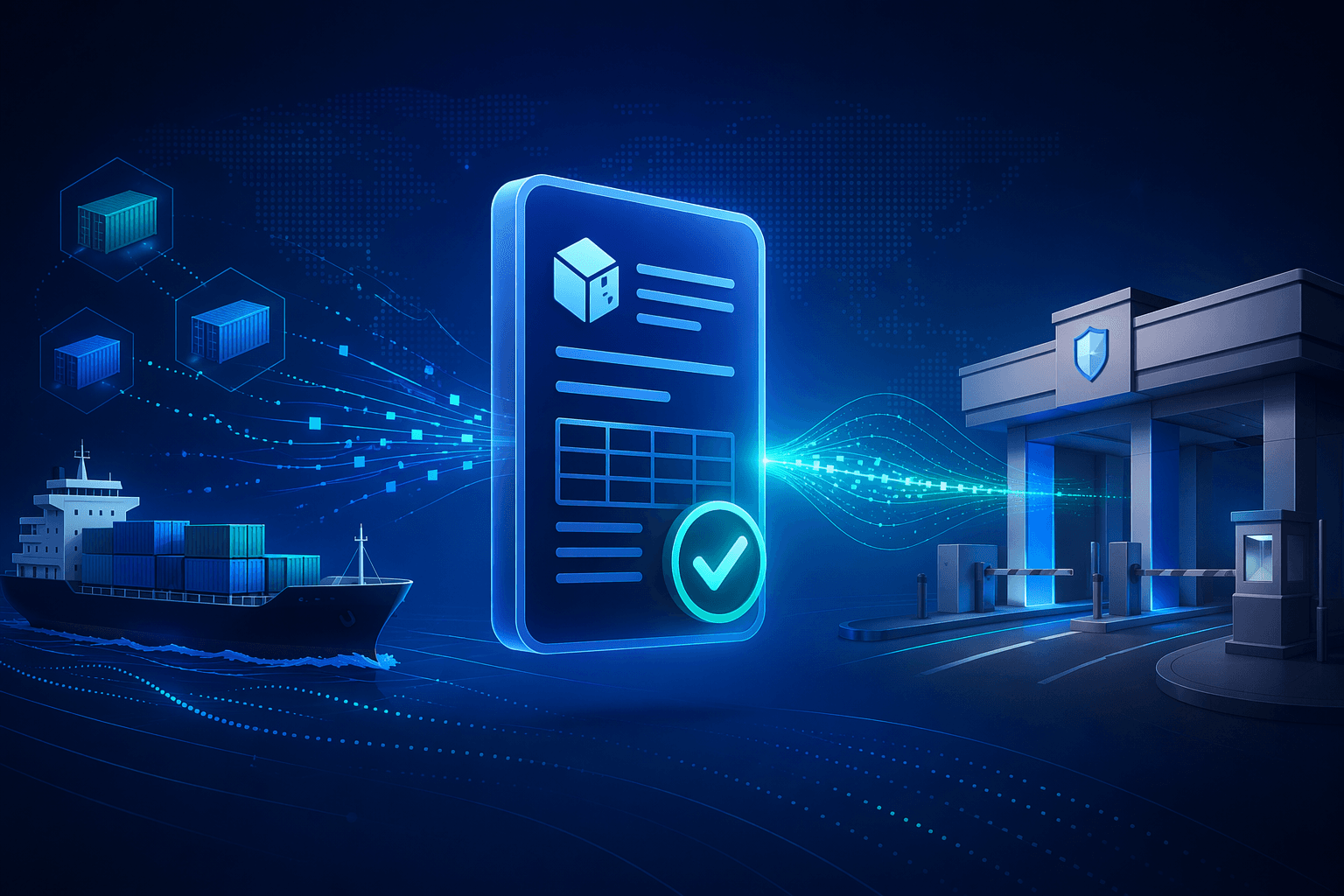
That is strategically significant, but it should be read carefully. The announcement is a selection and partnership signal, not evidence that Product Passports have become a universal border-validation layer across U.S. imports. The useful takeaway is narrower: Altana is positioned close to a pre-arrival customs workflow where product-specific evidence can be shared before goods reach the port.[3]
For importers, the promise of that workflow is easy to understand. If the product record already contains the value-chain map, supplier attestations, component evidence, and origin documentation, then customs review can begin from a structured file rather than a scramble of PDFs, emails, and spreadsheet extracts. That does not guarantee release. It can, however, change the timing and quality of the conversation with enforcement authorities.
The same caveat applies here as in the forced labor case: the tool does not replace the importer’s responsibility. A Product Passport is only as useful as the records, supplier participation, and verification logic behind it. What makes the CBP announcement notable is not that it proves automated clearance. It is that Altana’s architecture is being tested in the direction compliance teams actually need: product-level evidence prepared before arrival, not after a hold notice lands.
The tariff calculator shows a different kind of competence
Altana’s tariff stacking calculator is a separate proof point because it deals with a narrower, more mechanical pain: calculating the correct duty when overlapping tariff regimes do not simply add together. After the Supreme Court’s February 2026 IEEPA ruling, Altana shipped a minimum viable product within two weeks, according to Meta’s AI blog.[4]
The example cited was a shipment from Israel to the United States. A naive summation of rates produced 143.2%, while the actual duty was 28.2%. Altana referred to this as solving the “30% problem,” because the incorrect calculation came from stacking rates in a way that did not reflect the applicable duty logic under that specific IEEPA context.[4]
That example is valuable for two reasons. First, it shows that tariff automation is not just HS classification with a fresher interface. Many costly errors happen after classification, when teams apply country measures, exclusions, special programs, retaliatory tariffs, or emergency authorities in the wrong sequence. Second, it shows regulatory responsiveness. Shipping an MVP within two weeks of a major ruling is not the same as proving the tool will handle every tariff scenario forever, but it is meaningful in a period when trade measures can change faster than ERP rules and broker templates.
The boundary is important. This was a time-sensitive solution under a specific February 2026 IEEPA scenario, not a blanket guarantee that tariff classification and duty calculation are permanently automated for all goods, countries, and customs regimes. The stronger claim is that Altana can convert a fast-moving regulatory change into a usable calculation workflow quickly enough to prevent a real pricing or landed-cost error.[4]
Supporting signals that matter, but should stay in proportion
Altana’s platform page says that 85% of trade and procurement teams lack visibility into deep supply chain tiers where compliance risks and single-sourced dependencies are buried, attributing the figure to Gartner.[5] That is useful framing, but it is still being presented in Altana’s own marketing environment. It should not be treated as independent validation of Altana’s effectiveness.
The automotive industry signal is more specific. AIAG lists Altana as a technology provider for forced labor due diligence, which gives the company relevant credibility in an industry where supplier tiers, parts complexity, and regulatory exposure are all severe.[6] A listing is not the same as an audited performance comparison, but it does indicate that Altana is being considered within a serious automotive compliance context.
Security posture also belongs in the buying discussion. Altana announced FedRAMP High authorization, which the company says enables deployment in the most sensitive U.S. government environments.[7] For trade compliance, that matters because the platform may handle supplier identities, shipment records, bills of materials, sourcing evidence, and enforcement-sensitive documentation. Security credentials do not prove supply chain accuracy, but weak security can disqualify an otherwise useful platform.
Altana also claims on its platform page to provide the “first-ever system for accurate Scope 3 carbon measurement.”[5] That may be relevant for companies trying to connect trade, sourcing, and sustainability obligations, especially as carbon and due diligence regulations converge. For this review, though, it should remain secondary and self-reported. The stronger documented material is still in forced labor tracing, Product Passports, and tariff response.
Where Altana looks strongest
Altana is most convincing when the use case requires a product-specific evidence trail across multiple compliance problems. The same value-chain map that helps identify forced labor linkages can also support origin validation, supplier documentation, and pre-arrival customs review. The tariff calculator adds a different layer: once the product and origin facts are known, the platform can help teams apply volatile duty logic more accurately in at least some fast-changing scenarios.
That combination is unusual. Many tools can screen suppliers. Some can manage supplier questionnaires. Others can support customs classification, ESG reporting, or shipment visibility. The observed differentiator for Altana is the attempt to connect deep-tier tracing, component-level evidence, tariff calculation, and customs pre-validation in one workflow. There is no independent analyst ranking in the research record that proves Altana is the overall category leader for forced labor compliance, so the competitive claim has to rest on documented capabilities rather than market-label confidence.
For a buyer, the practical evaluation should focus less on the AI label and more on the investigation file the platform can produce. Can it show how a finished good connects to relevant components? Can it reconcile supplier names across languages and corporate forms? Can it distinguish a confirmed supplier relationship from an inferred one? Can suppliers add documentation in a way that customs, legal, and procurement teams can review? Can duty logic be explained, not just calculated?
Those are not abstract questions. They determine whether a compliance team has a defensible answer when a shipment is detained, a customer asks for UFLPA evidence, a sourcing team discovers a single-source dependency, or finance needs a landed-cost correction before pricing goes out.
What still needs confirmation
The main limitation is the source base. The automotive case is useful and detailed, but it is published by Altana.[1] The component-truth model is Altana’s own explanation of its methodology.[2] The tariff calculator evidence comes through Meta’s AI blog, not an independent customs audit.[4] The CBP announcement is a real and important signal, but it describes selection for a next-generation traceability effort, not broad operational maturity across the border environment.[3]
That does not make the evidence weak; it makes it bounded. A serious procurement process should still ask for customer references, product-level demonstrations using the buyer’s own supplier complexity, documentation samples suitable for customs review, and clarity on how AI-suggested links are labeled, challenged, and corrected. For forced labor work in particular, the review should examine false positives, false negatives, supplier cooperation rates, and the quality of the audit trail when a link is disputed.
Altana appears unusually well positioned for upstream trade compliance because its best-documented capabilities line up with the actual work: tracing components beyond Tier 1, resolving messy supplier identities, preparing product-specific evidence before arrival, and reacting quickly to tariff volatility. The strongest results remain vendor-sourced, and the CBP Product Passports story is still early. Even so, for organizations trying to connect forced labor due diligence, origin validation, duty exposure, and customs documentation in one workflow, Altana is one of the few platforms with concrete evidence in all of those lanes.
References
- Auto Supply Chain Compliance, Altana
- Value Chains & Component Truth, Altana TradeNerds Academy
- U.S. Customs and Border Protection Selects Altana’s AI-Powered Product Passports to Drive Next-Generation Supply Chain Traceability & Trusted Trade, BusinessWire, October 2025
- Altana Value Chain Management with Llama, Meta AI Blog
- Platform, Altana
- Technology Provider - Altana, AIAG
- New: Altana has achieved FedRAMP High authorization, LinkedIn
Comments
Join the discussion with an anonymous comment.