
AI image verification for supply chain security is too broad a phrase to approve as one budget item. A camera at a receiving dock checking a handbag’s stitching is not doing the same operational job as a scan tunnel judging parcel damage, a port system reviewing X-ray anomalies, or a warehouse camera matching shipped units against a purchase order. The useful question is not whether “AI can see more than people.” It is where a visual record changes a decision before the truck leaves, the return window closes, the shipment clears, or the dispute hardens.
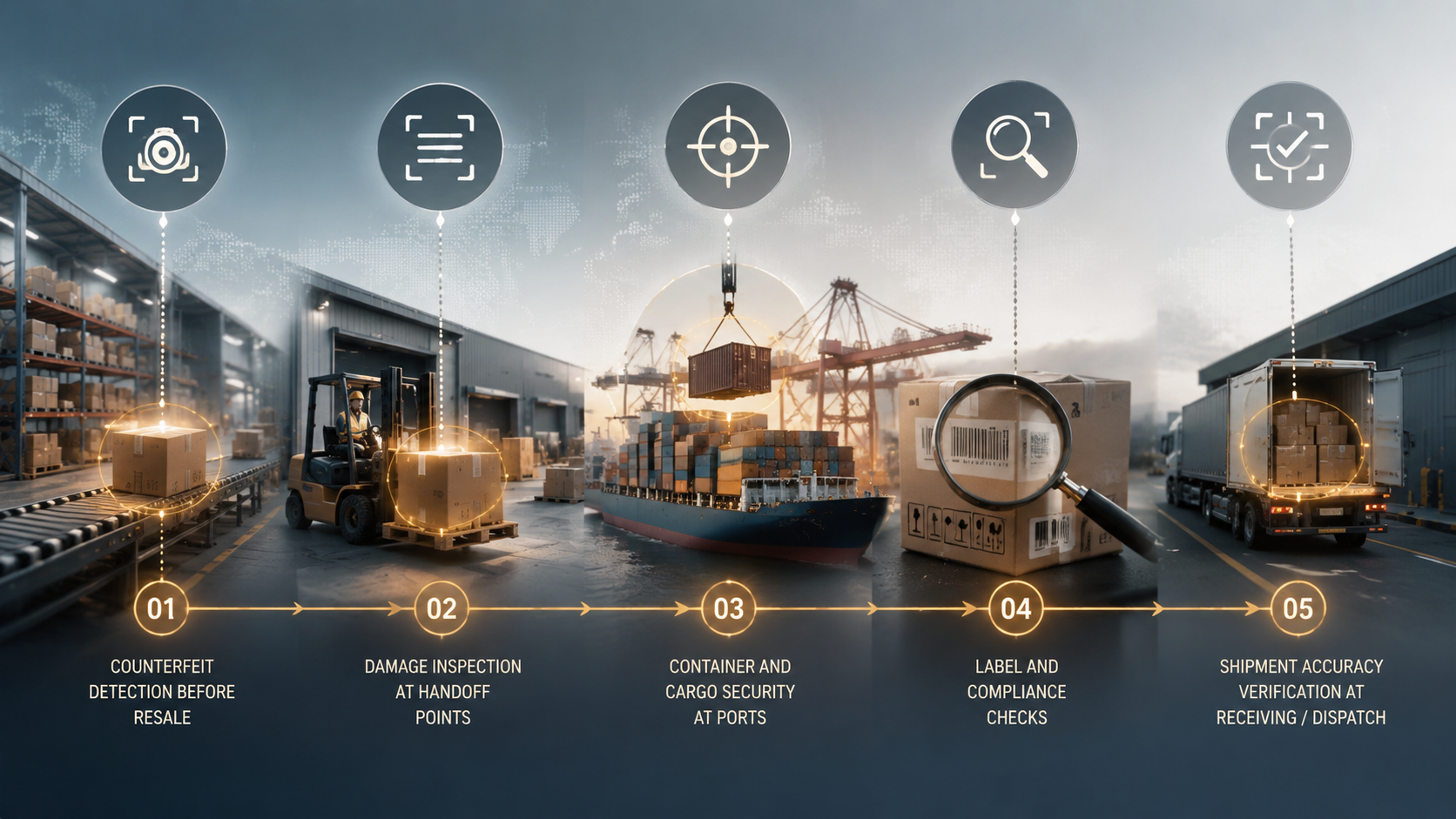
Placed along the movement of goods, the five applications look like this:
| Inspection point | Visual decision being automated | Evidence position in Q3 2026 | Main implementation burden |
|---|---|---|---|
| Counterfeit detection before resale, acceptance, return, or supplier escalation | Can the system confirm authenticity from product images and reference data? | Strongest production evidence among the five, led by Entrupy’s 2026 authentication data, 90M+ reference images, 99.86% accuracy claim, and financial guarantee [1] | Reference coverage by category, capture discipline, exception handling for “unidentified” results |
| Damage inspection at handoff points | Is the item, parcel, or container visibly damaged enough to trigger a claim, rework, rejection, or customer-facing exception? | Strong evidence that the problem is real and technically difficult; Amazon’s HAM2 pilot used a 30,000-image dataset, while Vimaan describes multi-camera, multi-angle parcel capture [2][3] | Lighting, angle coverage, image timing, WMS/PMS integration, and human review thresholds |
| Container and cargo security at ports, yards, or terminals | Does imagery or scan data suggest contraband, cargo anomalies, seal issues, or container damage? | Emerging with regulatory and port-security momentum; CBP-related X-ray/CT use is documented in industry education material, Ability Intelligent claims container damage detection capabilities, and Panama Transshipment Group deployed an AI-powered cargo security application in 2026 [4][5][6] | Specialized equipment, agency workflows, port operating systems, and high-consequence false positives |
| Label, marking, and compliance verification for regulated movement | Do labels, hazmat markings, serialization data, or seals match what regulated movement requires? | Emerging; the pressure is clear in customs, hazmat, pharmaceutical, and seal-integrity contexts, but public case evidence is thinner than for counterfeit or damage detection [4] | Readable image capture, master-data accuracy, regulatory rule mapping, and audit storage |
| Shipment accuracy verification at receiving or dispatch | Do visible products, cartons, or units match the PO, ASN, or shipment record? | Commercially available in vendor claims, including Intelgic’s claim of automated product verification against purchase orders, but independent production evidence remains limited [7] | Item recognition quality, packaging variation, PO/WMS integration, and exception queues |
Counterfeit Detection Has the Clearest Security Evidence
Counterfeit detection is where AI image verification looks least like a novelty and most like a control point. The decision is narrow: authenticate, reject, escalate, or hold until a specialist reviews the item. That fits marketplaces, luxury resale, returns operations, warranty review, gray-market investigations, and supplier disputes, where the cost of accepting a bad item can exceed the labor cost of inspection.
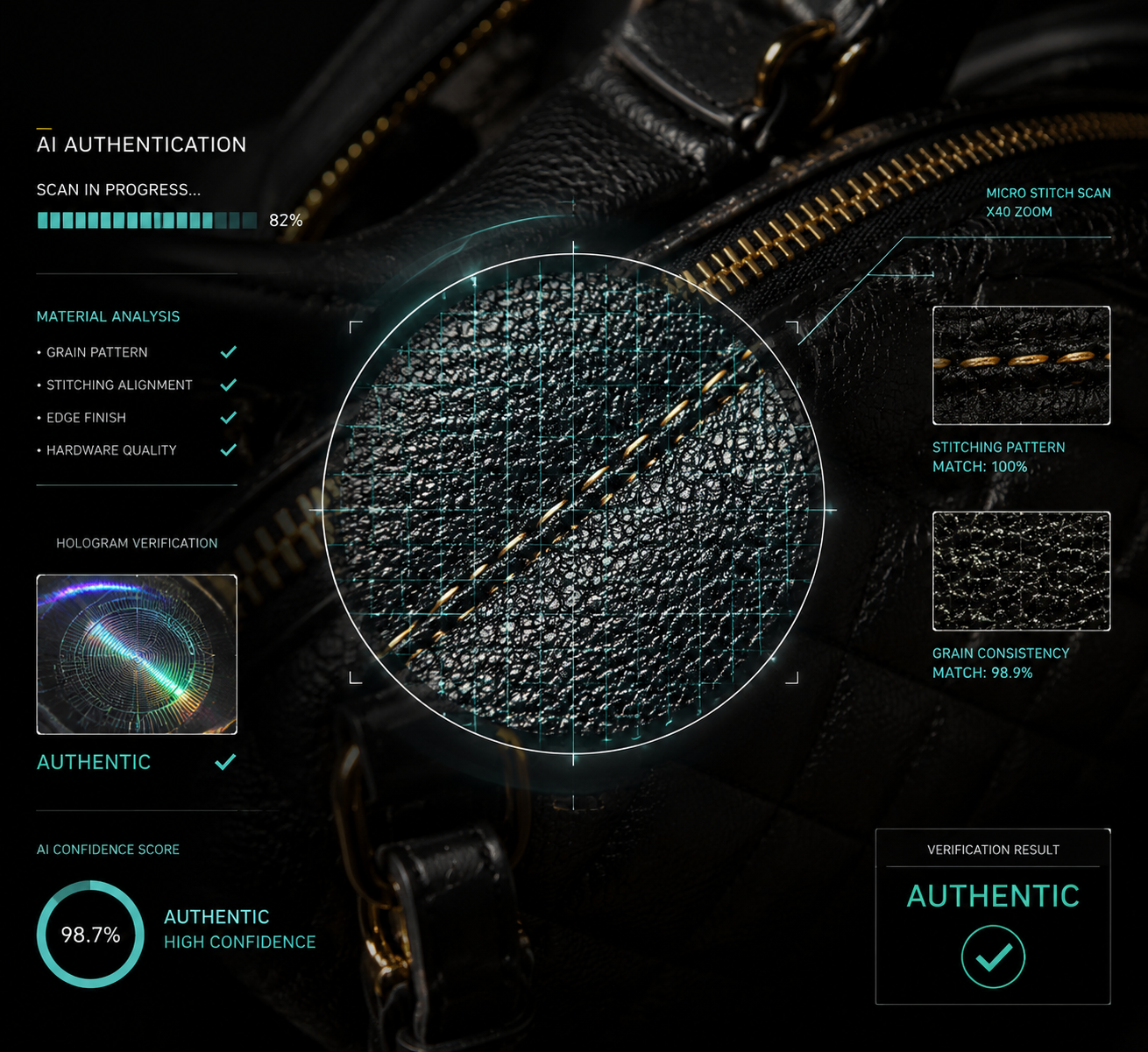
Entrupy’s 2026 State of the Fake report is unusually concrete for this market. The company reports more than $3.7 billion in authenticated goods, a reference base of more than 90 million images, authentications in under 60 seconds, a 99.86% AI accuracy claim, and an error rate below 0.14% [1]. WWD’s coverage of the same report gives third-party visibility to the scale of the data, though the underlying figures still come from Entrupy’s platform [8].
The most useful number in the report is not only the accuracy claim. It is the variation in “unidentified” rates by product category: 8.1% for luxury, 34.85% for apparel, and 95.75% for Fear of God Essentials [1]. That does not mean those shares were counterfeit. Entrupy defines the result as cases where its AI cannot confirm authenticity. A product may be outside the trained reference set, altered, damaged, or otherwise unsuitable for confirmation. In an operating procedure, “unidentified” should route to review or rejection under policy; it should not be reported internally as a counterfeit hit rate.
The financial guarantee is another reason this use case deserves attention. Entrupy says it provides a 100% financial guarantee, and the 2026 report describes a payout of about $20,000 on a modified Chanel bag [1]. That example matters because it shows the vendor accepting economic exposure when the authentication record is wrong or disputed. It does not remove buyer responsibility for capture quality, item eligibility, or process control, but it changes the conversation from “the model is accurate” to “who bears the loss when the record fails.”
Category coverage is the trap. A luxury handbag inspection program with trained operators, controlled capture, and a mature reference library is not automatically portable to apparel, electronics components, cosmetics, or replacement parts. AGMA’s 2026 anti-counterfeiting priorities rank AI-powered counterfeit detection as the second priority for technology manufacturers, which signals industry interest, not a universal proof of effectiveness across every product family [9].
For buyers, the maturity rating is high when the product category is covered, the decision is frequent, and the authentication result can be tied to a financial or contractual action. The procurement checklist should be plain: what categories are supported, what result states exist, how often “unidentified” appears, what images operators must capture, what guarantee applies, and how the record is preserved for dispute resolution.
Damage Inspection Is a Capture Problem Before It Is an AI Problem
Damage detection sounds simple until the operation has to decide what counts as damage. A crushed corner, a torn seam, a wet panel, a scuffed retail box, and a punctured shipper do not carry the same consequence. The camera record needs to support the decision being made at that location: accept with notation, reject, repack, trigger a carrier claim, route to refurb, or warn customer service before delivery.
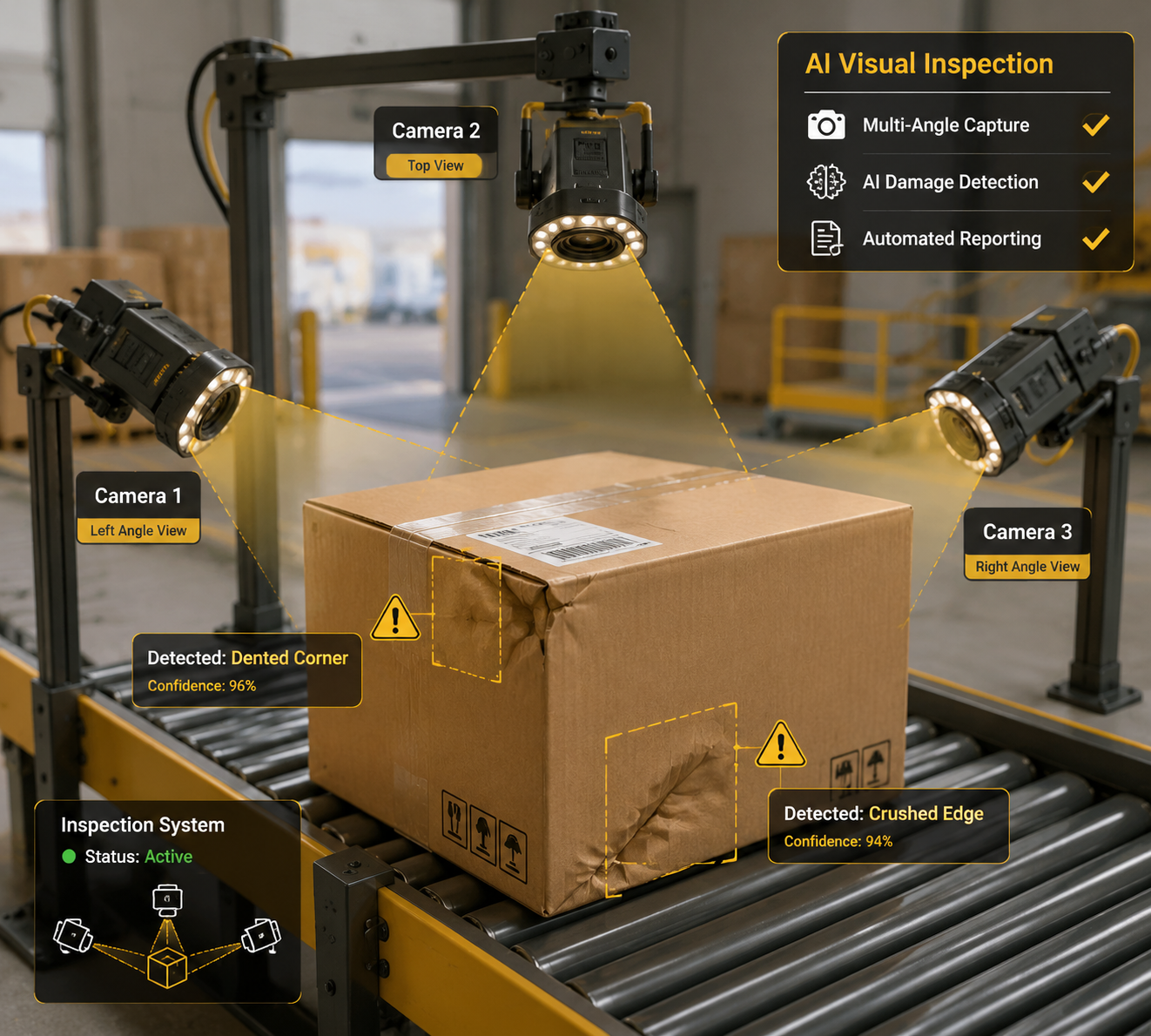
Amazon’s HAM2 pilot in Hamburg is useful because it does not make damage detection look easier than it is. Amazon Science described a 30,000-image dataset and a system combining supervised learning with anomaly-based machine learning. The article also notes that fewer than 1 in 1,000 items are damaged at Amazon’s scale, which makes the class imbalance severe even while the aggregate cost compounds [2]. At publication, this was a pilot at one fulfillment center, not a claim of network-wide deployment.
That low damage rate explains why casual image collection disappoints. If nearly every parcel is fine, a model can appear accurate while missing the rare cases that matter or over-escalating harmless packaging marks. The operating question becomes: which misses are tolerable, which false alarms stop flow, and which exceptions require a person before the item moves again?
Vimaan’s ParcelSCAN material points to the capture-side answer: multiple cameras, multiple angles, and image stitching over time rather than a single dock photo [3]. That architecture acknowledges what anyone who has argued over carrier damage photos already knows. One image can hide the torn side, flatten depth, wash out water staining, or make a crushed edge look like shadow.
Container damage detection raises the same issue at a different scale. Ability Intelligent’s CDD product page describes deep-learning detection of dents, cracks, deformations, and seal anomalies under variable lighting and weather, with integration into port management systems and warehouse management systems [5]. Those are vendor capability claims, not independent ROI evidence. Still, the claimed integration points are the right ones: if damage images do not attach to the container, booking, gate event, or claim file, the inspection becomes another orphaned photo archive.
Damage inspection is mature enough to justify pilots where handoff disputes are frequent and costly, especially parcels, returns, and reusable containers. It is not mature enough to buy on a demo clip. A serious pilot should measure capture coverage, false-alarm labor, missed damage discovered downstream, claim cycle time, and whether the WMS, TMS, PMS, or claims system actually receives a usable visual record.
Container and Cargo Security Is Moving, but the Evidence Is Not Yet General
Port and cargo security use cases sit closer to inspection workflow than warehouse productivity. The visual decision may involve X-ray imagery, CT analysis, seal condition, commodity-code prediction, container condition, or anomaly detection. The cost of a wrong decision can be high: unnecessary holds, missed contraband, customs penalties, vessel delays, or security exposure.
An IHA member-education overview describes U.S. Customs and Border Protection use of AI-driven X-ray and CT analysis at ports for contraband detection, commodity code prediction, and anomaly detection [4]. The source is a curated industry overview rather than an independent performance study, so it should be treated as deployment context, not proof of a specific detection rate.
The Panama Transshipment Group deployment is another sign of movement. Smart Maritime Network reported in May 2026 that the group deployed an AI-powered cargo security application [6]. That matters because terminal operators are beginning to operationalize the category. It does not yet tell a buyer how much inspection time fell, how many anomalies were confirmed, or whether the deployment economics generalize to a different port.
For Q3 2026, container and cargo security should be budgeted as an emerging control with regulatory and security tailwinds. The right buyer is usually not chasing a generic computer-vision ROI number. The right buyer has a known inspection bottleneck, a compliance mandate, a port or yard system that can consume inspection outputs, and a clear policy for what happens when the system flags an anomaly.
Label and Compliance Verification Belongs Where the Penalty Is Specific
Label and compliance verification is less dramatic than counterfeit detection, but it can be a cleaner operational fit. The system checks whether visible information is present, readable, and consistent with a rule: hazmat marking, pharmaceutical serialization, seal integrity, shipment labels, lot codes, or other regulated identifiers. The value is not that AI “understands compliance.” The value is that it can create a time-stamped inspection record before regulated movement continues.
The evidence base is still thinner than the pressure behind the use case. Port-security and customs contexts show why visual verification is relevant for regulated movement, but public materials do not support broad claims that AI label verification has already reduced penalties or prevented specific rates of noncompliance across supply chains [4]. For pharmaceutical serialization, hazmat handling, and sealed regulated shipments, the strongest case is often internal: repeated manual rechecks, inconsistent photo evidence, and avoidable holds.
This is a good candidate for targeted pilots, not sweeping transformation language. The pilot should start with one rule set and one decision point. If the question is “is the hazmat label present and legible before tender?” keep the system on that question. If the question is “does the serialized label match the shipment record?” then master-data quality and system integration matter as much as image quality.
Shipment Accuracy Verification Is Straightforward, but Still Early
Shipment accuracy verification is the most intuitive application: compare what the camera sees with the PO, ASN, pick list, or shipment record. If the system can identify the wrong SKU, missing unit, overage, wrong carton, or mismatched label before dispatch or receiving closeout, it can prevent a dispute that would otherwise become email archaeology.
Intelgic markets AI-powered product identification and shipment verification, including a claim of fully automated product verification against purchase orders [7]. That is a commercially relevant capability claim, but the public evidence available here does not establish independent accuracy, ROI, or deployment scale. The concept is sound; the proof burden remains with each buyer’s SKU mix, packaging variation, camera placement, and WMS or ERP integration.
This use case should not be dismissed because it lacks the drama of counterfeits or ports. It simply needs a narrower business case. A high-volume receiving operation with repeated supplier shortages may find value quickly. A low-volume operation with messy item master data may spend the pilot proving that its records, not its cameras, are the weak link.
Adoption Data Should Temper the Business Case, Not Lead It
Broad adoption numbers are useful only after the use case is clear. DHL’s AI-driven computer vision trend report says object-classification accuracy improved from about 50% to 99% in under a decade [10]. That is an important technology curve, but it is not security-specific evidence for damaged cartons, counterfeit goods, hazmat labels, or port anomalies. A buyer still has to ask what the system is classifying, under what lighting, with what exception threshold, and against which operational record.
Compiled supply chain AI statistics cite Gartner’s forecast that adoption of AI-enabled vision systems in supply chain would rise from 20% in late 2023 to 50% by 2027, McKinsey’s finding that AI-enabled distribution can achieve 5% to 20% logistics cost reduction and 20% to 30% inventory reduction, and Deloitte’s typical 2-to-4-year return timeline for AI investments [11]. Those benchmarks frame expectations; they do not select the inspection point.
The practical investment test is more grounded:
- Frequency: the visual decision happens often enough that automation can change cost, speed, or consistency.
- Consequence: a wrong or missing visual record creates chargebacks, claims, rejected returns, regulatory exposure, counterfeit leakage, or customer harm.
- Evidence: the use case has production data, a credible guarantee, or at least a pilot design that measures outcomes rather than demo accuracy.
- Capture control: the operation can control lighting, angles, timing, image quality, and operator behavior.
- System closure: the result attaches to the WMS, ERP, TMS, PMS, claims file, customs workflow, or supplier scorecard where the decision is made.
Teams already assessing adjacent warehouse AI programs can use the same readiness discipline they would apply to machine learning for warehouse management: data quality, integration ownership, exception queues, and operating procedures decide whether the model output becomes a decision or another dashboard.
Where to Prioritize in Q3 2026
Counterfeit detection should be the first serious investment area when the product category is well covered, disputes are costly, and authentication can trigger a defined commercial action. It has the strongest public evidence among the five, but only inside the boundaries of supported categories, trained capture, and disciplined treatment of “unidentified” results.
Damage inspection deserves comparable attention where handoff disputes, claims, returns, or downstream discovery costs are material. The Amazon and Vimaan materials point to the same lesson from different angles: damage detection succeeds or fails on capture design, exception policy, and integration as much as on model performance.
Container security and label compliance are better treated as targeted pilots or compliance-driven deployments. They have momentum from customs, ports, regulated goods, and terminal security, but public evidence does not yet support a blanket ROI claim across all supply chains.
Shipment accuracy verification is worth watching and testing where PO disputes are frequent, item recognition is feasible, and records are clean enough for comparison. It is the shortest path conceptually, but still needs buyer-specific proof.
The mistake is to buy AI image verification as one security category. The safer sequence is to fund the inspection point where the visual decision is frequent, costly, and evidence-backed; pilot where regulation or security pressure is rising; and delay broad rollout until capture, integration, and exception handling are proven at the dock, tunnel, gate, or inspection station where the decision actually has to be made.
References
- State of the Fake Report 2026, Entrupy, 2026.
- The Surprisingly Subtle Challenge of Automating Damage Detection, Amazon Science, 2022.
- Parcel Inspection and Damage Detection with Computer Vision, Vimaan.
- Navigating AI Security in Ports & Intermodal Shipping, IHA Blog, February 5, 2026.
- Container Damage Detection (CDD), Ability Intelligent.
- Panama Transshipment Group deploys AI-powered cargo security application, Smart Maritime Network, May 21, 2026.
- AI-Powered Product Identification & Shipment Verification, Intelgic.
- AI Analysis Shows Global, Billion-Dollar Counterfeit Crisis, WWD.
- 2026 Anti-Counterfeiting Priorities for Tech Manufacturers, AGMA Global.
- Trend Report: AI Driven Computer Vision, DHL.
- Supply Chain AI Statistics: 18+ Statistics You Should Know for 2026, Open Sky Group.
Comments
Join the discussion with an anonymous comment.