
AI food traceability is suddenly being discussed against a messy regulatory clock. FSMA 204 was originally built around a January 20, 2026 compliance date, FDA has proposed extending that date by 30 months to July 20, 2028, and Congress has directed FDA not to enforce the rule before that later window. The practical reading is simple enough: the schedule has moved, but the traceability record FDA expects has not. Facilities that handle foods on the Food Traceability List still need additional records for Critical Tracking Events, the related Key Data Elements, Traceability Lot Codes, and an electronic sortable spreadsheet response within 24 hours when FDA asks for it.[1]
That distinction matters because many “AI-ready traceability” projects start in the wrong place. A model can classify documents, flag mismatched labels, summarize supplier certificates, or narrow a recall search. It cannot reconstruct lot discipline that was never captured, resolve inconsistent event names across plants, or turn supplier PDF traffic into reliable evidence without rules for what data must exist in the first place.

The Extension Changes the Project Calendar, Not the Data Model
The extra implementation window is useful. It gives operations, QA, IT, and supplier-management teams time to clean up master data, standardize lot-code practices, connect ERP and warehouse systems, and stop treating traceability as a binder exercise. It does not make the FSMA 204 record optional, and it does not reduce the need to capture the right event at the right operational handoff.
The rule is not asking for a general story about where a product came from. It requires specific Key Data Elements at specific Critical Tracking Events for covered foods. Those records must be maintained and, when requested, provided to FDA in an electronic sortable spreadsheet within 24 hours.[1] That 24-hour requirement is where paper logs, email folders, and “someone in receiving knows” processes tend to show their limits.
A manufacturer using the extra time well is not waiting for an AI vendor to solve traceability in 2028. It is using 2026 and 2027 to make every covered movement of product produce a clean event record. Once that record exists, AI becomes useful in a much more ordinary and verifiable way: it reduces review time, catches inconsistencies, and helps people retrieve evidence under pressure.
Start with the Seven Events FDA Actually Cares About
The center of an FSMA 204 traceability build is the Critical Tracking Event. FDA’s framework identifies seven CTEs: harvesting, cooling, initial packing, first land-based receiving, shipping, receiving, and transformation.[1] Different facilities will touch different combinations of those events, but the implementation question is the same: when this event happens, what data is created, who owns it, where is it stored, and can it be joined to the next event without a human retyping it?
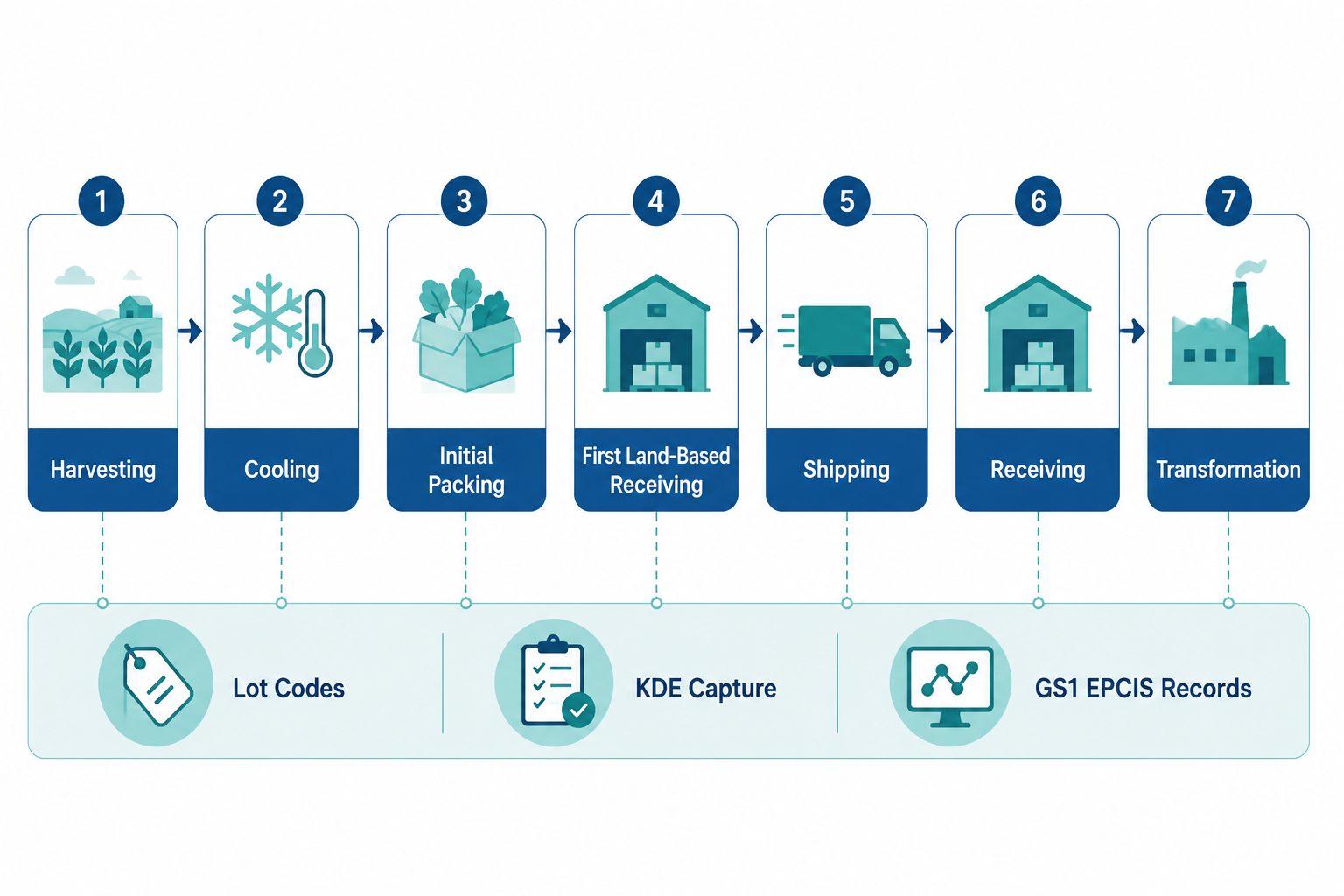
| Critical Tracking Event | What the system has to prove | Common weak point |
|---|---|---|
| Harvesting | Product is connected to the harvest event and assigned traceability information at origin. | Field, crew, harvest, and lot references are captured outside the core system. |
| Cooling | Product movement through cooling is recorded and linked to the relevant lot. | Cooling records sit in separate logs or temperature systems without lot-level joins. |
| Initial packing | Packed product receives traceability identity that can travel forward. | Pack runs, repacks, and label changes are not consistently tied to source lots. |
| First land-based receiving | Imported or previously off-shore product enters the land-based record with usable traceability data. | Supplier documentation arrives as PDFs, emails, or portal downloads with inconsistent fields. |
| Shipping | Outbound movement records what lot went where and when. | Shipment records live in ERP or TMS while quality disposition lives elsewhere. |
| Receiving | Inbound product is accepted, identified, and connected to supplier and shipment records. | Receiving scans confirm arrival but not always the KDEs needed for traceability. |
| Transformation | Inputs and outputs are linked when product is processed, mixed, cut, repacked, or otherwise changed. | Batch records do not preserve enough input-output detail to narrow recall scope. |
The transformation event is often where the real work sits for processors. If a facility turns incoming ingredients into a finished product, traceability depends on the relationship between inputs, process step, output lots, rework, holds, and releases. A recall search that stops at “we used that supplier lot sometime that day” is not the same as a record that can isolate the affected finished lots.
That is why Traceability Lot Codes deserve more attention than they usually get in executive decks. The code is not just a label field. It is the join key that allows receiving, production, shipping, supplier documentation, and customer records to line up. If plants rename lots, split them without recording the split, merge them into production without input-output relationships, or let suppliers send codes in unstructured documents, the AI layer will mostly be cleaning up preventable confusion.
Use Standards Before You Ask AI to Interpret the Mess
Interoperability is not a side issue for FSMA 204. Most manufacturers do not control the full chain. They receive supplier records, transform product internally, ship to customers, and answer auditors who expect a coherent trail. GS1 EPCIS-style event records are useful because they describe traceability as events: what happened, when it happened, where it happened, which objects or lots were involved, and why the event occurred in the business process.
That event structure fits plant reality better than a static database dump. Receiving is not the same event as shipping. Transformation is not the same event as cooling. Each one carries different KDEs and different evidence risk. When systems preserve those distinctions, an audit response becomes a controlled retrieval exercise instead of a scavenger hunt across ERP, WMS, quality management software, supplier portals, spreadsheets, and inboxes.
- Define one event vocabulary across plants, suppliers, and systems before configuring AI review workflows.
- Make Traceability Lot Codes persistent across receiving, production, storage, transformation, and shipping.
- Store KDEs as structured fields, not only as text embedded in certificates, bills of lading, or scanned forms.
- Connect quality disposition, supplier approval, and hold-release status to the same lot record used by operations.
- Test whether the record can be exported and sorted before assuming it will satisfy a 24-hour request.
This is the work that tends to look unglamorous until the first mock recall. It is also the work that determines whether AI has something dependable to analyze.
Where AI Belongs Once the Event Record Is Solid
AI becomes valuable after the traceability record has shape. At that point it can compress repetitive compliance work that already consumes QA and receiving teams: checking incoming certificates, matching labels to specifications, looking for documentation gaps, and ranking which exceptions need review first.
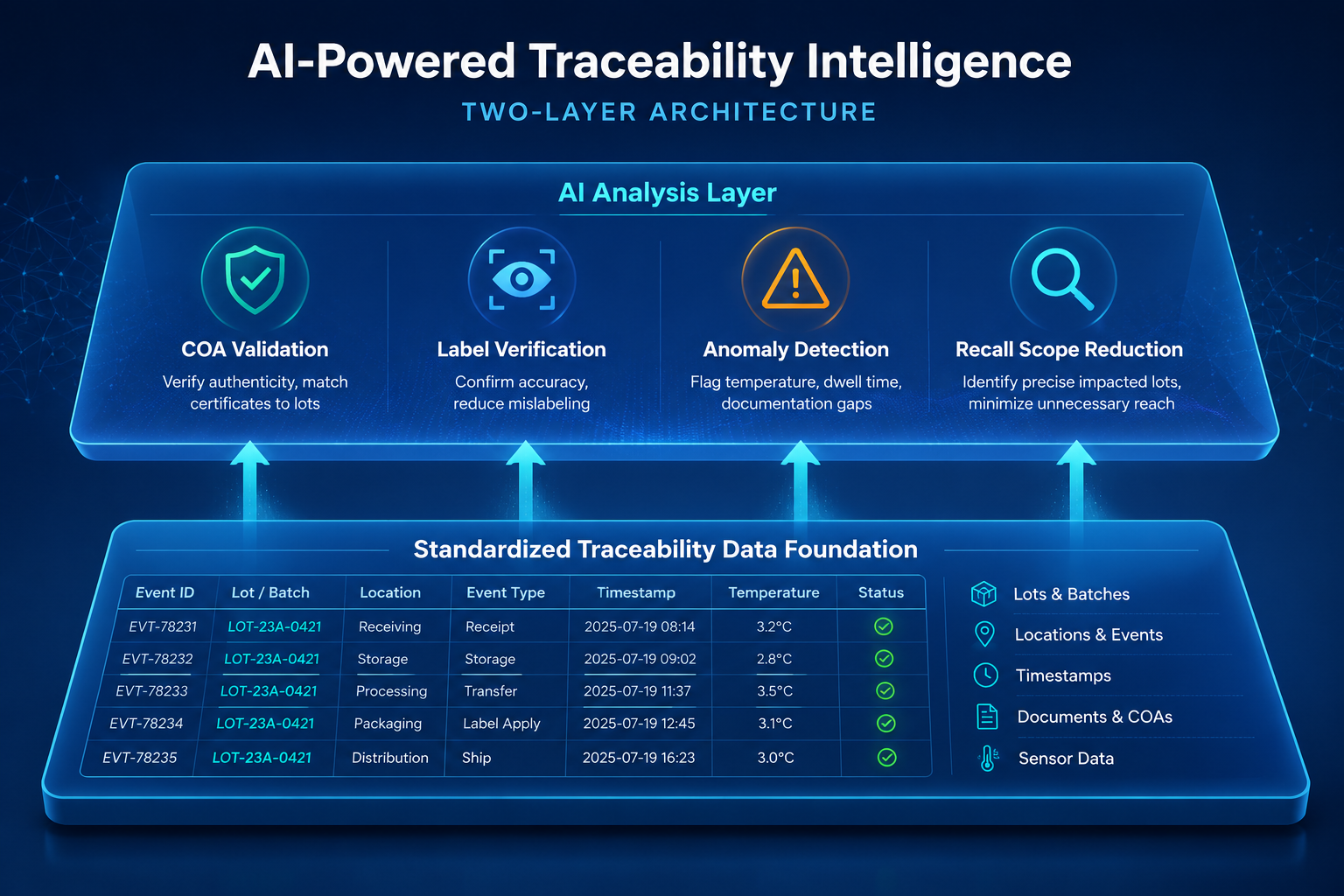
Supplier COA Validation
Supplier certificate review is a good first automation target because the task is repetitive, evidence-based, and still needs human escalation when something fails. A facility receiving many weekly deliveries from multiple suppliers may need staff to compare each COA against approved specifications, allergen expectations, microbial limits, lot identifiers, dates, and supplier status. AI can extract fields from incoming documents, compare them with approved specifications, and flag missing or inconsistent records before the lot moves further into production.
The control point is important: AI should not simply “approve” a supplier lot because a document exists. It should show which fields matched, which fields failed, which required values were missing, and which record it used as the approved specification. That audit trail matters more than the automation claim.
Label and Packaging Verification
Computer vision can help with label and packaging checks when it is tied to product specifications and lot records. Industry examples cited by AI food-safety vendors include the use of vision systems to inspect packaging or labeling, and vendor reporting around large food companies describes reductions in manual checking effort; those examples are useful as implementation signals, not neutral proof that every plant will see the same result.[2]
The practical value is easiest to see in high-changeover environments. A line changes from one SKU to another, packaging is staged, labels are printed, and the lot code must match the production record. An AI-assisted inspection workflow can compare the live image or print output against the expected SKU, allergen statement, date code, and lot format. The system still needs a release rule: who reviews mismatches, what stops the line, and how exceptions are documented.
Anomaly Flags Across Time, Temperature, and Documentation
Traceability data also gives AI a place to look for patterns that are easy to miss in separate systems. Dwell time between receiving and cooling, missing COAs for accepted lots, repeated supplier documentation gaps, shipment records without linked KDEs, or temperature histories that do not fit the expected route can all become exception signals.
Cold-chain IoT and predictive shelf-life modeling belong in this picture, but they should not take over the traceability architecture. Temperature history is one evidence stream attached to a lot and event trail. For a deeper treatment of sensors, temperature excursions, and shelf-life analytics, see the related guide to AI food safety in the cold chain.
Recall Scope Reduction
Recall support is where traceability work becomes visible to executives, customers, and regulators. The operational question is not whether AI can produce a polished report. It is whether the system can identify affected inputs, transformations, finished lots, shipments, customers, and still-exposed inventory quickly enough for a controlled response.
FoodReady, a vendor source, reports that AI-native traceability implementations have reduced mock recall time from 4–8 hours to 10–30 minutes, cut data-entry errors by 85–95%, reduced daily traceability documentation time by 60–75%, moved audit preparation from more than 40 hours to 8–10 hours, and supported first-time audit pass rates above 90% across its customer base.[3] Those numbers should be treated as directional vendor evidence rather than independent benchmarks. They still describe the right kind of payoff: fewer manual joins, fewer retyped fields, faster retrieval, and a smaller group of people trapped in audit-room document assembly.
FoodReady and Supply Change Capital also cite industry estimates that recalls average about $10 million per incident and that AI-enabled traceability can reduce recall scope by 50–95%.[3][4] The recall-scope figure should not be read as a guarantee. Scope narrows only when the facility has enough lot-level input-output detail to distinguish affected product from unaffected product.
Audit Schemes Add Pressure Before FDA Ever Calls
FSMA 204 is not the only reason to build this correctly. Facilities operating under GFSI-benchmarked schemes already know that traceability has to work during audits, not just during regulatory events. Mock recalls, one-up/one-back tracing, supplier records, finished-product distribution, and mass-balance exercises expose the same weaknesses: incomplete lot links, slow document retrieval, uncertain ownership, and systems that cannot reconcile production reality with quality records.
This is where AI can make the business case more concrete without pretending to replace the standard. If a mock recall requires people to pull receiving records from one system, batch sheets from another, shipment data from a third, and COAs from email, automation can reduce the manual burden. But audit readiness still depends on whether the underlying record is complete, controlled, and reviewable.
A Sensible Build Sequence for the July 2028 Window
The extended timeline gives manufacturers enough room to sequence the work instead of forcing a thin AI layer over inconsistent records. A realistic program usually starts with the traceability map, not the model selection.
- Map covered foods, facilities, suppliers, products, and process steps against the seven FSMA 204 Critical Tracking Events.
- Define required KDEs, Traceability Lot Code rules, event ownership, and exception handling for each CTE the company performs.
- Standardize event records using an interoperable structure such as GS1 EPCIS-style event data.
- Integrate ERP, WMS, QMS, MES, supplier portals, label systems, and document repositories around the lot and event model.
- Run mock recalls and 24-hour sortable-record tests before adding advanced AI use cases.
- Layer AI into document validation, label checks, anomaly detection, shelf-life modeling, and recall-scope analysis once the evidence trail is reliable.
Supplier onboarding will determine how much friction remains. If suppliers keep sending certificates as inconsistent PDFs, screenshots, or emails, the receiving site may still need AI extraction just to normalize incoming data. That can be useful, but it is a workaround. The better long-term target is structured supplier data that maps directly to the receiving event and the approved specification.
Integration sequencing also needs discipline. Many plants already have pieces of the record: ERP item masters, WMS location scans, QMS holds, MES batch records, label systems, temperature logs, and supplier portals. The mistake is assuming that because each system has some traceability data, the company has a traceability system. FSMA 204 response depends on whether those records can be joined, sorted, exported, and defended.
ROI Expectations Should Stay Operational
Market projections make the category look large. Supply Change Capital cites estimates that the food traceability market will grow from $36.9 billion in 2026 to $67.4 billion in 2034, and points to separate research projecting the AI food-safety market toward $13.7 billion by 2030 at about 30.9% CAGR.[4] Those figures explain why vendors are crowding the space. They do not tell a plant manager whether a system will survive a mock recall.
The better ROI measures are closer to the work: minutes to complete a mock recall, hours spent preparing for an audit, number of supplier documents requiring manual re-entry, percentage of receiving exceptions caught before use, number of label mismatches stopped before shipment, and how precisely the company can separate affected from unaffected inventory during an incident.
Academic and industry reviews describe AI’s role in food safety as expanding across monitoring, prediction, decision support, and traceability, while also noting that data quality, interoperability, governance, and validation remain limiting factors.[5][6] That matches what implementation teams see on the floor. The hard part is rarely buying an algorithm. The hard part is making sure the algorithm is looking at complete, current, and controlled records.
What to Have in Place Before Calling the System AI-Powered
A credible AI traceability system should be able to show its working. During an audit or incident, the team should not have to explain that the model “knows” where the product went. It should be able to open the event record, show the Traceability Lot Code, display the related KDEs, connect the supplier and transformation records, identify downstream shipments, and produce the sortable file.
- Every covered CTE has an owner, timestamp, location, lot reference, and required KDE capture point.
- Traceability Lot Codes remain consistent through receiving, storage, production, transformation, and shipping.
- Supplier documents are linked to lots and specifications rather than stored as disconnected attachments.
- Exceptions create review tasks with disposition history, not informal messages.
- Mock recalls test both regulatory export and internal decision-making speed.
- AI outputs are reviewable, explainable at the field level, and tied to source records.
Companies now have time to build this correctly, but not time to skip the unglamorous data work. AI helps FSMA 204 compliance when the traceability record underneath it is complete, sortable, standardized, and usable under audit pressure. Without that foundation, it is another layer of interpretation sitting on top of records people still cannot trust.
References
- FSMA Final Rule on Requirements for Additional Traceability Records for Certain Foods — FDA
- How AI Is Transforming Food Safety — IONI
- Transforming Food Safety with AI-Native Traceability Across Hundreds Facilities — FoodReady
- AI-enabled traceability: The next — Supply Change Capital
- How AI Is Reshaping Food Safety — IFT Food Technology Magazine, June 2026
- Artificial Intelligence in Food Safety: Recent Advances, Challenges, and Future Perspectives — Foods, 2025
Comments
Join the discussion with an anonymous comment.