
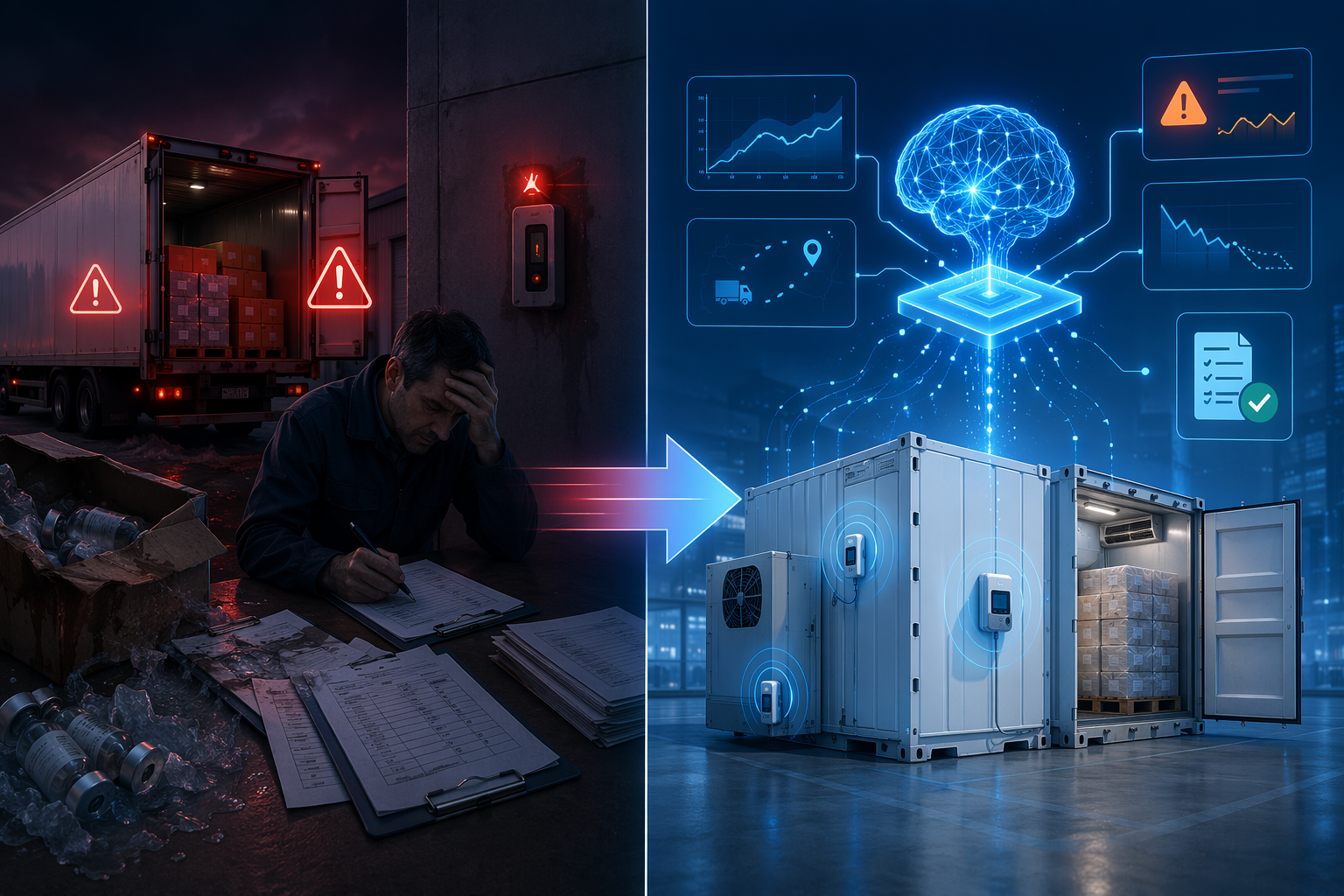
Traditional cold chain monitoring tells a team that a shipment has crossed a temperature threshold. Cold chain monitoring AI sensors try to identify the conditions that make that crossing likely before it happens: a reefer unit drawing down more slowly than usual, a lane with repeated dwell-time risk, a door-open pattern that changes the thermal profile, or a sensor stream that starts to drift away from normal behavior while the load is still technically in range.
That distinction matters because the cold chain is already under enough pressure without adding decorative analytics. MarketsandMarkets valued the cold chain monitoring market at $8.31 billion in 2025 and projected it to reach $15.04 billion by 2030, a 12.6% CAGR.[1] FleetRabbit’s 2025 cold chain outlook frames temperature excursions as a $35 billion annual problem, an industry-consensus estimate rather than an audited loss ledger.[2] The useful question is not whether more data will be collected. It is whether the data arrives early enough, cleanly enough, and specifically enough for someone to act before product integrity is at risk.
What the AI Layer Actually Adds
A temperature sensor by itself is not predictive. It measures. A logger records. A connected logger transmits. The AI layer begins to matter only when continuous sensor readings are interpreted against equipment behavior, route context, asset history, and compliance records in a way that changes the next operational choice.
In a working predictive setup, the pipeline usually looks like this: IoT sensors collect temperature, humidity, vibration, door, power, and location signals from trailers, containers, cold rooms, and packaging; those signals are transmitted into a platform with time stamps and asset identifiers; the platform compares current behavior with learned patterns; and the output is translated into risk, maintenance, or documentation actions.
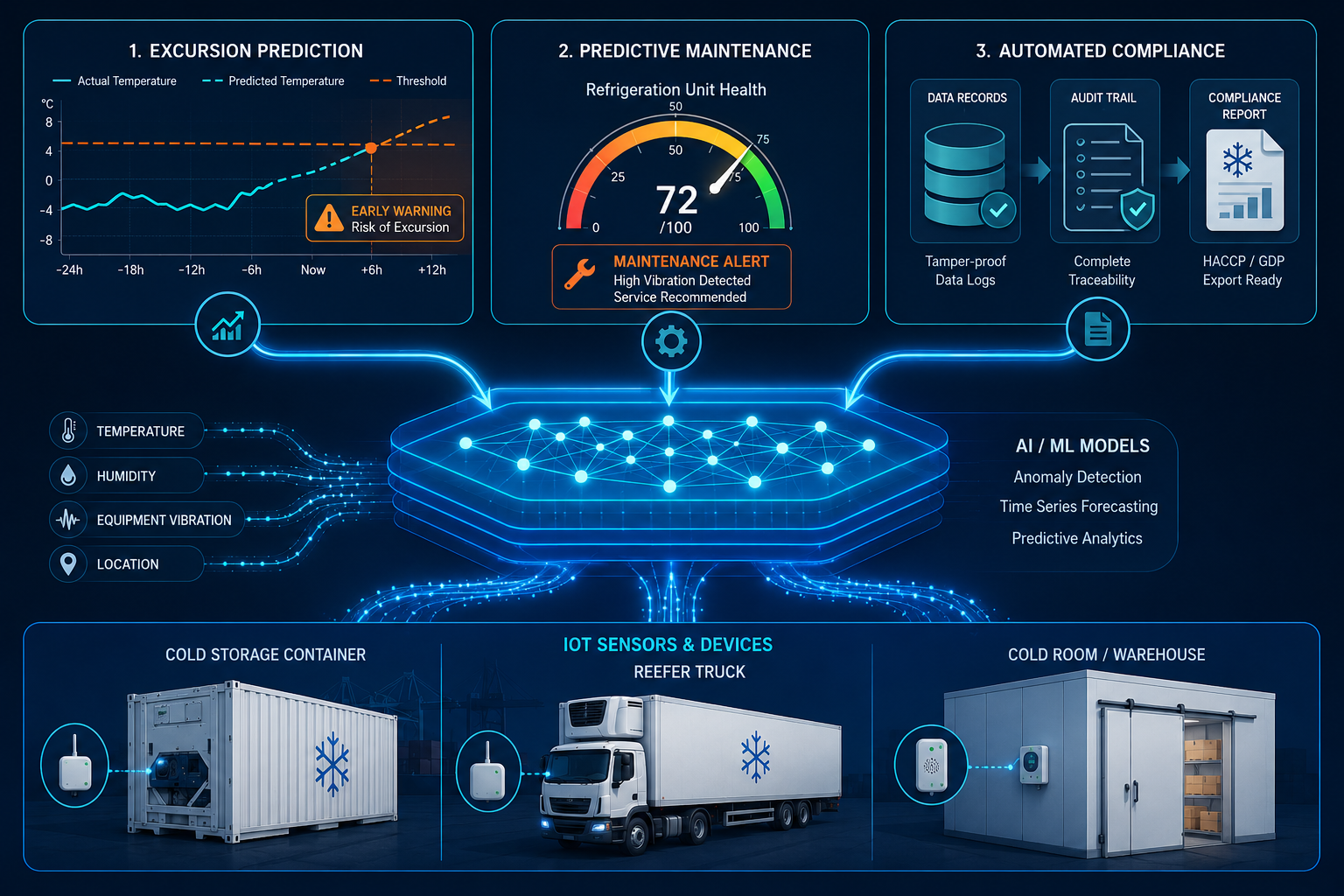
SenseAnywhere describes the important step as detecting equipment drift patterns hours before thresholds are crossed, rather than waiting for a breach and then flagging it.[3] That is the dividing line between a dressed-up alarm and a genuinely predictive system. A threshold alert says, “The load is now outside the allowed band.” A risk prediction says, “This asset, on this route, under these conditions, is trending toward an excursion unless something changes.”
The operator does not need a more impressive graph at that moment. They need to know whether to adjust a setpoint, dispatch service, move product to another asset, change a route instruction, escalate to QA, or document a controlled deviation. Prediction earns its keep when it narrows those choices while there is still time to choose.
From Excursion Alerts to Excursion Risk
Cold chain teams have lived with threshold alerts for years. They are necessary, but they arrive late by design. A high-temperature alarm confirms that a rule has been violated or is being violated. It helps with containment, quality review, and disposition. It does not, by itself, prevent the event.
An excursion-risk model is trying to read the slope before the cliff. For example, a refrigerated trailer may still be within specification, but its recovery after each door opening may be getting slower. A container may be holding temperature, but compressor cycling may look different from comparable trips. A warehouse dock may not breach a product limit, but repeated dwell patterns may raise risk for certain lanes or packaging configurations. The practical value is not that the model says “AI detected anomaly.” It is that the alert is tied to a likely failure mode and a usable intervention window.
That difference also changes how QA sees the record. In a reactive system, the file often starts with the excursion: time out of range, maximum temperature, product exposure, corrective action, release or rejection. In a predictive system, the record can include earlier risk signals, actions taken before the breach, and evidence that the team intervened while the product remained protected. That does not eliminate quality review, but it gives the reviewer a better chain of events than a red line on a temperature chart.
Predictive Maintenance Is Part of the Same Story
Many temperature events are treated as shipment problems because the shipment is where the damage appears. Operationally, the cause may sit upstream in refrigeration assets: a unit that is beginning to lose pull-down performance, a sensor that is no longer reliable, a door seal that changes the heat load, or a container that performs acceptably in mild conditions and poorly when the lane gets harder.
This is where AI sensors connect monitoring to maintenance. Instead of using temperature data only to judge the load, the platform can use repeated operating patterns to judge the asset. A model that sees slower recovery times, unusual cycling, repeated near-threshold behavior, or lane-specific underperformance can push the asset toward inspection before it becomes the next urgent call from the road.
The maintenance action does not have to be dramatic. Sometimes the right answer is to keep an asset off a high-risk lane until it is checked. Sometimes it is a service ticket. Sometimes it is replacing a sensor that is producing suspect readings. The important change is that maintenance is informed by cold chain performance data while the system is still capable of preventing a product event.
Automated Documentation Is Useful, but It Is Not Prevention
Automated compliance documentation is one of the more credible benefits of AI-enabled monitoring, especially in pharmaceutical, biologics, vaccine, and high-value food networks. If sensor streams, interventions, maintenance actions, and QA notes are captured in a consistent record, audit preparation becomes less dependent on hunting through emails, spreadsheets, logger downloads, and carrier portals.
But cleaner documentation should not be confused with risk reduction. A platform can produce a beautiful retrospective file and still fail to prevent the event. The stronger systems use documentation as a byproduct of connected operations: the same signal that prompts intervention also records who saw it, what action was taken, when the handoff occurred, and how the product stayed within or returned to its required handling conditions.
What the Outcome Claims Show
The documented results are promising, but they need careful reading. FleetRabbit’s 2025 technology outlook reports 45–60% reductions in temperature excursions for AI-integrated cold chain platforms compared with manual operations, and also cites automated compliance documentation as 70% faster than manual audit preparation.[2] TraxTech, citing CSCMP research, reports that AI-driven warehouse optimization can reduce operational costs by 15–25% and improve accuracy rates to 99.5% in cold chain environments.[4]
| Reported outcome | Source framing | How to read it |
|---|---|---|
| 45–60% reduction in temperature excursions | FleetRabbit technology outlook | A documented benchmark range, not a guaranteed result for every network |
| 15–25% operational cost reduction | CSCMP research cited by TraxTech | Most relevant where AI is connected to warehouse or operational optimization, not just shipment tracking |
| 99.5% accuracy rate | CSCMP research cited by TraxTech | Useful as an environment-specific performance claim, but the article source does not make it a universal model benchmark |
| 70% faster audit preparation | FleetRabbit technology outlook | Credible as a documentation-efficiency claim when records are already digitized and connected |
These numbers are best treated as outcome ranges from reported deployments and industry-facing research, not procurement promises. The upper end depends on baseline maturity. A network moving from manual logger downloads to real-time AI-supported monitoring has more room to improve than a network that already has dense sensor coverage, strong carrier compliance, and disciplined exception management.
The real deployment examples are also useful if kept in their lane. CSafe says its AI demand-forecasting system predicts container demand weeks in advance and supports a 99.9% container availability guarantee.[5] That is a strong illustration of AI helping with asset availability, but it is a single-company vendor case, not a market average. MarkEn reports that an unnamed global pharmaceutical company using AI-backed IoT monitoring saw a 40% drop in temperature excursions.[6] That is directly relevant to excursion reduction, though the company is not named and the case study does not provide a third-party audit. Lineage Logistics is cited in coverage of computer-vision pallet scanning and AI-powered optimization in cold environments, a reminder that cold chain AI is not limited to in-transit temperature alarms.[4]
There is also a narrower academic evidence base around commodity-specific prediction. A model that performs well for one product and one cold chain pattern can be valuable, but it should not be treated as proof that the same accuracy transfers across vaccines, biologics, seafood, produce, and frozen distribution. Cold chain risk is too dependent on packaging, thermal mass, route conditions, dwell behavior, and asset performance for one commodity result to become a universal benchmark.
The Data Foundation Decides Whether Prediction Works
The least glamorous part of cold chain monitoring AI sensors is also the part that decides whether the investment works: sensor coverage, calibration discipline, connectivity, event context, and clean handoffs between systems. A model cannot infer a missed dock delay if no system records the dwell. It cannot diagnose refrigeration drift if asset identity is inconsistent. It cannot separate a product risk from a sensor fault if the sensor program is poorly governed.
Thermal Control Magazine’s 2026 expert roundtable makes the boundary plain: AI is only as good as the underlying sensor data, and many cold chain networks still operate in silos without real-time visibility.[7] GCCA Cold Facts, quoting PLM Fleet VP Don Durm, points to the handoffs between transportation modes as the weakest link because systems often do not connect cleanly.[8] Those two observations match what tends to happen in live operations. Risk accumulates where responsibility changes hands.
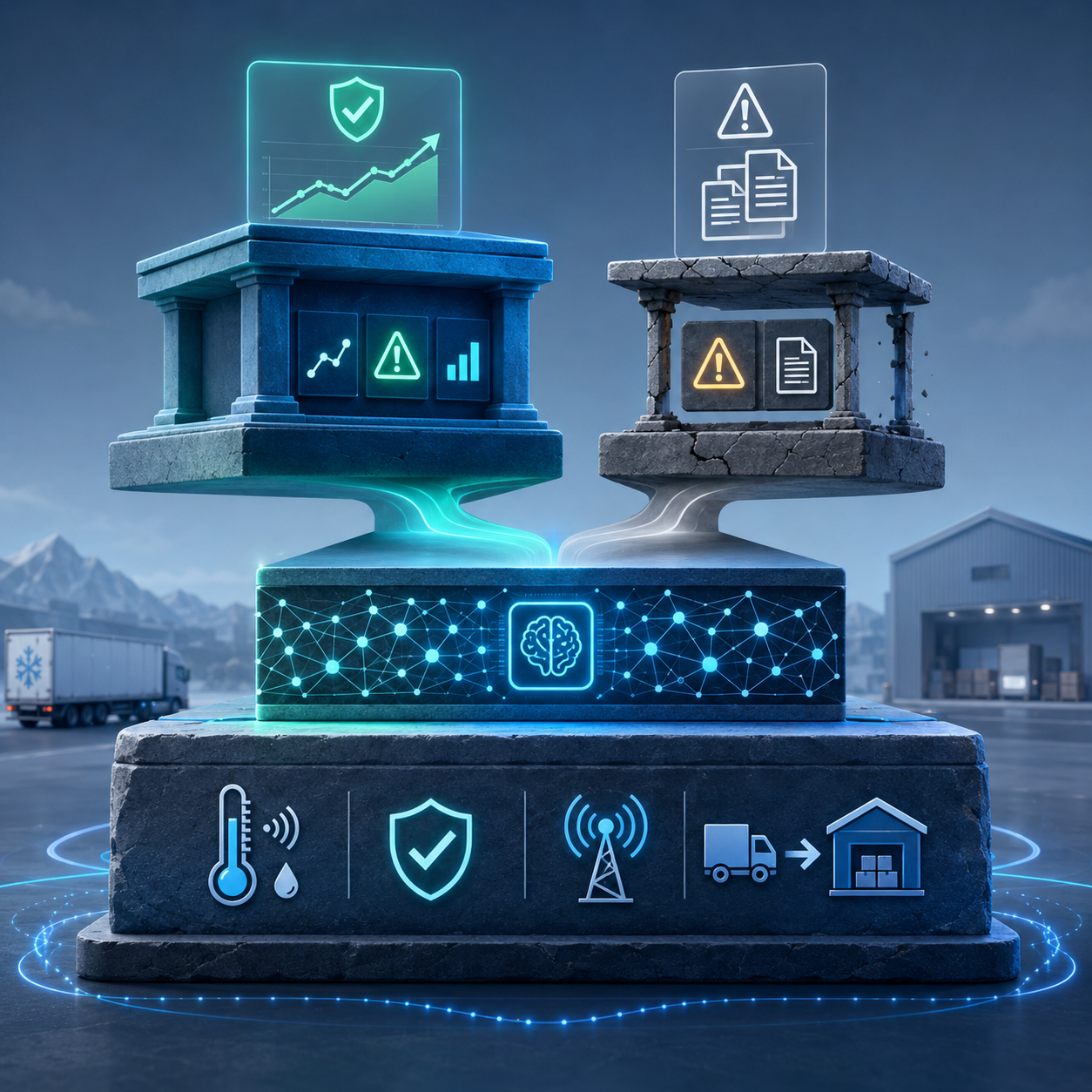
This is why data readiness belongs near the center of the buying discussion, not in the final slide of an implementation plan. Before expecting predictive results, a cold chain team should know whether it has reliable sensor placement, complete time stamps, asset-level identity, lane and carrier context, exception codes that operators actually use, and enough integration across warehouses, carriers, control towers, and QA systems. ChainSignal’s data quality checklist for supply chain AI is a useful companion for that review because cold chain prediction fails in the same places other supply chain AI fails: incomplete signals, inconsistent master data, and exception workflows that do not close the loop.
The handoff problem is not a footnote
Cold chain records often look continuous after the fact because someone assembled them into a shipment file. Operationally, the journey may have moved through a manufacturer, pack-out site, airport, ground carrier, forwarder, customs hold, cross-dock, final-mile carrier, and receiving facility. Each handoff can change custody, system visibility, alert ownership, and response time.
Predictive monitoring only helps if the risk signal reaches the party that can act. A lane-control team may see the alert but not have authority to change the asset. A carrier may have the asset but not the product stability context. QA may understand the consequence but receive the record too late. The AI output has to be routed through an escalation path that matches the physical chain of custody.
Training matters for the same reason. Thermal Control Magazine’s roundtable notes that even strong AI insights fail if ground teams are not trained to interpret and act on the data.[7] A prediction that says “elevated excursion risk in the next few hours” is only useful if the team knows what action is authorized, how to document it, and when to escalate.
How to Evaluate Whether a System Is Predictive
A useful evaluation starts with the alert. If the platform mainly reports threshold breaches faster, it is improved monitoring. That may still be valuable, especially where teams are replacing manual checks or delayed logger downloads. But it is not the same as prediction.
- Ask what the model predicts: an actual excursion risk, an equipment-health issue, a dwell-time problem, a documentation gap, or only a threshold breach.
- Ask how early the signal arrives: prediction has operational value only if the intervention window is long enough for the responsible team to act.
- Ask what context the model uses: temperature alone is weaker than temperature plus asset behavior, route, dwell, door, power, and historical performance.
- Ask who receives the alert: the right recipient is the person or team with authority to change the outcome, not merely the person who owns the dashboard.
- Ask how the action is recorded: predictive systems should preserve the risk signal, response, timing, and quality-relevant evidence in the audit trail.
The answer does not have to be perfect on day one. A network may start with high-value lanes, critical SKUs, or problem assets before expanding. The important thing is to avoid buying a prevention story when the operating model can only support better retrospective documentation.
For leaders comparing this investment with other supply chain AI projects, broader ROI context can help. ChainSignal’s supply chain AI ROI use-case benchmark is useful for positioning cold chain monitoring against planning, inventory, and execution use cases. The cold chain decision, though, should stay anchored in product-risk mechanics: fewer excursions, earlier maintenance action, faster quality review, and a stronger record of custody.
Where the Practical Line Falls
AI sensors make cold chain monitoring predictive when they do more than stream live temperatures into a dashboard. The working system has continuous sensor data, dependable asset and shipment context, models that detect drift before a breach, and workflows that move the warning to someone who can intervene. That is where excursion prediction, predictive maintenance, and automated compliance documentation start reinforcing each other.
Without that foundation, the AI layer mostly produces more sophisticated alerts and cleaner after-action files. Those can still be improvements. They are just not the same as prevention.
References
- Cold Chain Monitoring Market, MarketsandMarkets, Sep 2025
- Cold Chain Logistics 2026, FleetRabbit, Dec 2025
- How Does AI Improve Cold Chain Monitoring and Management?, SenseAnywhere, 2026
- Predictive Algorithms in Cold Chain Logistics, TraxTech, 2025
- AI in the Cold Chain: Revolutionizing Logistics and Enhancing Customer Experience, CSafe, 2025
- AI and IoT: Pioneering the Future of Cold Chain Monitoring, MarkEn, 2025
- AI Brings Predictive Intelligence to the Cold Chain, Thermal Control Magazine, Apr 2026
- AI Is Transforming Cold Transportation, GCCA Cold Facts, June 2026
Comments
Join the discussion with an anonymous comment.