
AI for software recall management supply chain is best read as AI software used to manage product recalls across supply chains, not as the recall of software products. That distinction matters because the hard part is not writing a cleaner notification. It is proving, under pressure, which lots, serials, facilities, customers, distributors, service centers, and field units are actually implicated.
The pressure has become difficult to absorb with the usual recall-room routine. Sedgwick’s Q1 2026 data, reported by Risk & Insurance, counted 492 million units recalled across industries, up 27% quarter over quarter; pharmaceutical units rose 2,400% quarter over quarter because of one massive event, and automotive units rose 71.7%. The same reporting notes that the average single recall exceeds $10 million in direct costs, a broad cross-industry figure that should not be confused with the much larger extremes sometimes seen in specific sectors. [1]
Scale is only one side of the problem. The other is the clock. A recall does not wait while someone opens supplier PDFs, searches ERP item masters, exports warehouse transactions, emails a co-manufacturer, and asks a planner which substitute material was used on the night shift. For food teams, FSMA 204 planning also needs to reflect the extended July 2028 compliance date, not older deadline language that still appears in some project decks.

Where AI Actually Enters the Recall Workflow
Recall management has always been a data problem disguised as a crisis process. AI changes the workflow only where it can remove lookup, extraction, matching, or prioritization work that previously depended on people reconciling partial records.
| Recall stage | Manual burden | AI-enabled capability |
|---|---|---|
| Intake and detection | Read supplier letters, complaint narratives, warranty claims, and internal deviations one by one | Extract recall details from documents and detect recurring defect signals in unstructured records |
| Traceability | Search ERP, MES, WMS, supplier, lot, serial, and logistics records across systems | Build a connected traceability graph from operational data |
| Scope prediction | Estimate affected product by spreadsheet joins, planner memory, and conservative assumptions | Predict likely affected lots, serials, facilities, and downstream nodes |
| Containment execution | Coordinate holds, stop-ship actions, field notices, and disposition manually | Trigger and track workflow tasks inside recall, quality, ERP, or service systems |
| Customer and field interaction | Handle repeated inquiries through call centers or service teams | Automate high-volume interactions and route unresolved cases |
| CAPA follow-up | Translate findings into corrective and preventive action after the immediate event | Suggest and track CAPA workflows tied to recall evidence |
The table makes AI sound tidy. The actual operational value is uneven. Automated intake may save hours of clerical work, but traceability and scope prediction determine whether the organization contains the right product before the deadline turns into a regulatory and customer problem.
The First Bottleneck Is Intake: Turning Recall Letters into Usable Data
Many recall events begin with an outside document that was not designed for the receiving company’s systems. A supplier sends a PDF recall letter. It may contain affected parts, lot ranges, serial numbers, dates, plants, or distribution instructions, but those details still have to become structured records before anyone can compare them against inventory, production, or shipments.
Oracle’s Recalls Curation Assistant, introduced in its 26A inventory release notes, is a useful example of this narrower but practical capability: it parses PDF recall letters for header details, affected parts, lots, and serials, reducing manual data entry at the front of the recall process. [3]
That is not predictive containment by itself. It is the difference between starting a recall with a searchable object and starting with a PDF someone must retype while other people wait. In a regulated workflow, that difference is not cosmetic.
Traceability Is Where the Business Case Starts to Get Real
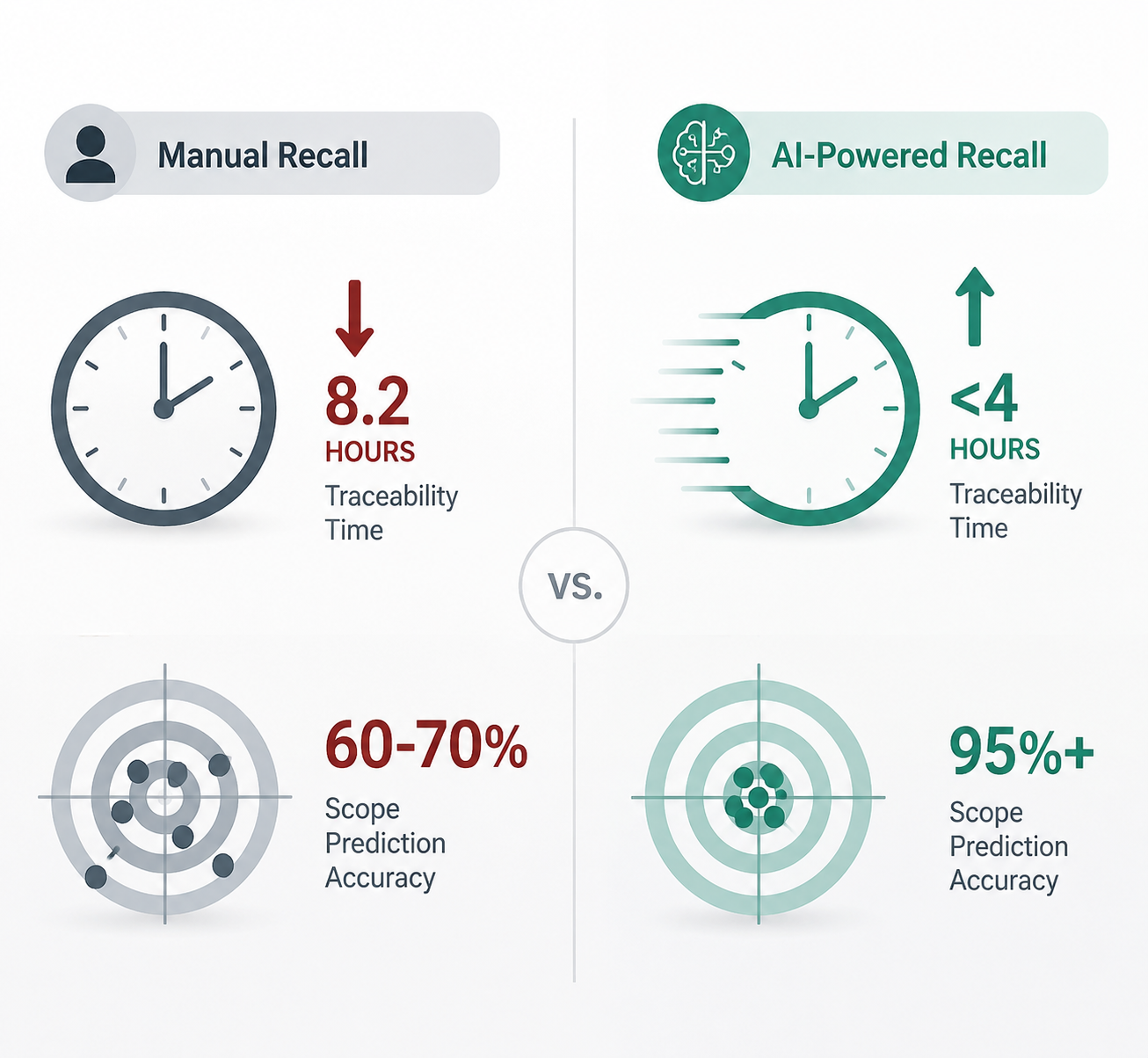
The strongest argument for AI recall management software sits in traceability because the baseline is still so manual. iFactory, citing Grocery Manufacturers Association data, reports that manual single-batch traceability averages 8.2 hours, exceeding the FDA’s 4-hour one-up-one-back expectation by 105%, and says manual traceability fails in 68% of actual recall events. [2]
The same iFactory material reports AI-powered one-up-one-back completion in under 4 hours for single-batch events and under 6 hours for multi-batch events. Those are vendor-reported benchmarks, not independently audited universal results, but they are pointed at the right operational question: can the system connect the records fast enough to support containment decisions inside the expected window? [2]
In practice, traceability software has to answer several questions without making the quality team rebuild the product genealogy from scratch:
- Which raw material lots, components, ingredients, or subassemblies touched the suspect item?
- Which production orders, lines, shifts, equipment, and co-manufacturers were involved?
- Which finished goods lots or serials were created, reworked, split, relabeled, or repacked?
- Which inventory is still on hand, which is in transit, and which has reached customers, dealers, hospitals, stores, or service networks?
- Which substitutions, manual adjustments, or data gaps need human review before the scope is finalized?
This is why real-time traceability graph products are more relevant to recall readiness than generic AI dashboards. TruMetric describes Trace Central as end-to-end AI traceability designed to connect product movement and traceability records across the supply chain, while TrackVision AI positions its recall execution software around rapid tracing and affected-product identification. [5][6]
The graph matters because recall evidence rarely lives in one clean table. A lot may be born in MES, moved through WMS, financially represented in ERP, transformed by a co-packer, and later identified through complaint, warranty, dealer, or field-service records. If AI cannot reach those records, it can only summarize the uncertainty faster.
Scope Prediction Is Useful Only If It Is Testable
Traceability asks where the product went. Scope prediction asks what else is likely affected. That distinction is easy to blur during a live event, especially when the organization is choosing between a narrow recall that may miss product and an overbroad recall that removes safe inventory, disrupts customers, and burns scarce capacity.
iFactory reports AI scope prediction accuracy above 95%, compared with 60-70% manual scoping. Again, the caveat belongs in the same sentence as the number: this is vendor-reported benchmark material, not an independently audited standard across food, pharma, medical device, and automotive recalls. [2]
Even with that caveat, the mechanism is plausible when the underlying data is good. A model can compare common suppliers, shared lots, shared production windows, equipment history, rework relationships, distribution paths, complaint clusters, and warranty signals faster than a war room can maintain linked spreadsheets. It can also surface adjacent lots for review instead of forcing teams to choose between memory and blanket expansion.
The buyer’s question is not whether the demo produces a confident affected-lot list. The question is whether the system can explain why each lot or serial is in scope, out of scope, or flagged for human review. A black-box scope recommendation is a poor fit for a recall file that later has to survive regulatory, customer, and legal scrutiny.
ERP-Orchestrated Recall Workflows Reduce the Handoff Problem
Once the affected scope is credible, the workflow still has to move. Inventory holds must be placed. Shipments must stop. Field, distributor, dealer, hospital, or retail instructions must be issued. Disposition, returns, replacement, destruction, rework, and credit decisions must be tracked. This is where recall software has to stop being an analysis layer and become part of execution.
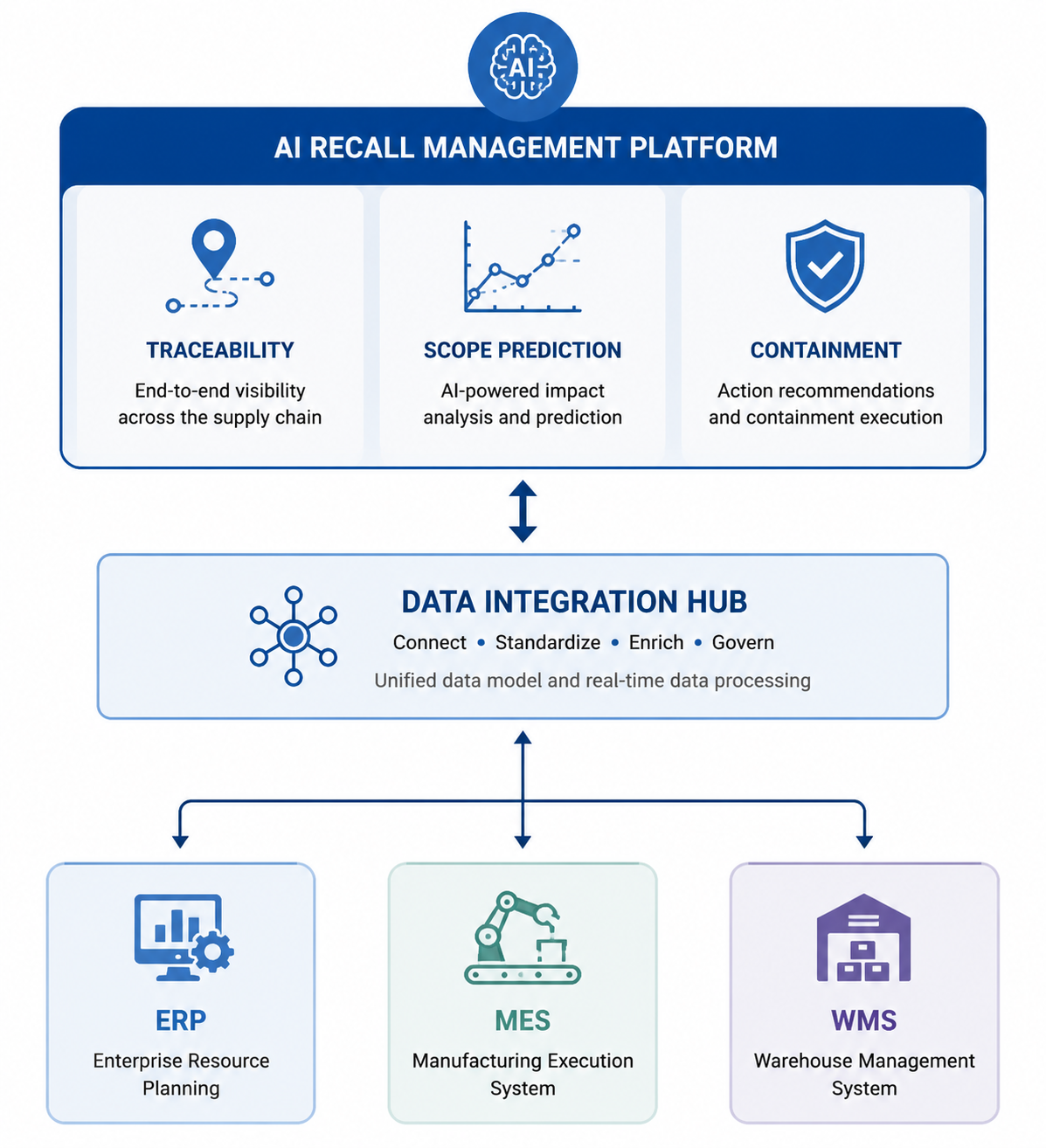
Cegeka’s Quality Impact Recall Agent, described for Microsoft Dynamics 365, uses Model Context Protocol to orchestrate recall workflows within ERP. The important point is not the protocol name; it is that recall actions occur where operational records and controls already live, rather than in a disconnected side system that someone must reconcile later. [4]
This distinction is easy to underweight in procurement. A recall platform that identifies affected material but cannot place holds, create tasks, update statuses, or preserve evidence still leaves the late-night coordinator managing execution by email. Integration depth determines whether AI compresses the process or simply produces a better-looking list.
The Data Connections Decide Whether AI Compresses Time
Recall AI is only as useful as the operational systems it can read and act through. For most supply chain organizations, the minimum serious data map includes ERP, MES, WMS, supplier quality, lot genealogy, serial history, purchase orders, production orders, shipment records, complaint systems, warranty claims, service records, and logistics events.
The integration work is not glamorous, but it is where implementation succeeds or stalls. Item numbers do not always match supplier part numbers. Lots can be split, merged, relabeled, or consumed under alternate units of measure. Serial records may sit in service systems rather than manufacturing systems. A warehouse hold can exist in WMS while commercial teams still see available inventory in ERP. AI cannot infer governance that the organization has never encoded.
This is also why mock-recall benchmarks should be read carefully. A vendor can be legitimately impressive in a configured pilot and still underperform when introduced into a company with partial supplier feeds, inconsistent lot capture, custom ERP fields, and undocumented rework practices. The right validation question is not “What is your fastest mock recall?” It is “What happened when your system used data shaped like ours?”
Detection Before the Recall Is a Different, Narrower Claim
Some AI recall management discussions move from containment to prevention too quickly. Complaint and warranty analysis can help detect defect signals earlier, but early signal detection is not the same thing as preventing recalls. It can shorten the time between weak signals and investigation if the organization has the authority and discipline to act on them.
Product Law Perspective’s 2026 discussion of AI in product safety describes proactive defect detection from consumer complaints and warranty claims using techniques such as natural language processing. That capability belongs upstream of the formal recall workflow: it can help safety, quality, and legal teams see recurring patterns before a field issue is fully defined. [8]
The boundary matters. A spike in complaints may justify containment review, engineering analysis, supplier investigation, or field monitoring. It does not automatically establish defect causality, affected scope, or recall obligation. AI can prioritize attention; accountable teams still have to investigate and decide.
Customer and Field Interactions Are High Volume, Not the Whole Recall
Once a recall reaches customers or the field, the workload changes shape. People want to know whether their unit is affected, what to stop using, where to return it, whether a replacement exists, and how service will be scheduled. These interactions can swamp call centers and service teams, especially when identifiers are hard to find or the recall requires visual inspection.
TechSee reports a recall-management services case with more than 300,000 automated recall interactions, 40% faster resolution, and double-digit cost reduction. That is evidence for service automation at scale, not proof that the upstream traceability or scope decision was correct. [9]
For buyers, the distinction is useful. A customer-facing AI tool can reduce interaction volume, improve routing, and help people complete recall steps. It should not be evaluated as a substitute for product genealogy, containment controls, or regulatory documentation.
CAPA Is Where the Recall File Becomes a Quality System Record
After the urgent containment work, the recall becomes evidence. Quality teams need to show what happened, what was affected, what was contained, what was missed, which decisions were made, and which corrective or preventive actions followed. That is not clerical cleanup; it is how the organization proves control.
IONI’s recall management software overview includes AI-suggested CAPA workflows as part of recall software coverage. This is a reasonable place for assistance: drafting task structures, linking investigation evidence, tracking ownership, and keeping follow-up from drifting after the immediate customer and inventory pressure declines. [7]
The same caution applies here as elsewhere. Suggested CAPA is not approved CAPA. The system can propose likely actions or organize evidence, but effectiveness checks, root-cause conclusions, and regulatory accountability remain human responsibilities.
How to Evaluate AI Recall Management Software
A serious evaluation should force the vendor out of the generic AI conversation and into the organization’s own recall mechanics. The strongest demos use messy operational data, not polished sample records.
- Traceability time: Ask the vendor to run one-up-one-back and multi-batch traceability on representative ERP, MES, WMS, supplier, lot, serial, and shipment data, then compare the result with current mock-recall performance.
- Scope accuracy: Require the system to explain why each lot, serial, facility, customer, or field unit is included, excluded, or flagged for review.
- Integration depth: Confirm whether the platform only reads data, or whether it can trigger holds, stop shipments, create tasks, update statuses, and preserve evidence in systems of record.
- Benchmark provenance: Separate vendor-reported mock-recall results from independently audited outcomes, and ask which industries, data conditions, and recall types produced the numbers.
- Implementation timeline: Test the proposed schedule against actual master-data quality, interface availability, validation requirements, security review, and user training.
- Human review points: Identify where quality, regulatory, legal, operations, service, and commercial teams approve recommendations before action is taken.
No single vendor in the current landscape should be assumed to cover every capability equally. Oracle illustrates document intake. Cegeka illustrates ERP-orchestrated workflow. TruMetric and TrackVision AI represent traceability graph and recall execution positioning. iFactory carries the most specific traceability and scope benchmark claims. IONI points to CAPA workflow coverage. Product Law Perspective supports the upstream defect-signal discussion. TechSee shows how customer and field interactions can be automated at high volume. Those are different jobs.
A Practical Standard for Buying
AI recall management software can materially compress detection-to-containment work and improve affected-scope decisions, but only when it is connected to the operational systems where recall evidence is created. The sub-4-hour traceability and 95%+ scope prediction figures are useful targets precisely because they can be tested. They should not travel through a business case without their vendor-reported label attached. [2]
The clean purchasing standard is demanding but fair: prove traceability time, prove scope accuracy, prove integration depth, show where the benchmarks came from, and run the implementation plan against the organization’s own data environment. Anything less leaves the same person reconciling partial records at 2 a.m., only now with an AI dashboard open beside the spreadsheet.
References
- Product Recalls Drop in Frequency but Surge in Scale, Risk & Insurance
- Product Recall Management Traceability & AI Mock Recall Exercise Optimization, iFactory
- AI Agent: Recalls Curation Assistant, Oracle Help Center
- Transforming Product Recalls with AI, Cegeka, Jan 2026
- End-to-End AI Traceability: Trace Central, TruMetric
- Traceability software for rapid recall execution, TrackVision AI
- Best Recall Management Software in 2026, IONI AI
- How AI Is Revolutionizing Product Safety, Product Law Perspective, Mar 2026
- How AI Is Transforming Product Recall Management Services, TechSee
Comments
Join the discussion with an anonymous comment.