
The hard part of a produce recall is not announcing that something went wrong. It is drawing the boundary while the clock is running. A quality team may know that a seal failed, a cooler drifted, a supplier lot is suspect, or a pathogen test has turned positive. What they often do not know fast enough is whether the exposure stops at one line, one hour, one pallet group, one customer shipment, or a much larger slice of the day’s production.
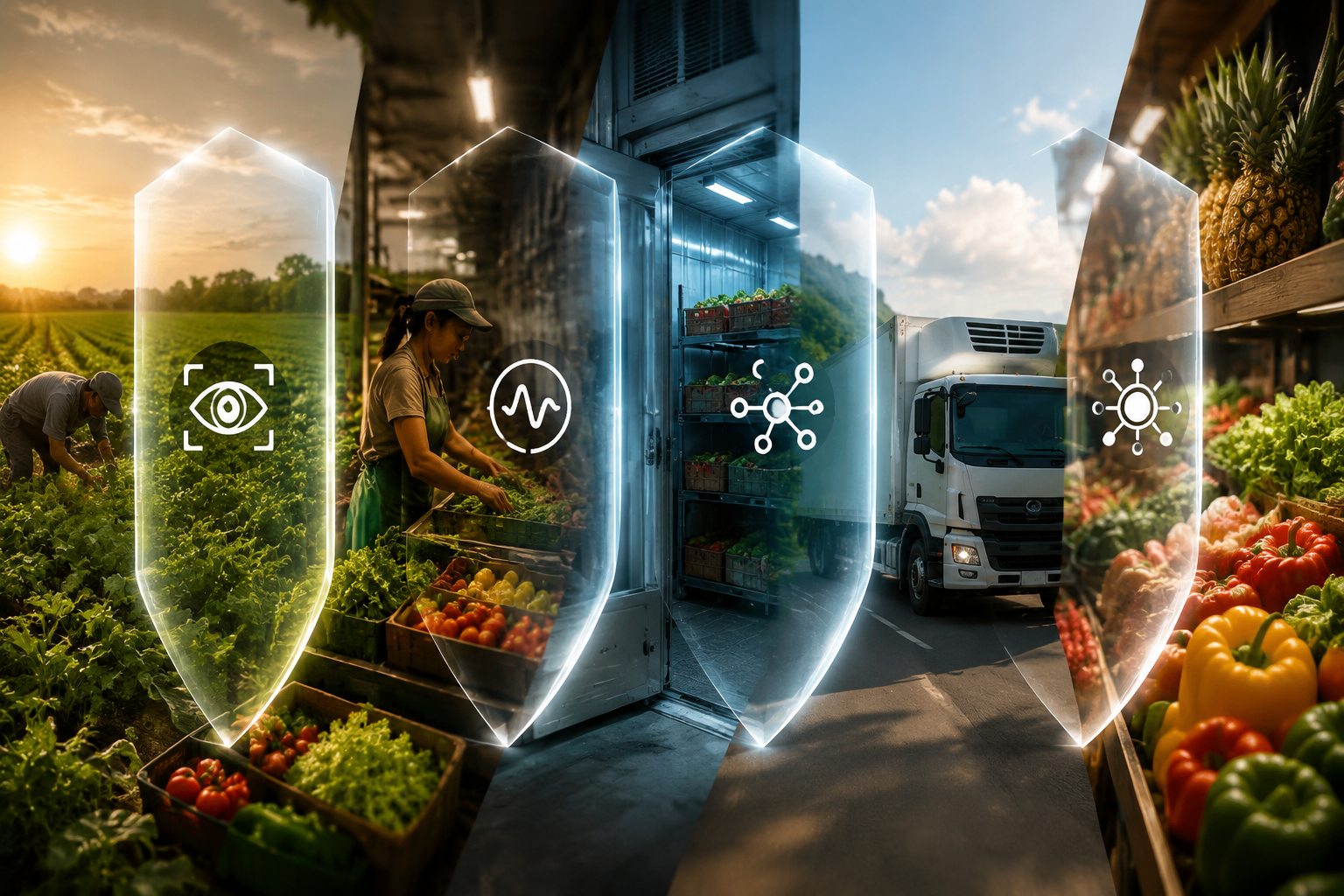
That is where AI for supply chain recall management in produce becomes useful: not as a promise that recalls disappear, but as a way to remove uncertainty before and during the decision. The strongest deployments combine four layers: inline computer vision, predictive cold-chain analytics, AI lot traceability, and recall orchestration. Each layer answers a different operational question.
| Layer | Operational question it answers | Recall exposure reduced |
|---|---|---|
| Inline computer vision | Did a defect, seal gap, foreign material risk, or package integrity issue escape the line? | Lowers the chance that bad product ships |
| Predictive cold-chain analytics | Is temperature behavior drifting toward a condition that will compromise product before a standard alarm fires? | Creates earlier intervention points |
| AI lot traceability | Which exact lots, pallets, shipments, and customers are tied to the suspect condition? | Narrows recall scope |
| Recall orchestration | Who needs to hold, notify, review, document, and release product now? | Shortens containment time and reduces coordination errors |
The First Boundary Is Set on the Line
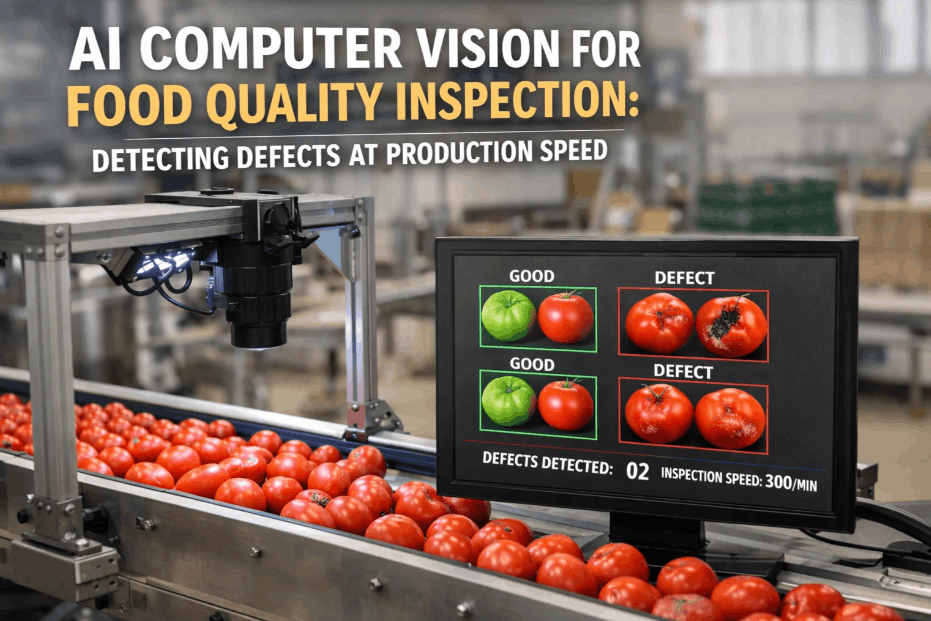
Produce operations have always had inspection. The question is how much surface area inspection actually covers. In a high-speed packing or processing environment, manual checks are often a sample against a much larger flow. In the FreshPak Foods case published by iFactory, the company describes manual sampling as covering roughly 0.04% of units on high-speed lines, compared with AI vision inspection of 100% of units at speeds up to 300 units per minute.[1]
That difference matters because many recall decisions begin with a small physical failure. A package seal gap, a misapplied label, damaged film, residue in the wrong place, or a quality defect can be easy to miss when a human inspector is checking samples under production pressure. If the first confirmed failure appears after shipment, the recall coordinator is already working backward through incomplete certainty.
The iFactory case is useful because the mechanism is visible. The system is described as detecting seal gaps down to 0.3 mm with 99.7% accuracy and a 0.12% false rejection rate, while operating at production speed. iFactory reports that the FreshPak deployment prevented a $12 million recall and reduced complaints by 94%.[1]
Those are vendor-reported figures, so they should not be treated as a universal benchmark for produce processors. Still, the case points to the right kind of evidence. It does not simply say that AI improves quality. It names the defect class, the line-speed condition, the inspection coverage, the false rejection burden, and the operational result. That is the level of detail a quality leader needs before believing a recall-prevention claim.
Inline vision is strongest when it is tied to a decision rule that the plant can defend later. If a camera flags a seal gap, the system should preserve the image, timestamp, line, product, lot, and disposition. If the unit is rejected, the rejection reason should be recorded in the same data environment that the traceability team will use if related failures appear. A rejected unit with no usable record is a quality event; a rejected unit with clean lineage data is evidence.
Other food manufacturing examples point in the same direction, though they are not produce-specific proof. IONI AI reports that Nestlé reduced manual checks by 80% through AI wrapper integrity inspection and that PepsiCo achieved 95% defect detection accuracy with inline computer vision.[2] These figures support the broader inspection pattern, but they should not be pasted into a produce business case without checking product form, packaging format, line speed, lighting, reject handling, and validation protocol.
Temperature Drift Is a Recall Signal Before It Is a Recall Cause
Cold-chain analytics sits between prevention and traceability. It may not identify a bad seal or a contaminated field lot, but it can catch the conditions that turn a manageable quality deviation into a wider exposure. For produce, that usually means watching how time, temperature, route behavior, door openings, dwell time, and facility handoffs interact before product condition is visibly compromised.
A June 2026 Food Technology Magazine article from the Institute of Food Technologists describes a five-function model for AI-enabled cold-chain intelligence: sense, detect, predict, decide, and prove.[3] The important shift is from a reactive alarm to a predictive operating loop. Sensors capture conditions. Detection identifies abnormal patterns. Prediction estimates where the condition is headed. Decision support recommends intervention. Proof preserves the record.
For a recall team, the last word in that sequence is easy to underestimate. Proof is what keeps a shipment from being swept into a recall merely because it was near the problem. If one pallet group experienced a temperature pattern that crossed an internal risk threshold and another did not, the records need to show that distinction clearly enough for QA, customers, and regulators to follow.
This is also where a cold-chain AI program can become too vague. A dashboard that says a route is “high risk” may be useful for operations, but it is not enough for recall containment. The system needs to preserve the underlying event history: which asset, which sensor, which threshold, which time window, which product, which lot, which corrective action, and who accepted the disposition.
For a deeper treatment of this layer, see how AI sensors make cold chain monitoring predictive. In recall management, the practical test is narrower: can the temperature record separate exposed product from product that merely shared a carrier, facility, or day?
Traceability Decides How Wide the Recall Gets
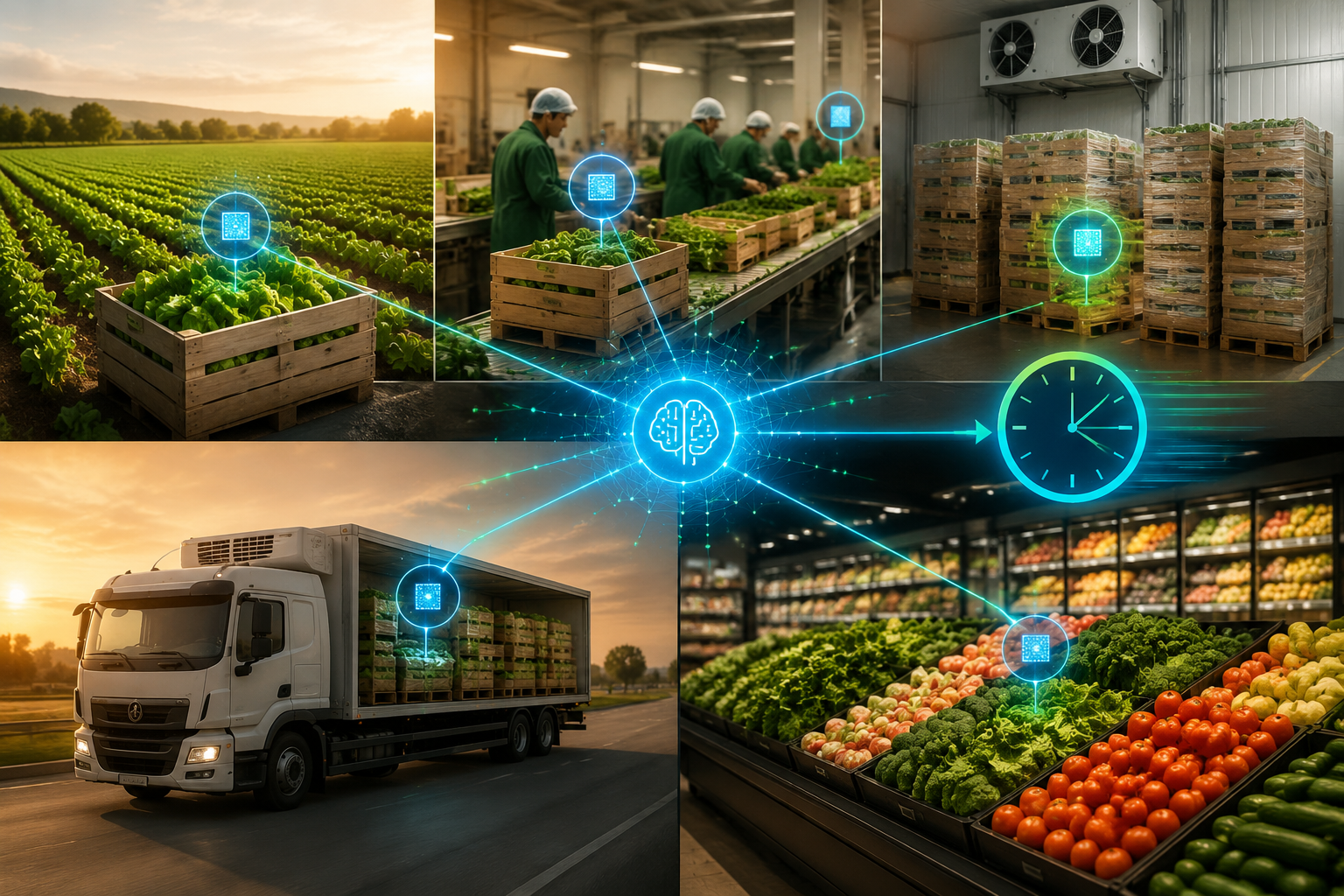
Once suspect product may have shipped, prevention gives way to boundary-setting. This is the layer where AI lot traceability earns its place. The problem is rarely that no records exist. The problem is that supplier files, receiving logs, production runs, pallet IDs, bills of lading, customer orders, and ERP records do not speak the same language quickly enough.
The best-known produce example is Walmart’s lettuce traceback work with IBM Food Trust. Walmart reported that tracing a package of sliced mango previously took 6 days, 18 hours, and 26 minutes, and that tracing lettuce through the blockchain-based system took 2.2 seconds.[4] The broader lesson is not that every company can copy the number, but that data structure changed the recall question from a document chase into a query.
For produce companies preparing for FSMA 204, this distinction is becoming operationally important. FDA’s Food Traceability List includes 14 fresh produce categories among 18 listed categories, and the FSMA 204 compliance date has been extended to July 20, 2028.[5] The later date reduces immediate enforcement pressure, but it does not remove the data-model work: companies still need to capture and connect key traceability events and critical tracking events in a way that can be retrieved under pressure.
AI helps when it cleans up the record layer rather than decorating it. Unframe describes AI lot normalization and key data element extraction that reduce manual data entry by 70% to 90% and compress recall analysis from days to minutes.[6] FoodReady reports that AI-native traceability platforms can reduce recall scope by 50% to 95% through precise lot-level identification, and that mock recalls can be completed in 10 to 30 minutes compared with 4 to 8 hours manually.[7]
Both Unframe and FoodReady figures are vendor-reported. They are still relevant, but they answer different questions. Unframe’s numbers emphasize administrative compression: less manual entry, faster analysis, better normalization. FoodReady’s numbers emphasize recall execution outcomes: narrower scope and faster mock recall completion. Walmart’s example shows a large-company traceback architecture. These should not be averaged into one “AI reduces recall time by X” claim.
The practical buyer question is more specific: which uncertainty does the system remove? Does it reconcile supplier lot codes against internal production lots? Does it associate rework with finished product? Does it handle commingled field lots? Does it connect parent-child lot relationships after repacking? Does it keep customer shipment records close enough to production records that a recall coordinator can isolate by pallet, invoice, or delivery destination?
A produce recall often expands because one of those links is weak. If a processor cannot prove which finished goods received a suspect input, the safe answer may be to pull the broader run. If a distributor cannot tell which customers received the affected pallets, the communication list grows. If a packer cannot separate lots processed before and after a sanitation hold, the day becomes the boundary. AI lot tracking is valuable when it turns those broad defensive boundaries into narrower defensible ones.
For a closer look at this layer, see how AI lot tracking cuts recall response from days to minutes. The produce-specific issue is that traceability has to survive commingling, short shelf life, rapid customer movement, and a product form that may change from field-packed carton to washed, cut, blended, repacked, or private-label item.
Recall Orchestration Turns the Boundary Into Action
A traceability answer does not automatically stop product. Someone still has to put shipments on hold, notify customers, reconcile inventory, preserve records, assign tasks, approve releases, and document every decision. This is where recall orchestration tools, including AI agents, begin to matter.
Cegeka describes a Quality Impact Recall Agent that simulates recall scenarios, identifies impacted batches, and orchestrates containment actions.[8] FoodReady reports that automated traceability workflows reduce data entry errors by 85% to 95%.[7] Those claims address a different pain point than computer vision or traceback speed: they reduce the manual coordination burden after the suspect boundary has been identified.
In practice, orchestration should be judged by how well it controls handoffs. A useful system can open a recall or mock-recall event, import the suspect lot definition, generate the affected inventory list, assign holds by facility, prepare customer notification drafts, track acknowledgments, log regulatory documentation, and keep QA from managing the event through disconnected spreadsheets and inbox threads.
The word “agent” should not imply that the software gets to decide recall scope by itself. In produce, the better pattern is supervised orchestration: AI proposes the affected set, highlights missing evidence, routes tasks, and documents completion, while QA, food safety, legal, and commercial leaders retain approval authority. The system should make the recall coordinator faster and less exposed, not invisible.
What the Evidence Supports—and What It Does Not
The stakes are high enough without inflating the evidence. Esko, citing FDA data, counted 320 FDA and USDA food recalls in 2025, while U.S. PIRG’s Food for Thought 2026 report attributed 37.5% of food recalls to foodborne illness.[9][10] The often-cited $10 million average direct recall cost comes from a 2011 FMI/GMA study, so it is useful as dated context rather than a current ROI benchmark.[11]
The credible claim is not that AI prevents produce recalls in general. The credible claim is narrower: AI can reduce recall exposure when it increases inspection coverage, warns earlier on cold-chain drift, normalizes lot records, compresses traceback, and coordinates containment work. Each of those mechanisms has supporting evidence, but no single independent benchmark currently proves a universal recall-reduction rate across the full produce supply chain.
That distinction matters for vendor selection. A computer vision supplier may have strong defect-detection results but no meaningful traceability layer. A traceability platform may accelerate mock recalls but depend on clean inputs from suppliers and production systems. A cold-chain model may predict risk well but fail to connect the risk event to lot-level disposition. Recall orchestration may move tasks quickly while still inheriting bad master data.
The strongest business case should therefore be built around operational evidence, not category claims. Ask for line-speed validation on your product form. Ask how false rejects are handled. Ask how lot codes are normalized across suppliers. Ask whether commingled or transformed product is supported. Ask how mock-recall timing is measured. Ask what evidence is preserved for customer and regulator review. Ask which numbers are independently audited and which are vendor-reported.
For legal and documentation implications, see how AI food traceability reduces and creates lawsuit exposure. The same records that narrow a recall can also expose weak controls if the organization cannot explain thresholds, overrides, missing data, or delayed action.
The Practical Standard for Produce Recall AI
A produce company does not need every AI capability at once, but the layers should be designed to connect. Inline inspection events should feed lot history. Cold-chain drift should attach to product and shipment records. Traceability data should support mock recalls before a real event. Orchestration should preserve decisions, not just accelerate messages.
The operational test is simple to state and hard to pass: when something goes wrong, can the team prove where the exposure starts and stops? AI is credible for reducing produce recall exposure when it is governed as a workflow across inspection, temperature intelligence, lot traceability, and containment execution. It is not yet supported by one holistic industry benchmark proving a universal recall-reduction rate.
References
- iFactory FreshPak Foods case study, iFactory, 2026.
- AI in Food Manufacturing: Quality Control and Defect Detection, IONI AI, 2026.
- Food Technology Magazine cold-chain AI five-function model, Institute of Food Technologists, June 2026.
- Walmart and IBM Food Trust lettuce traceback case study, Walmart / IBM.
- FSMA Final Rule on Requirements for Additional Traceability Records for Certain Foods, U.S. Food and Drug Administration.
- AI Lot Normalization and KDE Extraction, Unframe, March 2026.
- AI-Native Traceability and Recall Management, FoodReady, 2026.
- Quality Impact Recall Agent, Cegeka, 2026.
- Food and Beverage Recall Trends, Esko, citing FDA data, 2025.
- Food for Thought 2026, U.S. PIRG Education Fund, 2026.
- Capturing Recall Costs: Measuring and Recovering the Losses, Food Marketing Institute / Grocery Manufacturers Association, 2011.
Comments
Join the discussion with an anonymous comment.