
Two vendors can walk into the same steering committee, both sell a supply chain control tower system, and leave the buyer with two completely different products. One is mainly a transportation visibility layer. Another is a planning engine with scenario simulation. A third is an execution platform that can trigger replenishment or reroute inventory. The label is the same; the operational decision being improved is not.
That is why the useful question is not whether a platform deserves the control tower label. It is whether it helps a planner, logistics manager, inventory owner, or executive make a better decision before the cost shows up in missed revenue, excess stock, expedited freight, or service failure.
Gartner’s definition keeps the discussion grounded because it treats a control tower as more than a dashboard: people, process, data, organization, and technology all have to be present. Gartner also describes the capability sequence as sense, analyze, predict, solve, execute, and learn, which is a useful way to separate passive monitoring from actual decision support.[1]
For shortlisting, though, a buyer needs something even more concrete. Grid Dynamics’ four-cluster blueprint is a practical sorting device: strategic planning, inventory visibility, inventory flow control, and impact analysis and resolution.[2] Those clusters are not four names for the same thing. They correspond to different operating constraints, different ROI mechanisms, and different vendor strengths.
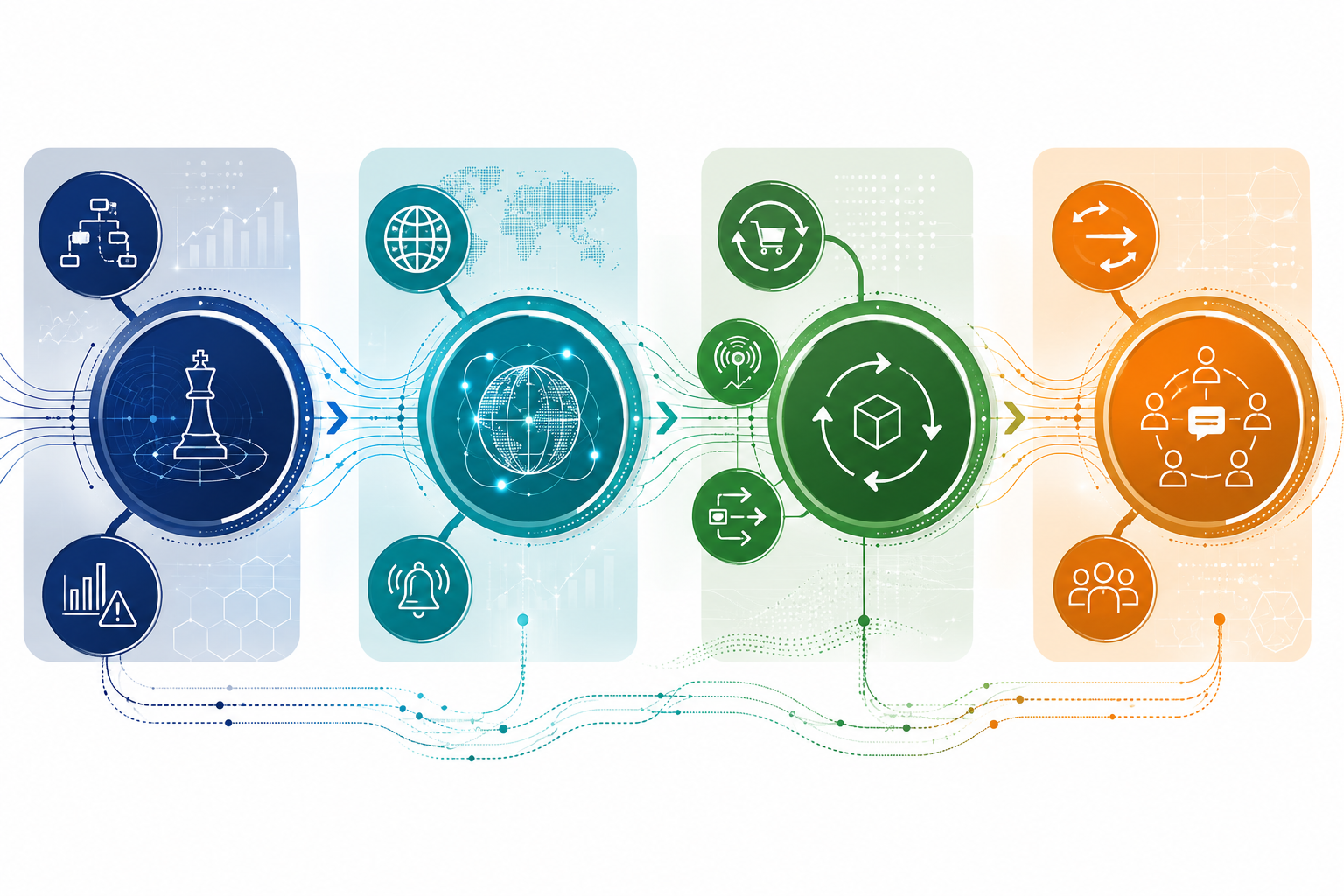
| Functional cluster | Main operating job | Likely value driver | Representative vendor orientation |
|---|---|---|---|
| Strategic planning | Model revenue at risk, supplier options, demand scenarios, and network trade-offs | Better planning decisions before disruption becomes execution cost | Planning-led platforms such as Blue Yonder, Kinaxis, and o9 Solutions |
| Inventory visibility | Show inventory, orders, shipments, and exceptions across regions, partners, and channels | Fewer blind spots, faster exception detection, better available-to-promise confidence | Visibility-led platforms such as Project44, FourKites, SAP, and E2open |
| Inventory flow control | Turn demand signals and inventory positions into replenishment, allocation, and movement decisions | Lower inventory, improved service, reduced manual planning effort | Execution-led or tightly integrated planning-execution platforms |
| Impact analysis and resolution | Quantify disruption effects, recommend trade-offs, support rebalancing and collaboration | Faster issue resolution, lower disruption cost, clearer executive escalation | Control towers with strong simulation, collaboration, and workflow execution |
The market is growing faster than the definitions are stabilizing
The category has momentum, but that has not made it easier to compare products. Business Research Insights separates operational control towers from analytical control towers and reports that operational control towers accounted for 58% of market share in 2023, compared with 42% for analytical control towers. The same source estimates the supply chain control tower market at USD 8.75 billion in 2026.[3]
Those figures are useful as a signal of buyer interest, not as proof that the category has a settled architecture. Market estimates vary across research firms, and definitions often include different combinations of transportation visibility, planning analytics, fulfillment orchestration, and AI decision support. The more revealing number is the capability gap: Business Research Insights reports that only 30% of firms had visibility beyond direct suppliers in 2024.[3] A control tower demo can look end-to-end while the deployed operating model still stops at tier-one visibility.
That gap is where many business cases become soft. If the bottleneck is supplier-tier visibility, buying a polished internal inventory dashboard will not solve it. If the bottleneck is allocation during constrained supply, a shipment-tracking product may produce excellent alerts and still leave planners working the real trade-off in spreadsheets.
Strategic planning: model the consequence before the network absorbs it
The strategic planning cluster is where the control tower is closest to an executive decision system. The job is not to display that a supplier is late or a node is constrained. The job is to translate that signal into possible business consequences: revenue at risk, margin exposure, customer service impact, capacity alternatives, and supplier trade-offs.
In this cluster, the buyer should look for what-if modeling, supplier optimization, scenario comparison, and the ability to connect planning assumptions to financial and service outcomes. The system should help answer questions such as: which orders are exposed if a supplier misses a committed date, which customers should be protected if supply is short, and whether a higher-cost source is justified by revenue protection.
This is where planning-led vendors tend to have an advantage. Locus groups control tower providers into visibility-led, planning-led, and execution-led models, with Blue Yonder, Kinaxis, and o9 Solutions falling into the planning-led orientation.[4] That taxonomy is not the only way to divide the market, but it helps prevent a familiar shortlisting mistake: comparing a scenario-planning platform with a transportation visibility platform as if both were designed for the same decision.
The planning cluster also exposes the limits of a purely visual command center. A red exception on a map may get attention, but strategic planning requires the system to rank options and consequences. If the platform cannot connect an exception to revenue, margin, service commitments, or supplier alternatives, the executive view is mostly theater.
For teams comparing planning-led platforms, a deeper vendor comparison such as Blue Yonder vs. Kinaxis is more useful than asking for a generic control tower ranking.
Inventory visibility: necessary, often oversold, and still not the same as control
Inventory visibility is the cluster most buyers recognize immediately. It covers global reporting, shipment and order status, inventory positions, smart alerts, and available-to-promise services. It is also the cluster most likely to be mistaken for the whole control tower.
Visibility matters because operations teams cannot manage what they cannot see. If inventory records are fragmented across regions, systems, 3PLs, suppliers, and channels, even basic questions become slow: where is the stock, who has committed it, what is late, and which customer promise is now exposed? The 30% figure for visibility beyond direct suppliers shows why this cluster still deserves attention.[3]
But visibility has a ceiling. A system that only reports exceptions still leaves the hard work outside the platform. Someone has to decide whether to expedite, substitute, split an order, rebalance from another region, or revise a promise date. If those decisions happen in email, spreadsheets, and side calls, the control tower is functioning as a high-resolution alert layer.
Visibility-led vendors are still a legitimate fit when the current bottleneck is fragmented status data. Locus places Project44, FourKites, SAP, and E2open in a visibility-led group.[4] SAP can also be relevant for organizations whose standardization problem is as important as the control tower interface itself; buyers evaluating that path can look at SAP supply chain control tower options for standardized SAP shops.
A practical buying test is simple: ask what happens after the alert. If the demo moves from alert to recommended action, workflow ownership, and execution feedback, the system may extend beyond visibility. If it moves from alert to another screen, it is probably a visibility control tower, which may be exactly right for the problem, but should not be priced or justified as something broader.
Inventory flow control: where visibility starts changing physical and financial outcomes
Inventory flow control deserves more attention than it usually gets in control tower conversations because this is where the system starts to affect replenishment, allocation, and movement decisions. Visibility tells the team what exists and what is happening. Flow control helps decide what should move, where it should move, and which demand should be served first.
The operating problem is not just stock accuracy. It is the mismatch between changing demand, constrained supply, replenishment rules, and service commitments. A flow-control-oriented control tower may use demand sensing to detect shifts earlier, update replenishment recommendations, rebalance stock between nodes, or allocate scarce inventory against business priorities.
This cluster is also where ROI starts to become more tangible. Accenture reports directional outcomes for control tower adopters including up to a 1% revenue increase, 3% to 5% logistics cost reduction, 10% to 20% labor efficiency improvement, and 5% to 15% inventory reduction.[5] Those ranges should not be treated as a promise for every deployment. They are still useful because they point to the value levers that flow control can plausibly affect: inventory, logistics cost, planner productivity, and service-linked revenue.
The strongest business cases in this cluster usually name a specific decision cycle. For example, a team might focus on reducing manual replenishment review, improving allocation during constrained supply, or cutting expedite decisions caused by late inventory signals. A vague goal such as “increase agility” will not survive finance review as well as a named process with current cycle time, exception volume, inventory exposure, and ownership.
IBM’s own control tower outcome is a useful proof point, with an important boundary around it. IBM reports that it achieved USD 160 million in cost reduction and 100% order delivery during COVID through AI-powered demand sensing and decision support.[6] That is a real vendor-reported case, not a universal benchmark. Its value for buyers is the shape of the operating model: demand sensing was tied to decision support, and decision support was tied to execution under constraint.
AI matters in this cluster when it shortens the distance between signal and action. A model that detects a demand shift but cannot affect replenishment or allocation is still upstream of the decision. For a deeper look at how AI changes the control tower use case, see How AI Is Rewriting the Supply Chain Control Tower Use Case.
Impact analysis and resolution: support the trade-off after disruption has already arrived
Impact analysis and resolution is the cluster that gets tested when normal planning assumptions have already failed. A supplier misses a date. A port delay changes lead times. A regional demand spike consumes safety stock. The useful control tower is no longer just asking what happened; it is helping the organization decide what to do next and who must approve it.
The core capabilities here include impact analysis, inventory rebalancing, supplier collaboration, demand shaping, and workflow escalation. The system should quantify which orders, customers, products, and financial outcomes are affected. It should also make the trade-offs visible enough that supply chain, commercial, finance, and regional teams are not each optimizing a different version of the problem.
This is where Gartner’s sense-analyze-predict-solve-execute-learn sequence becomes more than terminology.[1] Sensing the disruption is the first layer. Analyzing exposure, predicting downstream effects, solving for alternatives, executing the chosen response, and learning from the outcome are separate capabilities. A platform may be strong in the first two and weak in the last three.
Neudesic reports control tower implementation outcomes including 2x predictive accuracy, 20% cost reduction, and 50% faster issue resolution.[7] As with other vendor and consulting figures, these should be read as directional and source-bound rather than guaranteed. The most relevant metric for this cluster is issue resolution speed, because disruption value often depends on whether the organization can act while alternatives still exist.
A resolution-oriented demo should make the decision path visible. Who receives the recommendation? What alternatives are considered? Can the system show revenue or service impact by option? Can it trigger supplier collaboration or transportation action? Does it record the decision and learn from the outcome? Without those mechanics, “resolution” may just mean a better incident report.
ROI depends on the cluster, not the control tower label
The safest way to read control tower ROI claims is by matching each figure to the capability that could actually produce it. Inventory reduction belongs mainly to flow control and planning. Logistics cost reduction may come from transportation visibility, exception management, and execution decisions. Labor efficiency depends on workflow automation and exception prioritization. Revenue protection belongs to planning, allocation, and disruption response.
| ROI claim or value area | Most relevant cluster | How to interpret it |
|---|---|---|
| Up to 1% revenue increase | Strategic planning, flow control, impact resolution | Potential value from protecting demand, prioritizing constrained supply, and improving service decisions |
| 3% to 5% logistics cost reduction | Inventory visibility, flow control, impact resolution | Potential value from fewer expedites, better exception handling, and more informed movement decisions |
| 10% to 20% labor efficiency improvement | Visibility, flow control, impact resolution | Potential value from reducing manual tracking, triage, and planner rework |
| 5% to 15% inventory reduction | Strategic planning, flow control | Potential value from better replenishment, allocation, and stock positioning |
| 50% faster issue resolution | Impact analysis and resolution | Potential value when alerts, ownership, options, and execution workflows are connected |
Business Research Insights also reports a 4-to-8-month payback period for leading organizations using AI-powered control towers.[3] That figure is worth noting, but it needs a careful reading because the underlying methodology is not disclosed by the source. A buyer should treat it as an indicative claim, not a planning assumption.
The better internal business case starts with the bottleneck. If the current pain is planner overload, labor efficiency may be defensible. If the pain is excess buffer stock, inventory reduction belongs in scope. If the pain is late discovery of supplier problems, tier visibility and disruption response matter more. The same platform can support several value levers, but the buyer should not let a vendor attach every possible ROI category to a narrow deployment.
For a more detailed ROI treatment, use What ROI can supply chain control tower software deliver? as the companion view rather than trying to force every ROI claim into the same shortlist discussion.
Vendor fit: three orientations, four operating problems
Vendor selection becomes clearer when the four functional clusters are mapped against vendor orientation. Locus’ three-model taxonomy is useful here: visibility-led, planning-led, and execution-led.[4] IBM offers another typology, distinguishing logistics and transportation, fulfillment, inventory, supply assurance, and end-to-end control towers.[6] The labels differ, but both frames point to the same buying reality: no single vendor is equally strong across every operating problem.
| Vendor orientation | Best fit when the bottleneck is | Watch for |
|---|---|---|
| Visibility-led | Fragmented shipment, order, supplier, or inventory status across partners and regions | Strong alerts without enough decision automation or execution ownership |
| Planning-led | Scenario modeling, allocation trade-offs, supplier optimization, revenue-at-risk analysis | Powerful planning models that may still need integration into execution workflows |
| Execution-led | Replenishment, routing, fulfillment, field execution, and operational response | Strong action layer that may depend on upstream planning and master data quality |
| End-to-end suite | Standardization across planning, inventory, logistics, and fulfillment on a common platform | Broad coverage that may not be deepest in the buyer’s highest-value constraint |
This is where procurement scorecards often blur the issue. A feature matrix can make every vendor look close if the questions are broad enough: visibility, alerts, analytics, AI, collaboration, workflow. The better scorecard asks for evidence against the buyer’s constraint. If the constraint is inventory rebalancing under shortage, the demo should show the rebalancing logic, approval path, execution handoff, and performance feedback. If the constraint is supplier risk, the demo should show supplier-tier data, exposure modeling, and collaboration workflows.
Oracle, SAP, IBM, Blue Yonder, Kinaxis, o9, Project44, FourKites, E2open, and Locus may all appear in control tower conversations, but they do not enter from the same architectural center of gravity. Some start from enterprise applications, some from planning, some from transportation visibility, some from fulfillment execution. For broader platform architecture comparisons, see AI Supply Chain Software in 2026; for a more explicit vendor-model taxonomy, see How to Pick the Right Supply Chain Control Tower Model.
What to ask before the shortlist hardens
A control tower evaluation should begin with the decision that is currently failing or taking too long. That sounds obvious until a demo starts with a global map, animated lanes, and exception counts. The map may be useful. It is just not a substitute for naming the operational decision.
- If the problem is executive exposure, prioritize strategic planning: revenue at risk, supplier alternatives, scenario comparison, and financial impact.
- If the problem is fragmented status data, prioritize inventory visibility: partner connectivity, smart alerts, available-to-promise confidence, and tier visibility.
- If the problem is stock movement and allocation, prioritize inventory flow control: demand sensing, replenishment logic, allocation rules, and execution handoff.
- If the problem is disruption response, prioritize impact analysis and resolution: exposure modeling, recommended actions, collaboration, escalation, and learning loops.
The second question is organizational, not technical: who acts on the recommendation? A control tower that predicts an issue but has no process owner becomes a better forecasting layer. A control tower that recommends an action but cannot get approval from commercial, finance, procurement, or regional operations becomes another queue. Gartner’s five-element definition matters here because people, process, data, organization, and technology all have to line up before the system changes outcomes.[1]
The third question is whether the platform learns from execution. If a recommendation is accepted, rejected, overridden, or delayed, that decision history should improve future analysis. Without the learn loop, the control tower may keep generating technically correct recommendations that the organization cannot or will not execute.
Industry configuration also matters. A consumer goods network, a high-tech spare-parts operation, a pharmaceutical cold chain, and an industrial manufacturer may all need control tower capabilities, but the bottlenecks and compliance burden will differ. For industry-specific patterns, see AI Supply Chain Control Tower Use Cases by Industry.
The practical buying implication
The best supply chain control tower system is not the one with the broadest claim to end-to-end visibility. It is the one whose strongest cluster matches the constraint that is costing the business money, time, service, or credibility right now.
For one company, that may mean planning-led scenario modeling because the real pain is revenue exposure from constrained supply. For another, it may mean visibility-led partner connectivity because the organization still cannot see beyond direct suppliers. For a third, it may mean flow control because inventory exists in the network but does not move to the right promise at the right time. For another, it may mean impact resolution because every disruption turns into a cross-functional escalation with no shared view of trade-offs.
Buyers who want a broader evaluation framework can use The 2026 AI Supply Chain Tool Buyer’s Guide after they have named the control tower cluster they actually need. The sequence matters. First identify the operational decision. Then shortlist the vendor model. Then test whether the platform can sense, analyze, predict, solve, execute, and learn in the part of the supply chain where the business case lives.
References
- Gartner: What supply chain managers should know about control towers, Supply Chain Dive
- Supply chain control tower use cases, Grid Dynamics
- Supply Chain Control Tower Market Report, Business Research Insights
- Best Supply Chain Control Tower Providers, Locus
- Supply chain control tower, Accenture
- What are control towers?, IBM
- Supply Chain Control Towers Benefits, Neudesic
Comments
Join the discussion with an anonymous comment.