
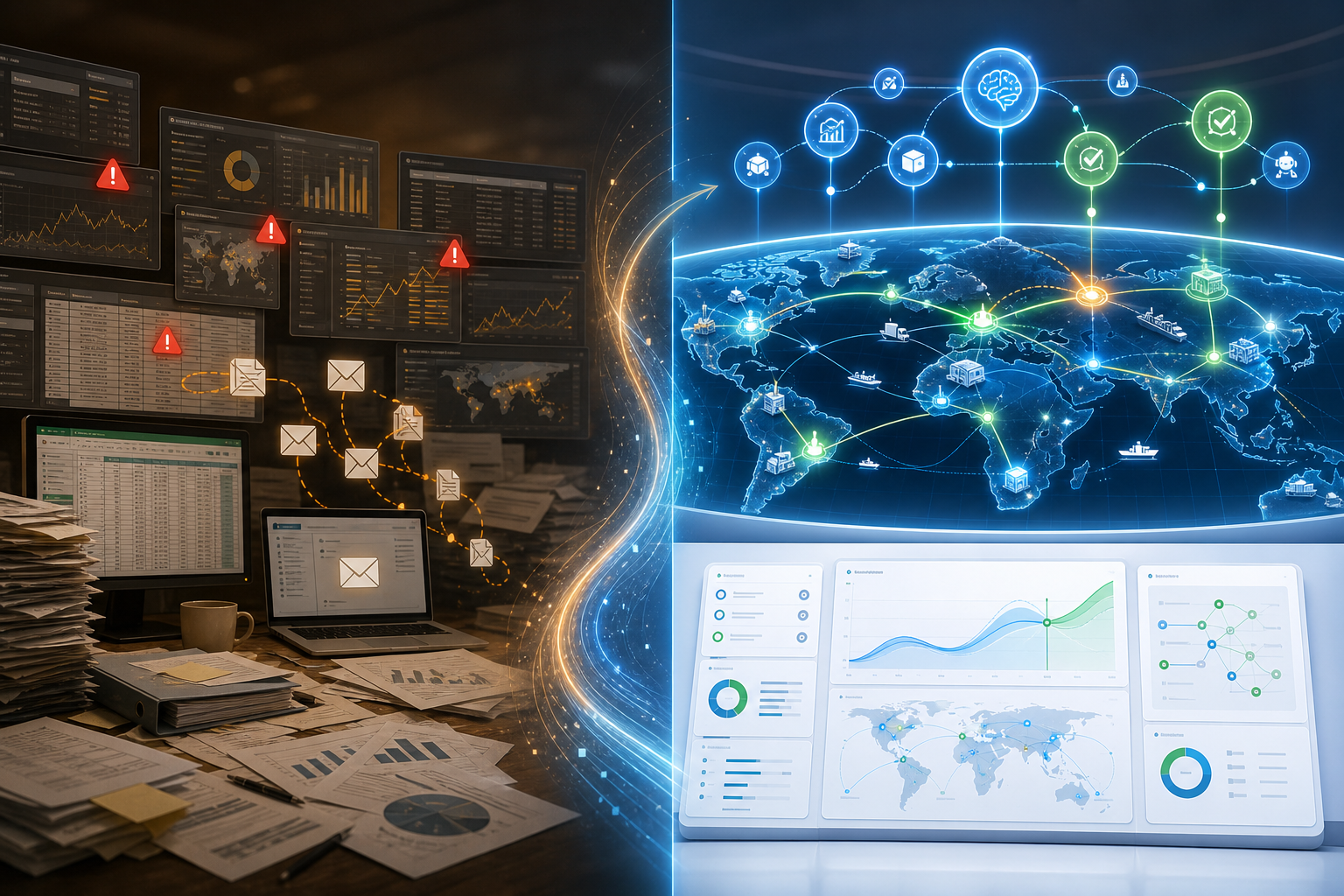
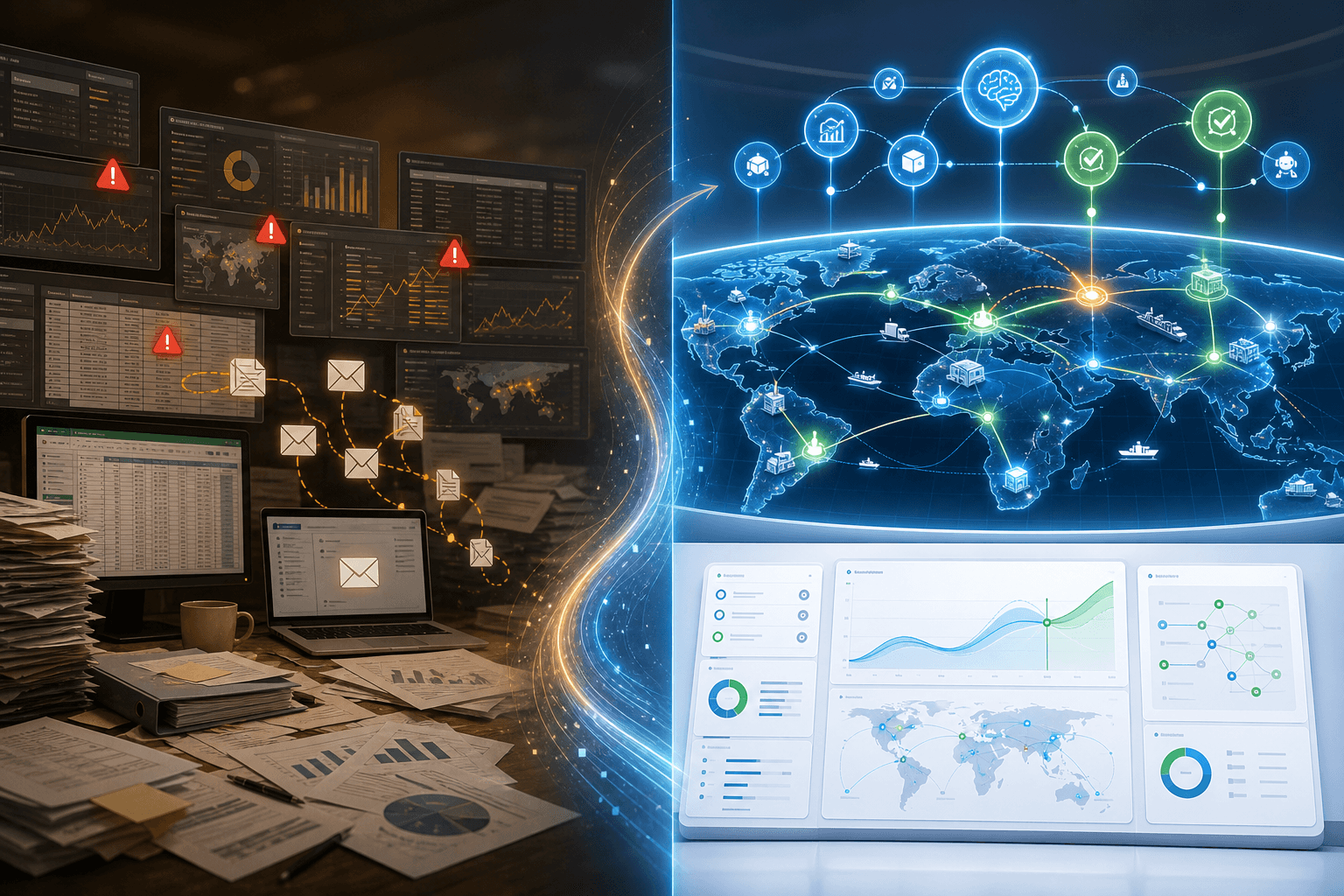
Why One Control Tower Does Not Fit All Industries
The phrase "supply chain control tower" implies a single pane of glass, but the glass shows a different picture depending on the industry looking through it. A control tower built for a pharmaceutical company must prioritize cold-chain telemetry and lot-level serialization; the same architecture deployed at an automotive OEM would fail because it cannot model multi-tier supplier sequencing or trigger just-in-time line-side delivery adjustments. The cost of ignoring these differences is not theoretical — it is measured in spoiled inventory, production line stoppages, and missed service-level agreements.
This article examines how AI-powered control towers must be configured differently across five verticals: manufacturing, retail and e-commerce, pharma and life sciences, automotive, and food and beverage. Each section covers the primary supply chain function the tower addresses, the specific use cases it enables, the AI techniques that make those use cases possible, representative vendors, and documented outcomes. For readers who need a baseline definition of control tower capabilities and maturity levels before proceeding, the site maintains a dedicated glossary entry on supply chain control tower AI.
Manufacturing: Inbound Material Visibility and Production Continuity
For discrete and process manufacturers, the control tower's primary job is to keep production lines running. Unlike retail, where the tower orchestrates inventory across stores and warehouses, manufacturing control towers focus on inbound material tracking, production schedule synchronization, and downtime prevention. The financial stakes are high: in the automotive industry, one minute of production line downtime can cost up to €5,000, according to a case study involving SAP and Schnellecke Logistics SE.
Specific Use Cases and AI Techniques
- Real-time inbound material visibility: Machine learning models ingest data from supplier systems, carrier APIs, and IoT sensors to predict material arrival times and flag delays before they impact production schedules.
- Predictive maintenance triggers: Digital twins of production lines simulate equipment performance and alert planners to potential failures, enabling proactive maintenance windows that minimize unplanned downtime.
- Autonomous shipment handling: Cognitive control towers from vendors like Siemens can automatically manage 95% of shipments, surfacing only the exceptions that require human expertise.
- Production schedule synchronization: The tower reconciles inbound logistics data with production plans in near real time, adjusting schedules dynamically when material shortages or quality issues arise.
The AI techniques underpinning these use cases include anomaly detection for identifying supply disruptions, digital twin simulation for production modeling, and prescriptive analytics for recommending corrective actions. The digital twin glossary entry on this site provides a deeper look at how digital twins function in operational supply chain contexts.
Vendor Examples and Documented Outcomes
The SAP and Schnellecke Logistics SE case demonstrates the operational impact of a well-configured manufacturing control tower. Before deployment, retrieving data required 15 to 20 manual steps across multiple systems. After implementation, report generation time dropped from two hours to immediate availability, and the tower provided real-time visibility into inbound logistics and production line status. Siemens reports that its cognitive control towers analyze over 200 external data signals — including vessel positioning, port performance, weather, and carrier schedules — to achieve autonomous management of 95% of shipments, with an 80% reduction in manual updates and a 15% decrease in detention and demurrage charges.
Retail & E-Commerce: Omnichannel Orchestration and Peak Season AI
Retail control towers operate in a fundamentally different environment than manufacturing towers. The primary challenge is not keeping a single production line running but orchestrating inventory flow across hundreds or thousands of locations — stores, warehouses, dark stores, and third-party logistics partners — while managing volatile demand patterns driven by promotions, seasons, and trends. Last-mile delivery alone accounts for 41 to 53 percent of total supply chain costs, according to Capgemini research cited by Locus, making it a primary target for AI-driven optimization.
Specific Use Cases and AI Techniques
- Store-level inventory rebalancing: AI models analyze point-of-sale data, store traffic patterns, and inventory levels to recommend or automatically execute transfers between locations, reducing stock-outs and markdowns.
- Dynamic delivery slotting: Reinforcement learning algorithms optimize delivery time windows and route assignments in real time, balancing customer preferences with fleet capacity and driver availability.
- Peak season demand surge anticipation: Demand sensing models incorporate external signals — weather, social media trends, competitor promotions — to predict demand spikes days or weeks ahead, allowing proactive capacity planning.
- Automated carrier allocation: The tower selects the optimal carrier for each shipment based on cost, service level requirements, and real-time capacity data, reducing manual decision-making and improving on-time delivery.
The AI techniques deployed in retail control towers include demand sensing for short-term forecasting, reinforcement learning for route and slot optimization, and machine learning for anomaly detection in order fulfillment. The site's AI demand forecasting use case reference and AI in TMS use case provide deeper dives into these specific application areas.
Vendor Examples and Documented Outcomes
Locus reports that AI-powered retail control towers can improve on-time delivery to 99.5 percent SLA adherence and reduce delivery costs by 15 to 30 percent in the first year of deployment. Other documented outcomes include a 45 percent increase in deliveries per day using the same fleet and a 38 percent reduction in WISMO (Where Is My Order) customer contacts. Neudesic, in its analysis of AI-powered control towers for retail, cites a 2x improvement in predictive accuracy for inventory needs, a 20 percent reduction in operational expenses, and a 50 percent faster issue identification rate.
| Metric | Reported Improvement | Source |
|---|---|---|
| On-time delivery SLA adherence | 99.5% | Locus |
| Delivery cost reduction (year one) | 15–30% | Locus |
| Deliveries per day (same fleet) | +45% | Locus |
| WISMO contacts | −38% | Locus |
| Predictive accuracy for inventory | 2x improvement | Neudesic |
| Operational expenses | −20% | Neudesic |
| Issue identification speed | 50% faster | Neudesic |
Pharma & Life Sciences: Cold Chain Integrity and Serialization Compliance
Pharmaceutical control towers operate under constraints that do not exist in any other vertical: regulatory mandates for serialization, temperature-controlled logistics, and recall readiness. A control tower that cannot track a single vial from production line to patient bedside — and prove the cold chain was never broken — is not fit for purpose. IBM reports that hospitals lose as much as 10 percent of inventory value due to lost or misplaced items, a figure that underscores the financial impact of poor visibility in healthcare supply chains.
Specific Use Cases and AI Techniques
- Real-time temperature deviation alerts: IoT sensor data from cold-chain shipments is fused with weather data and route information to predict temperature excursions before they occur, enabling proactive rerouting or repackaging.
- Lot-level track and trace: AI models reconcile serialization data across manufacturing, distribution, and dispensing points, flagging discrepancies that could indicate counterfeiting or diversion.
- Recall management automation: When a quality issue is detected, the tower identifies all affected lots across the network, calculates the financial exposure, and generates recall documentation in minutes rather than days.
- Predictive quality analytics: Machine learning models analyze production batch data and environmental conditions to predict quality deviations before they result in rejected batches.
The AI techniques most relevant to pharma control towers include IoT sensor data fusion for cold-chain monitoring, predictive quality analytics for batch release decisions, and graph-based traceability models for serialization. While this article focuses on control tower orchestration, readers interested in the specific inventory optimization patterns for pharma — including serialized inventory management and expiry-driven allocation — should consult the site's MEIO by industry vertical guide.
Vendor Examples and Documented Outcomes
IBM offers purpose-built control towers for healthcare and life sciences, emphasizing end-to-end visibility across inventory silos and disparate systems. FourKites' Intelligent Control Tower has been deployed by pharmaceutical companies to monitor cold-chain shipments and manage compliance documentation. CBC Inc. reports that AI-driven control towers in pharma environments can reduce out-of-stock events by 40 percent and cut response time to disruptions from days to under four hours, based on a deployment monitoring over 1,900 retail pharmacy locations and analyzing 4.5 million data points per hour.
Automotive: Multi-Tier Supplier Sequencing and JIT Synchronization
Automotive supply chains are among the most complex in any industry, characterized by multi-tier supplier networks, just-in-time delivery windows measured in hours, and production lines that can be stopped by a single missing component. An automotive control tower must provide visibility not just into direct suppliers but into sub-suppliers two or three tiers deep, because a disruption at a Tier 2 semiconductor plant can halt a Tier 1 assembly line and, within days, stop an OEM's final assembly.
Specific Use Cases and AI Techniques
- Multi-tier supplier risk scoring: Graph neural networks model the relationships between suppliers, sub-suppliers, and production lines, identifying which nodes in the network pose the highest risk of disruption.
- Dynamic sequencing adjustments: Reinforcement learning algorithms adjust delivery sequences in real time based on production line changes, quality holds, or transportation delays, ensuring the right part arrives at the right station at the right time.
- Production line downtime prediction: Digital twins of the production system simulate the impact of material shortages, equipment failures, or labor constraints, allowing planners to take preventive action before the line stops.
- Automated carrier dispatch for line-side delivery: The tower triggers carrier dispatch automatically when inventory at a specific production station falls below a threshold, maintaining JIT flow without manual intervention.
The AI techniques that distinguish automotive control towers include graph neural networks for supplier network analysis, reinforcement learning for dynamic sequencing, and digital twin simulation for production continuity planning. The digital twin glossary entry provides additional context on how digital twins are applied in production environments. For readers tracking the evolution toward autonomous decision-making in control towers, the agentic AI market editorial covers the latest developments in agentic AI for supply chain execution.
Vendor Examples and Documented Outcomes
The SAP and Schnellecke Logistics SE case is the most cited example of an automotive control tower deployment. Schnellecke, an automotive logistics provider, partnered with SAP to create a control tower that eliminated 15 to 20 data retrieval steps and reduced report generation time from two hours to immediate availability. The case highlights the financial imperative: one minute of production line downtime can cost up to €5,000. Kinaxis also serves the automotive sector with its Maestro platform, which provides concurrent planning capabilities for managing multi-tier supply networks. The site's Kinaxis vs SAP IBP vs o9 comparison provides a detailed evaluation of these platforms for readers in the vendor selection stage.
Food & Beverage: Perishable Inventory and Sustainability Tracking
Food and beverage control towers must manage the tension between freshness and availability. Unlike automotive, where a missing part stops a line, in food and beverage, the wrong inventory allocation leads to spoilage, waste, and missed service levels. The control tower's primary function is to match supply — constrained by shelf life, production schedules, and harvest cycles — with demand that varies by season, promotion, and weather.
Specific Use Cases and AI Techniques
- Dynamic shelf-life allocation: Machine learning models predict which products will sell fastest at each location and allocate shorter-shelf-life inventory to high-turnover stores, reducing spoilage.
- Detention and demurrage reduction: AI models analyze carrier arrival patterns, warehouse receiving capacity, and appointment schedules to minimize the time trucks spend waiting at docks, reducing penalty charges.
- OTIF (On-Time In-Full) optimization: The tower monitors order fulfillment against customer-specific OTIF windows and recommends adjustments to picking, packing, and shipping processes to avoid penalties.
- Sustainability metric tracking: Control towers aggregate data on carbon emissions, fuel consumption, and waste generation across the supply chain, enabling reporting and identifying reduction opportunities.
The AI techniques used in food and beverage control towers include machine learning for shelf-life prediction, natural language processing for parsing supplier communications and contract terms, and optimization algorithms for detention and demurrage reduction. The AI demand forecasting use case reference provides additional detail on demand sensing techniques relevant to CPG and food and beverage companies.
Vendor Examples and Documented Outcomes
o9 Solutions reports that a food and beverage client achieved a 60 percent reduction in stock-outs, 70 to 90 percent touchless planning adoption, a 53 percent decrease in inventory losses, and an 11 percent improvement in forecast accuracy (to 87 percent), with service levels reaching 99.5 percent. FourKites documents a case involving one of the top 15 global food and beverage manufacturers: the company reduced detention costs by more than $500,000, decreased OTIF penalties by nearly $800,000, and improved logistics team productivity by 35 percent using the FourKites Intelligent Control Tower.
Decision Matrix: Matching Your Industry to the Right Control Tower Subtype
Not all control towers are built the same way. The market can be broadly divided into three subtypes: visibility-led towers that focus on real-time monitoring and alerting, planning-led towers that integrate with S&OP and IBP processes, and execution-led towers that can autonomously trigger actions across logistics, warehousing, and procurement. The right subtype depends on the industry's primary operational challenge.
| Industry | Primary Control Tower Subtype | Key AI Capabilities Required | Representative Vendors |
|---|---|---|---|
| Manufacturing | Execution-led | Digital twin simulation, predictive maintenance, anomaly detection | SAP, Siemens, Kinaxis |
| Retail & E-Commerce | Execution-led | Demand sensing, reinforcement learning for routing, inventory optimization | Locus, o9 Solutions, Neudesic |
| Pharma & Life Sciences | Visibility-led with compliance overlay | IoT sensor data fusion, serialization traceability, predictive quality | IBM, FourKites, CBC Inc. |
| Automotive | Execution-led with planning integration | Graph neural networks, reinforcement learning for sequencing, digital twin | SAP, Kinaxis, o9 Solutions |
| Food & Beverage | Planning-led with execution capabilities | Shelf-life prediction, detention/demurrage optimization, demand sensing | o9 Solutions, FourKites, IBM |
Comments
Join the discussion with an anonymous comment.