
The fastest way to buy the wrong supply chain control tower is to put every vendor that uses the phrase into one comparison spreadsheet. By the third demo, the columns usually look tidy: visibility, AI, optimization, alerts, workflows, analytics, integrations. The problem is that those columns hide the operating model. One platform is built to capture shipment events and alert a team. Another is built to model inventory and capacity scenarios weeks or months ahead. A third is built to trigger dispatch, routing, appointment, or exception actions close to real time.
Those are not small feature differences. They answer different operational questions: can we see the disruption, can we plan around the disruption, or can we execute the response fast enough?
The decision is timely, but not because the market is suddenly full of new labels. Business Research Insights anticipates the global supply chain control tower market at USD 8.75 billion in 2026.[1] In a FourKites and Inbound Logistics survey of 250 U.S. supply chain leaders, 37% said control tower investments were a priority, up six points from the prior year.[2] At the same time, Blue Yonder reported that only 66% of leaders believe their organizations are ready for the future in 2026, down from 73% the prior year.[3] More money is moving toward the category just as confidence is weakening.
For buyers already past the basic definition of a supply chain control tower, the useful comparison is not “which vendor has the most AI?” It is “which layer of the operating stack is this platform actually strongest in?”
Start With the Stack, Not the Vendor Category
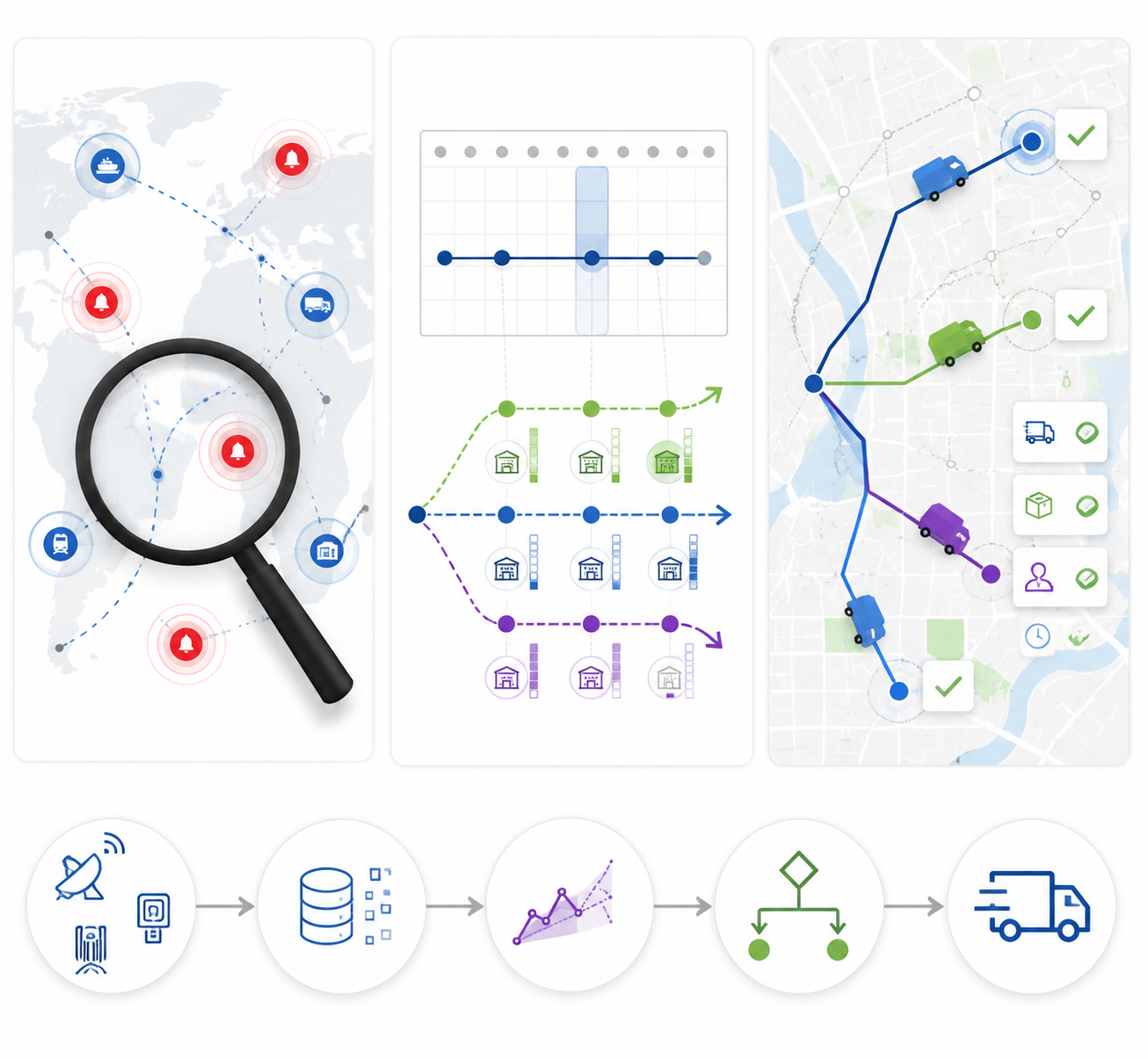
A control tower has to move through a practical sequence before it can credibly promise autonomy: capture events, normalize data, predict what is likely to happen, decide what action should be taken, and execute that action. nShift describes the investment imbalance in this stack clearly: companies often concentrate spending in the upper layers such as analytics and user interface while underfunding event capture and normalization at the bottom.[4]
That matters because the top layer cannot compensate for a broken bottom layer. If carrier events arrive late, location statuses are inconsistent, EDI messages are incomplete, and master data is unresolved, then a beautiful prediction screen mostly gives the team a more polished version of the same uncertainty.
| Operating model | Primary bottleneck | Strongest layer of the stack | Typical buyer mistake |
|---|---|---|---|
| Visibility-led | The organization cannot see disruptions early or consistently enough. | Capture, normalize, alert | Expecting alerts to become resolved exceptions without redesigning response work. |
| Planning-led | The organization cannot evaluate scenarios, inventory positions, or capacity choices fast enough. | Predict, simulate, decide | Buying planning optimization and expecting same-day dispatch control. |
| Execution-led | The organization sees the issue and may know the answer, but cannot act quickly enough across systems and teams. | Decide, execute | Automating action before event capture and data normalization are mature. |
Visibility-led, planning-led, and execution-led is a buyer heuristic, not a certified analyst taxonomy. It is still useful because it forces the first cut of the shortlist around the job the platform performs under pressure. Some vendors now straddle more than one model, and many roadmaps are moving toward broader orchestration. That does not remove the need to identify the original center of gravity.
Visibility-Led Towers: When the Problem Is Not Seeing Soon Enough
A visibility-led control tower is the right place to start when the organization still argues about what happened. Shipment location, appointment status, estimated arrival, dwell time, order status, inventory movement, carrier event quality, and exception alerts sit at the center of the model. Project44, FourKites, E2open, and SAP are commonly discussed in this lane, though each has its own scope and adjacent capabilities.
This model is not basic in the dismissive sense. It is foundational. E2open and o9, citing analyst data, state that 80% of organizations still lack a fully implemented visibility platform.[5] If that is true in your environment, a planning-led or execution-led pitch will run into the same wall quickly: the platform cannot reliably decide or act on events it does not receive, trust, or reconcile.
The danger is stopping at the alert. Gartner data cited by o9 and nShift says only 7% of supply chains can execute decisions in real time, even though 95% say they need to react quickly.[6] Another operational detail is even more revealing: an average disruption requires 34 manual system updates across six different platforms.[6] That is where many visibility programs disappoint operations managers. The control tower sees the exception, but the response still depends on planners, customer service, transportation coordinators, and warehouse teams pushing updates through disconnected systems.
A visibility-led model is a fit when the current pain sounds like this: customer service learns about delays from customers, transportation teams cannot trust carrier milestones, inventory promises are made with stale status, or managers spend the morning reconciling whose spreadsheet is closest to reality. It is a poor fit if the business already has reliable event capture and the real constraint is that no one can rebalance supply, change inventory policy, or trigger execution fast enough.
What to Verify Before Shortlisting Visibility-Led Vendors
- Which events the platform captures directly versus through partners, carriers, ERP feeds, or customer-provided integrations.
- How the platform normalizes inconsistent carrier, order, inventory, and location statuses.
- What happens after an alert: who receives it, what workflow opens, what systems are updated, and which steps remain manual.
- Whether exception rules can distinguish operationally urgent events from noise.
- How the vendor measures alert quality, false positives, and response-cycle reduction rather than dashboard adoption alone.
Planning-Led Towers: When the Problem Is Not Planning Ahead
Planning-led control towers sit upstream from daily execution. Their strongest work is in scenario modeling, inventory positioning, capacity planning, supply-demand balancing, allocation choices, and what-if analysis. Blue Yonder, Kinaxis, and o9 Solutions are frequent examples of this model. A buyer comparing Blue Yonder and Kinaxis, for example, is usually evaluating planning architecture, scenario responsiveness, constraint handling, and enterprise planning fit before asking whether a dock appointment can be changed this afternoon.
This is the model to evaluate when the organization can see a disruption but cannot decide what it means for the network. A late inbound container may be visible, but planners still need to know which orders are exposed, whether substitute inventory exists, whether capacity can be moved, which customers should be prioritized, and what margin or service trade-offs follow. That is a planning problem before it is an execution problem.
o9 has published a case study in which a large food and beverage manufacturer using an AI-powered control tower achieved 93% touchless order planning and a 3–5% OTIF improvement.[7] Those are vendor-published results from a specific deployment, not a universal planning-led benchmark. Still, they illustrate the kind of outcome a planning-led model is designed to pursue: fewer planner touches, better service performance, and faster translation of demand and supply signals into feasible plans.
The mismatch appears when an executive sponsor expects a planning tower to behave like an execution console. Scenario optimization can recommend a better allocation, production shift, or inventory move. It does not automatically mean the carrier appointment changes, the store delivery route resequences, the warehouse labor plan updates, and the customer notification goes out. Those actions require execution integration and workflow authority that may sit outside the planning platform.
Planning-led tools become more valuable as decision complexity rises. If the business has many SKUs, multi-echelon inventory, constrained production, volatile demand, or costly service trade-offs, the ability to compare scenarios matters more than shaving minutes off a dispatch task. If the operation mainly needs last-mile route changes, carrier exception handling, or same-day appointment recovery, planning-led strength may feel too far from the floor.
The Planning-Led Shortlist Test
- Ask which decisions the platform optimizes: inventory, production, capacity, allocation, replenishment, transportation, or service prioritization.
- Separate scenario recommendation from execution authority; confirm which downstream systems actually receive approved decisions.
- Require examples of planner-touch reduction, planning-cycle compression, or service improvement tied to comparable operating complexity.
- Check whether real-time events feed the planning model quickly enough for the decisions you expect it to support.
Execution-Led Towers: When the Problem Is Acting Fast Enough
Execution-led control towers are where the action promise becomes concrete. They focus on routing, dispatch, exception resolution, delivery orchestration, task assignment, workflow automation, and sometimes autonomous response. Locus, Outvio, and Syren are examples often associated with execution-heavy use cases, especially where delivery, transportation, or fulfillment actions need to move faster than a human coordination loop can manage.
The labor case is real. McKinsey has reported that 40–60% of a supply chain planner’s time is spent on transactional activities rather than value-adding strategic work.[8] In the control tower context, that transactional load shows up as copying updates between systems, chasing approvals, sending emails, rekeying appointment changes, refreshing ETAs, and manually assigning recovery tasks. A visibility tool may expose the work. An execution-led tool tries to remove or compress it.
Vendor-published results can be compelling, but they need to be read as vendor-published results. Locus reports customer data showing 25% efficiency gains, 45% more deliveries per vehicle, and an 8% SLA improvement.[9] FourKites has reported that AI-powered control towers can achieve payback in 4–8 months.[10] Those claims may be highly relevant in a business case, but they should not be treated as typical outcomes without checking deployment scope, baseline maturity, geography, operational density, integration depth, and what costs were included.
Execution-led platforms also carry the sharpest readiness risk. Automating a bad signal does not create autonomy; it creates faster rework. If the platform cannot trust event capture, normalize statuses, or reconcile order and location data, then automated decisions will need human supervision at exactly the point the business expected relief.
That is why execution-led should not be treated as the top rung of a maturity ladder for every company. It is the right model when the bottleneck is response latency and coordination effort, not when the organization is still missing the shared facts needed to act. Gartner predicts that 60% of supply chain disruptions will be resolved without human intervention by 2031, and investment in real-time decision-execution technology is on track to increase fivefold by 2028.[6] Those forecasts point to where the category is heading, not to what every network is ready to run today.
For buyers studying agentic workflows or autonomous operations, execution-led towers overlap with the broader move from dashboards to decisions. The same discipline still applies: define which action is safe to automate, which action needs approval, which action should only be recommended, and which action should stay with a human because the business consequence is too high.
Where Execution-Led Evaluation Gets Practical
- Identify the exact execution loop: route change, dispatch assignment, appointment recovery, carrier escalation, warehouse task, customer notification, or order promise update.
- Map every system touched before and after the action; execution value often depends on reducing handoffs, not adding another console.
- Define authority levels for recommend, approve, auto-execute, and rollback.
- Validate the data freshness required for the action; a routing decision and a monthly inventory decision do not need the same latency.
- Ask the vendor to show exception closure, not just exception detection.
Hybrid Vendors Are Normal, but Centers of Gravity Still Matter
The category is not frozen. FourKites is primarily associated with visibility but has been adding execution-oriented capabilities through digital workers. o9 is planning-led but also positions parts of its platform around execution. SAP, E2open, Blue Yonder, Kinaxis, and others can appear in multiple comparison sets depending on module scope and deployment design. That is one reason vendor demos become confusing: the roadmap language is often broader than the operating center of the current implementation.
A hybrid claim is not a red flag by itself. It becomes a problem when the buyer does not know which capability must be proven first. If the bottleneck is event capture, the demo should spend more time on network coverage, data latency, normalization, milestone quality, and exception rules than on autonomous action. If the bottleneck is planning, the demo should stress scenario logic, constraints, planning-cycle impact, and decision traceability. If the bottleneck is execution, the vendor should show how a detected issue becomes a completed action across systems.
This is also where a broader supply chain AI vendor directory can help keep adjacent categories separate. Planning suites, visibility networks, transportation execution tools, autonomous agents, and analytics products may all use control tower language, but they do not carry the same implementation burden.
A Shortlist Discipline That Prevents the Usual Mismatch
Before scoring vendors, force the team to name the operational bottleneck in one sentence. Avoid blended statements such as “we need end-to-end AI visibility and optimization.” That phrase may be true at a strategy level, but it is too vague for a shortlist. Use a sentence that exposes the work:
- “We do not see shipment and inventory exceptions early enough to protect service.”
- “We see the disruption but cannot evaluate network trade-offs quickly enough.”
- “We know the right response but lose time pushing it through systems and teams.”
The first sentence points to a visibility-led shortlist. The second points to a planning-led shortlist. The third points to an execution-led shortlist. If more than one sentence is true, sequence the work instead of pretending one platform purchase will erase every gap at once.
The second filter is stack readiness. A planning-led model needs event and master data good enough to feed scenarios. An execution-led model needs decision inputs reliable enough to trigger actions. A visibility-led model needs enough workflow design that alerts do not become a new inbox for the same manual work. The weakest layer in the capture-to-execute sequence will set the pace, regardless of how advanced the demo looks.
The third filter is proof. Ask vendors to demonstrate the exact bottleneck using a realistic exception flow. A visibility-led demo should show how the platform captures, reconciles, prioritizes, and routes the signal. A planning-led demo should show how the platform evaluates options and explains the trade-off. An execution-led demo should show the action, the system updates, the approval logic, and the rollback path. If the demo keeps returning to a dashboard, the platform may be stronger at display than control.
For teams that need a more general buying guardrail, an evaluation framework for AI tools in supply chain management can sit beside this taxonomy. But the control tower shortlist should stay anchored to the operating model. Diagnose the bottleneck, verify that the required layer of the stack is strong enough, then compare vendors inside the model that matches the problem.
References
- Supply Chain Control Tower Market, Business Research Insights, 2026, link
- Control Tower Investment Survey, Inbound Logistics / FourKites, 2026, link
- Blue Yonder 2026 Survey, Blue Yonder, 2026, link
- Supply chain control tower 2026: dashboard to decision, nShift, link
- Analyst data on visibility platform implementation, E2open / o9 Solutions, link
- Gartner data cited by o9 and nShift on real-time execution and disruption response, Gartner, link
- AI-powered control tower case study at a large F&B manufacturer, o9 Solutions, link
- Supply Chain 4.0 Study, McKinsey, link
- 10 Best Supply Chain Control Tower Providers in 2026, Locus, 2026, link
- Why Supply Chain Control Towers Didn't Deliver on Their Promise, FourKites, link
Comments
Join the discussion with an anonymous comment.