
For an SAP-standardized enterprise in Q3 2026, the shortlist question is not whether SAP has a control tower. It does. The harder question is whether SAP Supply Chain Control Tower is the right operating layer for the work being funded: visibility, exception management, and planning alignment, or active execution across routing, dispatch, warehouse tasks, and non-SAP data sources.
That distinction matters because SAP Supply Chain Control Tower is not a standalone execution platform sold on identical terms with specialist control tower vendors. It is a module within SAP Integrated Business Planning, licensed separately with its own named-user metric, according to a March 2026 licensing analysis.[1] That placement is not a footnote. It explains why the product can be attractive to SAP shops that want fewer interfaces to own, and why it should not be treated as a replacement for platforms built around dispatch, routing, or multi-source orchestration.

Start With the Operating Job, Not the Product Name
The phrase sap supply chain control tower can make two different buying teams think they are discussing the same thing when they are not. A planning VP may want one view of demand, inventory, capacity, and fulfillment exceptions. A transportation director may want the system to re-route freight, assign carriers, and trigger execution changes. An IT director may be listening for a third issue entirely: whether the new layer creates duplicate master data and another brittle integration estate.
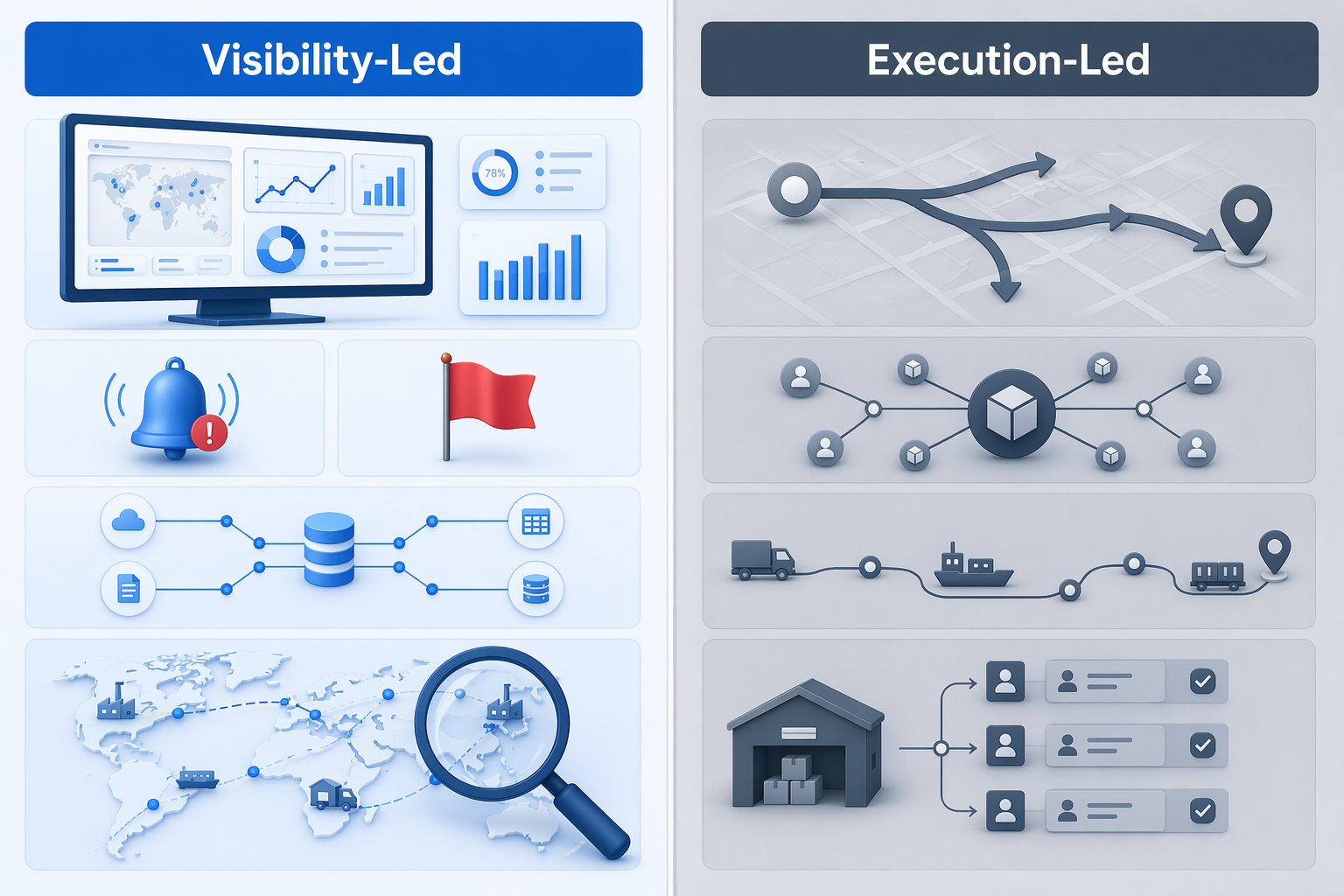
The cleanest way to separate those conversations is to classify the control tower by operating model. Locus’s 2026 comparison of 10 control tower providers places SAP with Project44 and E2open in a visibility-led category: strong in monitoring, alerts, and exception dashboards, but limited in execution capabilities and not handling routing or dispatch.[2] Locus is one vendor’s taxonomy, not a formal industry standard, but the line it draws is operationally useful. It asks what the system does after it sees the exception.
For a broader explanation of that visibility-led, planning-led, and execution-led split, ChainSignal’s supply chain control tower model taxonomy is the useful companion piece. In this SAP profile, the relevant point is narrower: SAP’s control tower is built first to expose the operating picture and manage exceptions inside an SAP-centered planning architecture.
| Buying Need | SAP Fit In 2026 | Reason To Be Careful |
|---|---|---|
| Integrated visibility across SAP planning and execution data | Strong fit | Value depends on SAP data quality and process standardization |
| Exception monitoring and planning-team response | Strong fit | The workflow still has to be owned after go-live |
| Carrier routing, dispatch, and transportation execution | Weak fit as a sole platform | Independent comparisons classify SAP as not handling routing or dispatch |
| Multi-source orchestration across SAP and non-SAP operating systems | Conditional fit | Native SAP integration helps, but the architecture is not primarily designed as a neutral execution fabric |
| Autonomous or agent-led execution | Roadmap signal, not yet a verified replacement | 2026 announcements and pilots should not be counted as broad production proof |
What SAP’s Native Integration Actually Buys You
SAP’s strongest argument is architectural rather than cosmetic. SAP describes its control tower approach as leveraging data from source systems instead of creating new data sources.[3] Independent analyses from AltexSoft and IBM also describe the control tower pattern around integration with existing enterprise systems rather than a detached operating database.[4][5] In a large SAP estate, that design choice can reduce avoidable reconciliation work.
The practical benefit is not that integration disappears. It never does. The benefit is that the center of gravity stays close to systems the enterprise already governs: SAP ERP or S/4HANA, SAP IBP, SAP Extended Warehouse Management, SAP Transportation Management, and SAP Business Network where those are deployed. The control tower can draw from the same governed structures instead of asking the business to accept a parallel version of customers, locations, products, orders, and exceptions.
That matters in steering-committee terms. If the control tower becomes another layer with its own master data assumptions, the rollout risk shifts from “Can we see exceptions?” to “Which version of the exception does operations believe?” Once planners, logistics teams, customer service, and finance start reconciling different event timestamps or order states, the dashboard has already lost part of its authority.
SAP’s approach is better suited to enterprises that want the control tower to sit inside the existing governance model. It is especially relevant when the funded problem is cross-functional visibility: late supply, projected stockouts, demand-supply misalignment, service risk, and exception prioritization. In that setting, native integration is not just an implementation convenience. It is part of the operating design.
The same design also creates the boundary. A system that is optimized to leverage source-system data and preserve the SAP planning architecture is not automatically the best place to run highly dynamic execution decisions across a fragmented technology landscape. If transportation, warehouse labor, yard activity, supplier events, and external carrier networks all need to be orchestrated in real time across mixed systems, the integration question changes. The buyer is no longer only asking whether SAP can display the exception. The buyer is asking whether SAP is the right decisioning and action layer.
Visibility-Led Means the Product Can Be Valuable Without Being Sufficient
A visibility-led control tower can still solve expensive problems. It can reduce the time spent hunting for data, surface exceptions earlier, put planners and execution teams around the same operating picture, and support a more disciplined response process. For many SAP shops, that is exactly the problem that has been funded: too many handoffs, too many offline reports, and too much latency between the event and the management response.
The Schnellecke Logistics case gives a concrete version of that value. In an SAP-commissioned 2021 case study, Schnellecke reported that the control tower eliminated 15 to 20 data-access steps and reduced report generation from roughly 2 hours to immediate availability. The same case noted that 1 minute of downtime could cost up to €5,000.[6] Those are operationally meaningful numbers because they measure work removed from the process, not only user satisfaction.
The caveat is equally important. Schnellecke is a single SAP-commissioned case, not independent average-customer evidence. It is best read as proof that SAP’s architecture can produce sharp improvements in a favorable SAP ecosystem deployment, not as a guarantee that every enterprise will remove the same number of steps or compress every report cycle in the same way.
There is also a scale argument that should not be dismissed as generic market leadership. SAP says more than 1,000 companies use SAP IBP, and SAP Business Network facilitates $6.3 trillion in annual commerce across 190 countries.[7] For a control tower, that footprint matters because network and planning context can be hard for a third-party layer to reconstruct. A specialist platform may be faster in a specific execution domain, but it usually has to earn access to enterprise and network data that SAP may already touch.
That does not make SAP the universal answer. It means the integration and data-network advantage has to be evaluated against the actual gap. If the pain is reporting latency, exception fragmentation, or planning-team visibility, SAP deserves a serious place near the top of the shortlist. If the pain is “the tower sees the issue but nobody can act from it,” the buying team needs to press harder.
For teams building an economic case, ChainSignal’s control tower ROI framework is more useful than importing generic AI productivity claims into the business case. SAP’s evidence should be tested around cycle-time reduction, exception handling, report elimination, service impact, and the cost of integration work avoided.
Where the Boundary Becomes Hard
The hard boundary is execution. In the Locus 2026 comparison, SAP’s strengths are seamless SAP integration and visibility, while the limitation is explicit: it does not handle routing or dispatch.[2] That should be treated as a design boundary during shortlisting, not as a minor feature gap to be discovered during implementation.
A simple test is to ask what happens when the tower identifies a late inbound shipment, a constrained production order, or a warehouse bottleneck. If the expected action is to alert a planner, prioritize an exception, refresh a scenario, and coordinate a response inside SAP-governed processes, SAP’s model fits. If the expected action is to automatically reassign freight, dispatch a vehicle, resequence warehouse work, or orchestrate multiple external systems without a human-owned handoff, the fit is weaker.
This is where third-party alternatives can be legitimately attractive. A specialist execution-led platform may accept more integration burden in exchange for faster operational action in transportation, logistics visibility, fulfillment orchestration, or warehouse execution. That trade-off is not irrational. It is only dangerous when the enterprise buys execution capability but budgets and governs the program as if it were only adding a visibility dashboard.
SAP-standardized companies should be especially disciplined about this distinction because they can underestimate the cost of a shadow operating layer. Every non-SAP tower that writes back into SAP, interprets SAP events, or maintains its own version of master and transactional data creates ownership questions. Who maintains the mapping when the process changes? Who resolves the exception when the control tower and the source system disagree? Who is on call when the interface is technically alive but semantically wrong?
Those questions do not disqualify third-party tools. They define the price of choosing them. A business team that truly needs execution-led orchestration may be right to pay that price. A business team that mainly needs cleaner SAP-native visibility may be taking on integration risk without getting a proportionate operating gain.
The 2026 Roadmap Is Directionally Important, but Not Yet the Same as Proven Execution
SAP’s roadmap is moving toward more orchestration and agent-assisted work. At SAP Connect in October 2025, SAP announced Supply Chain Orchestration as a new AI-centric layer with general availability planned for the first half of 2026.[8] That announcement matters because SAP is clearly not positioning visibility as the end state.
The problem for a Q3 2026 buyer is evidentiary. As of July 2026, the actual general-availability status and adoption depth of Supply Chain Orchestration were not independently verified in the crawled sources used for this profile. A roadmap signal can justify asking SAP sharper questions. It should not be counted as installed-base proof that SAP has closed the execution gap.
SAVIC Technologies’ April 2026 analysis describes IBP telescopic planning as creating continuous multi-horizon visibility and cites 12% to 18% pick-productivity gains in pilots involving an EWM Real-Time Optimization Agent.[9] Those pilot figures are relevant, especially for SAP EWM customers watching agentic capabilities mature. They are not the same as broad evidence that SAP Supply Chain Control Tower itself now performs routing, dispatch, or autonomous multi-source orchestration at production scale.
SAPinsider’s analysis of control towers from 2021 through 2025 is a useful counterweight: current control towers do not have what is needed to build autonomous supply chains, with the market still planning-heavy and lacking tactical execution integration.[10] That conclusion may become dated as orchestration and Joule agents mature, but it is a fair warning against treating announced AI layers as operational replacements before they have been proven in the buyer’s own process scope.
For readers comparing agentic claims across vendors, ChainSignal’s agentic AI supply chain deployment patterns helps separate copilots, optimization agents, human-in-the-loop workflows, and autonomous execution. SAP’s roadmap belongs in that conversation, but it should be evaluated as staged capability, not as one finished control tower category.
How to Shortlist SAP Without Overbuying the Story
SAP belongs high on the shortlist when the enterprise is already standardized on SAP ERP or S/4HANA, uses or is adopting SAP IBP, and wants a control tower that improves visibility and exception management without creating a competing data layer. It is particularly defensible when the program sponsor is trying to reduce report latency, improve planning responsiveness, and keep governance inside the SAP architecture.
It should be challenged when the funded need is operational action beyond that scope. If transportation expects routing and dispatch, if warehouse teams expect automated task reassignment, if supply execution expects cross-platform orchestration, or if the business case assumes autonomous action, the shortlist should include execution-led alternatives. ChainSignal’s AI supply chain software comparison can help place SAP’s architecture beside broader platform models.
The commercial discussion also needs care. Public pricing is not listed, and enterprise terms can vary by deal structure, migration credits, and module bundling. The more useful sourcing question is not “What is the list price of the control tower?” but “Which users need named access, which IBP capabilities are already licensed, which adjacent SAP modules are in scope, and what integration work is avoided or still required?”
Implementation comparisons should also account for program risk, not only feature counts. A third-party tower may demonstrate stronger execution functionality and still create more work around data ownership, interface maintenance, process exception ownership, and SAP write-back design. For that angle, ChainSignal’s Kinaxis Maestro vs SAP IBP vs o9 implementation profile is the better lens than a pure capability matrix.
A Practical Qualification Test
Before treating SAP Supply Chain Control Tower as the preferred path, the buying team should ask five questions in plain operating language.
- Is the funded problem mainly visibility, exception prioritization, and planning coordination inside an SAP-centered landscape?
- Will the control tower rely primarily on SAP-governed source-system data rather than building an independent operating record?
- Who owns the exception workflow after the alert appears: planning, transportation, warehouse operations, customer service, or a control tower team?
- Which actions must be executed directly by the platform, and which can remain human-approved responses inside SAP processes?
- Are roadmap capabilities such as orchestration layers, Joule assistance, or optimization agents required for the initial business case, or are they upside after go-live?
If the honest answer points to integrated visibility and exception management, staying inside SAP is usually the lower-risk shortlist position. If the answer points to routing, dispatch, active multi-source orchestration, or independently verified autonomous execution, SAP’s current control tower should be evaluated alongside third-party execution-led platforms rather than assumed sufficient because it is native.
References
- SAP IBP Control Tower Licensing Framework, SAP Licensing Experts, March 2026.
- 2026 Comparison of 10 Control Tower Providers, Locus, 2026.
- SAP Supply Chain Control Tower Resource Page, SAP.
- Supply Chain Control Towers: Features, Benefits, and Software, AltexSoft.
- What Is a Supply Chain Control Tower?, IBM.
- Schnellecke Logistics Case Study, SAP, 2021.
- SAP Business Network and SAP IBP Adoption Materials, SAP, 2025.
- SAP Connect October 2025 Supply Chain Orchestration Announcement, SAP News, October 2025.
- SAP IBP Telescopic Planning and EWM Real-Time Optimization Agent Analysis, SAVIC Technologies, April 2026.
- SAPinsider Control Tower Analysis, SAPinsider, 2021–2025.
Comments
Join the discussion with an anonymous comment.