
The original promise of the supply chain control tower platform was hard to dislike: one operational view, earlier warnings, fewer surprises, and enough coordination to keep shipments, inventory, capacity, and customers from drifting apart. The disappointment was not that the screens were ugly or the ambition was wrong. It was that, after the map turned red, the work still spilled into email threads, carrier portals, spreadsheets, TMS screens, ERP updates, customer-service escalations, and late-afternoon exception calls.
That distinction matters because many control towers did improve visibility. They just did not reliably create control. In a 2025 FourKites survey of 250 supply chain leaders, only 22% of shippers with more than $1 billion in revenue rated their current control tower as highly effective at driving action, and only 2 in 10 organizations said they understood 75–100% of what was happening in their supply chain in real time.[1]
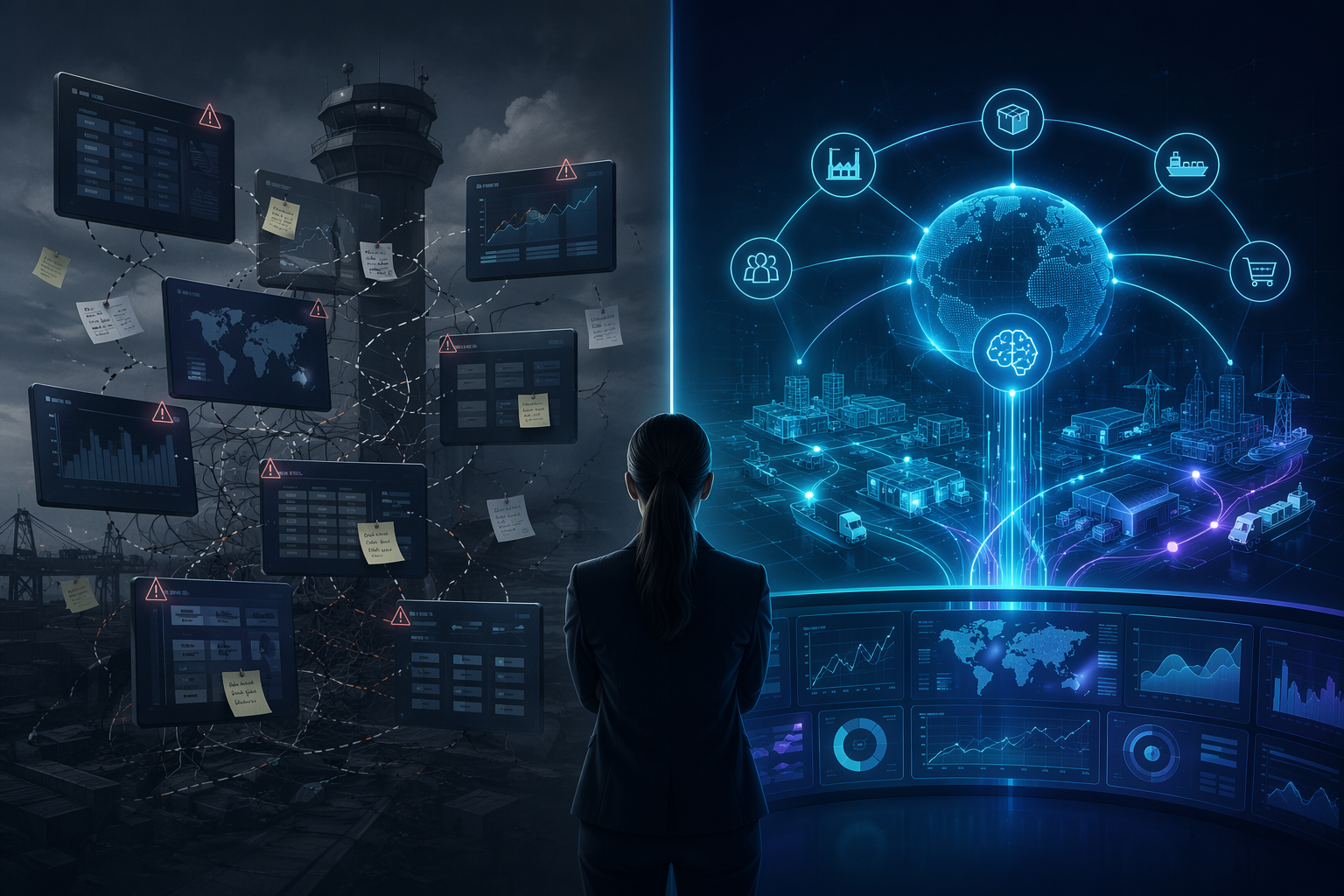
In 2026, the useful question is not whether control towers are back. It is whether the new generation is solving the operating failures that made the first generation feel so thin once a disruption arrived.
Where The Dashboard Model Broke Down
A control tower is supposed to connect signals across planning, transportation, inventory, order management, and customer commitments. For a fuller definition of the capability spectrum, see this AI-powered control tower definition. In practice, many early towers sat above fragmented systems instead of changing how those systems worked together. The tower saw pieces of the problem, but the operator still had to stitch together the response.
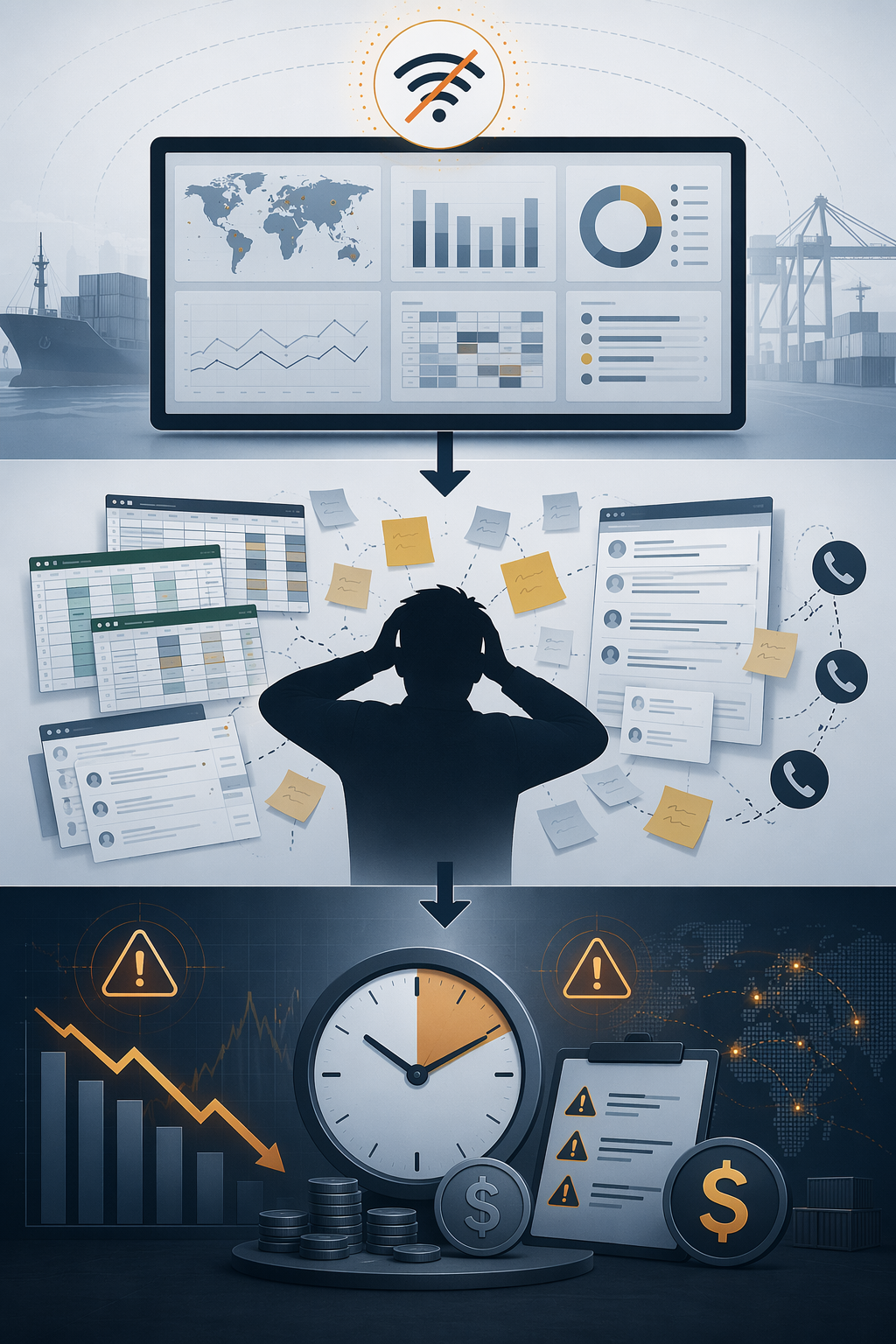
The workload numbers are a better diagnosis than most market forecasts. nShift cites Gartner research finding that the average disruption requires at least 34 manual system updates across 6 different platforms, and MIT research finding that a single disruption generates an average of 25 emails requiring input from 8 different roles.[2] That is not a visibility problem in the narrow sense. It is a coordination architecture problem.
A late truck might be visible in a tower before the customer calls. But if one team has to confirm the carrier event, another has to check inventory, a planner has to re-sequence demand, customer service has to rewrite a promise, finance has to anticipate a penalty, and someone still has to update the transportation record, the tower has not shortened the work. It has only announced the work earlier.
That is why Gartner's 2018 warning, discussed by ToolsGroup under the title “Don’t Believe the Control Tower Hype,” has aged well as a critique of that market era. The warning was aimed at vendors selling visualization layers on siloed data instead of solution towers that controlled processes end to end.[3] It should not be read as proof that current AI-enabled architectures cannot work. It should be read as an early description of the exact failure pattern many companies later recognized in their own operations.
Visibility Without Execution Creates A Second Workload
The common defense of first-generation towers was that they gave people the information needed to make better decisions. Sometimes they did. But in exception-heavy environments, information that does not trigger an executable workflow becomes another queue to monitor.
This is the part dashboard demos tend to flatten. A shipment delay does not live in one system. It touches appointment scheduling, allocation, replenishment, customer communication, carrier performance, warehouse labor, and sometimes contractual penalties. If the tower detects the event but cannot push the right updates into the right operational systems, the organization creates a manual bridge. That bridge is usually built out of planners, carrier managers, logistics leads, and customer service teams.
McKinsey has found that 40–60% of a supply chain planner’s time is spent on transactional activities rather than value-adding strategic work, as cited in nShift’s control tower analysis.[2] That figure explains why the old model felt expensive even when the software subscription was not the largest cost. The hidden bill sat in exception handling: searching, reconciling, updating, forwarding, checking, and rechecking.
The financial exposure then arrives through familiar channels. FourKites cites customer data showing 5–10% of revenue at risk from churn due to missed deliveries and OTIF penalties ranging from 3–5% of revenue.[1] Those are vendor-published customer data points, not universal benchmarks. Still, they point to the right consequence: the failure is not merely that a screen lacks elegance. It is that missed handoffs become missed commitments.
| Old Failure Point | What Operators Experience | Why It Matters |
|---|---|---|
| Siloed data | Teams argue over which timestamp, carrier event, or order status is current | The first minutes of a disruption go into reconciliation rather than response |
| Manual updates | The same exception is copied into transportation, order, customer, and planning systems | Visibility increases work unless the platform changes downstream execution |
| Alert overload | Every delay looks urgent until someone manually ranks customer, margin, penalty, and inventory impact | Teams burn time triaging alerts that should already be prioritized |
| Weak event data | Late or inconsistent carrier signals create false confidence or false alarms | Automation can only act well on events it can trust |
| No closed loop | The tower recommends action, but people still coordinate the fix across tools | The platform remains advisory rather than operational |
What AI Changes When It Is More Than A Better Alert
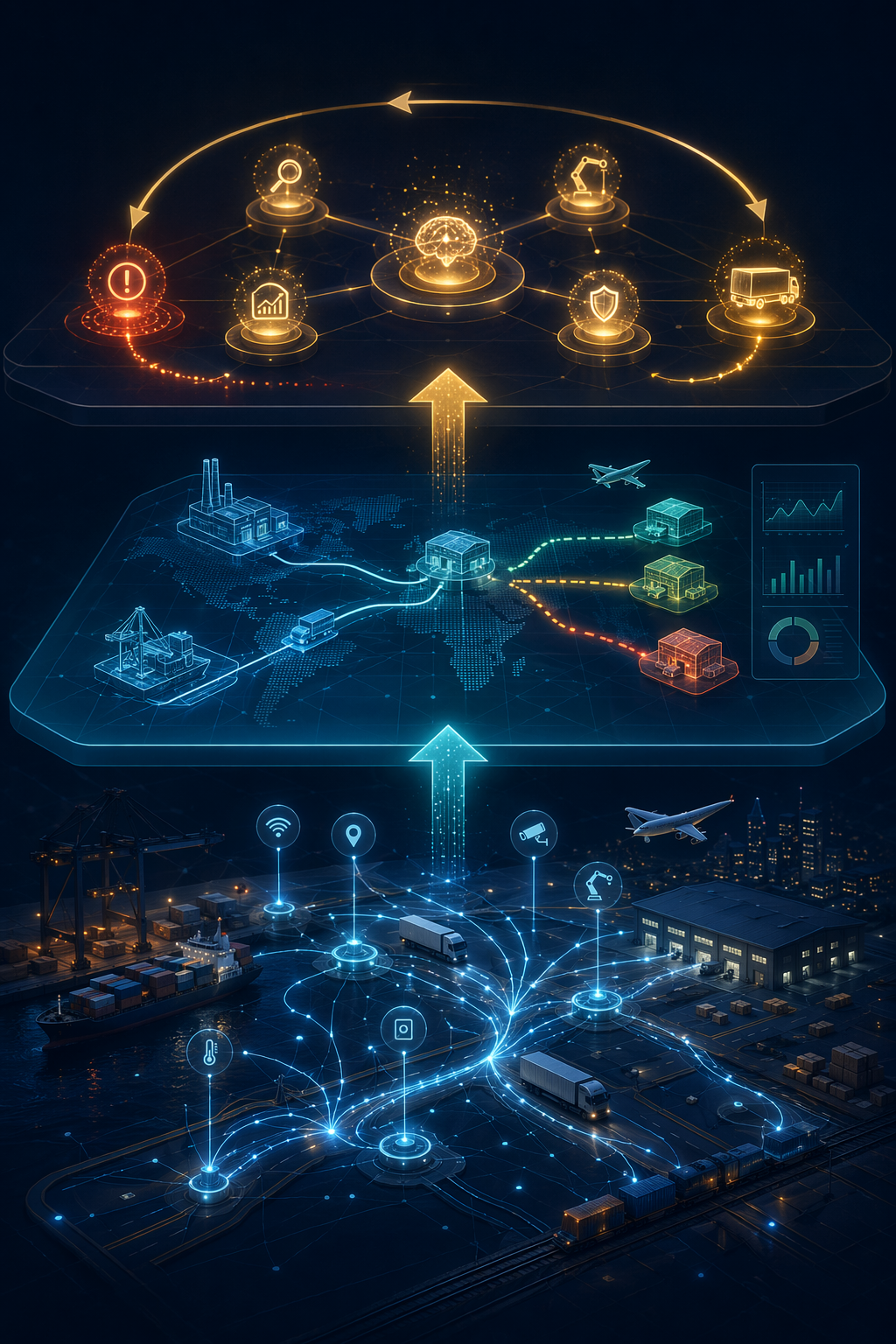
AI does not automatically make a supply chain control tower platform useful. A model layered on stale milestones and incomplete carrier feeds will only produce faster confusion. The meaningful change is architectural: real-time networks improve event flow, digital twins let teams test the operational effect of responses, and agentic workflows begin to close the gap between detection and execution.
Real-Time Networks Reduce The Reconciliation Tax
The first improvement is event flow. A tower that depends on batch updates, delayed milestone messages, and disconnected partner portals is already late. Real-time visibility networks try to normalize shipment, order, carrier, facility, and customer-impact signals before the exception becomes a meeting.
This does not eliminate judgment. It changes where judgment is spent. Instead of asking eight people to confirm whether the delay is real, the platform can put more effort into ranking the delay by service promise, inventory availability, penalty exposure, downstream production impact, and customer sensitivity. That is the difference between a tower that reports disruption and one that starts to organize response.
Digital Twins Make The Response Testable
The second improvement is simulation. A digital twin gives the tower a model of the network it can use to compare possible responses before a planner commits to one. If a customer order is at risk, the useful question is not only “Where is the shipment?” It is whether expediting, reallocating from another node, splitting an order, changing a carrier, or renegotiating a delivery promise creates the least damage across cost, service, and capacity.
That kind of scenario testing is where the control tower idea finally starts to deserve its name. It gives operators a way to see the probable consequence of an action before creating more work elsewhere. The best use is not theatrical forecasting. It is preventing a local fix from becoming a network-level problem.
Agentic Workflows Move From Detection Toward Action
The third improvement is execution. Agentic AI matters when it can take a detected exception, select from approved actions, trigger the next workflow, and escalate only the cases that exceed policy or confidence thresholds. For a deeper discussion of that transition, see this analysis of agentic AI in logistics disruption response and this view of supply chain deployment patterns in 2026.
The practical test is simple: after the alert fires, what happens without another meeting? Can the system recommend a reallocation, draft a customer update, open a carrier exception, change an appointment, update the order promise, or route a decision to the person with authority? If not, the organization may still have a better dashboard rather than a better operating system.
The Evidence Is Promising, But It Is Not Neutral
The strongest current evidence for AI-powered control towers comes from vendor-published case studies and customer data. That does not make it useless. It does mean it should not be treated like an independent industry baseline.
FourKites reports that one food and beverage manufacturer achieved more than $500,000 in annual detention reduction, more than $800,000 in OTIF penalty reduction, and a 35% workforce productivity gain after using its control tower capabilities. FourKites also states that AI-powered control tower deployments can achieve payback periods of 4–8 months, compared with years for traditional implementations.[1] Those are vendor-reported results, best read as evidence of what is possible under specific conditions rather than what every buyer should expect.
IBM describes a Schnellecke/SAP deployment that eliminated a 15–20 step data retrieval process and reduced line downtime, and IBM also reports that its internal Supply Chain Control Tower deployment delivered $160 million in cost reduction.[4] Again, the attribution matters. The operational pattern is the useful part: the value came from removing retrieval work and coordinating action, not from giving people another place to look.
Execution-led platforms make a similar argument from the transportation side. Locus reports customer data showing 25% efficiency gains, 45% more deliveries per vehicle, and an 8% SLA improvement.[5] Those figures come from a vendor source, but they highlight why execution capability matters: route decisions, dispatch constraints, delivery density, and SLA performance are not solved by visibility alone.
For teams comparing control tower investments with other supply chain AI programs, it is worth separating source-attributed ROI evidence from generalized claims. This collection of control tower software ROI data and broader supply chain AI ROI context can help keep the comparison grounded.
Market Growth Is Not The Same As Operational Maturity
The category is growing. Business Research Insights projects the control tower market at $8.75 billion in 2026, with growth commonly cited in the 13–17% CAGR range in vendor materials.[1] That context explains why the term is everywhere again. It does not prove the average deployment has escaped the old problems.
Adoption signals remain uneven. Research materials for 2026 cite only 37% of organizations prioritizing control towers, while a Blue Yonder survey cited in the same research set found that 66% of supply chain leaders feel ready for the future, down from 73% in 2025. Those figures point to a market that is active but not settled.
There is also a stubborn dependency that AI cannot talk its way around: carrier event quality. nShift emphasizes that even AI-powered towers are only as reliable as the event data feeding them; late or inconsistent carrier events produce unreliable output regardless of model quality.[2] A system that automates from weak signals can make the wrong action faster, with more confidence, and across more connected workflows.
That caveat should shape buying criteria. A platform’s claims about agents, prediction, or optimization are less important than its ability to ingest dependable events, reconcile identities across systems, rank exceptions by business impact, simulate response options, and execute approved actions in the systems where work actually happens.
The Buyer’s Test: Count The Handoffs After The Alert
A useful evaluation does not start with the map view. It starts with a real disruption from the company’s own network: a missed pickup, a late inbound component, a constrained lane, a warehouse labor issue, a short order, or a customer delivery at risk. Then the team should trace what happens after detection.
- How many systems still need to be updated manually?
- How many people need to confirm the same event before action begins?
- Can the platform rank the exception by revenue, margin, OTIF, customer, inventory, and capacity impact?
- Can it test response options before a planner commits to one?
- Which actions can it execute directly, and which still depend on email coordination?
- Where does weak carrier, supplier, or facility data break the workflow?
That exercise usually reveals the difference between a visibility platform and an operating platform faster than a feature checklist does. The best AI control tower use cases are not abstractly “proactive.” They remove specific steps from the disruption path: fewer manual updates, fewer status debates, fewer low-value alerts, fewer avoidable escalations, and fewer decisions made without understanding the downstream trade-off.
AI is rewriting the supply chain control tower use case because the serious platforms are finally aimed at the old root causes: integration friction, event latency, alert overload, simulation gaps, and the distance between insight and action. The evidence is encouraging, especially where vendors can show reduced manual retrieval, fewer penalties, productivity gains, and execution improvements. But much of that evidence is still vendor-reported, and adoption maturity is uneven. The label “control tower” is not the proof. The proof is whether the platform reduces manual coordination in the buyer’s own network after something goes wrong.
References
- Supply Chain Control Towers: What's Changing, FourKites, 2025.
- Supply Chain Control Tower 2026: Dashboard to Decision, nShift.
- Gartner Questions Supply Chain 'Control Towers', ToolsGroup.
- What is a Supply Chain Control Tower?, IBM.
- 10 Best Supply Chain Control Tower Providers in 2026, Locus, 2026.
Comments
Join the discussion with an anonymous comment.