
The ROI Paradox: Rising Investment, Elusive Returns
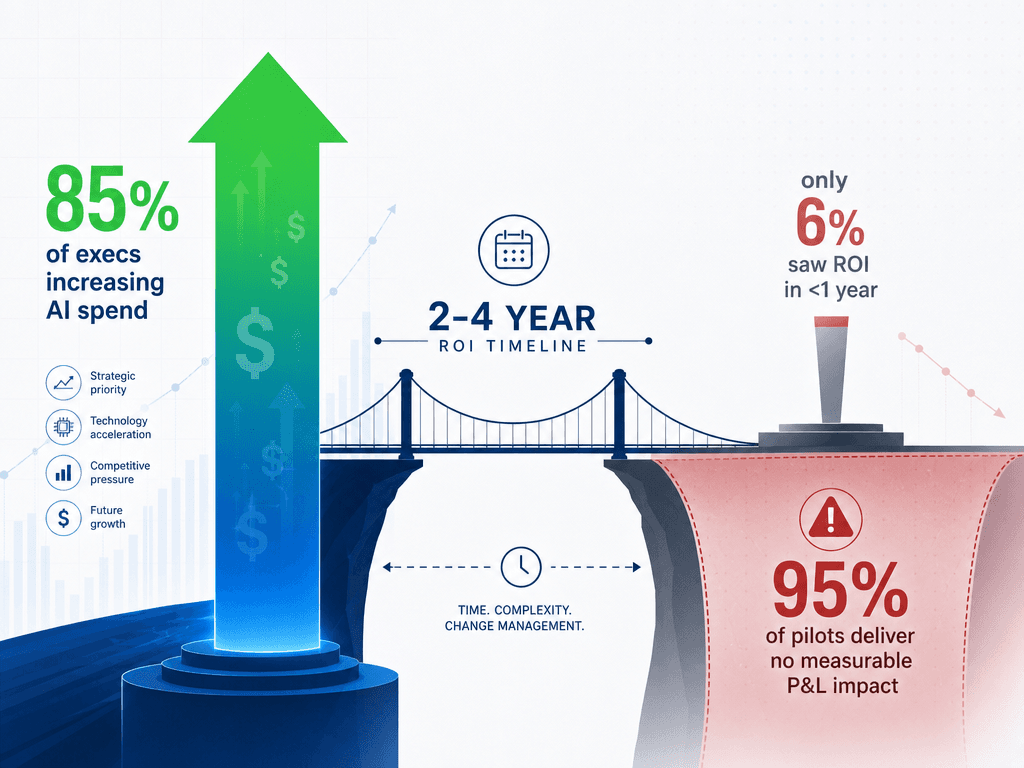
The enthusiasm for artificial intelligence in procurement and supply chain has never been higher. According to a 2025 survey by Deloitte, 85% of organizations have increased their AI investment over the past year. SupplyChainBrain reports that 85% of executives plan to increase AI spending in 2026, with one in five expecting a 20% or greater increase. The market reflects this momentum: Precedence Research valued the AI-in-supply-chain market at $9.94 billion in 2025, projecting it to reach $236.42 billion by 2035.
Yet the returns tell a different story. The same Deloitte survey found that only 6% of organizations saw ROI in under a year. More starkly, a 2025 study from MIT's NANDA initiative — cited by both Art of Procurement and SupplyChainBrain — found that 95% of enterprise AI pilots deliver no measurable P&L impact. This is the ROI paradox: surging investment colliding with elusive returns.
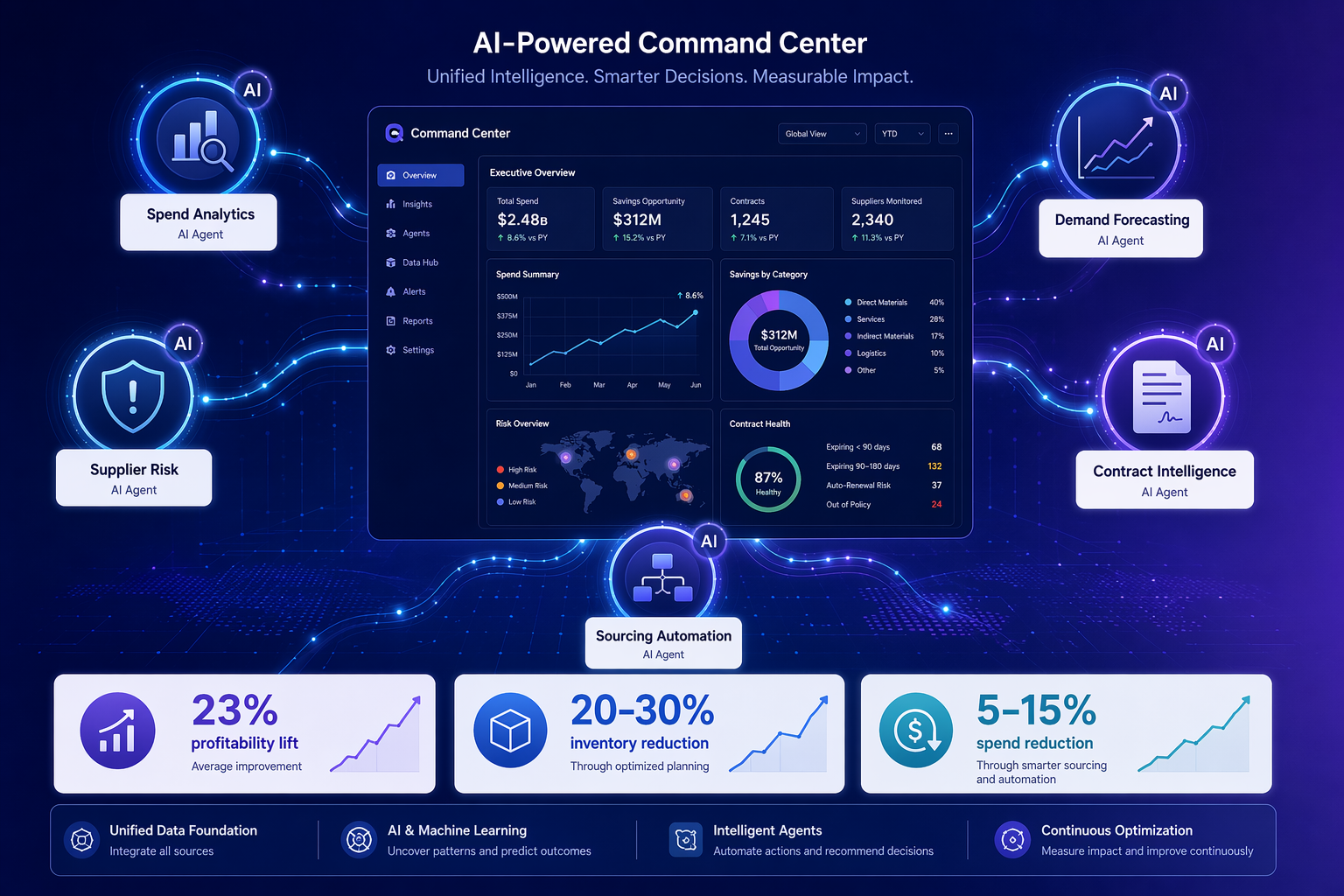
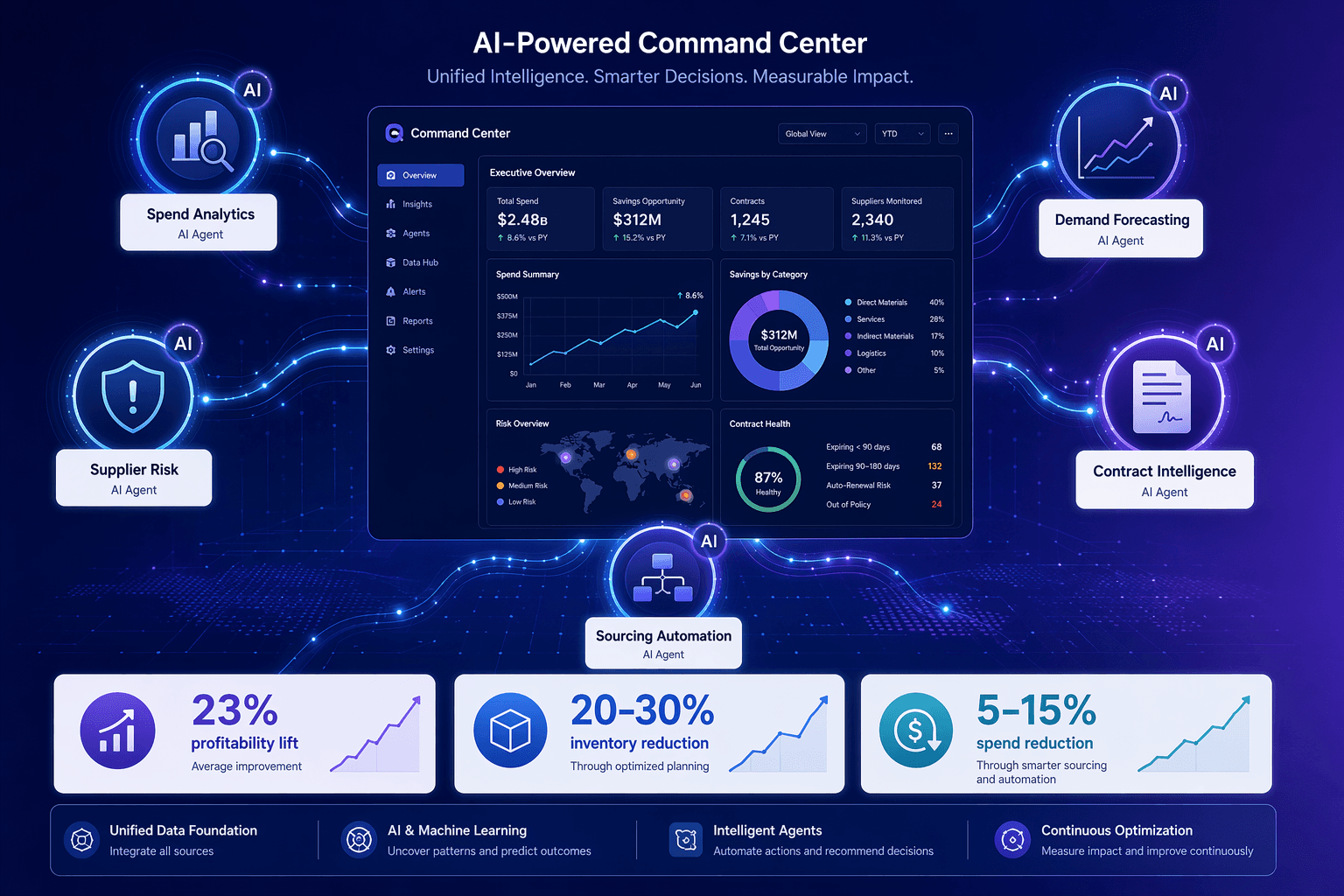
The core thesis of this article is that the ROI of AI in procurement and supply chain is real but unevenly distributed. Companies with AI-mature supply chains are 23% more profitable and six times more likely to use AI widely, according to an Accenture study of 1,148 companies across 10 industries in 15 countries. The difference lies not in the technology itself but in deployment discipline: anchoring to specific, measurable outcomes, leveraging external partnerships, and planning for a realistic ROI timeline. This article synthesizes data from McKinsey, Deloitte, Accenture, Gartner, and MIT to help you build a defensible investment case — one that survives CFO scrutiny.
For a detailed look at how procurement teams are navigating the gap between pilot and production, see our companion article From Pilot to Production: How Procurement Teams Are Actually Deploying AI, which covers deployment patterns in depth. Here, we focus on the business case.
What the Data Actually Says: ROI Ranges by Use Case
To build a credible business case, you need source-attributed ROI ranges — not vendor promises. The following table synthesizes findings from McKinsey, Deloitte, Accenture, and Gartner across the most common supply chain AI use cases. These figures represent the range of outcomes reported in studies, not guaranteed results for any single deployment.
| Use Case | Reported ROI / Impact Range | Primary Source | Adoption Maturity |
|---|---|---|---|
| AI-enabled distribution & logistics | 5–20% logistics cost reduction; 20–30% inventory reduction | McKinsey 2024 | Growing |
| Procurement spend analysis & automation | 5–15% procurement spend reduction; ~97% spend classification accuracy | McKinsey 2024; AIMultiple | Growing |
| Demand forecasting (AI-based) | 10–20% forecast accuracy improvement (typical range per Gartner 2024) | Gartner 2024 | Established |
| Agentic AI in procurement | 25–40% efficiency improvement potential | McKinsey | Emerging |
| AI-mature supply chain (cross-functional) | 23% higher profitability; 6x more likely to use AI widely | Accenture (1,148 companies, 10 industries, 15 countries) | Established (leaders only) |
| Generative AI in procurement (weekly use) | 94% of procurement executives use GenAI weekly; 64% expect AI to transform their role within 5 years | AI at Wharton / Hackett Group 2025 | Growing |
Two additional data points deserve attention. First, advanced spend analysis is the most popular AI use case in procurement, adopted by 78% of organizations that have implemented AI, according to APQC. Second, 8 out of 10 organizations implementing AI in procurement reported improved data quality as a result, and 48% said AI helped reduce contract leakage. These indirect benefits — data quality, compliance, decision quality — are often overlooked in ROI calculations but can be material.
It is also worth noting that the AI-in-supply-chain market is projected to grow from $9.94 billion in 2025 to $236.42 billion by 2035 (Precedence Research), though other analysts offer different projections. MarketsandMarkets, for example, estimates a more conservative trajectory from $13.93 billion to $50.41 billion by 2032. The wide variance reflects differing methodologies and scope definitions — a point worth raising if your CFO asks about market sizing.
Why 95% of AI Pilots Fail — and What Works Instead
The 95% failure rate from MIT's NANDA initiative is sobering, but it is not a reason to abandon AI investment. It is a reason to change approach. The same study identified a critical success factor: AI tools built through external vendor partnerships succeeded approximately twice as often as those built internally. This finding aligns with the broader pattern that deployment discipline — not technology selection — is the primary differentiator between success and failure.
Why do internal builds so often fail? The reasons are structural. Internal teams frequently underestimate the data readiness required: Gartner reported in 2025 that 74% of procurement leaders say their data isn't AI-ready. Internal projects also tend to lack the specialized talent for model development, deployment, and ongoing governance. And perhaps most critically, internal builds often lack a clearly defined, measurable outcome from the start — they begin as exploration rather than as solutions to a specific operational problem.
The failure data should not dominate the narrative. Pair it with the positive evidence: the same organizations that succeed with AI pilots go on to achieve the ROI ranges cited in the previous section. The difference is not that AI doesn't work — it is that most organizations do not yet know how to make it work in their specific context. For a deeper exploration of failure root causes, see our article Why Most Supply Chain AI Initiatives Fail — and What the 4% of Leaders Do Differently.
The 2–4 Year ROI Timeline: Why Pulling Funding at 12 Months Is a Mistake
One of the most common reasons AI initiatives fail to deliver ROI is that they are evaluated on the wrong timeline. Deloitte's 2025 survey found that while 85% of organizations increased AI investment, only 6% saw ROI in under a year. The majority of organizations that achieve satisfactory returns do so within a 2–4 year window. This is not a bug — it is a feature of enterprise AI deployment.
The first 12 months of an AI deployment are typically consumed by foundational work: data integration and cleansing, model training and validation, process redesign, and organizational change management. The 74% of procurement leaders who say their data isn't AI-ready (Gartner 2025) are not starting from a position where rapid ROI is possible. The value accrues in years two through four, as models mature, data quality improves, and the organization learns to trust and act on AI-driven recommendations.
This has direct implications for how you budget, communicate with executives, and govern the program. If your CFO expects a payback period of 12–18 months, you need to reset that expectation before the project begins — not after the first quarterly review. Structure the investment as a multi-year program with staged milestones and clear go/no-go decision points at each stage. The first milestone might be data readiness and model validation, not cost savings.
Building the Business Case: An ROI Calculation Framework
A defensible AI business case organizes benefits into three categories: direct savings, indirect savings, and risk avoidance. Each category requires different data sources and different levels of estimation confidence. The following framework provides a structured approach.
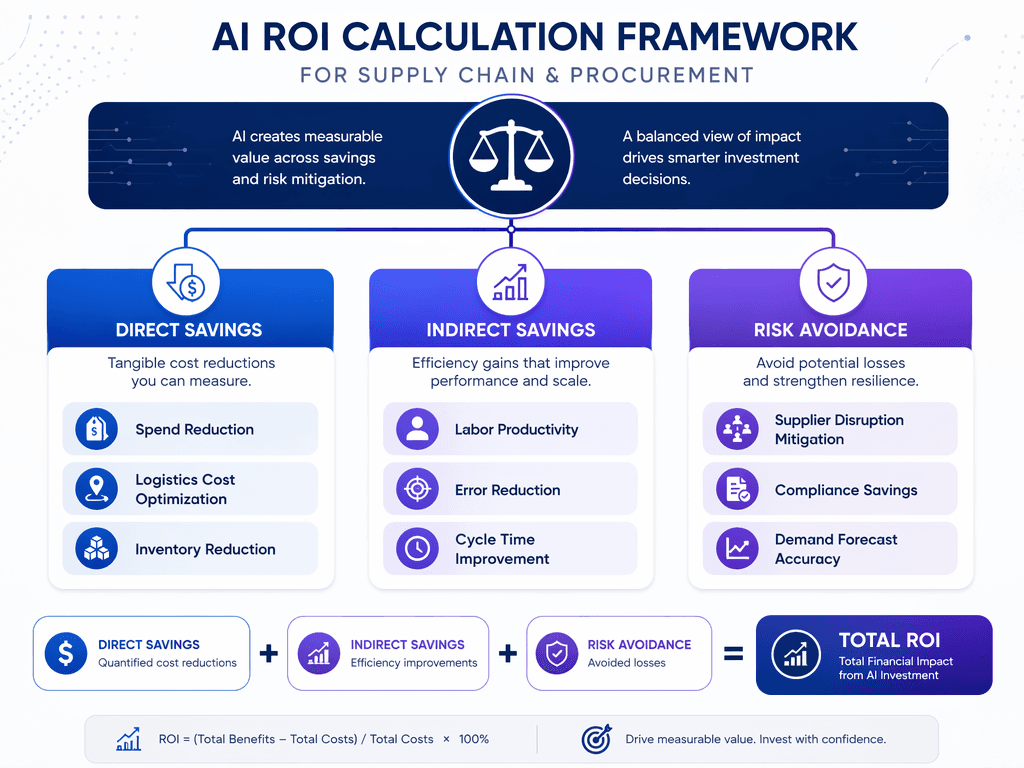
1. Direct Savings (Highest Confidence)
These are the most quantifiable and easiest to defend. Use your own spend data and apply the benchmark ranges from the table above as a sanity check.
- Procurement spend reduction: Apply the 5–15% range from McKinsey to your addressable spend. If your organization spends $500 million annually on direct and indirect materials, the potential savings range from $25 million to $75 million.
- Logistics cost reduction: Apply the 5–20% range from McKinsey to your total logistics spend (transportation, warehousing, distribution).
- Inventory reduction: Apply the 20–30% range from McKinsey to your current inventory carrying costs. For a company with $200 million in inventory, this represents $40–60 million in freed working capital.
2. Indirect Savings (Medium Confidence)
These benefits are real but harder to isolate from other operational improvements. Use conservative estimates.
- Labor productivity: The 25–40% efficiency improvement potential from agentic AI in procurement (McKinsey) can be applied to the portion of procurement work that is repetitive and rules-based (e.g., PO processing, invoice matching, supplier onboarding).
- Error reduction: 48% of organizations implementing AI in procurement reported reduced contract leakage (APQC). Estimate the current cost of contract leakage in your organization and apply a 30–50% reduction.
- Cycle time improvement: AI-powered contract negotiation and RFP/RFQ generation (42.33% of GenAI use cases per Deloitte's 2025 Global CPO Survey) can reduce sourcing cycle times by 30–50%.
3. Risk Avoidance (Lower Confidence, Potentially Higher Impact)
Risk avoidance is the hardest to quantify but often the most valuable. It includes supplier disruption mitigation, compliance savings, and improved forecast accuracy reducing stockouts and write-offs.
- Supplier disruption mitigation: AI-based supplier risk scoring can identify at-risk suppliers 4–8 weeks earlier than traditional methods. Estimate the cost of a single major supplier disruption (lost revenue, expediting fees, production delays) and apply a probability reduction.
- Forecast accuracy improvement: Gartner's 10–20% forecast accuracy improvement range translates directly into reduced safety stock, fewer stockouts, and lower write-off costs.
- Compliance savings: AI-powered contract analysis (41.27% of GenAI use cases per Deloitte) can identify non-compliance clauses, expiring contracts, and pricing discrepancies that would otherwise go unnoticed.
For a deeper dive into warehouse-specific ROI modeling, including payback periods and cost modeling, see our guide How to Build a Business Case for AI in Warehouse Management: ROI Benchmarks, Payback Periods, and Cost Modeling.
Benchmarking Your Readiness: The AI-to-ROI Maturity Model
Not every organization is equally positioned to capture AI ROI. The following maturity model helps you assess where you are and what you need to move to the next stage. The four stages are Ad Hoc, Pilot-Driven, Scaled, and AI-Mature.
| Dimension | Ad Hoc | Pilot-Driven | Scaled | AI-Mature |
|---|---|---|---|---|
| Data quality | Siloed, inconsistent, manual entry | Centralized but incomplete; 74% say not AI-ready (Gartner 2025) | Clean, governed, integrated with ERP | Real-time, self-healing data pipelines |
| Organizational alignment | No dedicated AI budget or team | One-off pilots; no cross-functional governance | Dedicated AI CoE; executive sponsorship | AI embedded in every supply chain function |
| Vendor partnership approach | No vendor engagement | Single vendor pilot; no structured evaluation | Multi-vendor strategy with clear evaluation criteria | Strategic partnerships; co-development |
| Governance & model management | None | Ad hoc; no model monitoring | Formal model governance; drift monitoring | Automated governance; human-in-the-loop design |
| Typical ROI timeline | No measurable ROI | 2–4 years (Deloitte); high failure risk (95% fail per MIT) | 1–3 years; consistent positive returns | Continuous improvement; 23% profitability premium (Accenture) |
Most organizations today are in the Pilot-Driven stage. The Hackett Group's 2025 CPO Agenda report found that 49% of procurement teams piloted generative AI in 2024, but only 4% achieved large-scale deployment. The gap between pilot and scale is where the 95% failure rate lives. Moving to the Scaled stage requires deliberate investment in data quality, organizational alignment, and governance — not just more pilots.
Action Plan: How to Pitch an AI Business Case That Survives Executive Scrutiny
The following five-step action plan is designed to help you build and present an AI investment case that addresses the likely objections from your CFO, CEO, and board. Each step is grounded in the data and frameworks presented above.
Step 1: Anchor to a Specific, Measurable Outcome
Do not pitch "AI in procurement." Pitch "reducing procurement spend by 8–12% over three years through AI-powered spend analysis and contract optimization." The more specific the outcome, the easier it is to model, track, and defend. Use the ROI ranges from the table in Section 2 as benchmarks, but anchor your projections to your own data.
Cite the McKinsey, Deloitte, and Accenture data as evidence that the ROI is real when deployed correctly. But be transparent about your assumptions: what portion of the benchmark range are you targeting, and why? What is your confidence level? A business case that acknowledges uncertainty is more credible than one that promises guaranteed results.
Step 3: Plan for a 2–4 Year Timeline with Staged Milestones
Structure the investment as a multi-year program with clear milestones: Year 1 is data readiness and model validation; Year 2 is pilot deployment and initial savings; Years 3–4 are scale and optimization. Include go/no-go decision points at each stage. This addresses the CFO's concern about sunk costs while preserving the long-term value.
Step 4: Include Risk Mitigation and Governance
Acknowledge the 95% pilot failure rate from MIT's NANDA study and explain how your approach mitigates it: use external vendor partnerships (which succeed ~2x more often), ensure data readiness before launch, and implement model governance from day one. This shows the board that you have studied the failure modes and built a plan to avoid them.
Step 5: Prepare for the CFO's Likely Objections
Anticipate the three most common objections and have data-backed responses ready:
- "Why can't we see ROI in 12 months?" Response: Deloitte found that only 6% of organizations see ROI in under a year; the majority achieve satisfactory returns in 2–4 years. Pulling funding at 12 months is the most common self-inflicted failure mode.
- "What if this is just another failed pilot?" Response: The MIT NANDA study shows that external partnerships succeed ~2x more often than internal builds. Our approach uses vendor partnerships, not internal development, and we have a staged go/no-go process.
- "How do we know these ROI numbers are real?" Response: The benchmarks come from McKinsey, Deloitte, Accenture, and Gartner — not from vendors. We are using conservative estimates from our own data, validated against these external benchmarks.
The ROI of AI in procurement and supply chain is real. Companies with AI-mature supply chains are 23% more profitable (Accenture). AI-enabled distribution can reduce logistics costs by 5–20% and inventory by 20–30% (McKinsey). But these returns are not automatic — they require deployment discipline, realistic timelines, and a business case that acknowledges both the potential and the risks. Use the data and framework in this article to build that case, and you will be well-positioned to secure the investment your organization needs.
Comments
Join the discussion with an anonymous comment.