
Context: Agentic AI Has Arrived in Supply Chain Operations
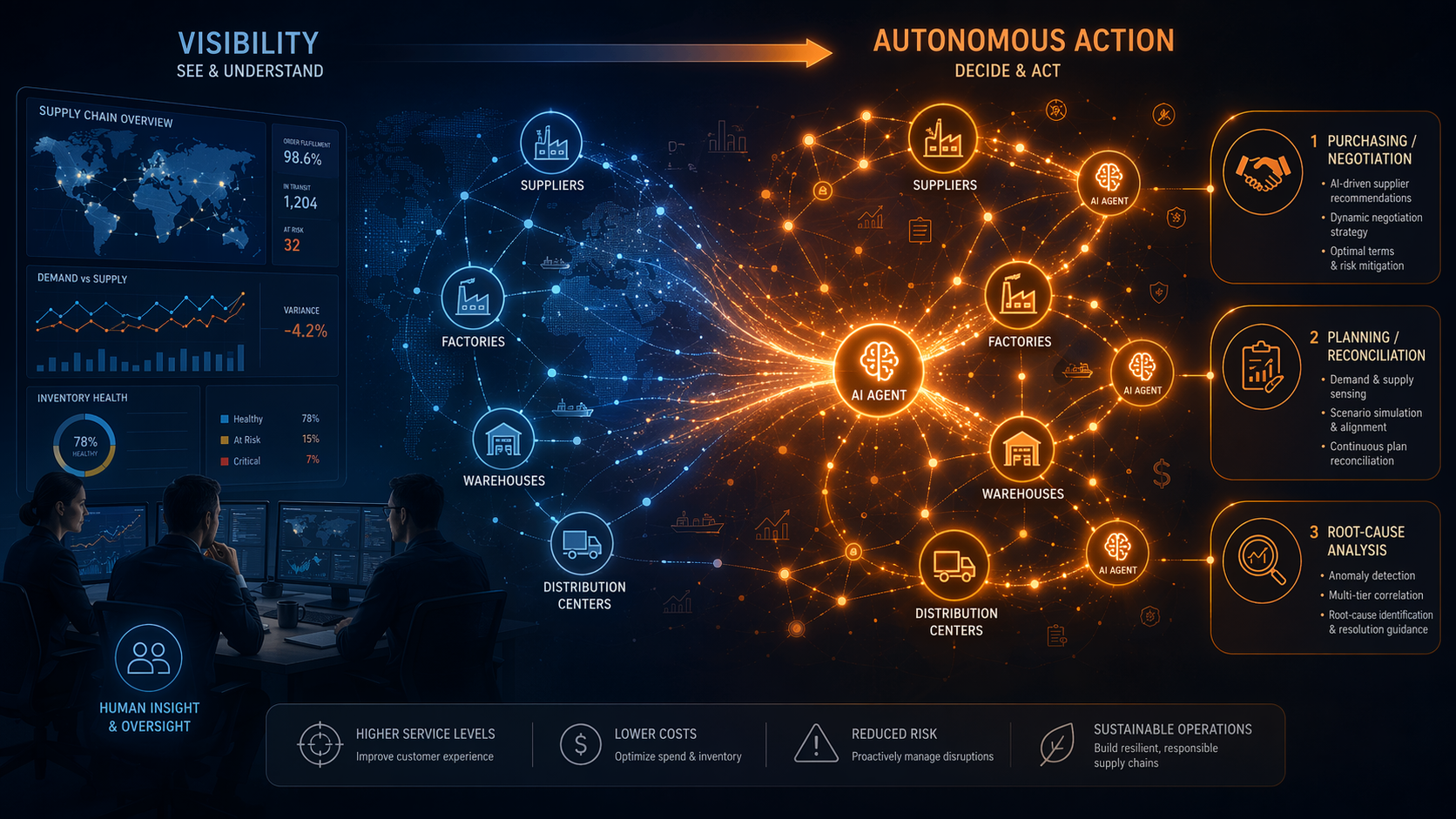
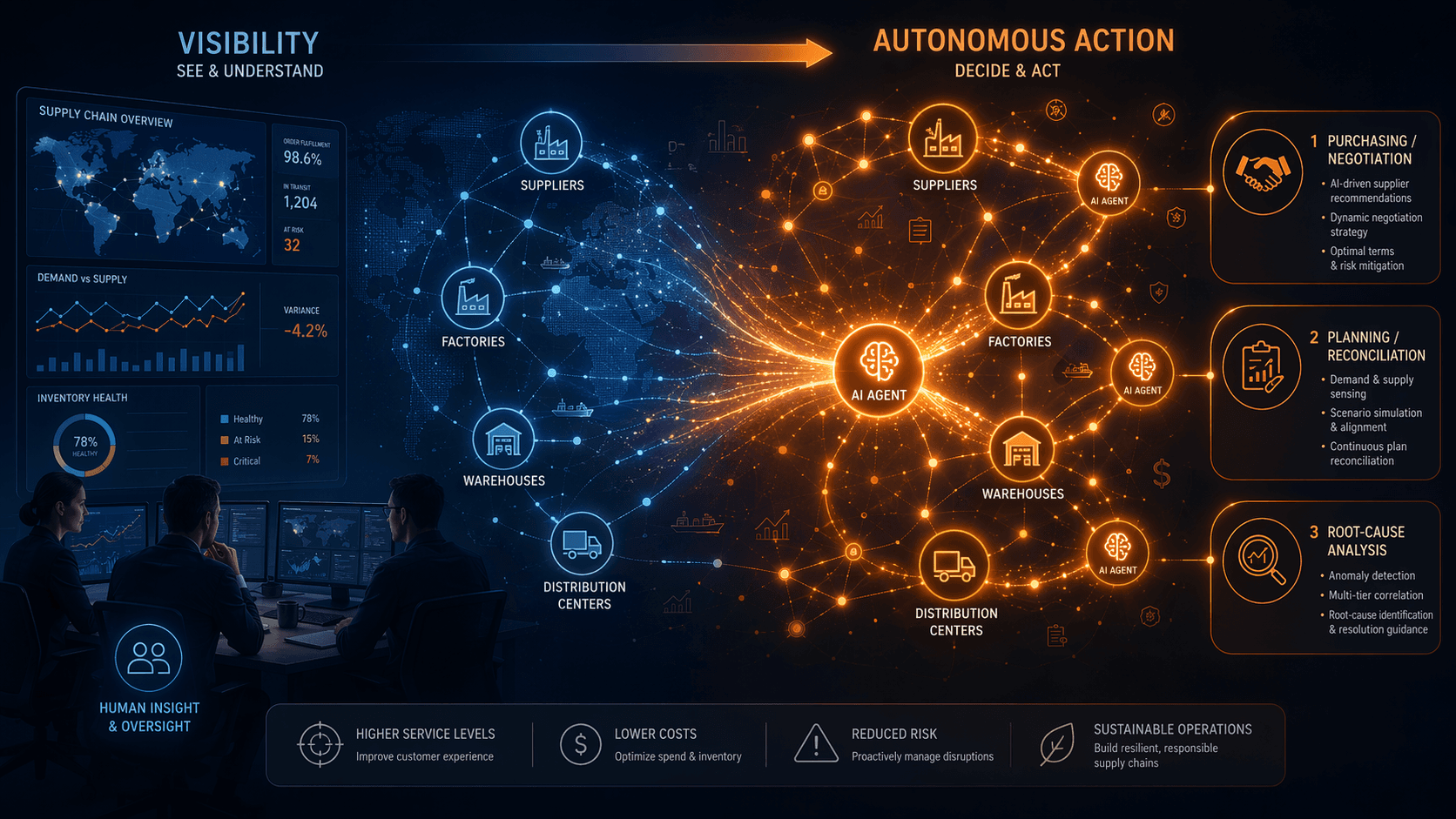
For the past several years, the dominant narrative around AI in supply chain has been about visibility. AI-powered control towers gave planners the ability to see disruptions earlier, track inventory across nodes, and monitor supplier performance on dashboards. That phase delivered real value, but it stopped short of action. A planner still had to interpret the alert, decide what to do, and execute the response manually.
In 2026, that boundary is dissolving. Agentic AI — autonomous software agents that can reason across systems, make decisions within defined parameters, and execute actions without waiting for human approval — has moved from vendor roadmaps into production deployments at forward-thinking organizations. The shift is not theoretical. According to BCG, agentic systems already accounted for 17% of total AI value in 2025 and are projected to reach 29% by 2028. Gartner predicts that by 2028, 15% of daily logistics decisions will be made autonomously by AI agents, and by 2031, 60% of supply chain disruptions will be resolved without human intervention.
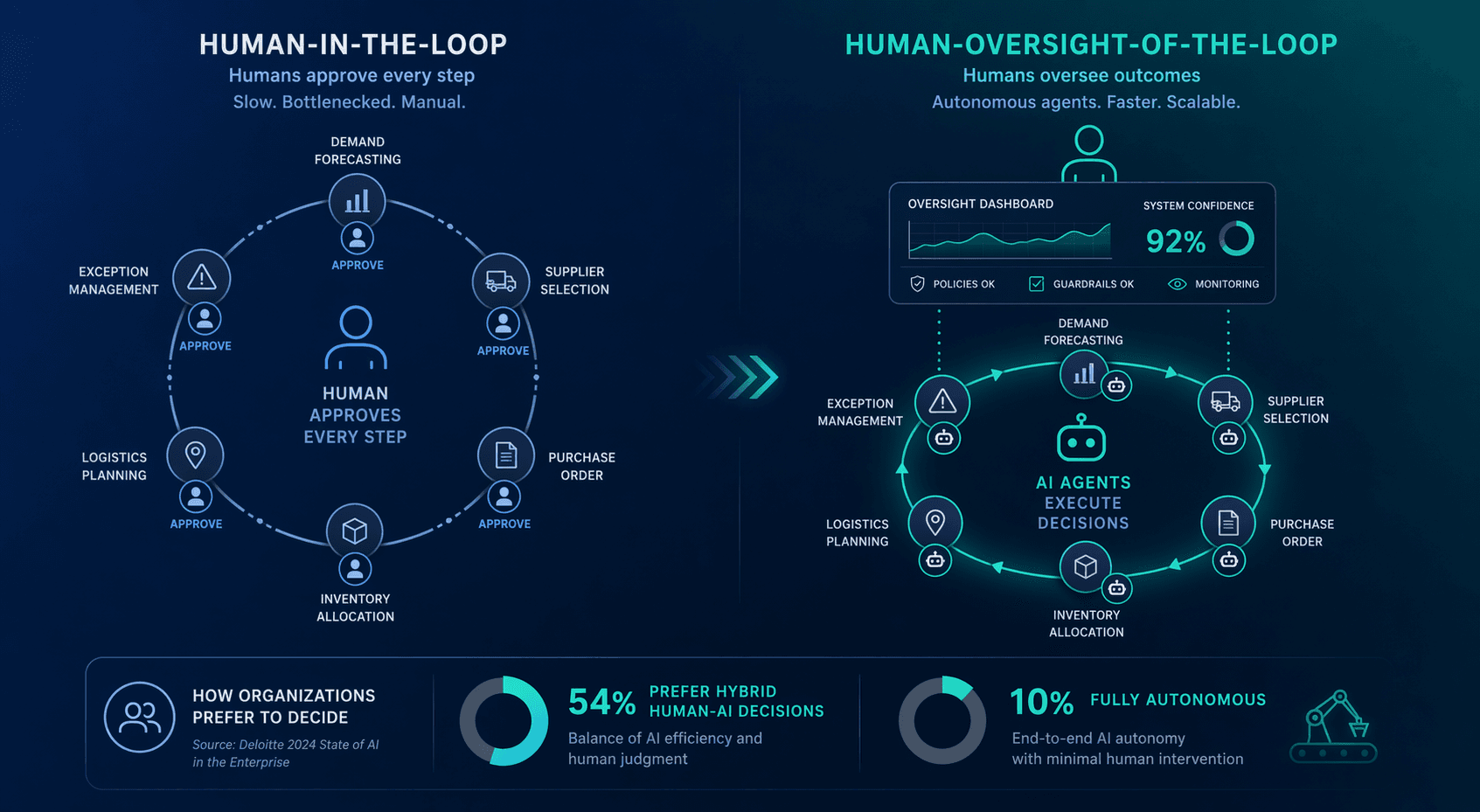
These are not distant forecasts. The 2026 RELEX State of the Supply Chain report, surveying over 500 supply chain leaders across retail, wholesale, and manufacturing, found that 67% of leaders are more confident in AI than they were in 2025, and 71% plan to invest in generative AI over the next three to five years — a 12-point increase from the previous year. The confidence is translating into action, but not uniformly. The same survey reveals a critical trust gap: only 10% of leaders trust AI to make critical decisions without human review, while 54% prefer a hybrid human-in-the-loop approach.
This article documents three concrete deployment patterns where agentic AI is already producing measurable results in 2026: purchase optimization, always-on integrated business planning, and autonomous root-cause analysis. These are not speculative use cases. They are implemented workflows at organizations that have moved beyond visibility into autonomous action. Each pattern is accompanied by the governance structures required to scale it responsibly.
Deployment Pattern 1: Purchase Optimization — Surfacing Working Capital Lost in Process Friction
Procurement teams manage thousands of SKUs sourced from dozens or hundreds of suppliers. For each purchase decision, the optimal outcome — best price, right lead time, acceptable quality — requires reconciling data that lives in separate systems: contract terms in a procurement platform, current spot prices from supplier portals, inventory levels in the ERP, and production schedules in the planning system. In practice, most of this reconciliation happens manually or not at all.
Agentic AI changes this by coordinating price discovery across suppliers autonomously. An agent monitors inbound purchase requests, checks them against contract terms and current market pricing, identifies opportunities to consolidate orders or switch to lower-cost approved alternatives, and surfaces the savings potential before the buyer commits. The agent does not replace the buyer's judgment — it compresses the research phase from hours to seconds and ensures that savings opportunities buried in process friction are surfaced systematically rather than discovered by chance.
RELEX, in its 2026 analysis of supply chain AI, identifies purchase optimization as one of three areas where agentic AI is already making a measurable difference. The pattern works because the decision space is bounded: the agent operates within pre-approved supplier lists, negotiated price ranges, and quality thresholds. It does not negotiate new contracts or approve spend above limits — it finds the best option within the rules procurement has already set.
- The agent monitors inbound purchase requests and cross-references them against contract terms, current spot pricing, and inventory levels.
- It identifies opportunities to consolidate orders, switch to lower-cost approved suppliers, or adjust order timing to capture volume discounts.
- It surfaces the savings potential and recommended action to the buyer, who reviews and approves before the order is placed.
- Over time, the agent learns which types of opportunities the buyer typically approves and can escalate only the exceptions that require judgment.
The working capital impact is direct. Every percentage point of savings on direct materials spend flows to the bottom line, and the agent ensures those savings are captured consistently rather than sporadically. For organizations with annual procurement spend in the hundreds of millions, even a 1–2% improvement represents a significant working capital release.
Deployment Pattern 2: Always-On Integrated Business Planning — Replacing the Monthly S&OP Cycle
The traditional Sales & Operations Planning (S&OP) cycle operates on a monthly cadence. Demand signals are collected, reviewed, and reconciled with supply capacity and financial targets over a period of days or weeks. By the time the plan is finalized, the demand signals have already changed. The process is designed for a world where volatility was manageable and monthly updates were sufficient. That world no longer exists.
Agentic AI enables a fundamentally different operating model: always-on integrated business planning (IBP). Instead of waiting for the monthly cycle, agents continuously reconcile demand signals from point-of-sale data, inventory positions, production capacity, supplier lead times, and financial targets. When a signal changes — a retailer drops a promotion, a supplier extends lead times, a logistics lane experiences disruption — the agent re-evaluates the plan and surfaces the impact on revenue, inventory, and service levels in near-real time.
RELEX describes this pattern as agents enabling "always-on IBP," where the monthly cycle is replaced by continuous reconciliation. The planner's role shifts from manually updating spreadsheets and running what-if scenarios to reviewing agent-generated recommendations, challenging assumptions, and making strategic trade-off decisions. The decision latency collapses from days to seconds.
| Dimension | Traditional Monthly S&OP | Always-On IBP with Agentic AI |
|---|---|---|
| Planning cycle | Monthly, with 1–2 week cycle time | Continuous, updated in near-real time |
| Data reconciliation | Manual data pulls and spreadsheet consolidation | Automated cross-system reconciliation by agents |
| Response to changes | Delayed until next cycle or ad-hoc meeting | Immediate re-evaluation and impact surfacing |
| Planner role | Data gatherer and spreadsheet operator | Strategic reviewer and exception decision-maker |
| Decision latency | Days to weeks | Seconds to minutes |
Dataiku reports that organizations using agentic AI systems in supply chain planning are achieving double-digit efficiency gains and reducing decision latency from days to seconds. The impact is most pronounced in environments with high demand volatility, short product lifecycles, or complex multi-echelon supply networks — exactly the conditions that break the monthly S&OP model.

Deployment Pattern 3: Autonomous Root-Cause Analysis — From Hours of Investigation to Minutes of Action
When a forecast misses by 20% or a supplier misses a delivery commitment, the first question is always the same: why? Answering that question today requires a planner to manually trace the issue across multiple systems — the demand planning system for the forecast, the ERP for inventory positions, the TMS for shipment status, the supplier portal for order confirmations. This investigation can take hours or days, during which the problem compounds.
Agentic AI compresses this timeline dramatically. An autonomous root-cause analysis agent monitors forecast accuracy and supplier performance continuously. When a threshold is breached — forecast error exceeds a defined percentage, a supplier's on-time delivery rate drops below a target — the agent traces the issue across connected systems, identifies the contributing factors, and surfaces a recommended corrective action. The investigation that once took a planner half a day is completed in minutes.
Unframe AI, a vendor in this space, documents a Fortune 500 manufacturer that deployed AI-powered supplier commitment monitoring and achieved 100% visibility into supplier commitments, three weeks' advance warning of supplier disruptions, and a 30% reduction in supply-driven stockouts. The agent in this deployment continuously monitors supplier performance data, compares actual delivery dates against committed dates, and flags deviations before they become critical. The manufacturer's planners receive alerts with the root cause already identified and a recommended action — issue an RFQ to a pre-approved alternative supplier, adjust safety stock parameters, or escalate to procurement.
The pattern extends beyond supplier performance. Agents can trace forecast misses to specific demand drivers (a promotion that underperformed, a competitor's product launch, a weather event), inventory discrepancies to data entry errors or system latency, and logistics delays to specific carrier or route issues. The common thread is that the agent does not just flag the problem — it identifies the cause and proposes the fix.
Governance and Trust: The Critical Requirement for Scaling Agentic AI
The three deployment patterns above share a common prerequisite: trust. Organizations will not deploy agents that make purchase decisions, adjust plans, or trace root causes unless they are confident the agents will act correctly, transparently, and within boundaries. The 2026 RELEX survey data makes the trust gap explicit: only 10% of supply chain leaders trust AI to make critical decisions without human review, while 54% prefer a hybrid human-in-the-loop approach.
This trust gap is not a barrier — it is a design constraint. Organizations that successfully deploy agentic AI build governance structures that address it directly. The operating model shift is from human-in-the-loop (where every action requires human approval) to human-oversight-of-the-loop (where humans define the rules, monitor performance, and intervene on exceptions). The following components are essential for scaling agentic AI responsibly:
- Confidence scoring: Every agent recommendation includes a confidence score that reflects how certain the agent is about the data quality, the completeness of its analysis, and the likelihood that the recommended action will produce the expected outcome. Low-confidence recommendations are automatically escalated to human review.
- Audit trails: Every action the agent takes — every data point it queries, every decision it makes, every recommendation it surfaces — is logged in an immutable audit trail. This is not optional. Regulators, internal auditors, and supply chain leaders need to be able to reconstruct why a decision was made.
- Human escalation paths: Agents are designed to know when they are out of their depth. When a decision falls outside defined parameters — a new supplier, a price above threshold, a disruption with no precedent — the agent escalates to a human with the relevant context already assembled.
- Enterprise-grade controls: Agent permissions, data access boundaries, and decision authority are managed through the same identity and access management systems that govern human users. An agent cannot access data or make decisions that its human counterpart would not be authorized to handle.
| Governance Component | What It Does | Why It Matters |
|---|---|---|
| Confidence scoring | Ranks agent recommendations by certainty level | Prevents low-confidence actions from executing without human review |
| Audit trails | Logs every agent action and decision | Enables reconstruction of decision rationale for compliance and learning |
| Human escalation paths | Routes out-of-bounds decisions to human reviewers | Ensures agents operate within defined authority boundaries |
| Enterprise-grade controls | Manages agent permissions via existing IAM systems | Prevents unauthorized data access or decision authority |
Unframe AI, in its analysis of agentic AI requirements, emphasizes that confidence scoring, audit trails, human escalation paths, and enterprise-grade controls are not nice-to-have features — they are prerequisites for production deployment. Without them, the trust gap widens rather than narrows, and the agent remains a pilot project rather than becoming an operational tool.
Path Forward: Start Low-Stakes, Prove Reliability, Expand Scope
The organizations that are successfully deploying agentic AI in 2026 did not start with autonomous purchase optimization or always-on IBP. They started with low-stakes decisions where the cost of an agent error was minimal and the learning value was high. The adoption path follows a deliberate progression:
- Start with low-stakes decisions. Deploy agents for exception flagging, data reconciliation, and alert triage — tasks where the agent's output is reviewed by a human before any action is taken. The goal is to build trust in the agent's accuracy and reliability without exposing the business to operational risk.
- Prove reliability through pilot programs. Define clear success metrics: accuracy of root-cause identification, percentage of recommendations accepted by human reviewers, reduction in investigation time. Run the pilot for a defined period (typically 60–90 days) and measure against baseline performance.
- Expand scope to higher-value decisions. Once the agent has proven reliable in low-stakes tasks, expand its authority to make recommendations in purchase optimization and planning adjustments — always with human review and approval. This is the hybrid operating model that 54% of leaders prefer.
- Graduate to autonomous execution. Only after the agent has demonstrated consistent accuracy, the governance framework is mature, and organizational trust is established should the agent be given authority to execute decisions autonomously within defined boundaries. Even then, human oversight remains in place for exceptions and strategic decisions.
This staged approach is not about delaying value — it is about ensuring that the value is real and sustainable. The organizations that rush to full autonomy without building the governance foundation typically encounter failures that set their programs back by quarters or years. The organizations that move deliberately, proving reliability at each stage, build the organizational trust required to scale.
The three deployment patterns documented in this article — purchase optimization, always-on IBP, and autonomous root-cause analysis — represent the leading edge of agentic AI in supply chain in 2026. They are not hypothetical. They are working now at organizations that have invested in the data readiness, governance structures, and operating model changes required to support them. For supply chain leaders who have already deployed basic AI/ML and are evaluating the next frontier, these patterns offer a concrete, proven path forward.
Comments
Join the discussion with an anonymous comment.