

Most procurement teams do not need another reminder that AI is coming. They need a cleaner answer to a harder question: what has to be true about the data before AI can do useful work without creating a new queue of manual corrections?
In procurement terms, AI-ready data has five practical characteristics. It is complete enough to answer the question being asked. It is consistent across systems and business units. It is current enough that buyers are not acting on stale supplier, price, or contract information. It is connected across spend, supplier, contract, PO, invoice, and risk records. And it is structured so machines can classify, compare, retrieve, and trigger workflows without guessing at every field.
That sounds basic until it is tested against real procurement data. Supplier names have legal suffixes, local spellings, legacy IDs, and acquired entities. Category trees reflect past reorganizations. Contract metadata is trapped in PDFs. Finance, procurement, and business stakeholders often use the same field name to mean different things. This is why the uncomfortable starting point matters: 74% of procurement leaders said their data was not AI-ready, even as many organizations continued deploying AI anyway, according to a SpecLens summary of Deloitte’s 2025 Global CPO Survey data.[1]

The issue is not whether procurement should wait for perfect data. It should not. The issue is whether the first investments are sequenced well enough that imperfect data becomes usable instead of permanently “temporary.” Deloitte’s Digital Masters research gives the business case some weight: organizations in the top quartile of data maturity achieved 3.2x ROI on AI investments, compared with about 1.5x for average organizations.[2] That figure is broader than procurement alone, so it should not be treated as a procurement-only benchmark. It is still a useful warning. AI ROI is not mainly gated by model ambition; it is gated by data maturity.
Structured procurement data is already associated with operating differences before the discussion gets to agents or generative AI. The Hackett Group reported that world-class procurement teams run sourcing cycles 24% shorter and requisition-to-PO cycles 58% shorter, with structured data identified as part of that performance gap.[3] Faster cycle times are not an abstract AI promise. They show what happens when downstream work stops waiting for basic facts to be reconciled.
The five characteristics that make procurement data usable for AI
“AI-ready” is sometimes used as if it means a complete enterprise data rebuild. In procurement, the standard can be more bounded. The data must be good enough for the specific decision or workflow the AI is supporting. A sourcing recommendation, a contract-risk summary, and autonomous invoice matching do not require identical data depth. They do require the same five disciplines.
| Characteristic | What it means in procurement | What breaks when it is weak |
|---|---|---|
| Completeness | Required fields are populated for the relevant use case, such as supplier ID, category, business unit, contract owner, payment terms, and renewal date. | AI fills gaps with assumptions, pushes low-confidence records to humans, or excludes large portions of spend from analysis. |
| Consistency | The same concept is represented the same way across systems, regions, and functions. | Supplier duplicates, mismatched category codes, and conflicting definitions make recommendations hard to trust. |
| Currency | Records are refreshed often enough for the decision cycle they support. | Buyers see expired contracts, outdated supplier status, old risk indicators, or pricing that no longer reflects the market. |
| Connectivity | Spend, supplier, contract, PO, invoice, and performance data can be joined through reliable identifiers. | AI can describe one dataset but cannot explain cause, obligation, leakage, or exposure across the procurement lifecycle. |
| Structure | Critical information is machine-readable, classified, and available in fields rather than buried in free text or documents. | Search and summarization may work, but workflow automation stalls because systems cannot act on the answer. |
The useful test is not whether every record is beautiful. It is whether a buyer, analyst, or workflow can rely on the field without opening three systems and a spreadsheet to confirm it. If the answer is no, the AI will inherit the same workaround culture that already slows procurement operations.
A four-phase roadmap that does not require a heroic overhaul
The most workable maturity path moves in four phases: data foundation, analytics, automation, and agentic operations. This progression appears in vendor-adjacent procurement data guidance, including SpecLens, and is best treated as a useful operating pattern rather than a formal industry standard.[1] Its value is sequencing. It keeps teams from buying automation for data that cannot yet sustain analytics, or discussing agents before supplier identity and taxonomy are under control.
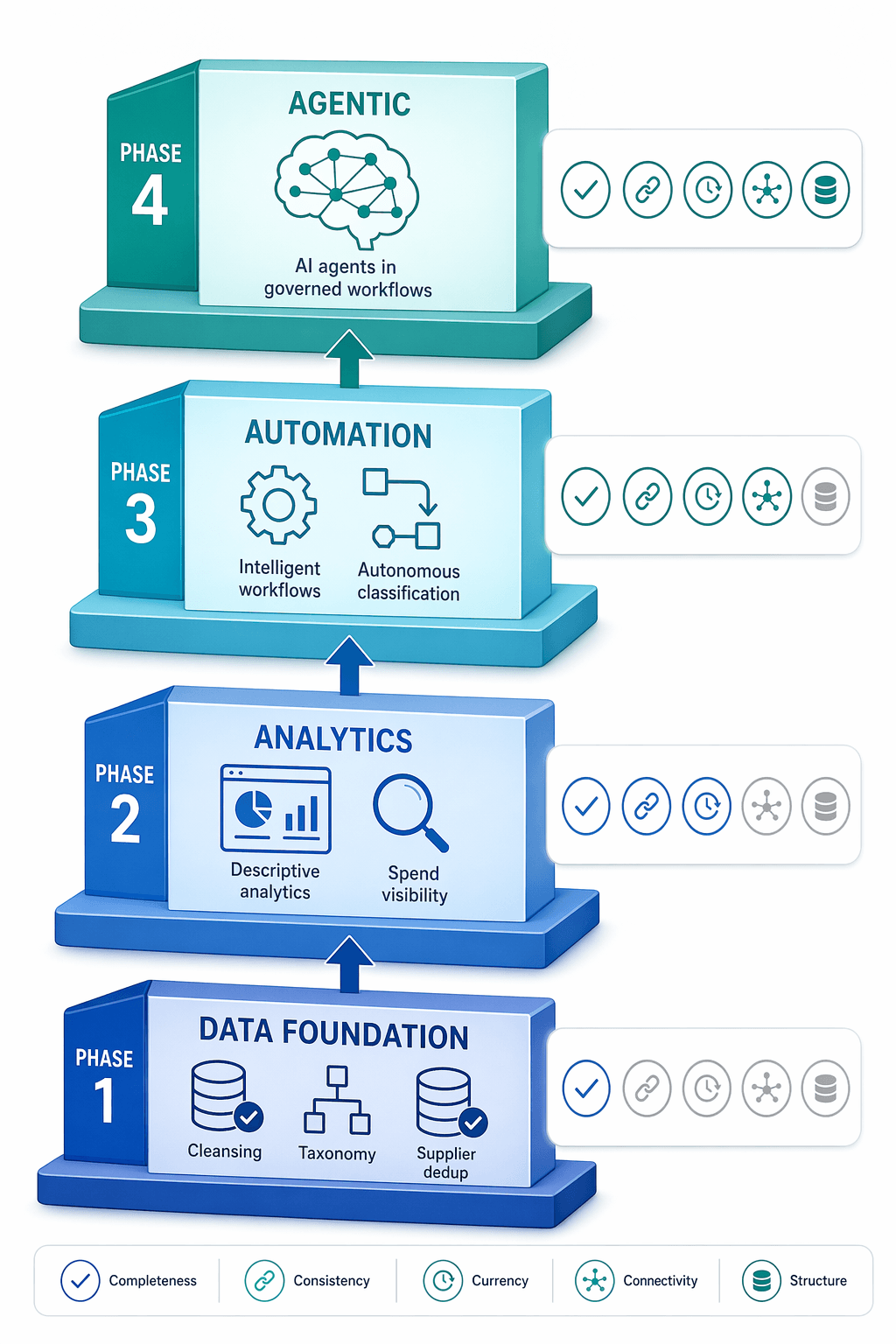
| Phase | Primary objective | Data characteristics improved | Typical procurement work |
|---|---|---|---|
| 1. Data foundation | Create trusted core records. | Completeness, consistency, structure | Clean master data, standardize taxonomy, deduplicate suppliers, align critical field definitions. |
| 2. Analytics | Turn trusted records into visibility. | Connectivity, currency, structure | Build spend dashboards, connect contract and supplier data, extract key contract fields, track leakage and exposure. |
| 3. Automation | Let systems act on governed data. | Consistency, connectivity, currency | Automate classification, intake routing, PO and invoice checks, renewal alerts, and exception handling. |
| 4. Agentic | Allow AI agents to operate within controlled workflows. | All five, especially connectivity and structure | Deploy agents that retrieve context, recommend actions, initiate governed workflows, and escalate exceptions. |
Phase 1: Data foundation
This is the phase most teams want to rush through and later regret. Foundation work is not glamorous, but it decides whether AI initiatives in procurement produce leverage or just prettier exception reports.
Start with spend consolidation. Pull the highest-value spend sources into one working environment, even if the target state is not yet the enterprise data lake. The point is to see the same supplier, category, business unit, and transaction fields together. In many organizations, the first useful outcome is not a model. It is discovering that category coverage, supplier naming, and business-unit mappings are worse than the steering committee assumed.
Supplier deduplication should follow quickly. A supplier master with duplicate entities prevents reliable spend aggregation, risk exposure analysis, contract matching, and supplier performance measurement. The practical move is to define a survivorship rule: which system wins for legal name, tax ID, parent-child relationship, payment status, diversity status, and risk flags. Without that rule, every cleanup meeting becomes a debate about whose spreadsheet is more current.
Then standardize the procurement taxonomy. This is where many projects slow down because taxonomy is not just a data exercise. It is a governance exercise with budget owners, category managers, finance, risk, and sometimes IT all defending different levels of detail. A taxonomy that cannot survive stakeholder sign-off will not survive AI classification. It will simply move the argument from Excel to a dashboard.
Phase 2: Analytics
Analytics begins when procurement can answer basic questions without a manual reconciliation sprint. How much did the company spend by category, supplier, region, business unit, and contract status? Which suppliers are off-contract? Which contracts renew in the next operating window? Which categories have enough transaction history to support sourcing recommendations?
This is the right phase to extract the most important contract fields rather than trying to digitize every clause at once. Renewal date, termination notice period, payment terms, price adjustment language, contract owner, supplier entity, governing category, and committed volume usually matter earlier than a perfect clause library. The first extraction pass should serve a defined workflow: renewal management, leakage analysis, supplier consolidation, or sourcing pipeline planning.
The analytics phase also exposes field-definition problems. If finance defines “addressable spend” one way and procurement defines it another, the dashboard will not settle the disagreement. It will hard-code it. The better move is to write operational definitions for the fields that drive decisions: addressable spend, managed spend, savings, avoidance, preferred supplier, contracted spend, maverick spend, and realized value.
Phase 3: Automation
Automation is where weak foundation work becomes expensive. If supplier identity, category, contract status, and approval rules are unreliable, automation does not remove work. It moves work to the exception queue, where procurement operations, AP, and category teams spend their time resolving what should have been settled upstream.
The early automation candidates should be narrow and measurable: autonomous spend classification for defined categories, intake routing based on category and value thresholds, renewal alerts from extracted contract metadata, PO-line completion checks, invoice-match exception triage, and supplier onboarding field validation. These use cases do not require perfect data across the enterprise. They require clearly governed data for the workflow being automated.
Classification deserves special attention because it is one of the hinge points between analytics and automation. Sievo argues that rules-based classification tends to reach a 75–85% ceiling, while AI-native classification can exceed 98% accuracy when applied with the right training data and governance.[4] Those figures come from vendor material, so they should be evaluated in context. The operational point still holds: when classification quality improves, more spend can move from manual review into governed workflows.
Phase 4: Agentic operations
Agentic procurement is the endpoint people like to discuss first: AI agents that monitor spend, identify sourcing opportunities, prepare supplier shortlists, draft negotiation briefs, trigger intake workflows, and escalate exceptions. In practice, agents are only as useful as the context they can retrieve and the controls they must obey.
At this phase, connectivity matters as much as accuracy. An agent asked to recommend a sourcing action needs spend history, supplier hierarchy, contract coverage, performance data, risk status, stakeholder demand, and policy constraints. If those records cannot be joined, the agent may still produce a fluent answer. It will not produce a dependable procurement action.
The governance line also changes. Earlier phases can tolerate more human review because the work is mostly analytical or assistive. Agentic workflows need explicit authority boundaries: what the agent may retrieve, recommend, draft, route, approve, or execute; which thresholds force escalation; and which source systems remain the record of truth. Without those boundaries, agentic procurement becomes another pilot that operations teams quietly compensate for.
Six one-day tests to find the first constraint
A readiness assessment does not need to begin with a six-month data inventory. Suplari’s framework offers six practical tests that can be run as a starting diagnostic: classification rate percentage, supplier uniqueness score, PO-line-item completion rate, invoice-match accuracy, contract-extraction density, and data-freshness age.[5] These tests are not a certification ritual. They are a way to find the first constraint.
- Classification rate percentage: How much spend can be assigned to a usable category without manual correction?
- Supplier uniqueness score: How many supplier records represent truly distinct entities rather than duplicates, branches, aliases, or outdated legal names?
- PO-line-item completion rate: Are the fields needed for approval, matching, category analysis, and policy checks actually populated?
- Invoice-match accuracy: How often can invoices match cleanly against POs, receipts, contracts, or expected terms?
- Contract-extraction density: For the contracts that matter most, how many critical fields are available in structured form?
- Data-freshness age: How old are the records being used for decisions, and does that age fit the workflow?
The value of these tests is that they point to a next move. A poor supplier uniqueness score belongs in Phase 1. Weak contract-extraction density belongs in Phase 2. Low invoice-match accuracy may require both foundation cleanup and automation redesign. The diagnostic should reduce debate, not create a new readiness dashboard that nobody owns.
The first bounded moves that create leverage
The fastest route is usually not an enterprise-wide cleanup. It is a bounded sequence that improves the fields and records most likely to feed AI-enabled decisions. Three moves deserve priority because they reduce rework across multiple phases.
Codify the taxonomy and get stakeholder sign-off
A procurement taxonomy is not ready because procurement likes it. It is ready when category managers, finance, business owners, and reporting teams agree that the structure is usable for decisions. The sign-off should cover category names, hierarchy depth, mapping rules, ownership, exception handling, and review cadence.
This work prevents a common failure mode: AI classifies spend into categories that look technically correct but are operationally useless. If facilities, IT, HR, and professional services all need different decision cuts, the taxonomy has to reflect those cuts before classification becomes automated.
Move classification from static rules toward AI-native methods
Rules still have a place, especially where policy requires deterministic handling. But rules alone struggle with supplier ambiguity, changing descriptions, local naming conventions, and mixed-category transactions. AI-native classification can use more signals: supplier identity, item text, historical mappings, GL codes, cost centers, contract links, and buyer behavior.
The implementation discipline is to start where the review burden is visible. Pick a high-spend or high-volume area, compare current classification output with expert-reviewed labels, define a confidence threshold, and route only low-confidence records to humans. That gives procurement a measurable way to reduce manual review without pretending the model is infallible.
Write field definitions that finance will actually accept
Field definitions are where AI readiness becomes a management discipline. Procurement may be able to tolerate informal meanings in conversation. Systems cannot. If “savings” means negotiated reduction in one report and realized P&L impact in another, AI-generated analysis will only accelerate disagreement.
The practical artifact is a short data dictionary for critical fields, signed off by procurement and finance. Each definition should specify the business meaning, source system, owner, refresh cadence, allowed values, calculation logic, and known exclusions. This is not bureaucracy for its own sake. It is how teams stop asking analysts to reconcile the same field every month.
Where market momentum fits
There is evidence that the market is shifting budget toward the data layer. CPORising reported that Gartner forecasts AI data readiness spending will grow roughly sevenfold through 2029.[6] The exact investment case will vary by organization, but the direction is unsurprising. As AI pilots move closer to procurement workflows, the weak points become less about model access and more about source quality, governance, and integration.
That does not mean procurement should wait for a fully funded enterprise data program. Waiting often means the same people keep cleaning supplier files, fixing category mappings, and explaining dashboard differences under a different project name. A better threshold is narrower: clean enough records, fields, and relationships to support the next AI-enabled decision or workflow.
The practical threshold for AI and procurement
Procurement data does not become AI-ready all at once. It becomes ready by use case, then by workflow, then by operating model. The first useful version may cover only a few categories, suppliers, contract types, or approval paths. That is acceptable if the boundaries are explicit and the data is governed inside them.
The early work is familiar: consolidate spend, remove supplier duplicates, extract the contract fields that matter, agree on taxonomy, and settle field definitions with finance. Done in sequence, those moves improve completeness, consistency, currency, connectivity, and structure without turning readiness into a transformation monument.
If procurement gets the taxonomy, field definitions, and classification engine right, AI can start producing value from imperfect data much sooner than most teams expect. The point is not to make the data perfect. It is to stop making people compensate for the same preventable defects every time the next tool arrives.
References
- Procurement AI Data Readiness, SpecLens.
- Procurement data quality standards for artificial intelligence adoption, Deloitte.
- The Hackett Group: Procurement Leaders Say AI Will Transform Their Jobs, The Hackett Group.
- Adopt Procurement AI Even with Imperfect Data Quality, Sievo.
- AI-ready procurement data, Suplari.
- Why Data Readiness Determines AI Success, CPORising, June 1, 2026.
Comments
Join the discussion with an anonymous comment.