
AI for supply chain disaster preparedness fails when it is bought as a generic resilience platform and succeeds when it is mapped to the actual work of a disruption lifecycle. Mitigation is not preparedness. Preparedness is not response. Response is not recovery. Each phase asks a different operational question, and each question needs a different kind of AI capability.
Before a hurricane season, the question is whether the team can see exposure early enough to act. During a port closure, the question is whether it can identify affected orders, suppliers, inventory, and customers before the business starts making blind promises. After a flood, fire, earthquake, or geopolitical shock, the question is whether the network can absorb the hit, finance the workaround, and return to acceptable service without quietly creating the next failure.
The stakes justify board-level attention. McKinsey has estimated that the average company experiences a major disruption lasting at least one month every 3.7 years, and that a severe event can erase up to 45% of one year’s profits; it has also reported that AI-driven forecasting can reduce forecast errors by 20% to 50%.[1] Those figures do not prove that any one AI product will pay for itself. They do explain why disaster resilience cannot sit in a side budget waiting for the next storm.
The empirical case is becoming stronger, but it still needs careful handling. A 2025 INFORMS study found that firms with just 2.4% of job demands related to AI could recover the full damage of natural disaster shocks, which the authors describe as direct evidence linking AI investment to measurable resilience under natural disasters.[2] The useful lesson is directional: AI capability appears to correlate with stronger recovery. The wrong lesson would be to turn 2.4% AI job demand into a procurement benchmark, because the study uses cumulative AI-relevant job postings as a proxy for investment rather than a direct measure of deployment maturity.
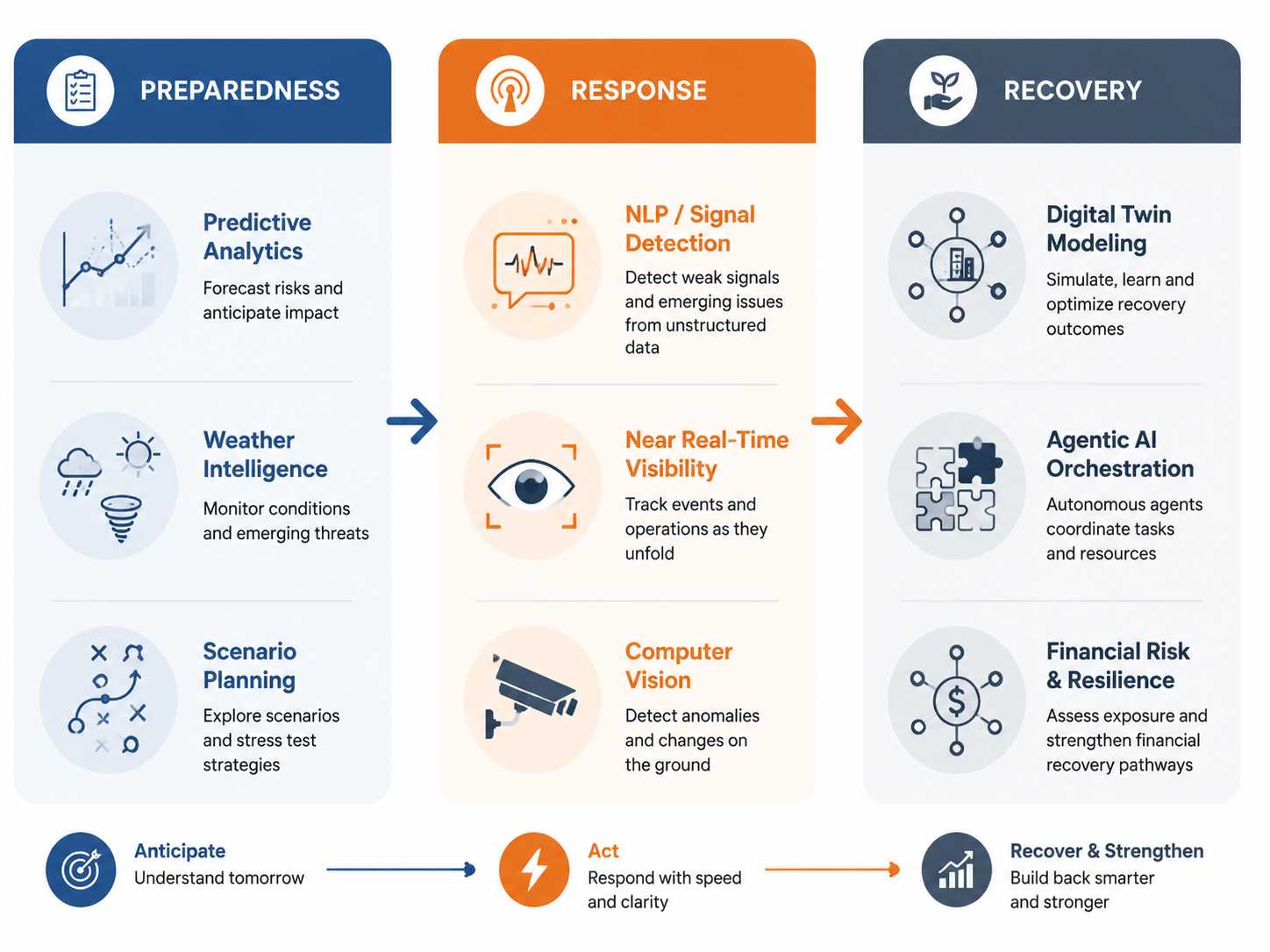
Start With The Phase, Not The Platform
A useful AI evaluation begins with the decision that has to improve. If the decision is made weeks before impact, predictive analytics and scenario modeling usually matter most. If the decision is made while alerts, emails, vessel notices, and supplier updates are multiplying, natural language processing and visibility tools move to the front. If physical conditions have to be observed, computer vision becomes relevant. If alternatives have to be tested across cost, capacity, service, and risk, digital twins earn attention. Agentic AI belongs only where the handoffs, authorities, and stop rules are explicit.
| Disaster lifecycle phase | Primary operational question | AI capabilities that usually fit | Evidence standard to apply |
|---|---|---|---|
| Mitigation | Where is exposure structurally too high? | Supplier risk analytics, knowledge graphs, network mapping | Can the model reveal concentration, dependency, or weak substitutes before a named event? |
| Preparedness | What could happen, where, and with how much lead time? | Predictive analytics, weather warning systems, digital twins, scenario planning | Can the output change inventory, sourcing, routing, or capacity decisions before impact? |
| Response | What is affected right now, and who must act first? | NLP signal detection, control towers, computer vision, near real-time visibility | Can the system reduce time to impact identification without flooding teams with low-value alerts? |
| Recovery | How does the network absorb the shock and return to service? | Digital twins, recovery analytics, constrained agentic workflows | Can recommendations connect to finance, operations, and accountable owners? |
This table is not a maturity model. A company with high Gulf Coast exposure may start with weather warning and hurricane planning. A manufacturer dependent on multi-tier electronics suppliers may start with knowledge graphs and supplier visibility. A shipper exposed to conflict-driven route changes may start with scenario planning. The right starting point is the phase where exposure, usable data, and decision ownership are clearest.
Mitigation: Find The Fragile Shape Of The Network
Mitigation work happens before the forecast cone, evacuation order, smoke plume, or port closure. It asks whether the network is already arranged in a way that will fail predictably: too much qualified capacity in one floodplain, too many alternate parts depending on the same upstream node, too much transport resilience assumed but not contracted.
Here, AI is most useful when it extends visibility beyond the first tier. Knowledge graphs can connect suppliers, sites, parts, commodities, lanes, and customers so that risk teams see shared dependencies that are invisible in a spreadsheet. Supplier risk models can combine internal performance data with external hazard, location, and event signals. The output is not a disaster prediction. It is a sharper map of where the business is brittle.
That distinction matters. A mitigation model that flags every supplier in a storm-prone region as high risk will create work without changing decisions. A better model separates exposure from consequence: which supplier sits in the hazard zone, which part it supports, whether an alternate exists, whether that alternate has available capacity, and which customer promise is at stake.
For readers building that layer, multi-tier supply chain visibility with knowledge graphs is the more relevant proof path than a generic AI control tower demo. The question is whether the model can expose hidden dependencies early enough for procurement, engineering, logistics, and finance to do something about them.
Preparedness: Use Prediction Only Where It Changes A Decision
Preparedness is where AI spending often looks most attractive and where false confidence can do the most damage. Predictive analytics, weather warning systems, supplier risk scoring, scenario planning, and digital twins all belong here, but they should not be treated as interchangeable.
Predictive analytics earns its place when lead time changes an operational move: pulling inventory forward, qualifying another supplier, changing carrier commitments, adjusting production sequence, or warning commercial teams before they commit to delivery dates that logistics cannot support. A forecast that arrives early but does not connect to a decision owner is just a prettier alert.
Weather intelligence is a straightforward example. A procurement team does not need AI to know that hurricane season exists. It needs help connecting changing weather probabilities to supplier sites, port capacity, inventory buffers, and customer exposure. That is where AI weather forecasting for procurement resilience and AI weather warning systems become preparedness tools rather than dashboard features.
Disaster-specific models can then sit underneath the same preparedness logic. Flood risk models can help teams identify exposed sites and routes before water reaches them. Hurricane planning can test supplier and logistics alternatives before landfall. Wildfire smoke detection can connect environmental signals to labor, transportation, and facility risk. Earthquake work is narrower: current AI can support risk mapping and preparedness, but claims about precise earthquake prediction need to be treated cautiously unless the supporting evidence is explicit.
Those narrower use cases deserve drill-downs when the exposure matches the network: flood risk management, hurricane disruption planning, wildfire smoke risk detection, and earthquake risk mapping. They should feed the same preparedness question: what action can the business take before impact?
Where Digital Twins Fit
Digital twins belong in preparedness when alternatives have to be tested before anyone is under pressure. A risk team can model what happens if a port closes, a supplier misses two production cycles, a commodity lane becomes unavailable, or a military strike forces rerouting. The value is not the simulation itself. The value is discovering which workaround fails because capacity, cost, customs, lead time, or inventory assumptions do not survive contact with the rest of the network.
That is why geopolitical and route-shock scenarios are good tests of preparedness maturity. AI scenario planning for Middle East commodity and route shocks and AI supply chain resilience planning for geopolitical escalation are not just security topics; they are exercises in whether operations, sourcing, logistics, and finance share the same version of the network.
Preparedness models should also carry a financial constraint. PreventionWeb warned in April 2026 that weak integration between AI and financial risk analysis remains a major limitation in disaster supply chains.[3] That warning is not academic. A model can recommend expedited freight, alternate sourcing, or inventory pre-positioning that operations can execute but finance cannot underwrite. If cost-to-serve, margin exposure, working capital, and insurance assumptions are outside the model’s operating loop, preparedness becomes a list of technically possible actions rather than funded choices.
Response: Compress The First Ugly Hours
Response is where AI gets judged fast. The event is already moving. Alerts arrive from weather feeds, port authorities, logistics providers, suppliers, news, social media, internal planners, and customer-facing teams. The leader on duty does not need a system that proves it has detected a disruption. She needs to know which suppliers, orders, sites, lanes, inventory positions, and customers are affected, and which decision has to be made first.
Natural language processing is useful in this phase because much of the early signal arrives as messy text: notices, emails, incident updates, advisories, news reports, and supplier messages. NLP can classify events, extract affected locations, match entities to supplier or logistics records, and route exceptions to the right teams. It does not remove the need for human judgment. It reduces the time spent turning unstructured noise into a working incident picture.
Visibility systems and control towers then have to connect that incident picture to execution. A control tower that shows a red dot on a map but cannot link the event to purchase orders, shipments, inventory, and customer commitments is still mostly awareness. The response standard is higher: identify impact, assign ownership, present options, and keep the status current as conditions change. ChainSignal’s discussion of control tower models and ROI is useful here because the distinction between visibility and decision support becomes expensive during a live disruption.
Vendor-reported operating examples are worth considering when they stay labeled as vendor-reported. Everstream Analytics says its clients have reported a 50% to 70% reduction in time to identify disruption impact and a 30% reduction in revenue losses from disruption.[4] DHL’s Resilience360 platform has been described by the World Economic Forum as serving more than 13,000 users with near real-time global visibility.[5] OpenSky Group’s statistics roundup reports that Blue Yonder makes 25 billion predictions per day and detects 96% of disruptions within an hour.[6]
Those are operating claims, not independently audited proof of universal performance. They are still useful because they express response value in units executives understand: minutes and hours saved, impact identified earlier, and losses reduced. A buyer should ask what counted as a disruption, how detection was measured, how false positives were handled, and whether the reported improvement came from AI alone or from workflow redesign around the tool.
Where Computer Vision Belongs
Computer vision belongs in response when physical conditions matter and cannot be inferred reliably from structured data. Camera feeds, satellite imagery, drone footage, yard images, warehouse video, and road or port visuals can help detect blocked access, smoke, flooding, congestion, damaged assets, or unsafe site conditions. It is not the first AI capability every supply chain needs. It is the right capability when the limiting question is, “What is actually happening on the ground?”
Its governance burden is also different. A computer vision system may influence safety calls, site access, carrier dispatch, or facility restart decisions. That means image quality, model confidence, escalation thresholds, and human review rules matter more than the elegance of the detection model.
Recovery: Treat AI As A Recovery Aid, Not A Recovery Owner
Recovery is narrower than preparedness and response, but it is where resilience claims either hold or collapse. The question is no longer whether the disruption was detected. It is whether the network can absorb the damage, allocate constrained supply, re-sequence production, restore service, manage customer commitments, and make financially defensible trade-offs.
The INFORMS finding is important in this phase because it connects AI capability with recovery from natural disaster shocks rather than only with prediction or visibility.[2] It does not say that a model can recover the business. It suggests that firms investing in AI-related capabilities may be better able to recover from damage. That is a meaningful distinction for anyone who has watched a technically sound recommendation fail because the alternate supplier was not approved, the carrier capacity was not contracted, or the margin impact was unacceptable.
Digital twins can support recovery by testing constrained alternatives after the facts change: which customers receive limited supply, which plants restart first, which lanes get scarce capacity, and how much service degradation the business can tolerate. Recovery analytics can compare the cost and service consequences of each path. But the model output has to meet the operating system of the company: finance approves spend, procurement confirms source feasibility, logistics confirms capacity, manufacturing confirms sequence, and commercial teams handle customer commitments.
This is also where agentic AI should be handled carefully. Dataiku’s 2026 trend report identifies agentic AI as an emerging supply chain trend.[7] In disaster work, that does not make autonomous agents the hero. It makes them candidates for bounded tasks: gathering status updates, drafting supplier outreach, preparing exception summaries, comparing approved playbooks, or routing recommendations to accountable owners. An agent that can trigger an expensive workaround without finance approval, customer prioritization rules, or human escalation is not resilience. It is unmanaged authority.
The Governance Gap Is Part Of The Use Case
AI disaster preparedness is often discussed as if the only hard part is model performance. In practice, the harder questions are usually organizational: who owns the decision, who can override the recommendation, who pays for the workaround, who explains the customer impact, and who reviews the model after the event.
A Gartner 2025 supply chain AI survey found that only 23% of organizations have a formal AI strategy. That figure fits what many operations teams already see: experimentation is running ahead of governance. The risk is not only that AI will be wrong. The risk is that AI will be partially right in a way the organization cannot absorb.
A useful governance test is simple. For each AI-enabled disaster use case, name the phase, the decision owner, the permitted action, the required human review, the financial constraint, and the post-event learning loop. If those cannot be named, the use case is not ready for live disruption response, even if the model looks impressive in a demo.
| Capability | Best first use | Governance question |
|---|---|---|
| Predictive analytics | Preparedness decisions with usable lead time | Who changes inventory, sourcing, routing, or production before impact? |
| NLP | Response signal triage from messy text sources | Who validates event classification and escalation? |
| Computer vision | Physical condition monitoring during live events | Who confirms safety or operational action when image confidence is uncertain? |
| Digital twins | Scenario testing before and after disruption impact | Which cost, capacity, and service constraints are binding? |
| Agentic AI | Bounded workflow assistance under explicit rules | What can the agent do without approval, and where must it stop? |
How To Choose The Starting Point
The strongest starting point is rarely the broadest platform. It is the phase where the organization has a known exposure, enough data to support a better decision, and an accountable owner who can act on the recommendation.
- If exposure is visible but dependencies are not, start with mitigation: supplier mapping, knowledge graphs, and concentration risk analysis.
- If exposure is seasonal or forecastable, start with preparedness: predictive analytics, weather warning, and scenario planning.
- If the business loses time during live events, start with response: NLP signal triage, control tower workflows, and impact identification.
- If post-event decisions create cost surprises or service conflicts, start with recovery: digital twins, financial-risk integration, and governed decision workflows.
- If the proposed use case requires autonomous action, treat agentic AI as a governed workflow project, not a resilience shortcut.
This is also where a capabilities framework helps. ChainSignal’s AI capabilities for disruption planning is a useful companion because it separates the tool classes from the disruption types. The point is not to build a complete AI stack in one budget cycle. The point is to stop asking one platform to solve every phase of the lifecycle.
The prioritization rule is blunt because the work is blunt: begin where exposure, data, and ownership are clearest; match the AI capability to that phase; then expand only when governance, financial-risk analysis, and operating workflows can absorb the recommendations. Anything broader than that may still make a good slide. It will not carry the first ugly hours of a real disruption.
References
- Risk, resilience, and rebalancing in global value chains, McKinsey & Company.
- Do Artificial Intelligence Investments Improve Firm Resilience to Natural Disasters? Evidence from Typhoons in China, Information Systems Research, 2025.
- AI: Enhancing efficiency and preparedness in disaster supply chains worldwide, PreventionWeb, April 2026.
- Artificial Intelligence Role in Supply Chain Risk Management, Everstream Analytics.
- How AI is making supply chains more resilient, World Economic Forum, January 2025.
- Supply Chain AI Statistics, OpenSky Group.
- Supply Chain AI Trends 2026, Dataiku.
Comments
Join the discussion with an anonymous comment.