
July 2026 is already inside the decision window. By the time a supplier switch, freight allocation, or inventory build shows up as a clean line in an operating plan, the practical lead time may already be gone. That is the uncomfortable setting for the second half of this year: June 2026 equatorial Pacific temperatures were already 1.5°C above normal, and Everstream Analytics assessed a greater than 60% probability that the event could match historic Super El Niño years such as 1982, 1997, and 2015.[1] Extreme weather had also overtaken cyber as the leading cause of supply chain disruption in 2025, according to BCI’s Horizon Scan.[2]
That combination matters less as a climate headline than as a procurement calendar problem. The main question for an AI weather warning system for supply chain teams is not whether it can describe a storm beautifully. It is whether it gives a sourcing lead, logistics planner, or inventory owner enough warning to make a costly but reversible move before the disruption becomes visible at the dock, plant, farm, canal, or warehouse.

The 2026 Exposure Is Regional, Not Abstract
Super El Niño risk does not arrive as one global supply chain event. It shows up as regional stress at different points in the calendar, with different operating consequences. Everstream’s June 2026 assessment identifies several Q3 and Q4 exposures that should be on procurement and logistics calendars now: drought risk in Southeast Asia from July through September, above-normal typhoon activity in the Western Pacific from August through October, renewed vessel draft restriction risk at the Panama Canal, and emerging heat, drought, and soil moisture deficits across Europe.[1]
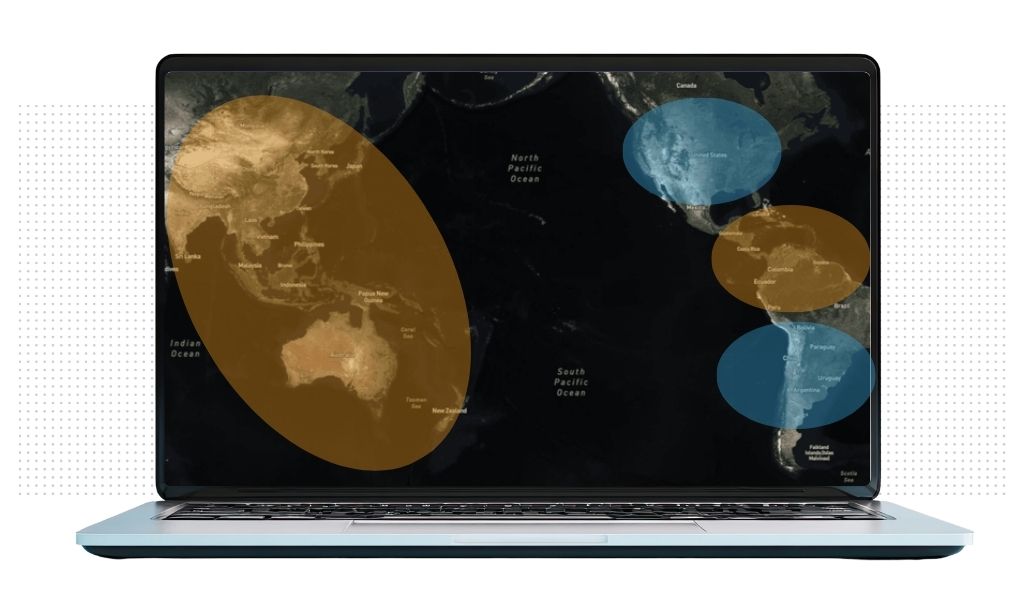
Southeast Asia deserves more than a footnote because the exposed commodities are not easily replaced on short notice. Everstream flags India and Indonesia for July–September drought risk affecting rice, palm oil, and coffee supply chains.[1] A buyer exposed to these categories cannot wait for failed harvest confirmation and still expect normal contracting leverage. The relevant actions sit earlier: reviewing alternative origins, revisiting allocation assumptions, checking supplier irrigation exposure where available, and deciding whether inventory buffers are justified before spot markets price in the same risk.
The Western Pacific risk is different. Above-normal typhoon activity from August through October is not a commodity yield problem first; it is a continuity and routing problem for ports, factories, inbound components, outbound finished goods, and feeder networks.[1] A warning that arrives days before landfall may still help with vessel and yard execution. It does not help much with supplier allocation if purchase orders, production slots, and freight commitments have already hardened.
The Panama Canal is a narrower chokepoint, which makes the operational question sharper. Renewed vessel draft restriction risk does not have to close the canal to create cost and schedule consequences.[1] Reduced draft can mean fewer loaded containers per transit, altered booking behavior, longer wait times, or diversion analysis through alternative routings. For shippers that depend on Asia–U.S. East Coast, U.S. Gulf, or related intermodal flows, this is exactly the kind of risk that belongs in freight allocation discussions before the lane is visibly congested.
Europe’s heat, drought, and soil moisture deficits create a broader operating field: inland waterways, crop inputs, energy demand, labor productivity, and warehouse or transport constraints can all become relevant depending on the network.[1] The useful point is not that every European supplier should be treated as a high-risk node. It is that supplier locations, lane dependencies, and inventory policy should be checked against the specific heat and moisture signals rather than against a generic “Europe risk” label.
Lead Time Is the Product
For supply chains, forecast accuracy is only half the test. The other half is whether the warning lands inside a decision window the company can still use. A seasonal signal that is imperfect but arrives three months before a contract decision may be more valuable than a sharper warning that arrives after inventory has been positioned and carriers have been booked.
| Forecast horizon | Typical supply chain decisions it can still influence | What the warning should connect to |
|---|---|---|
| 1–6 months | Supplier allocation, procurement contracts, stock controls, regional exposure planning | Supplier nodes, commodity categories, origin regions, manufacturing clusters |
| 2–6 weeks | Inventory positioning, routing options, freight mode review, port and lane contingency planning | Warehouses, lanes, ports, carrier commitments, priority SKUs |
| 0–14 days and near term | Execution monitoring, shipment sequencing, yard and labor planning, emergency rerouting | Active shipments, facilities, ports, weather alerts, operational teams |
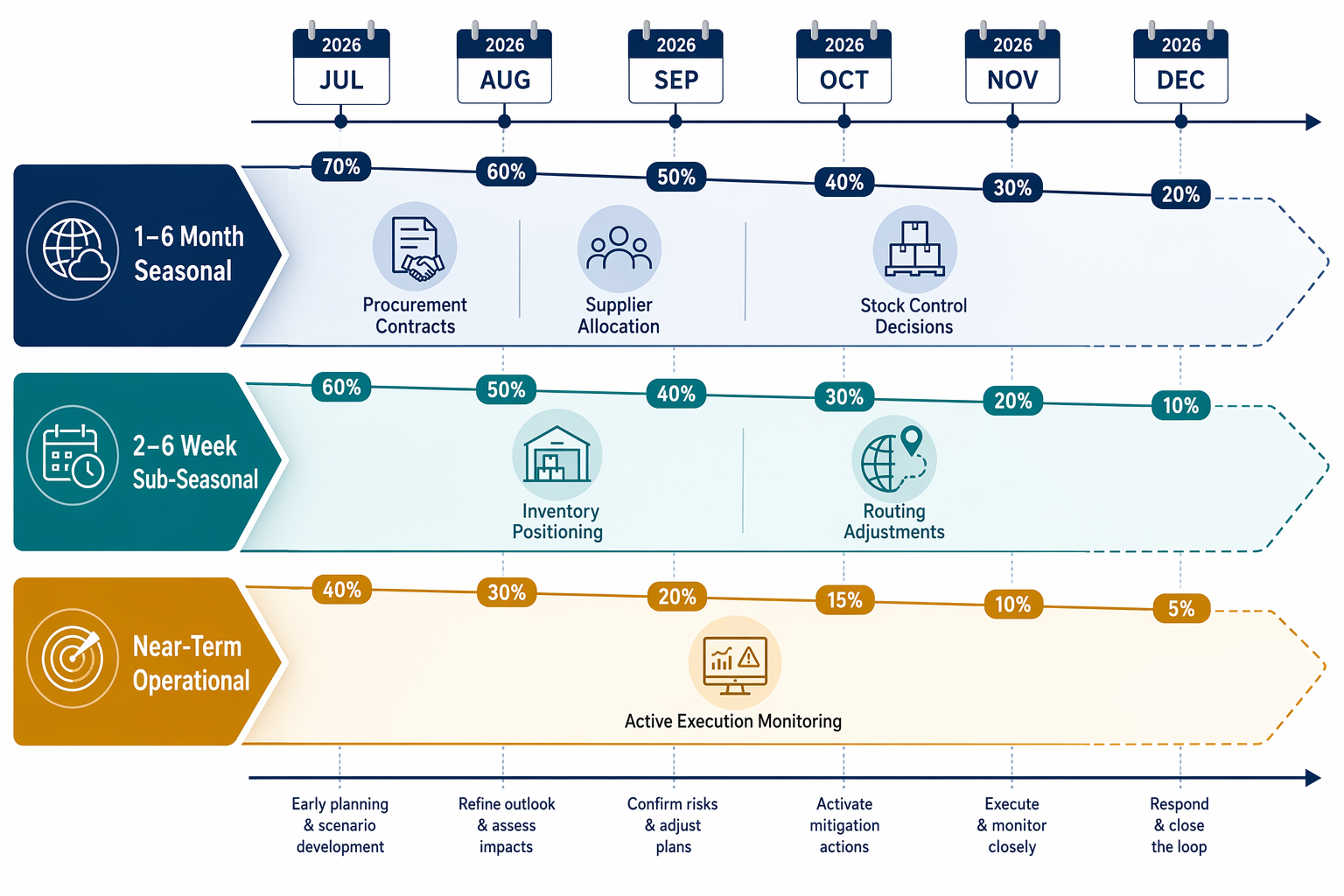
That mapping is where an AI weather warning system for supply chain use differs from a weather dashboard. The planner does not need a prettier map alone. She needs a risk signal tied to a supplier site, a production region, a port, a rail corridor, a canal, or an ocean lane, with enough lead time to decide who acts next.
Everstream describes platforms that ingest more than 20 billion daily data points from sources including NOAA’s Global Forecast System, Global Ensemble Forecast System, and ECMWF models, then produce forecast outputs across 0–14 day hourly, 2–6 week, and 1–6 month horizons at spatial resolutions from 1 to 25 kilometers.[3] In supply chain terms, those model outputs have to be translated into questions such as: which supplier sites sit inside the drought probability area, which lanes intersect likely severe weather corridors, and which warehouses become more important if a port or canal slows?
The probabilistic part is not a technical decoration. It is the whole operating condition. A 60% or 70% risk signal is not an instruction to abandon a supplier or reroute every shipment. It is a reason to set thresholds in advance: at what probability does procurement seek backup quotes, when does logistics reserve optional capacity, when does inventory move from watchlist to action, and who approves the cost when the event does not materialize?
How Weather Models Become Supplier And Lane Risk
The mechanics are easiest to understand as a chain of translation. The system starts with atmospheric and oceanic data. It uses global and ensemble models to estimate possible future conditions. It then overlays those forecasts onto the company’s operating map: suppliers, sub-tier regions if available, manufacturing sites, ports, warehouses, rail links, trucking corridors, and ocean lanes.
A useful output is not simply “typhoon risk in the Western Pacific.” It is a scored exposure for specific sites and lanes during a specific time window. A factory near a likely storm corridor, a port that handles the export leg, and a distribution center waiting for the goods should not receive the same action flag. One may need production pull-forward, another vessel monitoring, another safety-stock review.
Seasonal forecasts are best suited to commitments that take one to six months to change: supplier allocation, procurement contract terms, origin diversification, stock controls, and region-level exposure planning. Sub-seasonal forecasts are better suited to two-to-six-week decisions: where to stage inventory, whether to change a routing option, how much optional capacity to hold, and which shipments should move earlier. Near-term forecasts support execution: port monitoring, active shipment sequencing, yard preparation, worker safety, and last-mile adjustments.
This is also where internal workflow matters. If a forecast score lands in a risk portal but not in the procurement calendar, it is just another alert. The warning has to arrive with an owner, a decision threshold, a deadline, and a cost path. Otherwise, teams will keep waiting for certainty, and certainty usually arrives after the useful decision window has closed.
Companies already using adjacent weather-risk workflows can connect these signals to narrower playbooks. Flood-prone facilities may use lessons from AI flood prediction for a more resilient supply chain, while typhoon-exposed lanes may need the kind of pre-modeled alternatives discussed in AI-powered storm scenario planning for supply chain resilience. The point is not to create a separate weather process beside the supply chain process. It is to put the weather probability into the decision process that already controls spend, service, and risk.
Two Proof Points, Kept In Their Proper Place
The strongest case for seasonal usefulness is the ClimateAi and Hitachi example. ClimateAi says its six-month seasonal forecasts helped Hitachi procurement officers adjust stock controls and renegotiate supplier contracts ahead of projected cyclone impacts in Chennai, India.[4] The important feature is not the vendor name. It is the timing: procurement acted before impact, while contract and stock-control decisions were still movable.
That is the kind of action window Q3/Q4 2026 requires. If a company has supplier exposure in India, Indonesia, the Western Pacific, Panama Canal-dependent lanes, or drought-stressed European regions, seasonal warning should already be attached to named categories, named suppliers, and named lanes. A general awareness note will not renegotiate a contract.
The roofing inventory example around Hurricane Ian is useful, but it should not be overclaimed. ClimateAi has described a case in which sub-seasonal forecasting helped support pre-positioning ahead of Hurricane Ian in 2022.[4] That is a tropical cyclone example, not proof of El Niño-specific outcomes. Its value here is narrower and still important: it shows why the two-to-six-week window can matter for inventory and distribution decisions when a weather threat is not yet at the emergency-response stage.
Sub-seasonal warning is where many logistics teams can still act without rewriting the entire supply base. They can pull forward priority shipments, move buffer inventory closer to demand, review port pairs, hold optional capacity, or sequence outbound loads before congestion becomes common knowledge. Those actions are not free. They are easier to justify when the forecast is tied to specific revenue exposure, service-level risk, or customer commitments rather than to a broad weather alert.
What Boards Should Take From The Market Signals
The market context is noisy but directionally clear. Tradeverifyd projects the AI supply chain market to grow from $7.15 billion in 2024 to $192.51 billion in 2034, and reports that 72% of executives say automated mitigation is now mandatory.[5] Those numbers do not prove any individual platform will reduce losses for any individual company. They do show that weather intelligence is moving from experimental analytics into the normal toolkit for supply chain risk management.
The better board-level question is not whether AI weather tools are fashionable. It is whether the company has matched forecast horizons to decision rights. If procurement needs three months to change a supplier allocation, a two-week alert is too late. If logistics can reroute within ten days, a six-month seasonal signal may be useful mainly for watchlisting and option planning. If finance will not approve protective inventory until a disruption is certain, the organization has chosen to pay later, often with less control.
A practical evaluation should ask for five things: source, date, geography, lead time, and decision enabled. The June 2026 ENSO read should be treated as a June 2026 read; conditions evolve, and teams should verify the current state before committing spend. Regional forecasts should be linked to the company’s actual exposure, not to a global map that looks alarming. Probability scores should come with thresholds that determine when a team watches, prepares, or acts.
The Remaining 2026 Window
For companies exposed to the named Q3/Q4 hazards, the remaining window is uneven. Some seasonal procurement choices may still be open in July 2026, especially where contracts, allocation, or stock policy can be adjusted without full supplier replacement. Some two-to-six-week logistics choices will stay open deeper into the season. Near-term execution monitoring will remain necessary, but it should not be mistaken for resilience if all higher-leverage decisions were deferred.
An AI weather warning system for supply chain operations is useful only if it arrives before commitment hardens. For Southeast Asian crop exposure, Western Pacific typhoon lanes, Panama Canal draft restriction risk, and European heat or drought stress, the question in Q3 2026 is no longer whether probabilistic weather intelligence is interesting. It is whether procurement and logistics teams can still act on the seasonal and sub-seasonal lead time before the disruption reaches the operating report.
References
- 2026 Weather Risk for Supply Chains — Everstream Analytics, June 2026.
- Horizon Scan 2025 — Business Continuity Institute.
- Applying NOAA and AI Weather Forecasting Models to Supply Chains — Everstream Analytics.
- Hitachi Global Supply Chain Risk Model — ClimateAi.
- Supply Chain Statistics — Tradeverifyd, 2026.
Comments
Join the discussion with an anonymous comment.