
Extreme weather has moved from a background risk to a procurement calendar problem. In 2025, the BCI Horizon Scan finding cited in supply chain statistics roundups placed extreme weather as the leading cause of supply chain disruption, ahead of cyber for the first time in nearly a decade; because the accessible citation trail is secondary, the ranking is best treated as a serious signal rather than a standalone proof point.[1] The direction is still hard to ignore. NOAA recorded 27 billion-dollar weather and climate disasters in the U.S. in 2024, with total damages of about $182.7 billion.[2]
For procurement, the relevant question is not whether weather is volatile. It is whether warning arrives before a sourcing committee has locked the supplier mix, before a seasonal buy has closed, before a supplier allocation meeting turns into rationing, or before inventory policy leaves no room to build a buffer. That is where ai weather forecasting for supply chain planning becomes useful: not as a weather map, but as an earlier input into decisions that already have long lead times.
Short-term disruption alerts still matter. A flood warning can protect a shipment or reroute a carrier, and broader context belongs in pieces such as Why Supply Chains Need AI Weather Warning Systems in 2026. But seasonal procurement planning asks for a different kind of warning: enough confidence, early enough, to justify a sourcing or inventory move before the market has already repriced the risk.
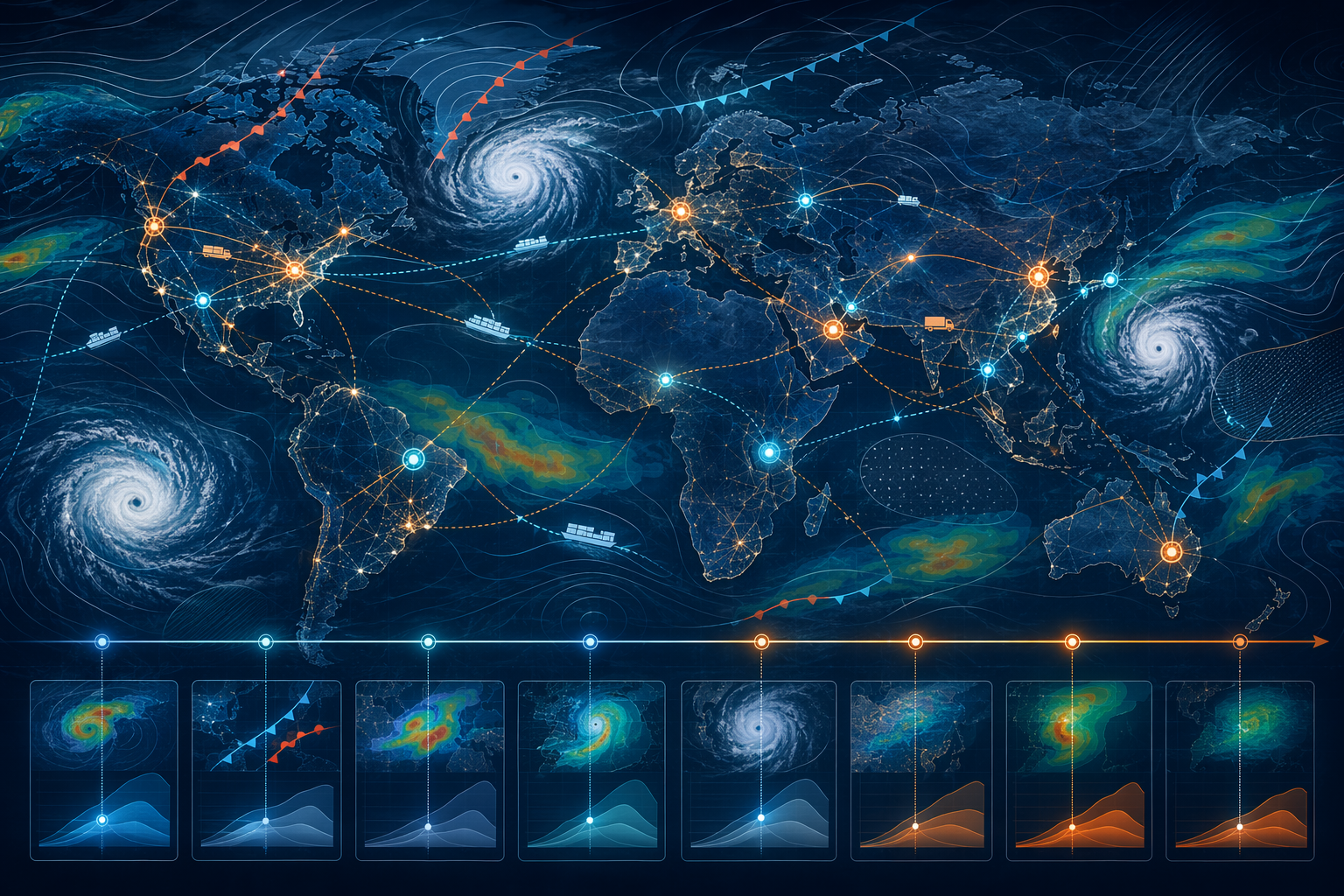
The useful window is one to six months, not perfect foresight
Procurement teams can often act on a one-to-six-month forecast in ways they cannot act on a same-week alert. They can pull forward purchases, negotiate optionality, qualify a backup supplier, change allocation assumptions, or pre-position inventory near a vulnerable region. None of those moves require certainty. They require a forecast horizon that overlaps with commercial lead times, and a confidence level high enough to justify a controlled cost.
That distinction matters because weather intelligence is easy to overclaim. A model that improves short-term demand forecasting in grocery retail does not automatically prove seasonal cyclone, drought, or commodity-risk forecasting for industrial procurement. The decision being forecast, the time horizon, and the cost of being wrong are different.
| Procurement decision | Why earlier weather intelligence matters |
|---|---|
| Inventory pre-positioning | Buffers must be approved, financed, moved, and stored before disruption raises freight or allocation pressure. |
| Supplier site monitoring | Cyclone, flood, heat, or drought exposure needs to be mapped to actual supplier locations, not only to national weather headlines. |
| Sourcing adjustment | A second source is useful only if commercial terms, quality checks, and capacity reservations happen before the same risk becomes visible to competitors. |
| Commodity exposure tracking | Agricultural and water-dependent inputs can show yield or availability risk before market prices fully reflect it. |
The procurement value is therefore less about predicting a storm on a specific day and more about ranking exposure early enough to change a plan. A seasonal signal may be too uncertain to trigger a single irreversible action, but strong enough to move a category manager from passive monitoring to a staged escalation path.
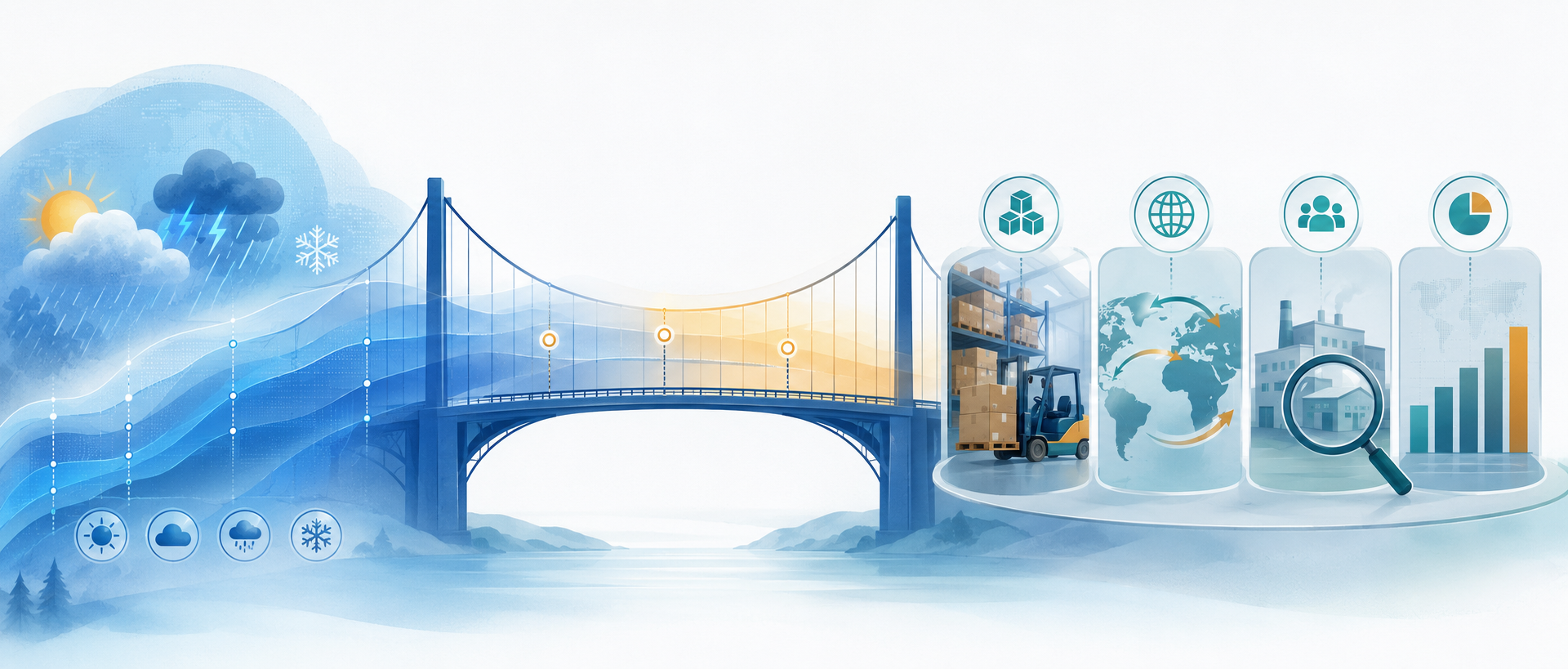
Hitachi shows what a procurement-ready use case looks like
The strongest enterprise example is Hitachi’s use of ClimateAi data in a global supply chain risk model. Hitachi’s own R&D page describes an approach that monitors supplier locations globally and uses ClimateAi’s seasonal forecasts to assess cyclone risk up to six months ahead at 1 km resolution.[3] That is the important bridge: forecast output is tied to supplier geography and then to a procurement action.
A generic cyclone outlook is interesting. A cyclone outlook mapped to a supplier network is operational. It lets a buyer ask which plants, contract manufacturers, component suppliers, ports, or logistics nodes sit inside the higher-risk zone; which materials depend on them; which purchase orders fall inside the exposed season; and which buffers would have to be approved now if the organization wants options later.
Hitachi’s page describes proactive inventory stockpiling as one response to this risk monitoring.[3] That is a familiar trade-off, not a magic optimization. Someone has to carry working capital. Someone has to defend the warehouse space. Someone has to explain why inventory was built if the cyclone season does not hit the expected location as severely as the forecast suggested. The forecast earns its place only if it improves the timing and discipline of that debate.
In practice, a procurement team would not need the model to say “this supplier will fail.” It would need a ranked list of exposed suppliers, a confidence range, and a decision rule. For example: monitor at low confidence, request supplier continuity plans at a higher threshold, reserve alternate capacity when exposure overlaps with sole-source materials, and pre-position inventory only when risk, lead time, and business criticality converge.
That also separates this use case from broader supplier risk scoring. Financial health, cyber exposure, ESG screening, and geopolitical risk may all belong in a supplier risk program, but weather risk needs physical-location fidelity. A headquarters address or supplier parent-company score will miss the operational question if the vulnerable asset is a coastal plant, a rail corridor, a port-adjacent warehouse, or an agricultural growing region.
Commodity buyers need a different map
Supplier-site monitoring is only one version of the problem. Food, beverage, apparel, packaging, chemicals, and industrial manufacturers also buy exposure to growing regions, river basins, water stress, heat patterns, and harvest timing. A factory may be fine while the commodity feeding it becomes tight.
Suntory’s ClimateAi case study is useful here, with the caveat that it is vendor-published rather than an independently audited ROI analysis. ClimateAi says Suntory detected drought impacts in a coffee-growing region 5–7 days before broader market awareness and identified 30–40% yield decline risks in key agricultural commodities.[4] The same case describes Suntory using those insights to shift plant breeding strategy toward more temperature-resistant varieties.[4]
That is not the same kind of procurement move as Hitachi’s pre-positioned inventory. It is more strategic and more agricultural. The relevant buyer may not be expediting components; they may be changing sourcing assumptions, crop science priorities, supplier development plans, or long-range commodity exposure. The warning still has procurement value, but the action window and accountability chain are different.
The same ClimateAi article cites CDP data indicating that beverage and agriculture sectors face up to $17 billion in climate-driven supply chain disruption exposure within three years.[4] Because that figure is presented through the vendor’s article rather than directly verified from a CDP source here, it should be read as directional context. It supports the scale of concern, not a precise budget assumption for a procurement business case.
The Wonderful Company offers a related but longer-range example. ClimateAi describes the company using ranch-level microclimate insights to assess vineyard viability and crop suitability.[5] That kind of analysis sits closer to agricultural planning than tactical procurement, but it shows why weather intelligence cannot always be reduced to a short-term disruption alert. Sometimes the decision is whether a region remains suitable for a crop at all.
Model capability matters only when it changes the decision
Weather AI has improved enough that procurement teams should pay attention, but the model architecture is not the procurement deliverable. Resolution, refresh rate, forecast horizon, and historical validation matter because they determine whether the signal can be mapped to supplier sites, agricultural regions, transport lanes, and contract windows.
The Weather Company describes IBM GRAF as a high-resolution atmospheric forecasting system with 3.5 km resolution and hourly updates.[6] That is a useful benchmark for how granular modern weather modeling can become, especially for near-term operational awareness. Hitachi’s cited ClimateAi deployment is more directly relevant to seasonal procurement because it references 1 km global resolution and a six-month cyclone outlook tied to supplier monitoring.[3]
The procurement test should be blunt:
- Does the forecast horizon overlap with sourcing, qualification, production, shipping, or inventory lead times?
- Can the forecast be geocoded to supplier sites, crop regions, ports, warehouses, or logistics corridors?
- Does the output express uncertainty clearly enough to support staged escalation rather than binary panic?
- Is the evidence for the deployment independently corroborated, vendor-published, or merely implied by a product claim?
- Can the procurement team connect each risk threshold to a specific action and cost owner?
Those questions keep the technology anchored to use. A beautiful forecast layer that never changes a purchase order, allocation decision, supplier conversation, or buffer policy is a dashboard, not resilience.
The boundary: probability is useful, certainty is dangerous
Seasonal AI weather forecasts are probabilistic. They express likelihoods, ranges, and relative risk. Procurement teams can use that, but only if they resist converting probability into a deterministic promise for the sake of executive neatness.
A responsible workflow treats the forecast as an input to option design. Low-to-medium confidence may justify supplier outreach, closer monitoring, or scenario pricing. Higher confidence plus high business impact may justify inventory buffers, alternate sourcing, or production resequencing. Very high exposure at a sole-source supplier may justify escalation even before the forecast is certain, because waiting for certainty can mean waiting until no practical option remains.
The working-capital consequence should stay visible. If a team pre-positions inventory and the severe weather does not materialize, the forecast did not necessarily “fail”; it may have supported an insurance-like decision. But that argument only holds if the risk threshold, confidence band, decision owner, and cost of the hedge were agreed before the move. Otherwise, probabilistic planning becomes an after-the-fact excuse.
This is also why AI weather forecasting should not replace supplier diversification, inventory policy, business continuity planning, or human risk review. It can sharpen the timing of those tools. It can reveal where weather exposure is clustering. It can give a committee a better reason to act before a disruption appears on a news feed. It cannot remove uncertainty from a seasonal decision.
For flood-specific monitoring, a narrower hazard view such as AI Flood Prediction for a More Resilient Supply Chain can complement seasonal forecasting. For disruption detection after an event emerges, the logic is closer to cases like Can AI Prevent Supply Chain Chaos from the Tacoma Narrows Closure?. The procurement-resilience opportunity here is earlier: turning seasonal weather probabilities into sourcing, buffer, and escalation decisions while there is still time to choose among them.
What procurement teams can take from the evidence
The enterprise evidence is promising but uneven. Hitachi’s example is the strongest because it is corroborated by Hitachi’s own R&D material and ties the model to supplier-location monitoring and inventory action.[3] Suntory and The Wonderful Company are useful vendor-published examples that show commodity and agricultural relevance, but they should not be treated as independent ROI proof.[4][5]
A practical procurement deployment should start with decision types, not with a model demo. Pick the categories where weather has historically caused allocation pressure, quality risk, freight disruption, or commodity volatility. Map supplier sites and origin regions. Define what a one-month, three-month, or six-month warning would actually change. Then set escalation rules that preserve uncertainty instead of hiding it.
AI weather forecasting can improve procurement resilience when it is attached to specific lead-time decisions: pre-positioning inventory before cyclone season, adjusting sourcing before a growing-region drought becomes a market story, or monitoring commodity exposure before suppliers begin answering vaguely. Its value is not that it guarantees the weather. Its value is that it gives buyers a disciplined reason to act earlier, with the uncertainty still visible.
References
- Supply Chain Statistics, Tradeverifyd
- U.S. Billion-Dollar Weather and Climate Disasters, NOAA National Centers for Environmental Information
- Building resilient supply chains through climate-aware supply chain risk management, Hitachi R&D
- Unlocking Resilient Supply Chains: Suntory’s ClimateAi Strategy, ClimateAi
- How The Wonderful Company Uses ClimateAi to De-risk Its Supply Chains, ClimateAi
- Global High-Resolution Atmospheric Forecasting, The Weather Company
Comments
Join the discussion with an anonymous comment.