
The hard part of hurricane planning is not knowing that a storm can disrupt supply. Everyone in the room already knows that. The hard part is deciding, while the forecast cone is still moving, whether to pull inventory forward, which customer commitments deserve the first allocation, which supplier cutoff is real, and which extra freight cost finance will accept before there is certainty.
That is where AI for supply chain hurricane disruption planning earns attention or loses it. The useful question is not whether AI can make hurricanes perfectly predictable. It is whether earlier probabilistic signals give demand planners, logistics teams, procurement, and finance enough usable lead time to make better calls before ports close, lanes tighten, carriers reprice, or suppliers stop accepting orders.
The urgency is no longer seasonal color. Supply Chain Digital reported a 38% overall surge in disruption, a 119% year-over-year increase in extreme weather disruption, and more than $182 billion in U.S. losses in 2024 tied to weather and climate disasters.[1] Those figures do not tell a planner which SKU to move. They do explain why the same manual playbook feels thinner every year.

When the Forecast Becomes an Inventory Decision
The cleanest operating example in the available material comes from ClimateAi’s Hurricane Ian case study. A roofing materials producer used ClimateAi’s ClimateLens platform ahead of Hurricane Ian to anticipate where demand would rise and pre-position Florida building-code-approved roofing materials before closures and transport restrictions reduced its choices.[2]
That distinction matters. The case was not simply a weather alert sitting beside a planning system. The forecast translated into a specific commercial move: put compliant roofing materials closer to Florida demand before the demand spike and before the network became harder to use. ClimateAi attributes $15 million in additional sales to that action during Hurricane Ian.[2]
The result should be read carefully. It is a vendor-published case study, not an independently audited benchmark across the building materials sector. But it is still operationally useful because the chain of action is visible: forecast signal, demand expectation, inventory positioning, constraint avoidance, sales capture. That is the level at which hurricane planning becomes real.
A planner does not need the model to be omniscient to benefit from that kind of lead time. They need the signal early enough to ask concrete questions: which regional DC can still ship, which product meets local code, which customer class is likely to buy first, which carriers can still move, and which replenishment decision becomes impossible if it waits another day.
The Reusable Workflow: Demand, Lanes, and Cost
The broader AI playbook for hurricane exposure is best understood as three operating motions, not as a technology stack demo. ClimateAi frames the hurricane-season use case around demand and inventory optimization, logistics rerouting, and financial modeling.[3] In practice, those motions have to meet inside one decision cycle.
| Operating motion | What AI is trying to surface | Decision it should accelerate |
|---|---|---|
| Demand and inventory optimization | Probable demand shifts by product, location, and timing | Which SKUs to position early and where |
| Logistics rerouting and alternate-source matching | Exposed lanes, facilities, suppliers, and feasible substitutes | Which routes, carriers, and suppliers to activate before cutoff |
| Financial impact quantification | Cost, margin, lost-sales, and service-risk scenarios | How much spend is justified before certainty arrives |
This is also where a supply chain control tower stops being a visibility slogan and starts doing useful orchestration work. Hurricane planning does not fail because one team lacks a dashboard. It fails when demand sees one risk, transportation sees another, procurement hears about a supplier cutoff too late, and finance receives the cost case after the decision window has closed.
Demand and Inventory: Move the Right Stock Before Optionality Collapses
Hurricane demand planning is not just a volume problem. It is a mix, location, and timing problem. A storm can raise demand for some products, suppress demand for others, and make ordinary replenishment assumptions useless for a few days. The most valuable AI signal is one that separates noise from action soon enough to change inventory placement.
The Hurricane Ian roofing-materials case shows why that matters. Florida building-code-approved materials were not interchangeable with every other roofing product in the network. If the model had only said “demand may rise in the Southeast,” it would have left the planner with too much interpretation and too little time. The operational value came from connecting a storm-driven demand signal to compliant inventory that could be positioned before constraints tightened.[2]
In a retail, building materials, food and beverage, pharmaceutical, or energy supply chain, the same discipline applies. AI can help prioritize SKUs by likely demand lift, service criticality, substitution limits, and reachable inventory. But the output has to be narrow enough to drive allocation. A planner needs something closer to “move this class of inventory into this region before this cutoff” than “hurricane risk is elevated.”
That does not eliminate judgment. It changes where judgment gets spent. Instead of waiting for orders to prove the spike, teams can debate the practical tradeoffs earlier: whether to pull from a neighboring DC, whether to short a slower market, whether to reserve stock for contracted customers, and whether to release inventory to channels that will actually serve recovery demand.
Logistics and Supplier Exposure: Cutoffs Matter More Than Risk Scores
Once inventory is identified, the next question is whether it can still move. A hurricane plan that recognizes demand but misses lane closures, warehouse exposure, carrier constraints, or supplier order cutoffs still leaves the business exposed. This is where rerouting and alternate-source matching become more than map overlays.
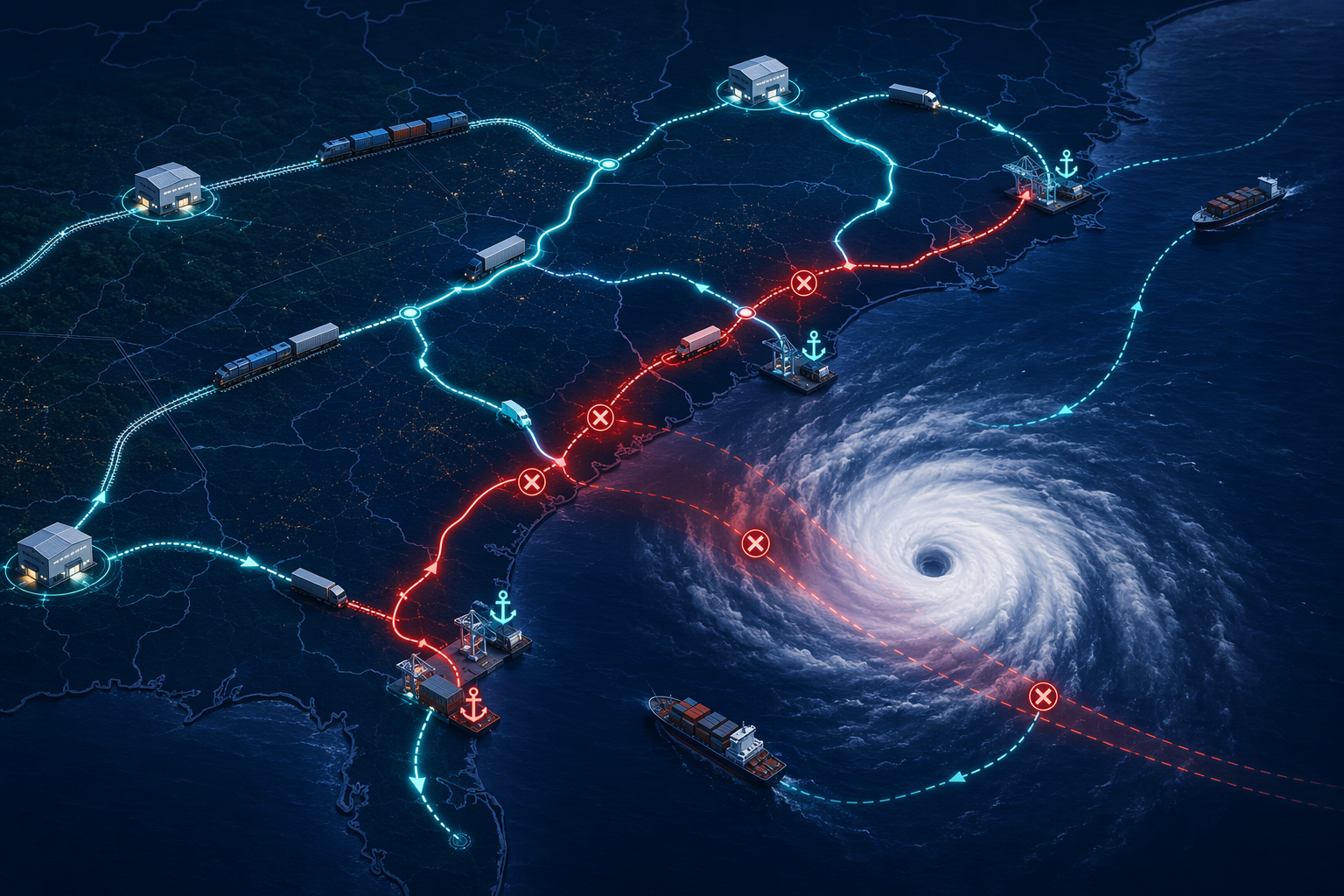
The Cooper University Health Care example, published by Interos, is useful because it turns supplier exposure into purchase orders. Ahead of Hurricane Idalia in 2023, Cooper used Interos.ai’s catastrophic risk model to identify three suppliers in the storm’s path, place orders before cutoff deadlines, and avoid critical medical supply shortages.[4]
Again, the attribution matters. The example comes from a vendor blog and relies on Interos’s proprietary model. It should not be stretched into a universal claim that every health system using AI will avoid shortages. But it does show the workflow a hurricane-exposed operation needs: expose the supplier, identify the deadline, act before the cutoff, and preserve service for critical demand.[4]
That is a different standard from simply flagging a node as red. A red supplier on a dashboard is only useful if someone knows whether to expedite, split the order, shift to an alternate supplier, reserve existing inventory, or notify clinical, store, or field operations that allocation rules are about to change.
In logistics, the AI layer can pair weather exposure with carrier capacity, route feasibility, facility status, supplier dependencies, and delivery priority. The best use cases look less like a single automated answer and more like a ranked set of options: keep the lane open until a defined cutoff, divert through another node, switch origin, pull from an alternate supplier, or accept a service miss where the cost of avoidance is worse than the consequence.
Companies already exploring broader AI logistics deployments will recognize the same pattern: prediction is only valuable when it is tied to dispatch, routing, tendering, sourcing, or allocation authority. Hurricane planning compresses that loop into fewer hours.
Financial Modeling: Decide What the Early Move Is Worth
The finance problem is usually quieter than the logistics problem until someone asks who approved the premium freight, the early buy, or the temporary inventory imbalance. AI-supported cost modeling is useful when it frames the tradeoff before the spend happens.
The Hurricane Ian case gives one documented commercial figure: ClimateAi attributes $15 million in additional sales to pre-positioning roofing materials before the storm-driven demand spike and network restrictions.[2] That is a sales-capture claim from a vendor case study, not a full margin analysis. It does not answer every ROI question a CFO will ask, but it gives the planning team a concrete example of why early movement can be worth more than the carrying cost or transfer cost that looks uncomfortable before the storm track settles.
A practical hurricane model should compare a small set of scenarios: do nothing until demand appears, pull inventory forward now, split inventory across exposed and safer nodes, expedite from an alternate source, or protect only the highest-criticality SKUs. The point is not to create a perfect financial forecast. It is to make the cost of waiting visible beside the cost of acting.
This is a good place for a digital twin supply chain model if the organization has one mature enough to use under pressure. Scenario simulation can help leaders see how a decision affects service, inventory, transportation cost, and margin across the network. If the model cannot connect those consequences to actual decision rights, it will still be a useful exercise, but not a hurricane-season operating tool.
What AI Changes in the Planning Cadence
The broad industry story is moving from reactive response toward predictive operation. The World Economic Forum has argued that AI can help protect global supply chains from major shocks by improving visibility and decision-making, while Supply Chain Management Review has described AI as part of a shift from reactive to predictive supply chain management.[5][6] Those claims are directionally useful, but hurricane planning needs a more grounded test.
The test is whether the cadence changes. Does the demand team see likely regional movement before order history confirms it? Does procurement see exposed suppliers before cutoff deadlines pass? Does logistics see alternate lanes before capacity disappears? Does finance see the service and margin consequence early enough to approve a decision instead of auditing it afterward?
When AI works in this setting, it shortens handoffs. Weather intelligence feeds demand sensing. Demand sensing changes inventory priority. Inventory priority changes transportation planning. Supplier exposure changes purchase timing. Cost scenarios give leaders a defensible reason to spend early or hold back. None of those steps is glamorous, but they are where hurricane outcomes are often decided.
This also connects hurricane disruption planning to the broader family of disaster-intelligence use cases, including AI for air-quality disruption risk. The hazards differ, but the operating requirement is similar: convert external risk into earlier internal decisions.
Where the Business Case Should Stay Honest
The honest case for AI in hurricane disruption planning is strong enough without overclaiming. Vendor case studies can be valuable, especially when they disclose an operational sequence and a measurable outcome. They are not the same as independent proof across industries, regions, and storm types.
The available materials include documented examples worth using: ClimateAi’s $15 million additional-sales claim during Hurricane Ian and Interos’s Cooper University Health Care account of avoiding critical medical supply shortages before Hurricane Idalia.[2][4] They do not justify a blanket promise that AI will prevent shortages, guarantee margin protection, or eliminate emergency freight.
Several commonly repeated AI supply chain ROI figures, including broad error-reduction and lost-sales mitigation ranges, should be treated cautiously unless traced to the original source and methodology. For a hurricane-season investment case, better evidence usually comes from the company’s own exposure: how often lanes close, how much premium freight is approved late, how many orders miss cutoff, how much inventory sits in the wrong node, and how often customer commitments are changed after the fact.
Teams benchmarking broader AI adoption can place hurricane planning inside a larger ROI portfolio, such as AI use cases in supply chain by function or an AI use case library. But hurricane planning should still be judged on its own decision calendar. A model that pays off in normal monthly planning may not be usable when a storm compresses the decision into days.
What to Operationalize Before the Next Storm
The practical build is not a giant hurricane command center assembled after the first named storm threatens the region. It is a set of decision rules, data feeds, and escalation paths that can run when the forecast is still uncertain.
- Define the SKUs that matter first: critical medical supplies, compliant building materials, emergency food and beverage items, repair parts, fuel-related products, or contracted customer commitments.
- Map supplier and facility exposure to action deadlines, not just geographic risk. The cutoff for placing an order or moving inventory is often more important than the storm’s landfall time.
- Pre-approve scenario thresholds for premium freight, early replenishment, inter-DC transfers, and alternate-source buys so finance is inside the decision before the emergency.
- Connect AI alerts to named owners in demand planning, logistics, procurement, and finance. An alert with no decision owner is just another notification.
- Review outcomes after the storm by decision timing: what was moved early, what waited too long, what cost more than expected, and what shortage or lost sale was avoided.
AI does not remove hurricane risk, and it does not make the forecast certain. Its practical value is narrower and more useful: it can turn recurring weather disruption into earlier demand signals, supplier exposure alerts, rerouting options, and cost scenarios that leaders can act on before the window closes.
References
- How Increasing Weather Disruption is Affecting Supply Chains, Supply Chain Digital
- Accurate Hurricane Forecasting Helps Roofing Materials Producer, ClimateAi
- Three Ways AI Can Help Companies De-Risk Supply Chains During Hurricane Season, ClimateAi
- Protecting Your Supply Chain From Extreme Weather: Steps to Minimize Risk, Interos.ai
- AI will protect global supply chains from the next major shock, World Economic Forum, January 2025
- How AI is shifting global supply chains from reactive to predictive, Supply Chain Management Review
Comments
Join the discussion with an anonymous comment.