
The real test for AI supply chain risk management in a Middle East conflict is not whether a platform can redraw a lane map. It is whether it can show, fast enough for a procurement review, what happens when fuel, fertilizer inputs, industrial gases, chemicals, ocean freight, port access, and air cargo capacity all move at once.
That is the problem the 2026 Middle East conflict has put in front of supply chain teams. Oliver Wyman’s March 2026 analysis described sharp, simultaneous commodity pressure: Brent crude up 25%, natural gas up 56%, urea up 26%, helium up 35%, sulfur up 23%, and polymers up 15% as conflict risk fed into energy, fertilizer, industrial gas, and petrochemical markets.[1] At the same time, Tive reported that ocean freight costs were up more than 4.5 times year-to-date on some routes, transit volumes through Hormuz were down over 60%, and Red Sea diversions were adding 10 to 14 days to schedules.[2]

This is where the spreadsheet starts to fail the room. A planner can update a crude price assumption, then a freight premium, then a lead-time adjustment, then a supplier allocation. By the time those tabs reconcile, the decision has usually become political: finance wants proof, procurement wants optionality, operations wants material, and logistics wants a lane that still exists.
AI what-if modeling does not remove that argument. Its useful promise is narrower and more practical: it can make the argument visible earlier. If a chemical producer is weighing whether to pull forward inventory, split volume across two regions, or pay a freight premium, the model can compare those choices against commodity indices, route status, supplier capacity, and current conflict assumptions in the same run.
The Shock Is Compound, Not Sequential
Commodity-exposed sectors rarely get the luxury of isolating one variable. An automotive supplier may face polymers and freight at the same time. A food or agriculture buyer may see energy, urea, vessel availability, and insurance premiums collide. Electronics and pharma teams can be affected by air hub disruption even when their bill of materials is not directly tied to oil.
Supply Chain Digital reported that the US-Iran conflict was reshaping supply chains not only through maritime risk but also through the closure of Gulf air hubs, narrowing the set of realistic logistics alternatives for time-sensitive shipments.[3] That matters because a route substitution that looks viable in a static network model may be unavailable, overbooked, or too slow when air and sea disruption overlap.
The first planning error in this environment is treating each shock as a separate scenario. A 25% crude increase is one finance conversation. A 10-to-14-day vessel delay is another. A supplier switch to a region with lower material exposure but worse port access is a third. In reality, the procurement decision combines all three, and the cost of waiting often sits outside the tidy part of the model.
| Planning Question | Why Single-Variable Modeling Struggles | What AI What-If Modeling Can Compare Concurrently |
|---|---|---|
| Should we buy ahead? | Inventory cost is modeled separately from freight delay and commodity volatility. | Carrying cost, likely shortage exposure, price movement, supplier reliability, and route availability. |
| Should we switch suppliers? | The substitute source may reduce commodity exposure but add geopolitical or logistics exposure. | Unit cost, qualification status, port options, transit time, capacity, and political-risk assumptions. |
| Should we reroute? | A new lane may solve one chokepoint while creating a lead-time or air-cargo constraint. | Ocean and air alternatives, freight premiums, delay windows, customer-service impact, and margin loss. |
| Should we wait? | No-action scenarios often understate the cost of late allocation or expediting. | Expected shortage cost, escalation triggers, premium freight, production risk, and finance thresholds. |
What the Model Has to Ingest
For this use case, the dividing line is not “AI versus no AI.” It is whether the model can join live or frequently refreshed operating data with geopolitical scenario inputs. Commodity-price history alone is not enough when a chokepoint changes. A transportation-control-tower feed alone is not enough when the purchase price variance is moving faster than the shipment.
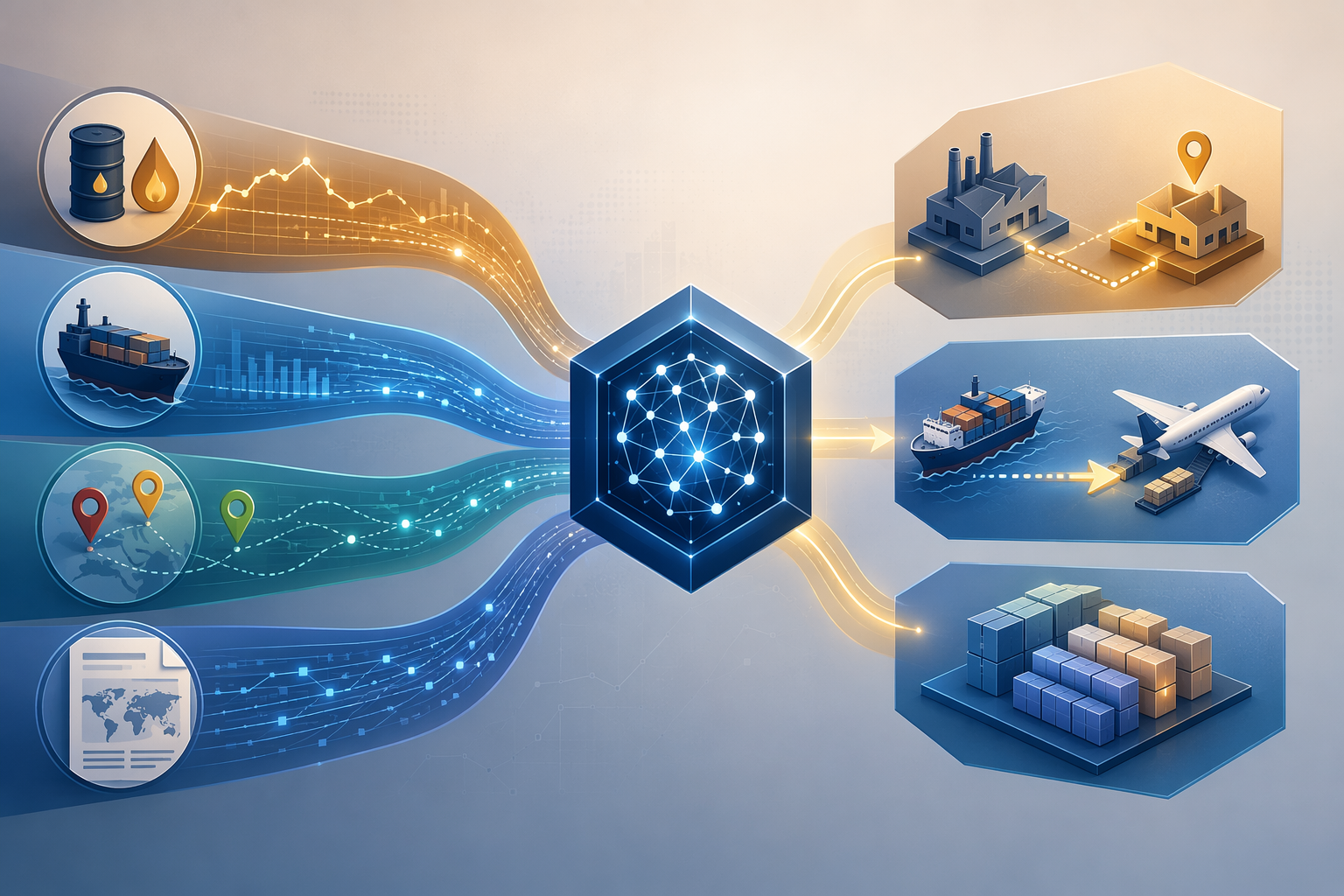
A credible setup usually starts with four input streams: commodity indices for exposed categories, freight-rate and capacity signals, route-status information for chokepoints and hubs, and dated geopolitical assumptions. The output should not be a single “recommended” answer unless the assumptions are visible. It should show how the decision changes if Hormuz capacity tightens further, if Red Sea delays lengthen, if gas prices stabilize, or if an alternate supplier has only partial capacity.
The useful simulations are not abstract. They answer questions a procurement lead can defend: how much margin is protected by qualifying an alternate supplier, how much working capital is tied up by building buffer stock, how many days are gained by rerouting, and which customers or plants are still exposed after the switch. The model earns its place when it reduces the time between a shock signal and a decision package.
The Decision Package Matters More Than the Dashboard
A dashboard that says “risk elevated” does not help much in a finance meeting. A useful what-if run shows the trade-off in money, days, and operational exposure. If the recommendation is to pay premium freight, the model should show the avoided production interruption or customer penalty. If the recommendation is to increase inventory, it should show the carrying-cost impact and the shortage risk it reduces. If the recommendation is to wait, it should make clear what trigger would change that decision.
This is also where procurement and planning teams should push vendors for scenario auditability. The question is not only what the model says; it is which dated assumptions produced the answer. In a fluid conflict, last week’s route status or diplomatic premise may already be stale.
Adoption Is Real, but It Is Not Proof of Resilience
AI scenario modeling is no longer a lab exercise. A Kinaxis and Economist Impact survey of more than 800 supply chain leaders found that 55% of companies were already using AI for scenario modeling, 71% had accelerated AI deployment, and 82% were integrating predictive analytics.[4] Those numbers are meaningful because they show that the capability has moved into operating environments where planners are already expected to make trade-offs under uncertainty.
They do not prove that the tools work in every crisis. The same survey found that 50% cited organizational inertia as a barrier.[4] That is not a soft issue. A model can identify the better supplier split, but it cannot by itself approve a new vendor, override a freight budget, or persuade a commercial team to accept a temporary service-level change.
The adoption data should therefore be read as evidence of readiness, not effectiveness. Many teams now have the machinery to run richer scenarios. Whether that machinery changes outcomes depends on data quality, governance, and whether executives have already agreed on the thresholds for action.
A Useful Case, with the Right Caveat
Sensos describes an automaker that avoided $220 million in losses during the Red Sea crisis by using AI-supported visibility and planning to pre-map 12 alternative ports with political stability scores.[5] The case is a good illustration of what early action can look like: alternatives were not invented after the disruption; they were mapped before the decision window closed.
It should not carry more weight than it can bear. The automaker is unnamed, and the figure comes from a vendor case study rather than an independently verifiable disclosure.[5] The practical lesson is still worth keeping: pre-mapped alternatives make a scenario model more operational. A supplier switch is only useful if the receiving port, onward transport, customs implications, and political-risk assumptions have already been tested.
For teams building a shortlist, that means asking vendors to demonstrate a live scenario using the buyer’s own exposed materials and lanes, not a generic resilience demo. A chemical buyer should see energy, sulfur, polymers, supplier allocation, and vessel delay in the same run. An automotive team should see tier-one and logistics exposure together. A food buyer should see fertilizer inputs and ocean routing side by side.
The Constraint: Bad Geopolitical Inputs Create Polished Blind Spots
PKF O’Connor Davies warned in March 2026 that AI models lacking geopolitical scenario inputs can produce incomplete risk assessments.[6] That is the central boundary for this use case. A fast model that does not understand the conflict premise is not necessarily safer than a spreadsheet; it may simply make the wrong assumption easier to circulate.
The minimum standard is scenario transparency. If a model says an alternate lane is viable, the team should be able to see whether that conclusion assumes stable Hormuz flows, continued Red Sea diversions, reopened Gulf air hubs, or a specific level of freight premium. If a model says a supplier switch protects margin, it should show whether the conclusion depends on gas prices staying elevated or falling back.
Academic work is beginning to support the broader claim that AI can strengthen supply chain resilience under geopolitical risk, but it should be applied carefully. A 2025 ScienceDirect paper using Chinese-listed firm data examined AI’s role in enhancing supply chain resilience under geopolitical risks, with findings especially relevant to high-tech industries; its setting limits how directly the conclusions transfer to Western enterprises or to every commodity-exposed sector.[7]
Where This Use Case Fits
AI what-if modeling is a strong fit when a company has multiple exposed inputs and more than one plausible response. It is less compelling when the decision is already fixed, the supplier base has no practical alternatives, or the organization will not act on a modeled trade-off. The highest-value settings are energy-intensive or commodity-exposed supply chains where material costs, freight premiums, and route availability can change the same purchase decision.
The test for procurement is concrete. Can the platform compare a supplier switch, modal shift, and buffer-stock build in one scenario run? Can it show the cost of acting now versus waiting? Can it expose the geopolitical assumptions behind the answer? Can the business approve the action before the scenario expires?
The 2026 Middle East conflict has made the case for faster scenario planning, but speed is not the whole argument. The value comes from modeling commodity and route shocks together, with dated assumptions that decision-makers can challenge. Without that, AI gives procurement a cleaner-looking version of uncertainty. With it, teams get a defensible way to decide whether to pay more now, reroute, qualify an alternate supplier, build inventory, or wait.
References
- How conflict in the Middle East affects global supply chains, Oliver Wyman, March 2026
- Middle East Risks Resurface: Supply Chain Disruptions and Key Insights, Tive
- How US-Iran Conflict is Reshaping Global Supply Chains, Supply Chain Digital
- 71% of supply chain leaders say they have accelerated AI deployment — why now, Kinaxis, late 2025
- Navigating Geopolitics and AI: Stabilizing Supply Chains in Turbulent Times, Sensos
- Supply Chain Disruption and Strategic Planning Amid Middle East Conflict, PKF O’Connor Davies, March 2026
- Enhanced supply chain resilience under geopolitical risks: The role of artificial intelligence, ScienceDirect, 2025
Comments
Join the discussion with an anonymous comment.