
A digital supply chain control tower usually looks convincing in a demo. The shipment map updates. The exception feed sorts by severity. The customer-risk widget turns red before the account team calls. Then the meeting ends, and someone still has to decide whether to expedite freight, reallocate inventory, renegotiate a dock appointment, or accept a penalty.
That gap is where many control tower business cases go soft. FourKites reports that only 22% of shippers with more than $1 billion in revenue rate their control tower as highly effective at driving action.[1] The problem is not that companies cannot see enough. It is that too many platforms stop at the point where work actually begins.
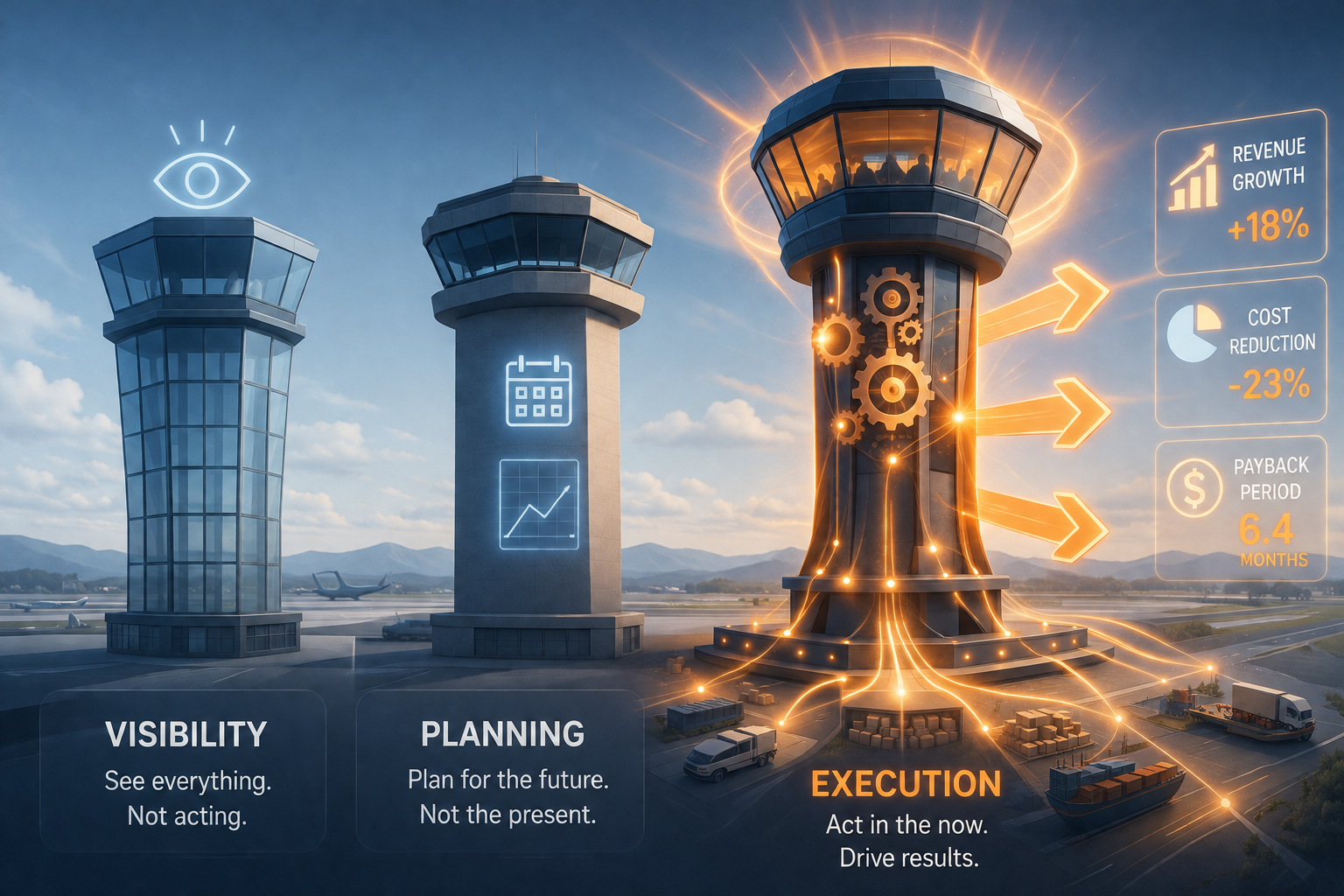
For buyers evaluating platforms in Q3 2026, the useful distinction is not “control tower or no control tower.” It is which operating model the platform really supports. Visibility-led systems track and alert. Planning-led systems optimize future scenarios. Execution-led systems orchestrate or automate the decisions needed when the plan is already under pressure.
The failure patterns are familiar enough to deserve their own treatment; a deeper breakdown is available in why supply chain control towers underdeliver and how AI fixes it. The harder buyer question is which model has the shortest and most defensible path to measurable ROI.

The Three Models Buyers Are Actually Comparing
Control tower vendors often use similar language: end-to-end visibility, predictive intelligence, exception management, orchestration, autonomous decisions. The labels blur together until the procurement team asks what changes on Monday morning. At that point, the market separates into three models.
| Control tower model | Primary job | Bottleneck it addresses | ROI path |
|---|---|---|---|
| Visibility-led | Track shipments, inventory, orders, and alerts | Lack of awareness across fragmented systems | Indirect; depends on whether teams act on alerts |
| Planning-led | Forecast, simulate, and optimize scenarios | Weak planning decisions weeks or months ahead | Potentially strong, but tied to planning adoption and model maturity |
| Execution-led | Trigger, recommend, or automate real-time actions | Slow exception resolution across functions and systems | Most direct; savings can be traced to cost, service, and productivity outcomes |
This taxonomy is not a cosmetic way to segment vendors. It changes how a business case should be written. A visibility-led platform should not be judged by autonomous-resolution metrics it was never designed to produce. A planning-led platform should not be dismissed because it does not automatically clear today’s detention queue. An execution-led platform, however, should be held to a harder standard: if it claims to orchestrate action, the buyer should expect evidence of faster decisions, lower avoidable cost, improved service performance, or higher team productivity.
Visibility-Led Control Towers: Necessary, But Easy to Overbuy
Visibility-led control towers solve a real problem. Many supply chains still run through disconnected transportation systems, warehouse systems, supplier portals, ERP records, spreadsheets, carrier emails, and customer-service escalations. A platform that brings shipment status, inventory position, order milestones, and supplier events into one view can remove a lot of low-grade operational fog.
The trouble begins when visibility is priced and governed as if it were resolution. An alert that a shipment is late does not decide whether to split the order. A supplier-risk flag does not approve an alternate source. A map pin moving slowly toward a distribution center does not reschedule labor at the dock. Those actions require authority, business rules, system write-back, and coordination across teams whose incentives may not match.
That is why the 22% effectiveness figure matters. It does not say control towers are useless. It says that awareness is frequently failing to become action at scale.[1] The platform may be correct, and still the transportation planner, procurement manager, or customer-service lead is left copying the alert into another workflow.
Visibility-led systems can still earn their place when the existing baseline is poor. If a company cannot reliably answer where critical inventory is, which orders are exposed, or which lane is degrading, it needs better sensing before it can automate much of anything. But the ROI case should be modest and specific: reduced manual status checks, faster escalation, fewer surprise misses, better carrier or supplier accountability. It should not quietly assume that a shared dashboard will change decision rights.
Planning-Led Control Towers Improve the Plan, Not the Exception Queue
Planning-led control towers deserve more respect than they sometimes get from execution teams. Forecasting, digital twins, network simulations, and scenario planning can improve decisions before the disruption becomes urgent. They help answer questions such as where inventory should sit, how capacity should be reserved, which supplier mix reduces exposure, and what service tradeoffs are acceptable under a constrained plan.
The upside is material, but the evidence has to be read carefully. Gartner expects 70% of large organizations to adopt AI-based supply chain forecasting by 2030, which frames forecasting as a multi-year adoption curve rather than a capability already embedded everywhere.[2] BCG has found that early digital-twin adopters achieve 20–30% better forecast accuracy and 50–80% fewer delays, while nShift notes that these results come from advanced deployments, not from simply buying a control tower with a simulation feature.[2]
That distinction matters. A digital twin supply chain capability can model the operating system, but the model does not automatically execute the decision. It may show that one distribution center will be capacity-constrained next quarter. It may recommend a different stocking policy. It may simulate the customer impact of a port disruption. Those are valuable planning decisions. They are not the same as automatically booking alternate transportation, reprioritizing orders, updating customer promises, and recording the financial consequence.
Planning-led control towers therefore create value in a different time horizon. Their strongest use cases sit weeks or months ahead of execution: demand sensing, inventory policy, capacity planning, supplier-risk modeling, network design, and scenario comparison. They can reduce the number of bad situations the operating team inherits. They do not, by themselves, remove the need for someone to resolve the situations that still arrive.
A buyer can spot the boundary by asking what happens after the scenario is selected. If the platform exports a recommendation into a meeting, spreadsheet, ticket, or planner workbench, it is still primarily planning-led. If it can also trigger governed actions in transportation, order management, procurement, or customer communication systems, it has started to move into execution-led territory.
Execution-Led Control Towers Shorten the Distance From Signal to Action
Execution-led platforms start from a less glamorous question: when the control tower detects a problem, who or what is allowed to do something about it?
This is where agentic AI becomes operationally interesting. The useful version is not a free-running bot making opaque supply chain decisions. It is a governed layer that interprets signals, checks constraints, recommends or initiates actions, writes back to systems, and escalates exceptions when confidence, cost, policy, or authority thresholds require a human decision. A deeper look at that layer is available in how agentic AI turns logistics control towers into autonomous orchestrators.
The measurable case for execution-led systems is stronger because the action is closer to the outcome. SAP and McKinsey report that agentic AI deployments have improved procurement workflow efficiency by 20–30%, reduced scrap by 55%, and cut logistics costs by 5–20%.[3] Those figures should not be treated as a universal promise; they describe reported deployment outcomes, not a guaranteed result for every company. But they point to the right kind of value: fewer manual workflow steps, less waste, and lower operating cost.
The food and beverage manufacturer case is more concrete. SAP reports that a global manufacturer using AI digital workers reduced detention costs by more than $500,000, avoided $800,000 in OTIF penalties, and improved logistics team productivity by 35%.[3] The important part is not that an AI label appears in the story. It is that the savings tie back to operational work: detention avoided, penalties prevented, and people spending less time pushing exceptions through the system.
FourKites reports that AI-powered control towers achieve 4–8 month payback periods, compared with years for legacy implementations.[1] As a vendor-reported claim, it belongs in the business case as directional evidence rather than a transferable guarantee. The buyer still has to ask which modules were implemented, what processes changed, how savings were measured, and whether the customer had enough integration maturity to let the system act.
Locus publishes execution-led metrics in the same category of evidence: 25% efficiency gains, 45% more deliveries per vehicle, and an 8% SLA improvement.[4] Again, these are favorable vendor-published outcomes. They are still useful because they measure execution productivity and service movement rather than dashboard adoption.
What Execution-Led Actually Has to Do
The term “execution-led” should not be awarded to any platform that places an “AI recommendation” button next to an alert. The platform has to close enough of the operating loop to change the rhythm of work.
- Detect the exception with enough context to understand cost, service, customer, inventory, and capacity implications.
- Select an action path, such as expedite, reroute, rebalance, substitute, reschedule, split, hold, or escalate.
- Check policies, thresholds, approvals, and commercial constraints before acting.
- Write the action back into execution systems instead of leaving it as a dashboard note.
- Record the outcome so finance, operations, and transformation teams can trace cost, service, and productivity effects.
This is also where the complementary capability view becomes useful. The four functional clusters of a supply chain control tower can help teams separate sensing, decisioning, collaboration, and execution capabilities instead of buying a bundle of features that all sit under one control tower label.
Why ROI Shows Up Faster in Execution
Execution-led control towers have a shorter ROI path because they attach the platform to work that already has a cost meter. Detention charges accrue. Premium freight hits the P&L. OTIF penalties are visible. Manual exception handling consumes planner capacity. Customer-service escalations take time. Missed appointments and poor route density show up in operating reports.
Visibility-led systems often have to prove value through avoided surprises, reduced search time, and better escalation. Those benefits are real, but they can be hard to isolate unless the baseline is messy and the measurement design is disciplined. Planning-led systems may produce large benefits, but the causal chain runs through forecast adoption, planning decisions, execution compliance, and market conditions. Execution-led systems can often point to a narrower before-and-after: this exception type used to require this many touches, this approval delay, this cost, or this service miss; now it does not.
That does not make execution-led deployments easy. SAP notes that 90% of AI use cases remain stuck in pilot mode, with trust, explainability, and fragmented systems acting as major barriers.[3] Those barriers are not side issues. If the execution layer cannot explain why it recommended an expedite, cannot access the transportation management system, cannot update order promises, or cannot respect approval thresholds, the company is back to a polished queue of unresolved work.
The right ROI framework therefore has to test both economics and operability. A useful companion model is outlined in what ROI supply chain control tower software can deliver. For platform selection, the practical questions are blunt: which exception classes will the control tower resolve, what percentage can be automated or semi-automated, which systems must be integrated, which roles approve which actions, and how will savings be audited?
How to Read Vendor Claims Without Losing the Plot
The control tower market has no shortage of attractive numbers. Some come from consulting research, some from vendor case studies, some from surveys, and some from platform performance claims. They are not interchangeable.
- Adoption data shows where the market is moving; it does not prove that a capability is already mature inside most operating teams.
- Forecasting and digital-twin improvements usually depend on data quality, model governance, planning discipline, and advanced deployment maturity.
- Vendor case studies are useful for identifying value pools, but they usually highlight successful implementations.
- Payback claims need scope: software, integration, process redesign, internal labor, and change management may not all be included.
- Execution metrics are strongest when they connect a specific automated action to a measurable cost, service, or productivity change.
This is not a reason to ignore strong case evidence. It is a reason to ask better follow-up questions. If a platform claims 4–8 month payback, the buyer should ask which workflows paid back first. If a digital twin claims major delay reduction, the buyer should ask whether the deployment was advanced, whether the recommendation was adopted, and whether the execution systems actually followed the plan. If an agentic AI workflow claims autonomy, the buyer should ask where human approval is still required and how exceptions are logged.
The Buyer’s Judgment in Q3 2026
A digital supply chain control tower should be evaluated by the bottleneck it removes. If the organization lacks shared truth, visibility-led may be the correct first move. If the organization makes poor medium-term decisions because demand, capacity, inventory, and supplier risk are weakly modeled, planning-led capabilities may deserve the investment. If the organization already sees the problem but loses money while people manually coordinate the response, execution-led is where the business case becomes hardest to ignore.
The distinction will matter more as AI features become standard packaging. A platform can have forecasting, digital twins, exception alerts, and agentic language and still leave the operating team with the same queue. The differentiator is whether the system changes who acts, how fast they act, how safely the action is governed, and whether the result can be traced to measurable payback.
In Q3 2026, a control tower business case should not be judged by visibility coverage alone. It should be judged by whether the platform can move from detection to governed execution fast enough to produce measurable cost, service, or productivity outcomes.
Comments
Join the discussion with an anonymous comment.