
The real use case for AI wildfire smoke supply chain disruption monitoring starts well outside the burn perimeter. A fire map can tell a transportation desk where flames are active. It usually does not tell the warehouse lead whether the next shift can work safely, whether drivers will lose visibility on a lane that is technically open, or whether a port will keep moving containers at the same pace under hazardous air.
That gap is not theoretical. During the 2018 Camp Fire, Amazon closed a Sacramento warehouse even though the facility was more than 80 miles from the fire origin. The issue was not direct flame exposure. It was smoke, worker safety, and the practical question of whether a building could keep operating under degraded air quality conditions.[1]
That is the failure mode traditional monitoring often misses. Supply chains do not wait for fire to reach the fence line before they slow down. They slow when people cannot safely staff a dock, when truckers face visibility and road restrictions, when air cargo schedules absorb weather and smoke-related delay, and when a supplier several tiers away loses usable operating hours.
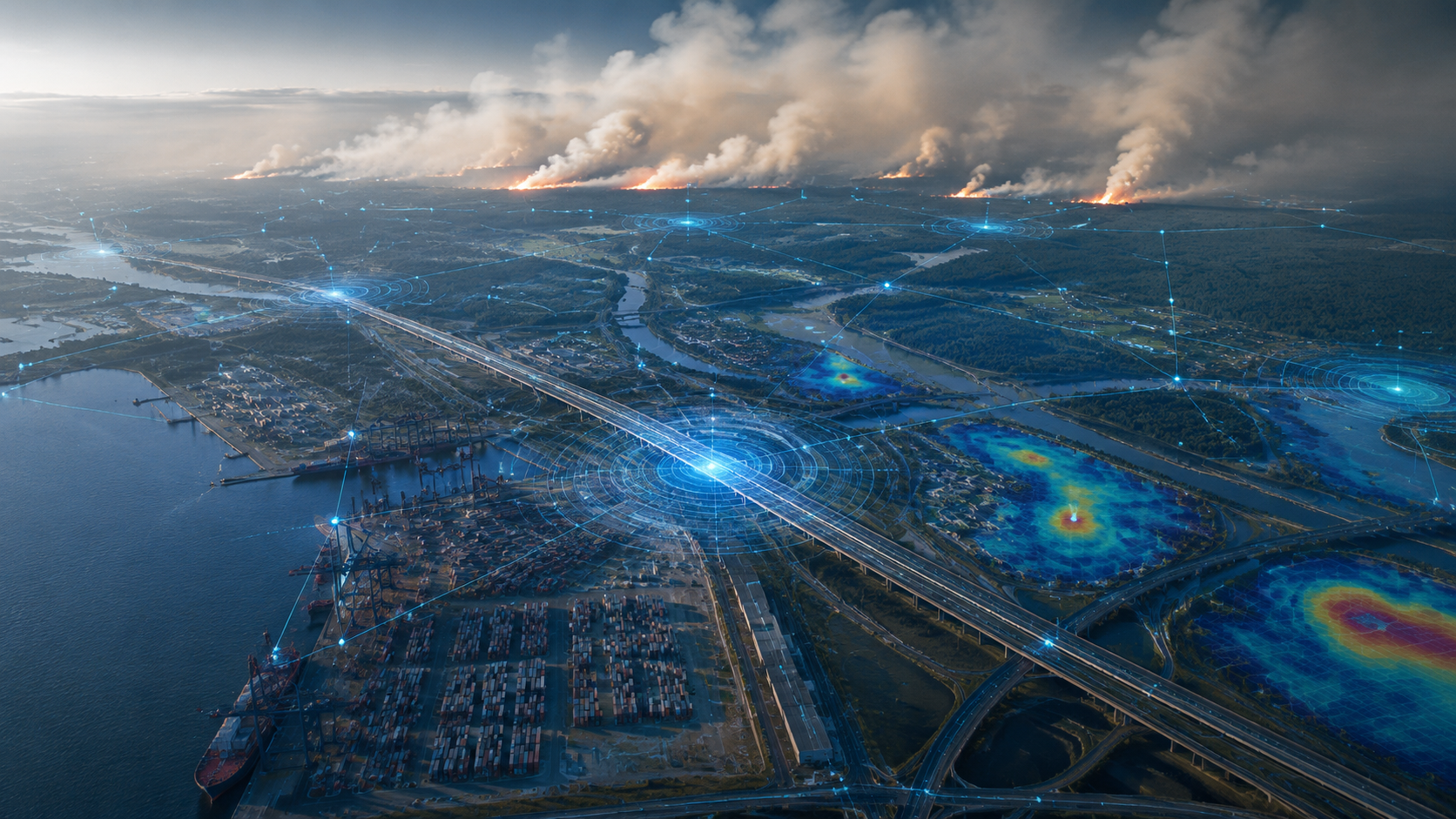
Smoke Turns A Fire Event Into A Network Event
The January 2025 Los Angeles wildfires showed why smoke-linked disruption belongs in supply chain planning, not only emergency response. Munich Re put direct damages at $53 billion, while UNDRR cited total economic losses above $250 billion. The same UNDRR account noted roughly 500 flight delays at LAX in one weekend and pointed to the exposure of the Los Angeles and Long Beach port complex, which handles about 40% of U.S. imports.[2]
Those figures are useful because they translate smoke and fire into planning variables: airport delay, port dwell time, labor availability, inland drayage capacity, and inventory timing. A planner does not need a dramatic facility loss to miss a service commitment. A few slower shifts at the wrong node can move the problem downstream into late customer orders, expediting, and production rescheduling.
Perimeter-based monitoring is still necessary. It tells teams where evacuation, asset protection, and direct damage risk are most urgent. But smoke behaves differently from fire. Wind can push hazardous air across regions that never appear inside a burn scar. That makes wildfire smoke a visibility problem, a labor safety problem, and a throughput problem before it becomes a property-loss problem.
What AI Adds Beyond A Fire Map
The strongest AI wildfire smoke supply chain disruption systems do not depend on one signal. They combine satellite imagery, air quality sensors, weather forecasts, public alerts, news ingestion, facility-level readings, and logistics telemetry. The point is not to produce a prettier smoke map. The point is to estimate where smoke will intersect with operating locations, transport lanes, supplier sites, and customer commitments early enough for someone to change the plan.
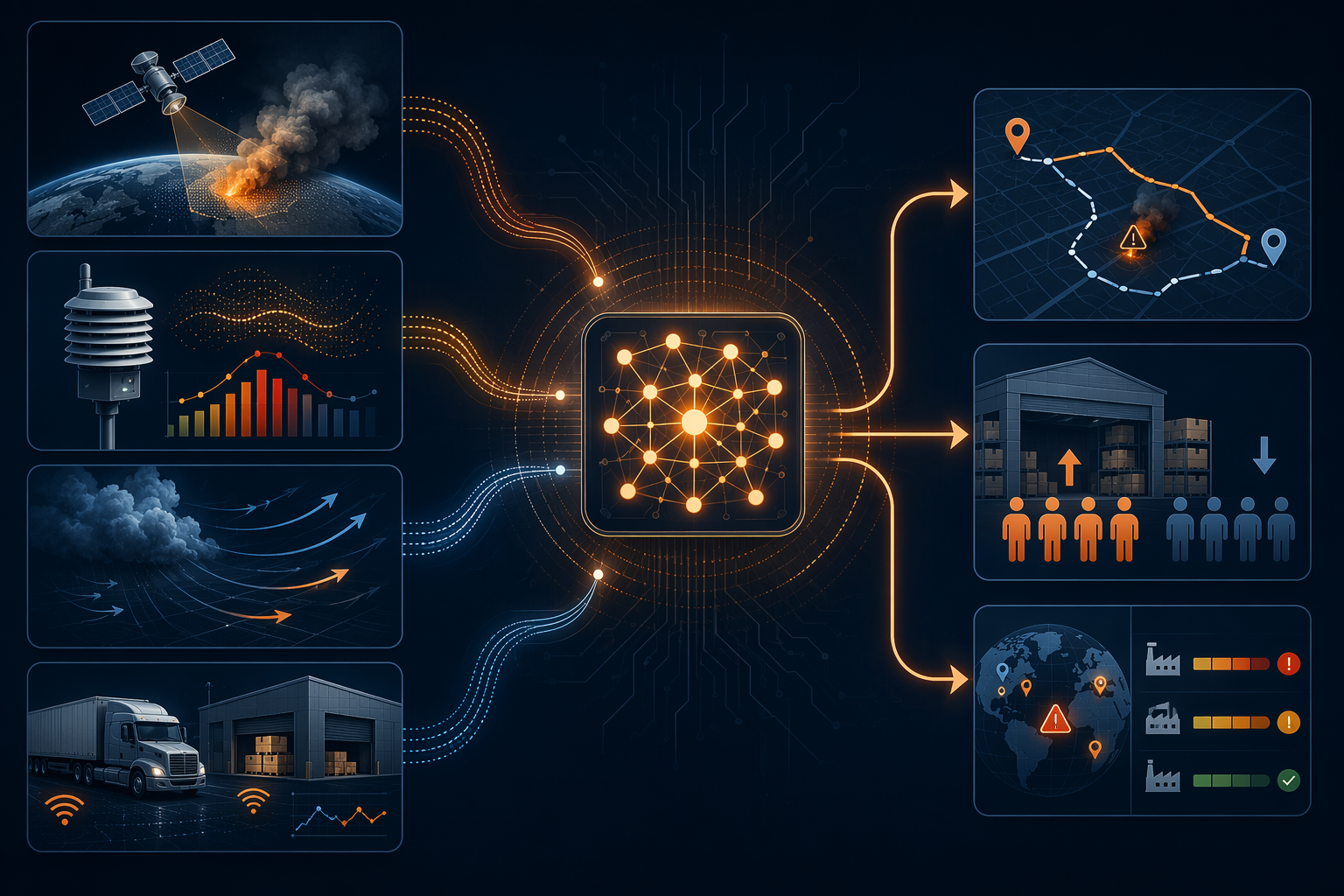
| Input | What It Helps Detect | Operational Question It Supports |
|---|---|---|
| Satellite smoke and fire imagery | Smoke plume location, spread direction, and affected corridors | Which facilities and lanes may be exposed before the fire perimeter changes? |
| Air quality sensor data | AQI deterioration near warehouses, yards, ports, and supplier sites | Can a shift be staffed safely, and when should contingency staffing start? |
| Weather forecasts | Wind shifts, smoke transport, and likely changes in visibility | Will an open route still be usable when drivers reach it? |
| News, public alerts, and AQI notices | Local closures, health advisories, evacuation signals, and emerging constraints | Is there a human-confirmed disruption that has not yet reached the control tower? |
| Logistics telemetry | Truck delays, dwell time changes, missed scans, slower facility throughput | Is the smoke forecast already showing up in execution data? |
IBM has described AI work around fire prediction and detection, including the use of models to process large environmental datasets. The same source references smoke plume forecasting work, including conditional Wasserstein GAN research at USC, as part of the broader push to forecast where smoke may travel rather than only where fire is burning.[3]
For supply chain use, the important mechanism is fusion. Satellite imagery can show the plume. Weather models can suggest where it may move. AQI feeds can confirm whether air quality is degrading near a facility. Natural language processing can pull in public alerts and local reports. IoT sensors inside or near facilities can detect conditions that are more specific than a regional AQI value. Truck, rail, port, and warehouse telemetry can show whether the forecasted hazard is beginning to affect execution.
A useful alert is therefore not simply “smoke detected.” It is closer to: smoke is forecast to affect this supplier cluster, this inbound lane, and this distribution center within a defined window; the latest AQI trend and wind forecast increase confidence; similar routes are already slowing; here are the shipments, purchase orders, and customer commitments exposed.
The 3–14 Day Window Only Matters If It Changes A Decision
Available evidence supports a 3–14 day early-warning window for AI-powered risk monitoring compared with traditional methods. That window is valuable only when it lines up with decisions that actually have lead time. A transportation manager cannot create regional truck capacity after everyone else has started calling the same carriers. A warehouse supervisor cannot responsibly staff a smoke-affected shift without time to check policy, PPE, local advisories, and labor availability. Procurement cannot qualify an alternate supplier after the plant has already missed material.
The best alerts are tied to playbooks that name the decision owner. If predicted smoke exposure crosses a threshold on a lane, transportation reviews rerouting and alternate capacity. If facility AQI risk rises, operations reviews shift timing, outdoor yard work, dock activity, and worker-safety procedures. If a supplier region is likely to lose operating hours, procurement checks inventory coverage and substitute sources. If port throughput begins slowing, planning recalculates arrival assumptions before safety stock is consumed.
- Rerouting: move freight before a lane becomes congested or visibility-constrained, not after drivers are already delayed.
- Warehouse staffing: adjust shift timing, safety controls, or workload allocation when smoke risk threatens worker health.
- Alternate capacity: pre-book carrier, warehouse, or cross-dock options while there is still availability in the market.
- Supplier review: identify exposed supplier sites and purchase orders before the disruption is discovered through missed deliveries.
- Inventory planning: update ETA, dwell, and replenishment assumptions before the shortage appears at the customer-facing node.
This is where the distinction between detection and decision support matters. A smoke model can be technically impressive and still arrive too late for operations. A less elegant alert that reaches the right desk with the right affected shipments may be more valuable than a more sophisticated forecast that remains detached from order, lane, and facility data.
How The Alert Becomes A Control Tower Action
Many companies would experience this use case through a risk platform, transportation visibility tool, or cognitive control tower rather than a standalone smoke model. Everstream, FourKites, Blue Yonder, and C3 AI are examples of the broader vendor landscape, but the category is more important than the logo. The system has to connect external hazard intelligence to internal operating data.
A conventional dashboard may show late shipments, missed milestones, or a facility exception after disruption is visible in the network. AI-enabled monitoring tries to move the trigger upstream. It looks for weak signals around the operating asset: a smoke plume forecast, AQI alerts, wind changes, local closure reports, facility sensor readings, and early movement anomalies. Then it scores likely impact against lanes, suppliers, warehouses, ports, and open orders.
That is also why this use case belongs close to the broader concept of a supply chain control tower AI. Smoke prediction is not valuable as an isolated weather layer. It becomes valuable when it changes the exception queue, the ETA logic, the inventory risk view, and the escalation path.
In a mature workflow, the alert carries three pieces of context. First, exposure: which assets, routes, suppliers, and orders are in the likely smoke path. Second, confidence: which signals agree, which are stale, and which are uncertain. Third, actionability: which playbook applies, who owns it, and how much time remains before the predicted operating impact.
A Practical Smoke-Risk Workflow
- Monitor regional fire, smoke, AQI, weather, and public-alert feeds around operating locations and critical lanes.
- Map those signals to facilities, yards, ports, suppliers, in-transit shipments, and customer commitments.
- Forecast likely impact windows, including degraded air quality, reduced visibility, delayed movement, and lower facility throughput.
- Trigger playbooks for rerouting, staffing, alternate capacity, supplier review, or inventory adjustment.
- Track whether execution data confirms the forecast, then update alerts as wind, AQI, and logistics conditions change.
The last step is easy to underweight. Smoke risk can improve or deteriorate quickly as winds shift. An alert that is not continuously refreshed can create the same problem as no alert at all: teams either chase a stale exception or miss the lane that became exposed after the first review.
What The Evidence Supports, And What It Does Not
The strongest quantified operating outcomes in the available material come from Everstream Analytics, and they should be read as vendor-reported client outcomes, not independent proof that every deployment will perform the same way. Everstream reports a 5% reduction in expedited freight, a 10% on-time delivery improvement, 30% fewer revenue losses from disruption, and 50–70% faster disruption impact assessment for its clients.[4]
Those numbers are still worth attention. Expedited freight, on-time delivery, revenue loss, and assessment speed are operational metrics, not vague resilience claims. They line up with the decisions smoke-risk monitoring is supposed to improve: booking capacity earlier, adjusting routes sooner, identifying exposed suppliers faster, and shortening the time between an external event and a usable impact view.
The market context also shows that buyers are paying attention to AI-enabled resilience, although the survey scope matters. ABI Research reported that 65% of supply chain professionals consider AI or GenAI important for purchase decisions, and that 77% are considering or implementing mobile automation.[5]
Broader cost figures explain why the category attracts budget. NetSuite, citing J.S. Held, reports that supply chain disruptions cost about $184 billion annually. The same NetSuite article cites Swiss Re data showing wildfire-related insured losses rising from about 1% to about 7% of global natural-catastrophe losses.[6]
None of that proves that an AI platform will prevent wildfire disruption. Adoption statistics are not effectiveness statistics. Vendor outcomes are not universal benchmarks. Annual disruption-cost estimates do not isolate smoke-specific losses. The defensible conclusion is narrower: wildfire smoke creates measurable operating exposure, and AI monitoring can be useful when it turns earlier signals into decisions with named owners and enough lead time to act.
Where Confidence Should Stop
Smoke forecasting has hard limits. Some satellite inputs may be constrained by 300m–2km pixel sizes, which is not the facility-level precision a shift supervisor wants. Wind can move smoke faster than an operating plan can be rewritten. AQI readings can vary across short distances, especially around yards, docks, and buildings with different ventilation and exposure. Public reports may be late, duplicated, or noisy.
That means alert design matters as much as model design. A good system should show which signals drove the alert, how current they are, and what uncertainty remains. It should distinguish a likely AQI-driven staffing issue from a confirmed road closure or a port throughput slowdown. The response to each is different, and blending them into one red warning wastes time.
The operating playbook should also avoid false precision. A risk score can help prioritize attention, but the final call may still sit with a transportation manager, site leader, safety team, or procurement owner. The useful question is not whether the model is certain. It is whether the alert arrives early enough, with enough context, for the right person to make a better decision than waiting for the control tower to turn red.
The Use Case In One Sentence
AI does not stop wildfire smoke from disrupting supply chains. It can detect smoke-linked operating risk earlier than many teams currently act on it, especially when satellite, AQI, weather, facility, and logistics signals are tied to predefined decisions on routing, staffing, capacity, supplier review, and inventory.
The same pattern appears in other physical-disruption monitoring use cases, including AI counter-drone systems for supply chain infrastructure: external signals only matter when they are connected to exposed assets, escalation rules, and operational consequences.
References
- California wildfires endanger supply chain workers, displace businesses, Supply Chain Dive
- The invisible costs of wildfire disasters in 2025, UNDRR
- California fires drive race for AI detection tools, IBM
- Artificial Intelligence Role in Supply Chain Risk Management, Everstream Analytics
- Supply Chain Disruptions 2026: How to Build Resilience with AI and Automation, ABI Research
- Supply Chain Risks: What They Are and How to Manage Them, NetSuite
Comments
Join the discussion with an anonymous comment.