
Weather has stopped being a background variable for supply chains. In 2025, extreme weather surpassed cyber incidents as the single largest cause of supply chain disruption in the BCI Horizon Scan, the first time that had happened since 2017.[1] Resilinc also reported a nearly 40% year-over-year increase in disruption alerts, with weather identified as the primary driver.[2] For planners, that does not land as a climate headline. It lands as a missed inbound load, a plant running short, a promotion without inventory, or an expedited freight bill that finance will ask someone to explain.
That is the useful test for AI weather forecasting in supply chain disruption work: did the forecast change a decision while there was still time to act? A model that produces an elegant storm track after purchasing has closed, trucks have departed, or store allocations have already been locked is interesting but not operational. The deployments that matter are the ones that move inventory, reroute freight, adjust replenishment, or change a procurement position before the disruption becomes visible in the usual systems.
One hurricane case shows the difference. ClimateAi says a roofing-materials producer used its hurricane forecasts ahead of Hurricane Ian to position inventory in advance, generating $15 million in incremental sales from that pre-storm decision.[3] The figure should be read carefully: it is a vendor-published case study from a specific company, product category, and event. Still, it is exactly the kind of evidence supply chain teams should examine, because the value was not attributed to “better weather awareness” in the abstract. It came from putting materials where post-storm demand was likely to surge.

What AI Weather Forecasting Adds Beyond a Weather Feed
Most supply chains already consume weather information somewhere. A planner checks a storm map. A logistics team receives alerts. A procurement group watches crop conditions. The gap is that those signals often sit outside the systems that decide what to buy, where to stage stock, which route to run, or which supplier deserves attention first.
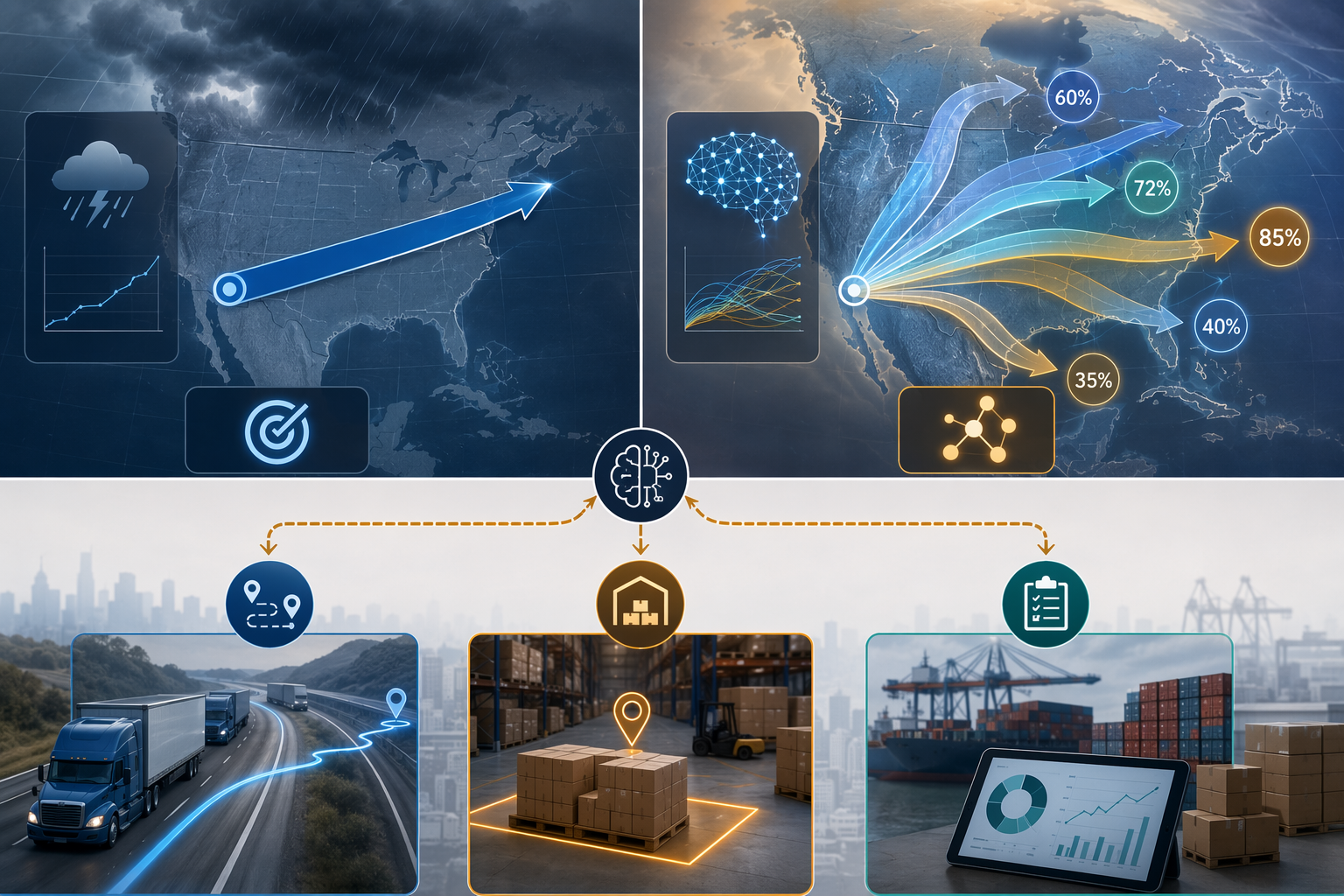
The newer AI weather forecasting systems are trying to close that gap by combining several layers of data and translating them into operational probabilities. Everstream describes a supply-chain weather model that integrates sources such as NOAA GFS and GEFS, ECMWF, IoT feeds, soil moisture, vegetation indices, more than 200 crop models, and the work of a dedicated team of five meteorologists.[4] ClimateAi describes long-range forecasting at 1 km resolution and says its models have been hindcast-validated at 18% to 62% better than NOAA and ECMWF benchmarks, depending on the variable and region tested.[5] The Weather Company’s GRAF model is another example of operational multi-source weather intelligence built to improve forecast coverage and granularity.[6]
The important shift is not that AI replaces meteorology. It is that the forecast can be made specific enough to connect with supply chain actions. A store-level demand forecast can absorb heat-wave signals. A transportation control tower can score lanes against storm exposure. A commodity team can evaluate a crop-region risk months before price movement arrives in the ERP. The same weather event can mean very different things depending on the product, node, supplier, and decision window.
The Forecast Has to Become a Decision
A supply chain does not need a perfect description of tomorrow’s weather. It needs a timely reason to change a plan. That makes the output format as important as the model. A deterministic forecast says, in effect, “this will happen.” A probabilistic forecast says, “this outcome is likely enough that waiting may cost more than acting.” Many organizations still prefer the first answer, even when the second is the only one available early enough to be useful.
This is where implementation gets uncomfortable. ClimateAi has written about using hindcasting to build trust in forecasts and cites 60% to 75% accuracy at six-month lead times.[7] That range can be valuable for procurement or agricultural supply planning, but it does not feel like certainty. A planner may ask for a yes-or-no answer because the purchase order, freight booking, or hedge position is binary. The model may only be able to say that the probability has crossed a threshold where inaction is now the bigger risk.
The practical question becomes: what decision rule is attached to the probability? A 70% chance of a regional heat wave might trigger extra beverage replenishment. A 65% probability of port disruption might trigger alternate routing for high-margin or time-sensitive freight. A 60% signal on crop stress might justify a partial hedge rather than a full procurement shift. Without those pre-agreed thresholds, AI weather forecasting remains another dashboard that people admire during a disruption review and ignore during planning.
Demand Sensing: Weather at the Shelf, Not Just the Region
The shortest decision window is often demand sensing and replenishment. Weather can move demand before a traditional forecast catches up: cold drinks during heat waves, seasonal hardware before storms, heating products before a cold snap, or recovery materials after severe weather. If the replenishment system only sees last year’s sales, recent point-of-sale trends, and promotions, it can underreact until the shelves have already sent the signal.
RELEX says machine learning models that factor in weather impacts can reduce forecast errors by up to 75% for weather-sensitive SKUs during heat waves.[8] Its broader machine learning demand-forecasting material describes how models can incorporate multiple demand drivers rather than treating history as the only reliable guide.[9] That matters because weather does not affect every SKU equally. A heat wave might lift demand for some categories, depress demand for others, and do almost nothing to the rest of the assortment.
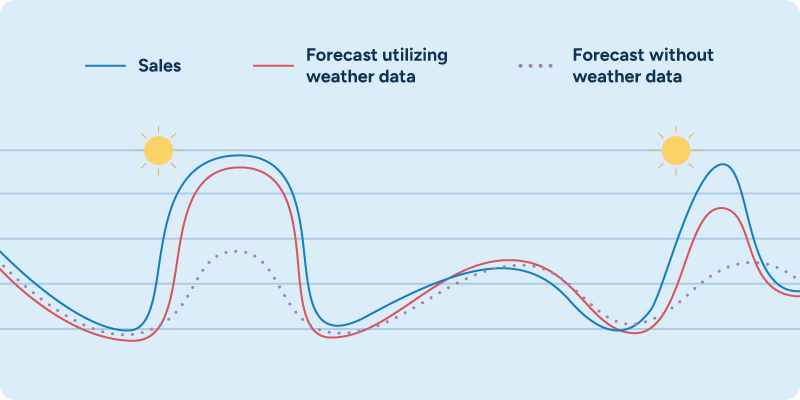
This is a cleaner use case than many broader AI planning claims because the operational lever is visible. The forecast changes store-level or DC-level replenishment quantities. It can also change allocation logic when constrained inventory must be sent to the locations most likely to experience a weather-driven spike. Teams evaluating AI demand forecasting in CPG and retail should pay attention to whether weather is treated as a live driver in the model or as an after-the-fact explanatory field.
Logistics Rerouting and Inventory Prepositioning
Transportation teams usually feel weather as compression. A route that looked feasible becomes risky. A carrier cancels. A port slows. A DC cannot receive. The operational value of AI weather forecasting is not only in predicting the event; it is in giving the team enough lead time to separate freight that can wait from freight that should move now, reroute, or be staged somewhere else.
The roofing-materials case ahead of Hurricane Ian is useful here because it joins two actions that are often discussed separately: forecasting demand and positioning inventory. ClimateAi attributed $15 million in incremental sales to the producer’s ability to place inventory before the hurricane created post-storm demand.[3] The planner’s question is not whether that number transfers to another business. It probably does not. The transferable pattern is the decision sequence: identify exposed demand, move stock before capacity tightens, and avoid trying to serve the surge only after the event has made transportation harder.
Short-range weather intelligence can also support lane-level routing choices. The higher-value use is rarely a blanket “avoid the storm” rule. It is a ranked queue: which shipments are most exposed, which customers have the least tolerance for delay, which inventory can be substituted, and which routes still have enough capacity to matter. That is where links into TMS, OMS, WMS, and control tower workflows become more important than the weather model alone. For a deeper look at the route-alert side, see how AI weather alerts optimize logistics routes.
Hurricane planning is a good stress test because lead time, confidence, and physical execution collide. Forecasts change as the storm develops. Warehouses and carriers face the same regional constraints. Demand can appear in places that were not the highest-volume markets under normal conditions. A useful model has to update the risk picture without forcing planners to rebuild the entire response from scratch. For supply chains with recurring tropical exposure, proactive hurricane supply chain planning is less about a single event playbook than about predefining which probabilities trigger which inventory and routing actions.
Commodity Procurement Needs the Longer Window
Procurement and commodity teams need a different kind of weather forecast. They are often less concerned with tomorrow’s road conditions than with crop stress, regional precipitation patterns, soil moisture, and the price consequences that may arrive months later. The operational move is not to send a truck around a storm. It is to buy earlier, diversify supply, hedge, or avoid being forced into the market after everyone else has seen the same shortage.
ClimateAi describes a coffee case in which a customer acted six months early on a 69%-confidence forecast of a Brazilian coffee price spike and saved $3 million.[5] The same source describes an unnamed commodities firm generating $2 million to $6 million in new profits through smarter hedging, and says Simplot saved millions on a $300 million fertilizer budget.[5] These are vendor-disclosed examples, not neutral industry averages. They still show why long-range weather signals are attractive in procurement: if the forecast arrives before the market fully prices the disruption, the action window is commercially meaningful.
This is also where probabilistic thinking becomes hardest to avoid. A six-month crop-risk signal will not behave like a confirmed supplier shipment date. It is a planning input, not a guarantee. The better procurement response is usually graduated: adjust a portion of the buy, add optionality, review supplier concentration, or test a hedge. Teams that wait for certainty may receive it only after the price has moved.
Supplier Risk: Weather Exposure Beyond the First Tier
The most frustrating weather disruption is the one hidden behind a supplier name that looked safe. A buyer may know the contracted vendor but not the facility, sub-tier dependency, logistics corridor, or regional exposure that turns a storm into a material shortage. Weather forecasting becomes more useful when it is joined to supplier mapping.
A TraxTech article describes a Cooper Health example involving Interos in which the organization identified four vendors in a hurricane path and secured supply from one that was shutting down.[10] ClimateAi has also described a Hitachi deployment for a global supply chain risk model.[11] These cases point to a different operating pattern from demand sensing or transportation: the forecast is valuable because it prioritizes outreach. The team can ask which vendor is exposed, what inventory is available, whether an alternate source is already qualified, and who needs executive escalation before the supplier sends the disruption notice.
Supplier-risk use cases should not be oversold as fully autonomous resilience. The map has to be good enough. Facility locations, supplier relationships, product dependencies, and alternate-source status need to be maintained. If the supplier graph is wrong, a high-resolution forecast can still point at the wrong operational answer. Teams comparing AI supplier risk monitoring tools should test how weather exposure is connected to actual supplier, facility, part, and revenue impact data.
Where the ROI Claims Are Strongest—and Where They Are Not
The strongest ROI cases share a few traits. The weather-sensitive decision is obvious. The company has a clear action it can take before the event or price movement. The value pool is large enough that avoiding one bad position can pay for the system. Roofing materials before a hurricane, coffee procurement before a crop-driven price spike, and fertilizer purchasing against a large budget all fit that pattern.[3][5]
| Workflow | Typical Weather Signal | Decision Changed | Evidence in the Research |
|---|---|---|---|
| Demand sensing and replenishment | Heat waves, cold snaps, severe-weather demand shifts | Store or DC replenishment quantity, allocation priority | RELEX reports up to 75% lower forecast errors for weather-sensitive SKUs during heat waves |
| Logistics and inventory positioning | Hurricane track, storm exposure, lane risk | Preposition inventory, reroute freight, prioritize constrained capacity | ClimateAi roofing case attributes $15M incremental sales to pre-Hurricane Ian positioning |
| Commodity procurement | Crop-region risk, precipitation, soil moisture, long-range anomalies | Buy earlier, hedge, diversify supply, adjust exposure | ClimateAi coffee case reports $3M saved from action on a 69%-confidence forecast |
| Supplier risk | Facility exposure to hurricanes or other severe weather | Escalate vendors, secure supply, activate alternatives | Cooper Health / Interos example identified four vendors in a hurricane path |
Those examples do not prove that every AI weather forecasting supply chain disruption project will produce seven-figure returns. They prove something narrower and more useful: when the forecast is tied to a high-value decision with enough lead time, the payback can be material. A company selling low-margin, non-weather-sensitive goods through a flexible network may see a different result from a company selling storm-recovery materials into constrained regions.
Forecast accuracy metrics also need careful handling. A model can be more accurate than a benchmark and still fail to improve operations if it arrives too late, is not trusted, or is not integrated into planning. Conversely, a forecast that is only moderately confident may create value if it changes a high-leverage decision before competitors or suppliers react. The question is not “what is the model accuracy?” in isolation. It is “what decision improves at this confidence level, and what does acting early cost if the signal is wrong?”
The Implementation Work Is Mostly Not Meteorology
Supply chain teams usually discover that the hard part is not buying a better forecast. It is connecting that forecast to messy operating data. Store histories need clean SKU-location patterns. Transportation decisions need lane, carrier, service-level, and inventory context. Supplier-risk models need facility-level mapping, not only headquarters addresses. Procurement models need commodity exposure and decision authority. A forecast cannot compensate for master data that points to the wrong node or a planning process that has no room to act.
This is why data readiness should be treated as part of the business case, not as an IT afterthought. Before a team asks whether the model can predict a disruption, it should ask whether its own systems can answer basic questions fast: which SKUs are weather-sensitive, which facilities are exposed, which orders can be delayed, which suppliers have alternatives, and who is allowed to approve a change. A data readiness assessment for AI inventory optimization is often a more honest starting point than a vendor demo.
Integration design matters for the same reason. If the signal lands only in a standalone dashboard, the team has to translate it manually into orders, allocations, routes, or supplier calls. That may work for a pilot with a small group of motivated users. It usually breaks during peak disruption, when the people who need the signal are already overloaded. Weather intelligence has more chance of surviving production when it appears inside the workflow where the decision is already made.
Adoption Is Early, Even If the Use Cases Are Real
The market direction is clear, but current capability is uneven. Gartner reported in mid-2025 that only 23% of supply chain leaders had a formal AI strategy.[12] Gartner has also predicted that 70% of large organizations will adopt AI-based supply chain forecasting by 2030.[13] Those two facts can coexist. Large organizations may move toward AI forecasting quickly over the next several years, while many current teams still lack the governance, data foundation, and operating discipline to use it well.
That distinction matters for buyers. A mature pilot should not be judged only by a model score. It should show the before-and-after decision: forecast received, threshold crossed, planner action taken, cost or revenue impact measured. The team should also know what happened when the forecast was wrong or only partly right. False positives can create unnecessary freight, inventory imbalance, or supplier noise. False negatives can create the very disruption the system was meant to prevent. The goal is not to eliminate judgment; it is to make judgment earlier and better informed.
A practical evaluation can stay simple:
- Name the decision window: hours for routing, days for replenishment, weeks or months for procurement.
- Define the action threshold before the season starts, including what happens at 60%, 70%, or 80% confidence.
- Connect the forecast to the system of action, not only to a reporting dashboard.
- Measure operational outcomes such as avoided stockouts, lower expedite spend, improved allocation, reduced exposure, or margin protected.
- Review exceptions after each event so planners can see when the model helped, when it overreached, and when internal data blocked the response.
The Next Barrier Is Organizational
AI weather forecasting is already deployable in specific supply chain workflows. The better evidence shows it changing replenishment, inventory positioning, routing, procurement, hedging, and supplier outreach. Some deployments have produced material value, including vendor-published cases in the millions of dollars.[3][5] That is enough to move the conversation out of the innovation lab, but not enough to declare weather disruption solved.
The useful systems depend on clean operating data, workflow integration, and decision rules that people are willing to follow under uncertainty. Many teams still want deterministic answers from probabilistic models. That instinct is understandable; someone has to own the inventory, the freight cost, or the procurement exposure if the forecast misses. But waiting for certainty is often just another way to act too late. The companies getting value are not treating AI weather forecasting as a smarter storm map. They are deciding, in advance, what they will do when the probability is high enough to matter.
References
- BCI Horizon Scan Report 2025, BCI, 2025.
- Global Supply Chains See Nearly 40% Annual Increase in Disruptions, Resilinc.
- Accurate Hurricane Forecasting Helps Roofing Materials Producer, ClimateAi.
- Applying NOAA and AI Weather Forecasting Models to Supply Chains, Everstream Analytics.
- Long-Range Weather Forecasts, ClimateAi.
- GRAF: The Global High-Resolution Atmospheric Forecasting System, The Weather Company.
- Hindcasting: How to Trust Climate Forecasts Before the Future Happens, ClimateAi.
- Improve Demand Forecasting Accuracy by Factoring in Weather Impacts, RELEX Solutions.
- Machine Learning in Retail Demand Forecasting, RELEX Solutions.
- AI Weather Forecasting and Supply Chain Risk Management, TraxTech.
- Hitachi Global Supply Chain Risk Model, ClimateAi.
- Gartner Survey Shows Just 23% of Supply Chain Leaders Have a Formal AI Strategy, Gartner, June 11, 2025.
- Gartner Predicts 70% of Large Organizations Will Adopt AI-Based Supply Chain Forecasting by 2030, Gartner, September 16, 2025.
Comments
Join the discussion with an anonymous comment.