
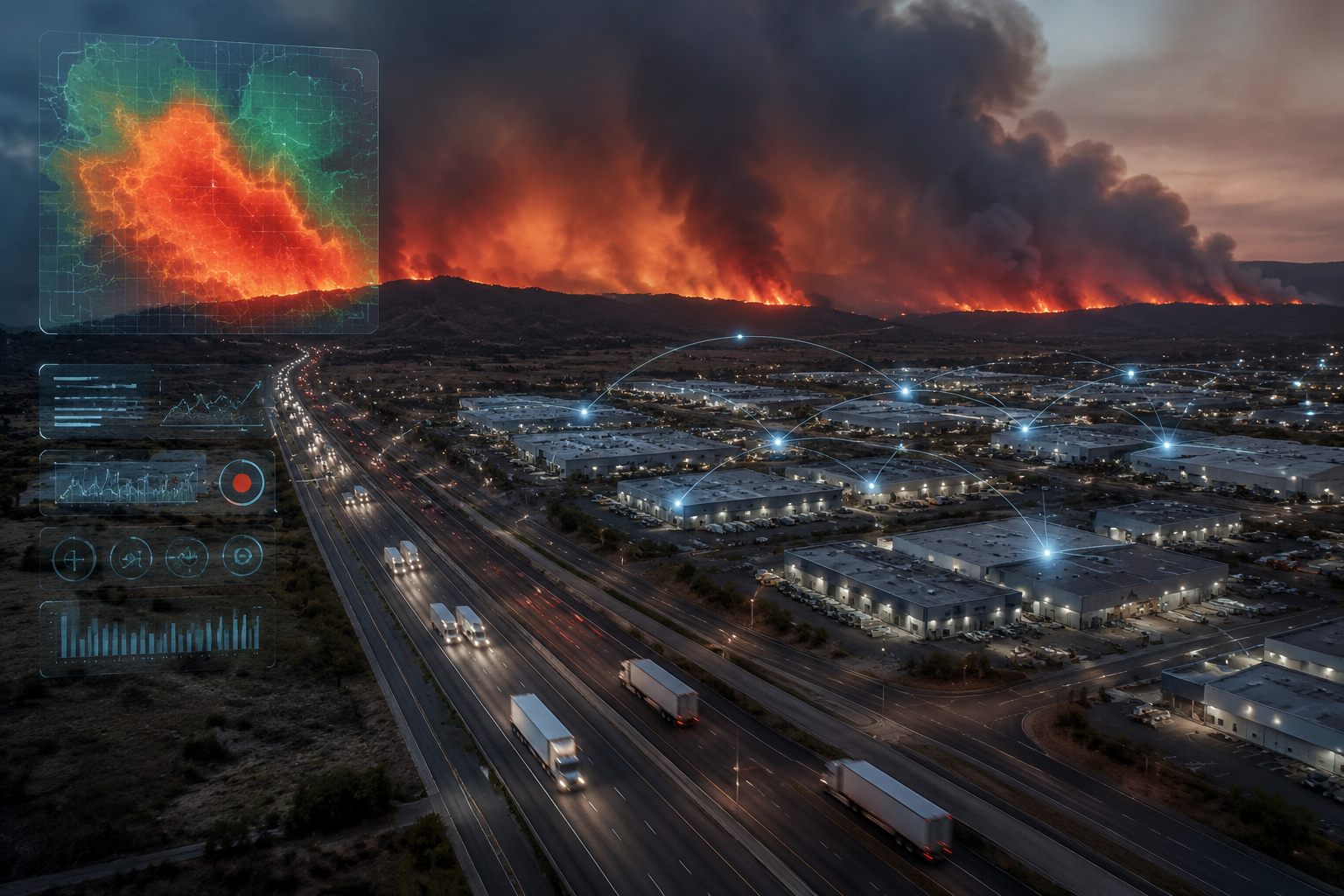
Wildfire disruption becomes a supply chain problem the moment someone has to decide whether a supplier can still ship, whether a lane is still usable, whether a warehouse can staff the dock, or whether a customer promise has quietly become impossible. The useful question is not whether AI can spot a fire on a map. It is whether AI can shorten the interval between “there is a fire” and “these purchase orders, carriers, suppliers, facilities, and customers are exposed.”
That interval is expensive. McKinsey analysis cited by Conexiom says companies experience a supply chain disruption lasting a month or longer every 3.7 years on average, and severe shocks can erase 45% of one year's EBITDA over a decade.[1] A ScienceDirect paper, citing Wang et al. 2022, reports an estimated $88.6 billion in supply chain disruption losses from the 2018 California wildfire season, about 60% of total wildfire economic costs that year; because that figure is relayed through a later methodology paper, it should be treated as a serious loss baseline rather than a standalone audited benchmark.[2] GEP put total damages from the January 2025 Los Angeles fires at $61.2 billion.[3]
For teams already using AI for broader weather disruption planning, wildfire is a harder operating case because the hazard moves fast, creates secondary effects such as smoke and air-quality constraints, and often forces decisions before the damage picture is complete. The best AI deployments do not replace the incident room. They feed it better evidence earlier, then connect that evidence to the systems where the business actually acts.
The Three Decisions AI Has To Support
AI for supply chain wildfire disruption usually gets flattened into one promise: prediction. That hides the more important buying distinction. A transportation manager trying to reroute freight around an active fire does not need the same system as a utility operator deciding where ignition risk is rising, or a procurement team trying to discover which sub-tier supplier sits inside a fire perimeter.
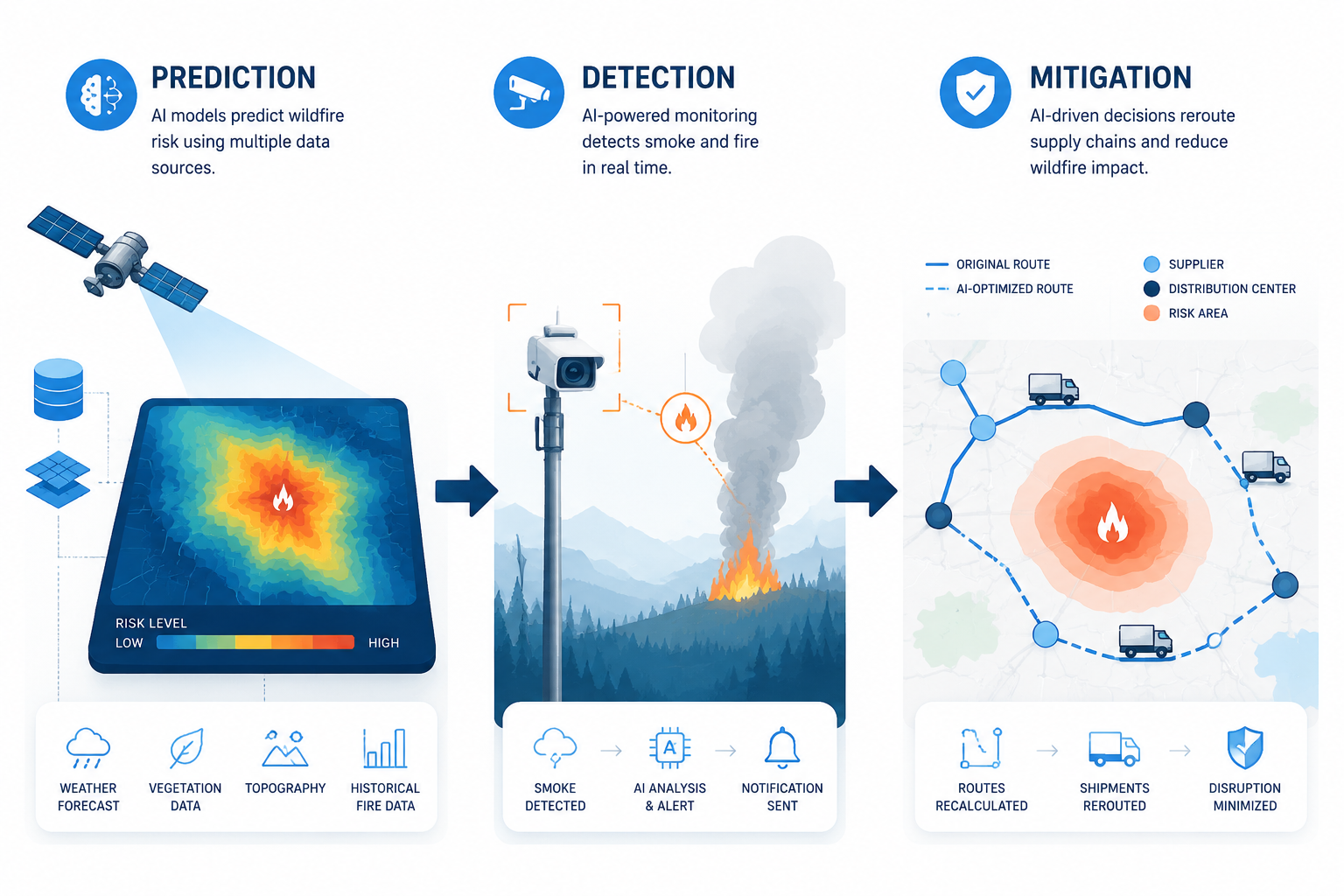
| Phase | Operational question | Typical AI capability | Supply chain action |
|---|---|---|---|
| Prediction | Where could ignition or spread create exposure? | Fire-behavior simulation, weather and terrain modeling, probabilistic spread forecasts | Pre-position inventory, review alternate suppliers, adjust planned lanes |
| Detection | Has a fire started, and is the signal reliable enough to escalate? | Satellite, camera, sensor, and geospatial models that reduce missed events and false positives | Open an incident, validate facility and lane exposure, notify owners |
| Mitigation | What is affected, who owns it, and what should change now? | Supplier mapping, shipment exposure analysis, risk scoring, rerouting and response recommendations | Switch suppliers, reroute freight, resequence orders, update customers |
The sequence matters because maturity is uneven. Some companies still cannot reliably map a tier-one supplier to a production site. Others already have shipment visibility and risk workflows, but lack early fire signals. The right investment depends on which decision is slow today.
Prediction: Useful When It Changes The Plan Before The Fire Arrives
Prediction is the most technically impressive part of the wildfire AI stack, but it only earns its keep in supply chain operations when it changes inventory, sourcing, capacity, or routing decisions before exposure becomes urgent.
FireAid, described by Lombard Odier with reference to WEF 2024, is reported to predict wildfire behavior 24 hours ahead with 80% accuracy.[4] Technosylva says its wildfire and extreme-weather platform runs 9 billion daily wildfire simulations and validates them against hundreds of thousands of real incidents.[5] USC researchers have also developed a conditional Wasserstein generative adversarial network model for probabilistic fire-spread prediction, a reminder that the field is moving beyond single deterministic fire lines toward probability bands and uncertainty-aware forecasts.[6]
For a supply chain buyer, the evaluation questions are less exotic than the model names. What geography does the model cover? How often does it update? Does it express confidence? Can it show the time window in which a site, lane, port approach, or utility service territory may become exposed? Can that forecast attach to supplier locations and planned shipments without an analyst manually rebuilding the map?
This is where prediction starts to overlap with supplier risk scoring. A forecast that shows fire spread toward a region is interesting. A forecast that says three sole-source components, two committed outbound loads, and one critical customer allocation sit inside the potential impact zone is operational. For a deeper treatment of supplier-level wildfire scoring, see how AI predicts wildfire risks across your supplier network.
Detection: Faster Signals, Fewer Empty Escalations
Detection sits between public awareness and operational response. The business penalty for a missed fire is obvious. The penalty for noisy detection is more subtle: teams stop trusting alerts, incident rooms fill with low-value checks, and the real event arrives into a queue already crowded with false positives.
IBM has described several AI-enabled detection approaches, including FireSat, a satellite constellation designed to detect fires as small as 5 square meters with a 20-minute update cadence while using AI to reduce false positives from clouds and reflections.[6] IBM also points to Dryad Networks' solar-powered chemical sensors, which detect fire signatures in the “smell” of air, and IBM/NASA geospatial foundation model work for environmental monitoring.[6]
Camera networks occupy a different implementation lane. Marketplace reported that Pano AI detection stations cost about $50,000 per year per station, and that Austin Energy deployed 13 cameras across 437 square miles.[7] That is not a universal cost model for every geography, but it gives buyers a practical planning unit: coverage requires physical infrastructure, siting decisions, and local operating partners, not just a software subscription.
Detection is most valuable to supply chain teams when it creates a clean handoff. An alert should carry enough location, timestamp, confidence, and perimeter context for the risk platform or control tower to ask the next question automatically: what in our network is nearby, moving through, or dependent on that area?
Mitigation: The Hard Part Is Knowing What The Fire Touches
Mitigation is where wildfire intelligence either becomes supply chain work or remains a weather layer. The difference is entity resolution: connecting hazard data to supplier sites, sub-tier relationships, transportation lanes, warehouses, carriers, open orders, inventory positions, and customer commitments.
Everstream Analytics is one of the clearer examples of this operational layer. The company describes an AI platform that combines predictive risk scoring, sub-tier supplier mapping, and automated rerouting recommendations. In vendor-reported client outcomes, Everstream cites a 5% reduction in expedited freight costs, a 10% improvement in on-time performance, a 30% reduction in revenue losses from disruption, 50% to 70% faster time to identify and assess disruption impact, and more than $2 million in annual temporary-freight savings.[8]
Those figures should not be read as independent benchmarks for every buyer. They are vendor-published outcomes, and results depend on baseline process maturity, data quality, carrier options, supplier flexibility, and governance. Still, they point to the right measurement frame. The ROI case is not “AI saw smoke.” It is reduced expedited freight, faster impact assessment, better on-time performance, and avoided revenue leakage.
Everstream also reported wildfire-related supply chain effects during the 2023 Canadian wildfires, including deliveries in Chicago and New York City delayed up to two days and shipment decreases of 50% to 75%.[8] Those are the kinds of secondary impacts many generic fire dashboards miss. A facility may be untouched while smoke, driver availability, road constraints, or regional congestion still degrade service. The same logic applies to AI planning for air-quality disruption, where the event footprint is broader than the flame perimeter.
Sentrisk, from Marsh McLennan, approaches the same handoff from a risk-intelligence and supplier-discovery angle. Marsh says Sentrisk uses “reading AI” to analyze thousands of shipping documents for sub-tier supplier discovery, applies proprietary XR risk scoring, and embeds more than 150 years of risk advisory experience.[9] For procurement teams, the important part is not the age of the advisory practice. It is whether document-derived supplier discovery can expose a dependency that never appeared in the ERP vendor master.
Exiger emphasizes geolocation-based supplier mapping and real-time wildfire zone overlays, with automated risk scoring of supplier exposure in active fire areas.[10] That is a practical mitigation primitive. If the platform knows where suppliers actually operate, not just where they invoice from, it can distinguish a supplier headquartered in a safe city from a production site, warehouse, or logistics node inside the affected zone.
The same multi-tier logic appears in other natural-disaster use cases, including AI earthquake risk monitoring and AI flood disruption planning. Wildfire is different in physics, but the data problem is familiar: a hazard map is only half the answer unless it is joined to the network graph.
What A Good Mitigation Workflow Looks Like
A useful wildfire mitigation workflow starts before the incident, with supplier locations, warehouse coordinates, customer allocations, and lane histories already normalized. During the event, the platform ingests fire perimeters, detection alerts, weather, road or regional disruption data, and shipment positions. It then ranks exposure by business consequence, not just geographic proximity.
- Procurement needs to know which suppliers, alternate suppliers, and sub-tier dependencies are exposed.
- Transportation needs to know which active and planned lanes may face delay, closure, smoke, or congestion.
- Planning needs to know which inventory buffers can absorb the delay and which orders should be resequenced.
- Customer service needs to know which commitments are at risk before the customer discovers the problem first.
- Finance needs to see whether the recommended action reduces exposure or simply moves cost into premium freight.
The review step matters. A model may recommend rerouting, but someone still has to confirm carrier availability, service commitments, safety constraints, and the cost of action versus waiting. The strongest systems make that review faster by gathering the evidence, not by pretending the decision has no trade-off.
Utility Outcomes Are Useful, But Not Perfect Supply Chain Proxies
Some of the most concrete wildfire AI outcomes come from utilities rather than supply chain control towers. Technosylva reports that its work with PG&E contributed to a 99% reduction in wildfire acres impacted, a 68% decrease in equipment-related reportable ignitions, and 56% shorter Public Safety Power Shutoff outage durations.[5] Marketplace also discussed PG&E outcomes in the context of AI-enabled wildfire risk mitigation.[7]
Those results matter because utilities operate under high-consequence, spatially complex wildfire risk. But they should not be imported wholesale into procurement or logistics business cases. A utility can de-energize equipment. A manufacturer may have to expedite components, move inventory, qualify alternates, or renegotiate service commitments. The evidence supports a narrower conclusion: high-resolution wildfire modeling can support measurable operational decisions when the organization has authority, process, and data to act on the signal.
How To Match Vendors To Maturity
The vendor landscape is easier to evaluate when grouped by the decision each platform is built to improve. Fire-behavior simulation platforms help teams see where risk may develop. Satellite, camera, sensor, and geospatial detection platforms help teams identify emerging fires faster. Supply chain risk platforms connect hazards to suppliers, shipments, and operations. Multi-tier supplier mapping tools help reveal dependencies that a tier-one-only view misses.
| If your current weakness is... | Start with... | Do not overbuy... |
|---|---|---|
| You do not know which suppliers or sites are exposed | Supplier location mapping, sub-tier discovery, wildfire alerting, and exposure scoring | Advanced fire simulation before the network graph is usable |
| You know your sites but learn about fires too late | Detection feeds from satellite, camera, sensor, or geospatial monitoring providers | Automated mitigation workflows before alert confidence and escalation rules are trusted |
| You receive alerts but response is manual | Impact assessment, shipment exposure analysis, workflow routing, and recommended actions | More dashboards that do not write to procurement, TMS, planning, or customer-service processes |
| You already have mature risk operations | Predictive simulation combined with automated playbooks and business-impact prioritization | Single-purpose tools that cannot integrate with supplier, lane, order, and customer data |
A low-maturity organization should usually start with exposure mapping and alerting. That means cleaning supplier and facility locations, assigning business criticality, linking major lanes and warehouses, and establishing who reviews an alert. Without that foundation, a more advanced fire model may produce a better forecast that still lands in the wrong inbox.
A mid-maturity organization can add impact assessment and workflow automation. This is where platforms such as Everstream, Sentrisk, and Exiger become more relevant: the value comes from translating an external event into ranked supplier, shipment, and operational exposure. Teams already evaluating broader supplier-risk platforms can use the 2026 AI supplier risk monitoring vendor directory or the autonomous procurement AI supplier risk scoring overview to compare wildfire-specific needs against broader supplier monitoring requirements.
A high-maturity organization can combine prediction, detection, and mitigation into a closed operating loop. That does not mean fully autonomous crisis response. It means predictive simulations flag emerging exposure, detection systems validate events, supply chain risk platforms identify affected entities, and workflow tools route decisions to the owners who can change sourcing, freight, inventory, or customer commitments.
The Buying Test
A credible AI wildfire vendor should be able to walk through the chain of custody for a single alert: source, update cadence, confidence, geographic precision, affected supplier or lane, recommended action, workflow owner, and measured outcome. If that walkthrough ends at a dashboard, the buyer is still carrying the operational burden.
- Ask what the model measures: ignition risk, spread probability, active-fire detection, supplier exposure, shipment delay, or financial impact.
- Ask how often the data updates and which regions, assets, and modes are covered.
- Ask how false positives and confidence levels are handled before an alert reaches operations.
- Ask whether supplier sites, sub-tier nodes, warehouses, lanes, carriers, and purchase orders can be joined without manual rework.
- Ask which outcomes the vendor has measured, and whether those outcomes are independently audited, client-reported, or vendor-reported.
The strongest ROI case emerges when prediction and detection are connected to procurement, logistics, planning, and customer-service decisions. Faster fire intelligence matters. Faster impact assessment matters more.
References
- Supply Chain Disruption Stats: 20 Costs (2026), Conexiom
- Probabilistic Wildfire risk assessment methodology and evaluation of a supply chain network, ScienceDirect
- How Los Angeles Wildfire Impacts Supply Chains, GEP
- Predicting the flame: how AI is reshaping our response to wildfires, Lombard Odier
- Wildfire & Extreme Weather Risk Intelligence, Technosylva
- California fires drive race for AI detection tools, IBM
- How one company is using AI for improved wildfire risk mitigation, Marketplace
- Artificial Intelligence's Role in Supply Chain Risk Management, Everstream Analytics
- Sentrisk, Marsh McLennan
- Southern California Wildfires and Windstorm, Exiger
Comments
Join the discussion with an anonymous comment.