
A useful storm forecast does not say, in broad terms, that weather is coming. It says which Florida distribution centers are likely to need roofing inventory before the trucks are scarce, which port lane is exposed to precipitation or wind, which supplier site sits inside the impact radius, and which SKUs have historically moved differently when the weather pattern appears. That is the practical test for AI supply chain weather disruption planning: whether a probabilistic forecast becomes a Tuesday morning planning decision before the disruption becomes a late exception.
The need is no longer theoretical. In 2025, extreme weather became the single largest cause of supply chain disruption for the first time in nearly a decade, surpassing cyber-related outages, according to BCI Horizon Scan reporting cited by Tradeverifyd.[1] Everstream Analytics reported that supply chain disruptions rose 38% year over year in 2024, while extreme weather events jumped 119%.[2] Maersk reported that 65% of global logistics decision-makers cite extreme weather disruption as the biggest driver for improving supply chain visibility.[3]
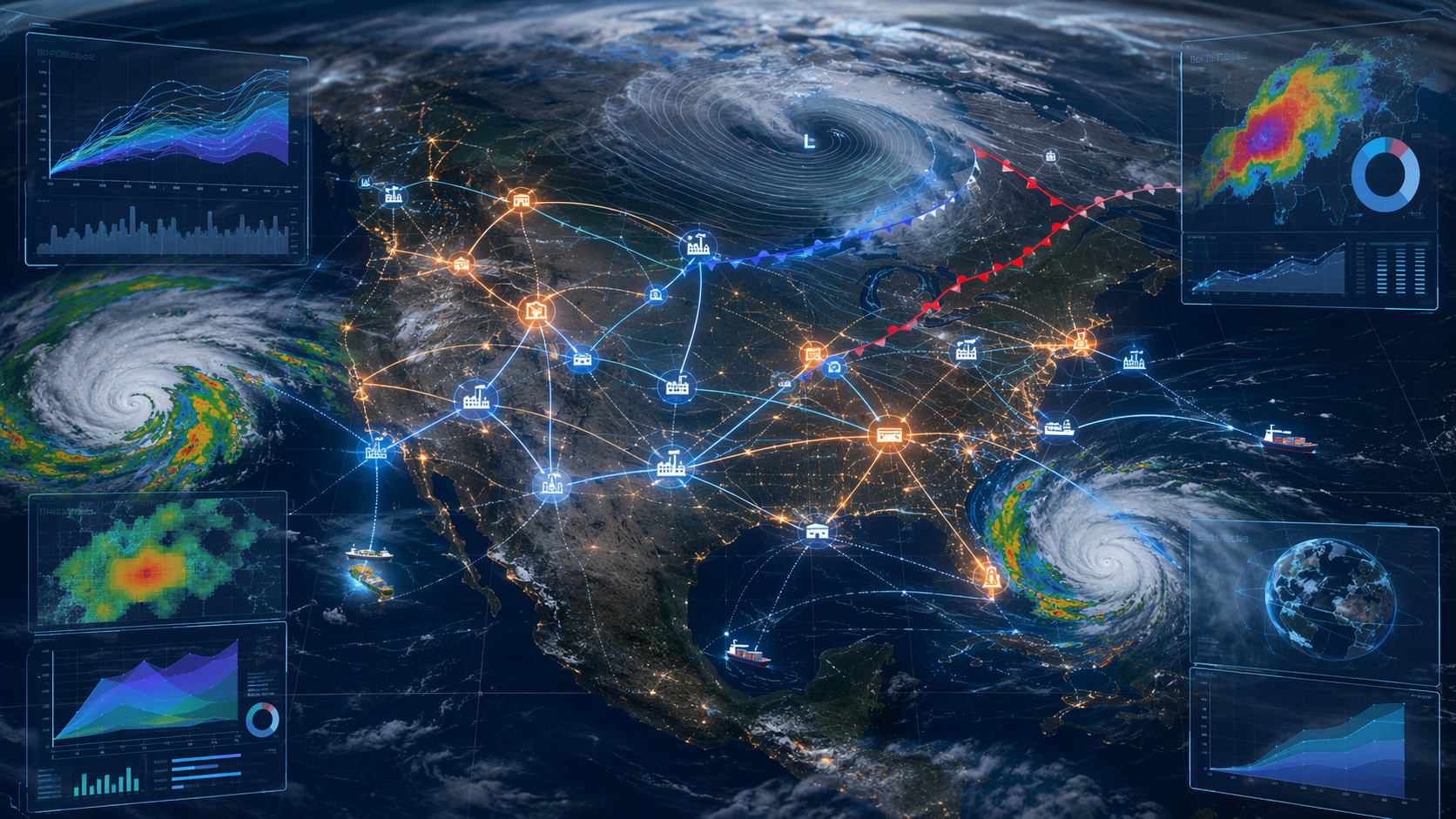
Those figures explain why the category is getting budget attention. They do not, by themselves, prove that AI weather planning works. The better evidence is narrower: systems that connect weather inputs to supply chain topology, convert the forecast into a probability-weighted operational risk, and then show what changed in inventory, routing, supplier alerting, or demand forecasting.
What AI Adds Beyond a Better Weather Alert
The planning problem is not that companies lack weather information. It is that a conventional alert often arrives detached from the network. A hurricane cone, heat advisory, flood warning, or precipitation map still leaves the planner to ask whether the affected area contains a supplier, a carrier hub, a port, a high-velocity store cluster, a commodity sourcing region, or a product category that historically spikes when customers prepare for the event.
AI systems are useful when they absorb that mapping work. The models described in current production use blend numerical weather prediction feeds such as NOAA GFS/GEFS and ECMWF, along with signals such as soil moisture, vegetative health indices, satellite imagery, historical disruption records, and demand histories.[4][5] The output is not “rain on Tuesday.” It is closer to: there is a defined probability of a given rainfall threshold in a specific geography, and that condition has previously correlated with demand movement, transportation delay, facility risk, or supplier exposure.
That difference matters because planners do not buy certainty. They buy lead time with enough specificity to decide whether the cost of acting is lower than the cost of waiting. Industry reporting cited by the World Economic Forum says Johnson & Johnson’s AI system identified 85% of major supply disruptions an average of seven days before impacts materialized.[4] That is a meaningful operating claim, but it should be read carefully: the figure comes through secondary reporting, and the methodology was not independently verified in the materials reviewed here.
The Workflow That Makes the Forecast Operational
The strongest implementations follow a chain that can be traced. Weather data enters the model; the model overlays the supply chain network; historical outcomes teach the system what has mattered before; outputs are expressed as probabilities and impact ranges; planners act inside their existing planning, ERP, TMS, procurement, or replenishment workflow. If any link is missing, the result tends to become another dashboard that someone checks after the meeting.
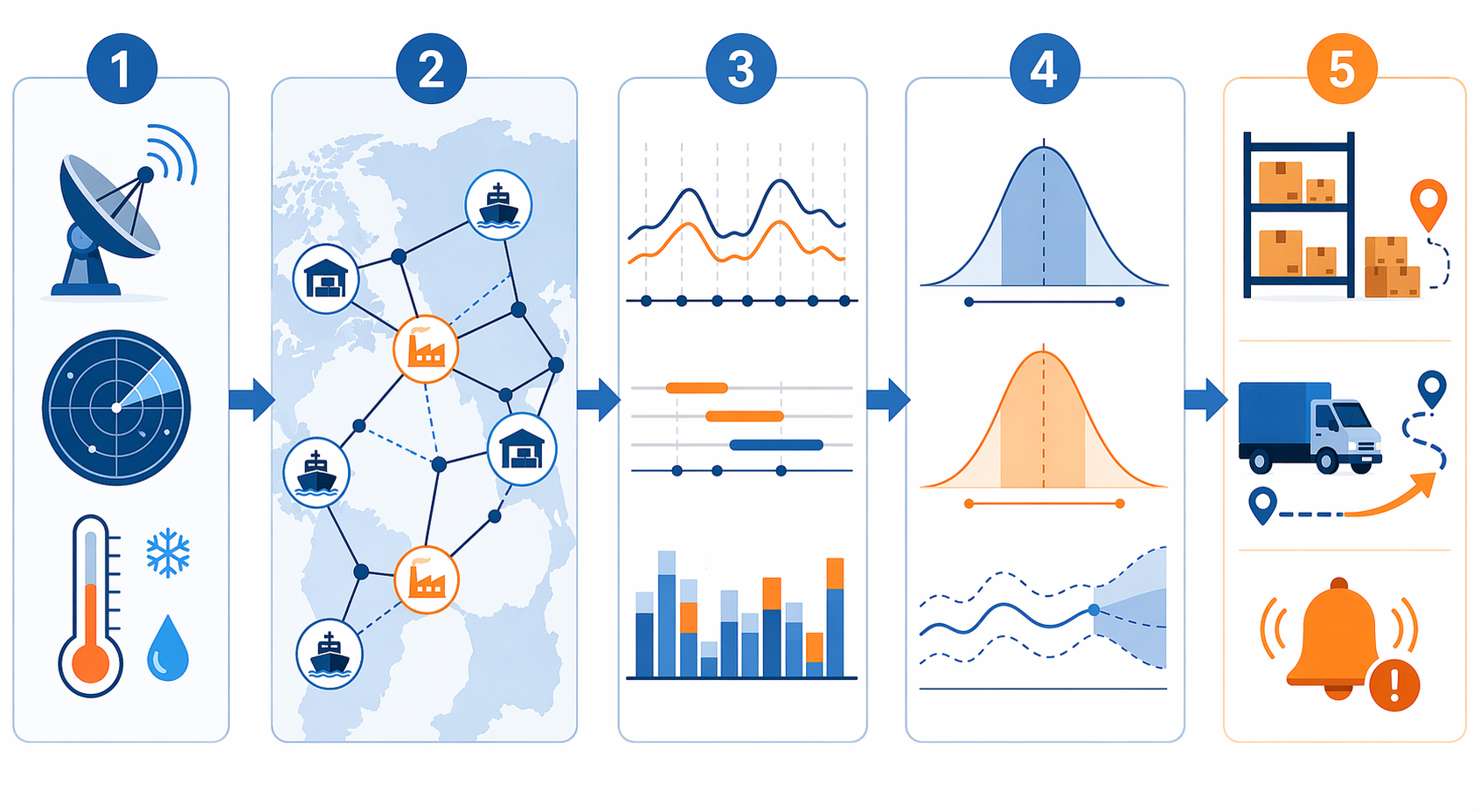
| Workflow layer | What the system needs | Planning decision it should support |
|---|---|---|
| Weather and climate inputs | Hyperlocal forecasts, ensemble model outputs, satellite and environmental signals | Assess timing, intensity, duration, and confidence range of the weather event |
| Supply chain topology | Ports, plants, warehouses, supplier sites, lanes, stores, regions, and SKU flows | Identify which physical nodes and flows sit inside the probable impact area |
| Historical disruption and demand patterns | Past sales, stockouts, lead-time changes, carrier delays, shutdowns, and weather observations | Estimate whether the event usually changes demand, supply availability, transit time, or service risk |
| Probabilistic outputs | Risk scores, confidence intervals, timing windows, and impact estimates | Decide whether to pull inventory forward, reroute, expedite, reserve capacity, or hold the plan |
| Planning actions | Workflow integration into replenishment, transportation, procurement, and risk management | Turn the alert into an owned decision with review timing and financial trade-offs |
The same intelligence layer can operate on different planning horizons, but the decisions are not interchangeable. A tactical use case may look 15 days out and ask whether a lane needs protection or a DC needs advance replenishment. A seasonal use case asks whether weather-sensitive categories should be forecast differently by region. A strategic use case asks whether a sourcing region, crop, facility, or port exposure is becoming less reliable over decades.
Everstream is an example of the tactical pattern. Its weather-risk capability uses NOAA and ECMWF data and applies it to supply chain topology so alerts can be tied to specific supplier, lane, and facility exposure rather than left as general meteorological events.[5][6] The company also says its applied meteorology modeling found that 22 of the top 25 global ports will experience increased precipitation by 2050, which pushes the same data logic into port-risk and network-design conversations.[5]
Inventory Positioning: The Clearest Documented Payoff
The most concrete case in the current evidence set comes from ClimateAi. During the 2022 Hurricane Ian event, a building materials producer used ClimateAi’s hurricane forecasts to pre-position Florida-specific inventory in distribution centers and captured $15 million in additional sales from that storm event.[7] The operational move is easy to understand: forecast early, locate likely demand and supply pressure, place the right inventory before the lane becomes constrained, then serve demand while slower competitors are still reacting.
That case deserves attention because it ties model output to a planning action and then to a documented commercial result. It also needs a guardrail. The $15 million figure is one company, one storm, and one product context. It does not mean every weather AI deployment produces that return, and it does not remove the normal costs of inventory carrying, allocation conflict, transportation capacity, or imperfect demand realization.
Still, the use pattern is strong. Weather-driven inventory positioning is especially relevant when the event changes both demand and supply at the same time: home improvement demand before a hurricane, beverage demand during heat, cold-chain stress during temperature extremes, or grocery stock-up behavior before major storms. In those situations, the decision is rarely “add inventory everywhere.” It is whether a specific region, SKU group, and fulfillment node deserves a different plan while there is still time to move product.
Demand Forecasting Works Best Where Weather Sensitivity Is Measurable
Weather-informed demand forecasting is not equally valuable for every category. It becomes more credible when there is a known relationship between weather conditions and buying behavior, and when the company has enough clean history to separate weather impact from promotion, price, holidays, distribution gaps, and local events.
RELEX reports that machine learning models factoring in weather can reduce forecast errors by up to 75% for weather-sensitive grocery products during unusual weather events.[8] That is a weather-specific claim, and the qualifier is important. It applies to weather-sensitive products and unusual events, not to the entire grocery forecast across all SKUs and all weeks.
The broader AI forecasting evidence is encouraging but less specific. McKinsey estimates that AI can reduce supply chain forecasting errors by 20–50% and mitigate lost-sales risk by up to 65%, as cited in industry coverage.[9] That range should not be treated as a weather disruption benchmark. It supports the general case for AI-assisted planning, while the weather-specific business case still depends on category sensitivity, geography, event frequency, and data quality.
Supplier and Logistics Risk: Where Topology Matters Most
Supplier-risk alerting is where weather AI stops being a forecasting exercise and becomes a network-mapping exercise. A planner does not only need to know that a storm may hit a region. The useful question is whether that region contains a sole-source supplier, a tier-two component site, a port of export, a cross-dock, or a carrier terminal that the enterprise depends on but does not see in its first-tier purchase order data.
Interos appears in this pattern through a MIT Sloan case in which risk alerts helped Cooper Health pre-order supplies before hurricane-related shutdowns.[10] The important detail is not that an alert existed. It is that the alert arrived early enough for the buyer or supply manager to place an order before the disruption constrained availability.
Transportation teams face a similar timing problem. If a model flags likely lane disruption with a usable confidence window, coordinators can reserve alternate capacity, pull shipments forward, protect priority loads, or change mode. If the alert arrives without shipment, inventory, customer, or carrier context, it becomes noise that someone has to manually translate while the exception queue is already growing.
Strategic Sourcing Is the Longer Horizon Version of the Same Question
Most supply chain weather planning discussions stay close to the next storm because that is where the operating pressure is visible. The same modeling logic can also support long-range procurement decisions when the input shifts from short-term weather to climate exposure. ClimateAi says Suntory used its 30–60-year climate forecasts to identify 30–40% yield-decline risks in key commodity sourcing regions and adjust long-term procurement strategy.[11]
That is not the same use case as rerouting a truck next week. The decision cycle is slower, the uncertainty bands are wider, and the stakeholders include procurement, agronomy, finance, and network strategy rather than only planning operations. But it belongs in the same evaluation frame because the buyer still needs a traceable chain from climate signal to exposed supply base to sourcing action.
Vendor Categories Worth Shortlisting
The market should not be read as one clean software category. Buyers are usually choosing among overlapping capabilities: weather intelligence platforms, supply chain risk networks, demand planning suites, and enterprise weather APIs. The right shortlist depends less on who has the best storm map and more on where the planning decision lives.
| Vendor pattern | Examples from current evidence | Best-fit planning use |
|---|---|---|
| Weather and climate intelligence tied to business action | ClimateAi | Inventory positioning, seasonal risk, agricultural and commodity sourcing exposure |
| Supply chain risk analytics with meteorology and topology | Everstream Analytics | Facility, supplier, lane, port, and multi-tier disruption alerts |
| Demand planning with weather as an explanatory signal | RELEX Solutions | Retail and grocery forecasting for weather-sensitive categories |
| Enterprise weather data and predictive analytics APIs | The Weather Company | Embedding weather intelligence into existing planning, operations, and analytics platforms |
| Supplier-risk visibility and event alerting | Interos | Pre-disruption supplier exposure alerts and procurement response |
The Weather Company reports that companies using AI weather intelligence can achieve 5–10% revenue increases along with substantial operating cost reductions.[12] That is a useful directional claim for business-case framing, but buyers should still ask which function produced the gain: better demand capture, fewer expedited shipments, reduced spoilage, improved labor planning, fewer missed deliveries, or a combination that may not transfer cleanly to another network.
A practical shortlist starts with the decision owner. If replenishment owns the problem, weather-sensitive demand forecasting and inventory allocation matter most. If transportation owns it, topology-linked lane risk and carrier alternatives matter more. If procurement owns it, supplier-site visibility and multi-tier exposure are the hard requirements. If strategy owns it, the buyer needs longer-range climate risk tied to commodities, facilities, and regions.
What Breaks in Implementation
The weak point is often not the weather model. It is the company’s own planning data. To estimate demand lift or disruption impact, the system needs historical sales, inventory, promotion, price, stockout, shipment, supplier, location, and weather data that can be matched at the right geography and time interval. Many organizations have the data somewhere, but not in a form that makes a clean training set.
ERP and planning-system integration is the next friction point. A weather risk score that stays in a portal has limited value if planners still have to rekey actions into a demand planning tool, TMS, supplier-risk platform, or allocation workflow. Production use needs ownership rules: who reviews the alert, what threshold triggers action, what financial trade-off is acceptable, and when the plan returns to normal.
The design also has to respect probability. Long-range weather prediction is constrained by chaotic atmospheric behavior, so the honest output is a confidence range, not a promise. A well-designed workflow makes the planner choose among actions under uncertainty: do nothing, monitor, stage inventory, reserve capacity, expedite, reroute, or escalate supplier exposure. The system should preserve the reason for the recommendation so that, after the event, teams can learn whether the threshold was too sensitive or too slow.
How to Judge the Business Case
The strongest business cases usually start where weather already causes measurable operational pain: lost sales before storms, forecast misses in weather-sensitive categories, repeated lane disruption, supplier shutdown exposure, spoilage, service penalties, or expensive last-minute freight. If the pain is vague, the model will be judged by anecdotes. If the pain is measured, the pilot can be judged by fewer forecast misses, earlier decisions, better allocation, avoided expediting, higher service, or captured demand.
- Ask whether the vendor can map weather signals to your actual ports, lanes, facilities, suppliers, SKUs, and regions.
- Require examples of probabilistic outputs, not only deterministic alerts or storm visualizations.
- Test the model against historical events your planners remember, including false alarms and missed disruptions.
- Confirm how alerts enter the existing planning workflow and who owns each action.
- Separate adoption metrics from effectiveness metrics; log whether the recommendation changed an actual plan.
AI weather disruption planning is now mature enough to evaluate for weather-sensitive demand, logistics rerouting, supplier-risk monitoring, and inventory positioning. The buyer lens should stay narrow and operational: does the system reduce uncertainty early enough, in the right part of the network, for someone to make a better decision than the existing process would have made?
References
- 79 Supply Chain Statistics To Know in 2026, Tradeverifyd
- The Impact of Extreme Weather on the Supply Chain, Everstream Analytics
- 5 Ways Severe Weather Disrupts Supply Chains, Maersk
- AI will protect global supply chains from the next major shock, World Economic Forum
- Climate Risk Management for Extreme Weather, Everstream Analytics
- Applying NOAA and AI Weather Forecasting Models to Supply Chains, Everstream Analytics
- Accurate Hurricane Forecasting Helps Roofing Materials Producer Come Out on Top, ClimateAi
- Improve Demand Forecasting Accuracy by Factoring in Weather Impacts, RELEX Solutions
- Effectively Using Weather Forecasts Is A Supply Chain Imperative, Forbes
- Supply Chain Resilience in the Era of Climate Change, MIT Sloan
- Unlocking Resilient Supply Chains: Suntory's ClimateAi Strategy, ClimateAi
- Managing Supply Chain Weather Risks with Predictive Analytics, The Weather Company
Comments
Join the discussion with an anonymous comment.