
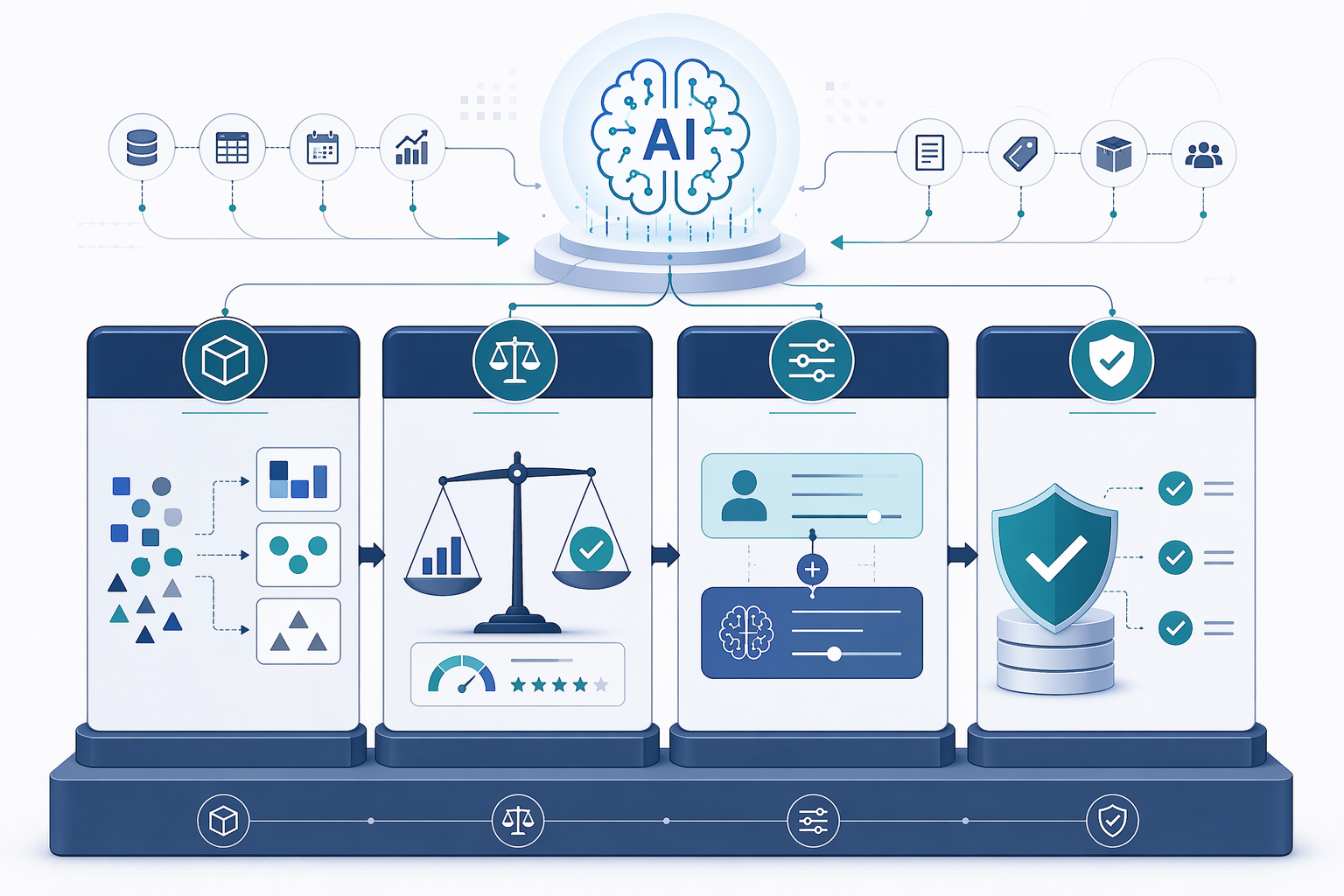
AI demand forecasting is moving from experiment to expected capability. Gartner projected in September 2025 that 70% of large organizations will adopt AI-based supply chain forecasting by 2030, as part of a broader move toward touchless forecasting processes.[1] A separate adoption snapshot reported that 45% of companies already use AI-powered demand forecasting and another 43% plan to implement it within two years.[2]
That pressure is real, but it is a poor reason to rush straight into model selection. The first implementation question is not whether a gradient boosting model, neural network, or probabilistic engine looks best in a demo. It is whether the organization knows which demand streams are forecastable, which planner overrides historically improved the forecast, which data fields can be trusted, and which decisions the forecast is supposed to trigger.
Horizon Solutions’ planning guidance puts a number on what many planning teams learn the hard way: 60–70% of real-world forecast accuracy variance comes from process and structural factors such as SKU segmentation, overlay discipline, FVA analysis, and data cleanliness, rather than from the specific algorithm chosen.[3] That does not make model capability irrelevant. Once the operating foundation exists, better algorithms can matter a great deal. But without that foundation, the model is asked to learn from a demand history that the business itself has not yet understood.
Start With The Demand The Business Can Actually Govern
A realistic AI demand forecasting program starts smaller than most executive decks want it to. The pilot should not be a symbolic sample of the whole business. It should be a bounded operating test where the team can see whether the model improves a forecast that planners, sales, supply, and finance already know how to review.
Industry benchmarks synthesized by GroupBWT from implementation maturity models describe a pilot stage of 0–3 months, often with $100,000–$500,000 budgets, intended to validate a 10–16% forecast error reduction on a bounded SKU set.[4] Those figures should be treated as analyst-consolidated benchmarks, not universal costs. The useful part is the discipline: a pilot has a defined scope, an agreed baseline, and a measurable improvement target before anyone declares that AI forecasting has “worked.”
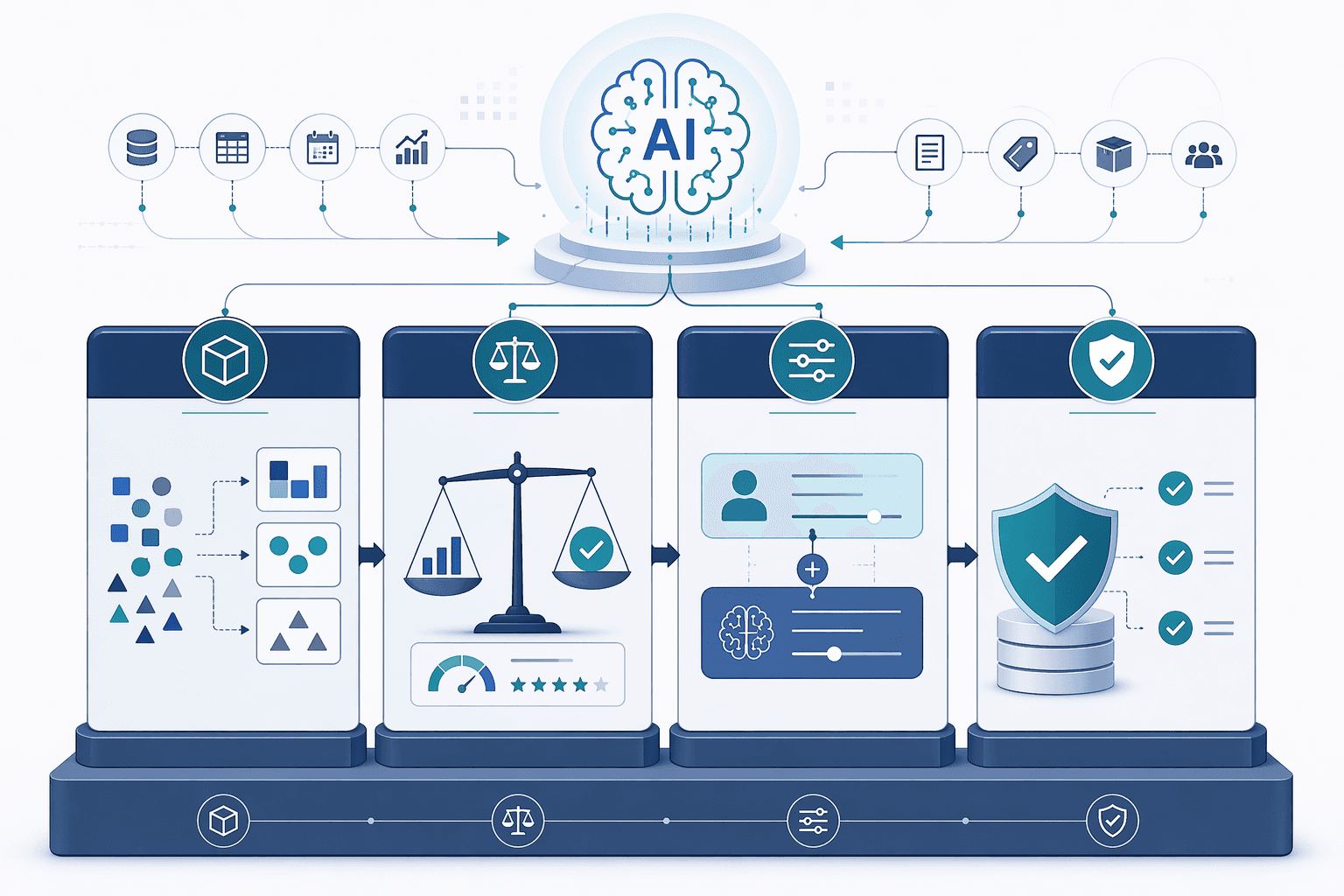
The most important preparation is SKU segmentation. A fast-moving staple, a slow-moving spare part, a promotion-driven seasonal item, and a newly launched product should not be treated as if they are the same forecasting problem. Segmentation decides where statistical automation is likely to be useful, where demand sensing might help, where human commercial input remains necessary, and where the forecast should be deliberately simple because the signal is too sparse.
Good segmentation is not just ABC volume ranking with a modern label. It should combine volume, volatility, intermittency, lifecycle stage, margin or service criticality, and the business action tied to the forecast. If a forecast drives factory capacity, the tolerance for missing a turning point is different from a forecast that only replenishes a low-value consumable. The model can support those differences only if the implementation team names them before training begins.
Forecast value added analysis is the second foundation. FVA asks a blunt question: did each step in the planning process improve the forecast compared with a simpler baseline? A planner override, sales adjustment, customer input, or consensus meeting is not valuable because an experienced person touched the number. It is valuable only if it improves accuracy, reduces bias, or adds usable context for the decision being made.
This matters because AI forecasting systems often inherit years of human overlays without knowing which ones were signal and which ones were noise. If planners routinely lifted forecasts before quarter-end because sales was optimistic, the system may learn a biased demand pattern. If planners made occasional corrections because they knew a distributor was destocking, those interventions may be exactly the kind of contextual signal the model needs. FVA separates the two.
Overlay management is the operating companion to FVA. During implementation, every human change to the statistical forecast should capture the reason, owner, time horizon, affected product-location-customer level, and expected duration. A vague “market intelligence” adjustment is difficult to learn from. A structured override for a confirmed promotion, customer onboarding, price increase, channel inventory correction, or supply allocation gives the model and the review team something to interrogate later.
Data governance is the fourth foundation, and it is usually where the pilot’s optimism meets the transaction system. AI demand forecasting needs clean history, consistent product and customer hierarchies, reliable calendar logic, usable lost-sales or stockout flags, promotion records, price changes, returns handling, and master data ownership. Many organizations cite data quality as a primary barrier to AI forecasting, but the more useful statement is operational: if no one owns the correction path for dirty demand history, the model will expose that problem rather than solve it.
Use The Maturity Roadmap As A Control Gate, Not A Slide
Gartner’s touchless forecasting plan identifies five implementation moves: define the vision, establish change parameters, define the data strategy, create the technology enablement roadmap, and plan the adoption journey.[1] Those are not abstract workstreams. They are control gates. If one is skipped, the gap usually reappears later as planner distrust, integration rework, or a forecast review that still runs on spreadsheets after the pilot model has been celebrated.
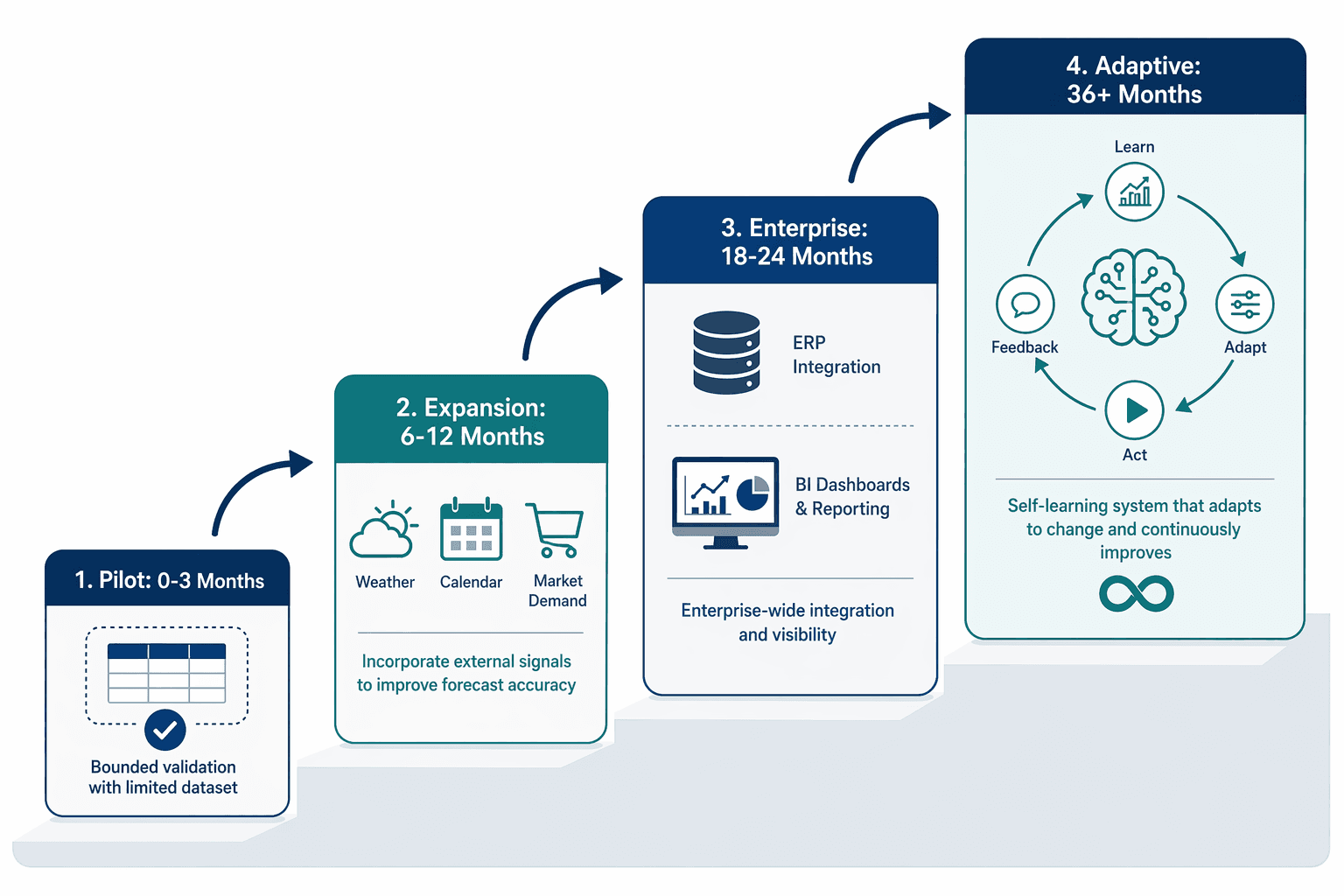
| Stage | Typical Timeframe | Primary Question | Implementation Focus |
|---|---|---|---|
| Pilot | 0–3 months | Can the model beat the agreed baseline on a governed SKU set? | Segmentation, data cleanup, baseline measurement, exception review |
| Expansion | 6–12 months | Can the system absorb external demand signals without creating noise? | POS, promotions, weather, customer and channel signals |
| Enterprise | 18–24 months | Can the forecast operate inside ERP, BI, and S&OP workflows? | Workflow embedding, integration, planner roles, executive review |
| Adaptive | 36+ months | Can AI become part of the operating core? | Continuous learning, automated exceptions, feedback loops, governance at scale |
The pilot gate defines the vision in a way planners can test. “Reduce forecast error” is not a vision; it is an outcome. A useful pilot vision names the decision being improved. For example, the goal may be better finished-goods replenishment for stable regional SKUs, improved promotion uplift estimates for a specific channel, or earlier detection of demand shifts for a priority product family. The narrower the decision, the easier it is to judge whether AI is improving the operating process rather than merely producing a different number.
Change parameters come next. The implementation team should define when the system is allowed to change a forecast automatically, when it must create an exception, and when human approval is required. A low-value, stable SKU might move toward automated touchless forecasting quickly. A constrained, high-margin item with customer allocation risk may still require planner review even if the model is statistically strong. Without those rules, planners are asked to trust a system whose recommendations carry consequences they cannot inspect.
The data strategy gate decides which demand history is valid for learning. The team should flag stockouts, one-time orders, substitutions, returns, channel loading, abnormal pandemic-era or disruption-era patterns, and product transitions. This is not an argument for cleansing history until it looks smooth. It is an argument for telling the model which observations represent demand and which represent operational distortion.
The technology roadmap should stay tied to the pilot’s workflow. If the pilot forecast is exported to a spreadsheet, manually adjusted, rekeyed into ERP, and then debated in a separate S&OP deck, the organization has tested a model but not an implementation. The roadmap needs to show where the forecast will be consumed, who can override it, how exceptions move, and which system becomes the record of decision.
Expansion Is Where External Signals Help Or Hurt
After the pilot, the temptation is to add more data because AI systems can technically process it. Expansion should be more selective. GroupBWT’s maturity progression places external-signal integration in the 6–12 month stage, including POS, weather, and promotions.[4] The timing is sensible: external signals are powerful only after the organization has already proven that its internal history, hierarchy, and baseline forecast can be governed.
The reason to take external data seriously is not fashion. AWS and Kearney’s executive insights note that 80% of useful data is generated outside the enterprise, a reminder that internal order history often shows demand late and imperfectly.[5] POS data may reveal consumer pull before replenishment orders arrive. Weather may explain local spikes. Promotion calendars may prevent the model from mistaking planned uplift for a permanent trend.
But each new signal needs a business hypothesis. POS data helps when sell-through is timely, mapped correctly to products and locations, and relevant to replenishment decisions. Weather matters for categories with proven sensitivity, not for every SKU that happens to ship through a region. Promotion data helps only if mechanics, timing, depth, and execution quality are recorded with enough consistency to distinguish a planned event from an unexplained demand spike.
This is also where build-vs-buy decisions become more concrete. AI/ML-native forecasting specialists may offer deeper modeling capability, richer signal handling, and more flexible experimentation. Enterprise platform modules may reduce integration friction because they already sit near ERP, planning workflows, security models, and master data. The right choice depends less on vendor positioning than on the constraint the organization actually faces.
- Privilege forecasting depth when demand behavior is complex, external signals are material, and the organization can support integration and model operations.
- Privilege workflow integration when the main failure risk is planner adoption, ERP alignment, approval routing, or fragmented planning calendars.
- Avoid treating either choice as permanent immunity from process work; both options still need segmentation, FVA, overlay rules, and governed data.
Enterprise Rollout Tests The Operating Model
The enterprise stage is where a promising pilot either becomes a planning capability or turns into another analytics asset maintained outside the decision flow. GroupBWT’s maturity model places enterprise deployment at roughly 18–24 months, with forecasting embedded in ERP and BI workflows.[4] That is the correct emphasis. A forecast that cannot survive the handoff into replenishment, production planning, financial review, and executive S&OP is not yet operational.
ERP integration is not just a technical connector. It forces decisions about planning level, timing, ownership, and reconciliation. The AI model may forecast at a product-location-week level, while finance wants product-family-month views and supply planning needs constrained volumes by plant. If those translations are not designed, the enterprise rollout creates competing numbers rather than better decisions.
Planner workflow needs the same attention. A model can generate thousands of exception flags, but someone must decide which exceptions deserve attention, which can be auto-approved, and which should be escalated. Exception logic should reflect materiality, service risk, forecast bias, volatility, and business consequence. Otherwise, the system simply moves the planning team from spreadsheet maintenance to alert maintenance.
Executive forecast review also changes. Leaders who previously debated a single consensus number need to become comfortable reviewing confidence ranges, assumptions, bias, and override performance. That does not mean turning every S&OP meeting into a data science session. It means replacing unstructured opinion fights with a clearer view of where the model is strong, where human judgment improved it, and where the business is choosing risk despite the forecast.
This is the stage where the commonly cited 20–50% forecast error reduction becomes plausible rather than decorative. ToolsGroup, citing McKinsey, reports that machine learning in demand planning can reduce forecast error by 20–50%.[6] That range should not be read as a software guarantee. It is more credible when the enterprise has narrowed the pilot properly, governed master and demand data, measured FVA, managed overlays, and built workflows that act on the forecast quickly enough for the improvement to matter.
Adaptive Forecasting Requires Governance, Not Less Of It
The adaptive stage is sometimes described as the point where AI becomes the operating core. GroupBWT’s synthesized maturity benchmarks place this at 36 months or more, with budgets reaching $10 million or above in large-scale programs.[4] The number will vary widely by enterprise size and scope, but the implication is useful: adaptive forecasting is not the pilot with a larger data set. It is a different operating model.
In adaptive operation, the system continuously updates forecasts as new demand signals arrive, routes exceptions based on business rules, learns from accepted and rejected overrides, and feeds downstream planning processes. The planner’s role does not disappear. It shifts toward exception diagnosis, assumption management, event interpretation, and governance of cases where the model’s recommendation conflicts with commercial or supply reality.
That shift requires more transparency, not less. Planners do not need to see every coefficient or technical feature weight, but they do need to know why a recommendation changed: a promotion was added, POS accelerated, weather shifted, a customer order pattern broke, stockouts distorted history, or similar items changed trajectory. A black-box forecast may pass a statistical test and still fail adoption if the people accountable for inventory and service cannot interrogate the exception.
Investment scrutiny will intensify as AI spending rises. Gartner forecast that AI model spending would grow 110% in 2026 to $32.6 billion, while total AI spending would reach $2.59 trillion.[7] Supply chain leaders should expect boards and CFOs to ask whether AI forecasting is producing measurable operating value, not just joining the AI portfolio.
Failure Modes To Design Out Early
Most AI demand forecasting failures are visible before rollout if the team is willing to look at the operating details. Poor data quality shows up when demand history includes stockouts, substitutions, one-time orders, duplicate customer records, inconsistent calendars, or unmanaged product transitions. The answer is not a late-stage cleansing sprint. It is named data ownership, agreed exclusion rules, and a repeatable correction path during the pilot.
Black-box distrust appears when planners receive a forecast change without a usable explanation. That failure connects directly to change parameters and overlay management. If the system can explain which signal changed, how large the exception is, and whether similar recommendations have previously improved accuracy, planners have something to evaluate. If it cannot, they will often recreate their old process outside the tool.
ERP integration complexity appears when the pilot was measured in isolation from the systems that execute planning decisions. Forecast levels, units of measure, calendars, product hierarchies, customer hierarchies, approval workflows, and version control all matter. A model that performs well in a sandbox can still fail if the enterprise stage has to reconcile conflicting numbers across planning, finance, and operations.
Organizational resistance appears when AI is introduced as a replacement for judgment rather than a change in how judgment is used. The better implementation question is not “Will planners accept AI?” It is “Which decisions will be automated, which will be exception-based, which require approval, and how will the business know whether human intervention added value?” Those rules protect planners from blind trust and protect the organization from unmanaged overrides.
A realistic implementation is therefore easy to distinguish from a technology purchase. It starts with a governed demand segment, measures the current process honestly, captures human overlays in a structured way, defines where automation is allowed, and expands only when the workflow can absorb the model’s recommendations. AI demand forecasting can deliver meaningful forecast error reduction, but it earns that result through staged operating discipline rather than model selection alone.
References
- Gartner Sept 2025 press release, Gartner, Sept. 16, 2025.
- AI in Demand Forecasting, Kanerika.
- Best Demand Forecasting Software 2026, Horizon Solutions.
- AI Demand Forecasting, GroupBWT.
- AI-Powered Demand Sensing, AWS Executive Insights.
- Machine Learning in Demand Planning, ToolsGroup.
- Gartner May 2026 press release, Gartner, May 19, 2026.
Comments
Join the discussion with an anonymous comment.