
A procurement team shopping for AI supplier risk monitoring tools in 2026 is not looking at one software category. It is usually choosing among three different architectures that happen to use similar language: dedicated supply chain risk management platforms, vendor or third-party risk management suites, and risk modules embedded inside procurement suites. The distinction matters because each one is built to see a different kind of supplier risk.
The category mistake is easy to make. A security team may call the problem “vendor risk” and mean cyber posture, questionnaires, and control evidence. A supply chain team may use “supplier risk” to mean a disruption at a tier-3 component supplier no one has mapped. A procurement operations team may want a risk score to appear inside sourcing, contracting, or supplier management workflows. Those are adjacent problems, not identical ones.
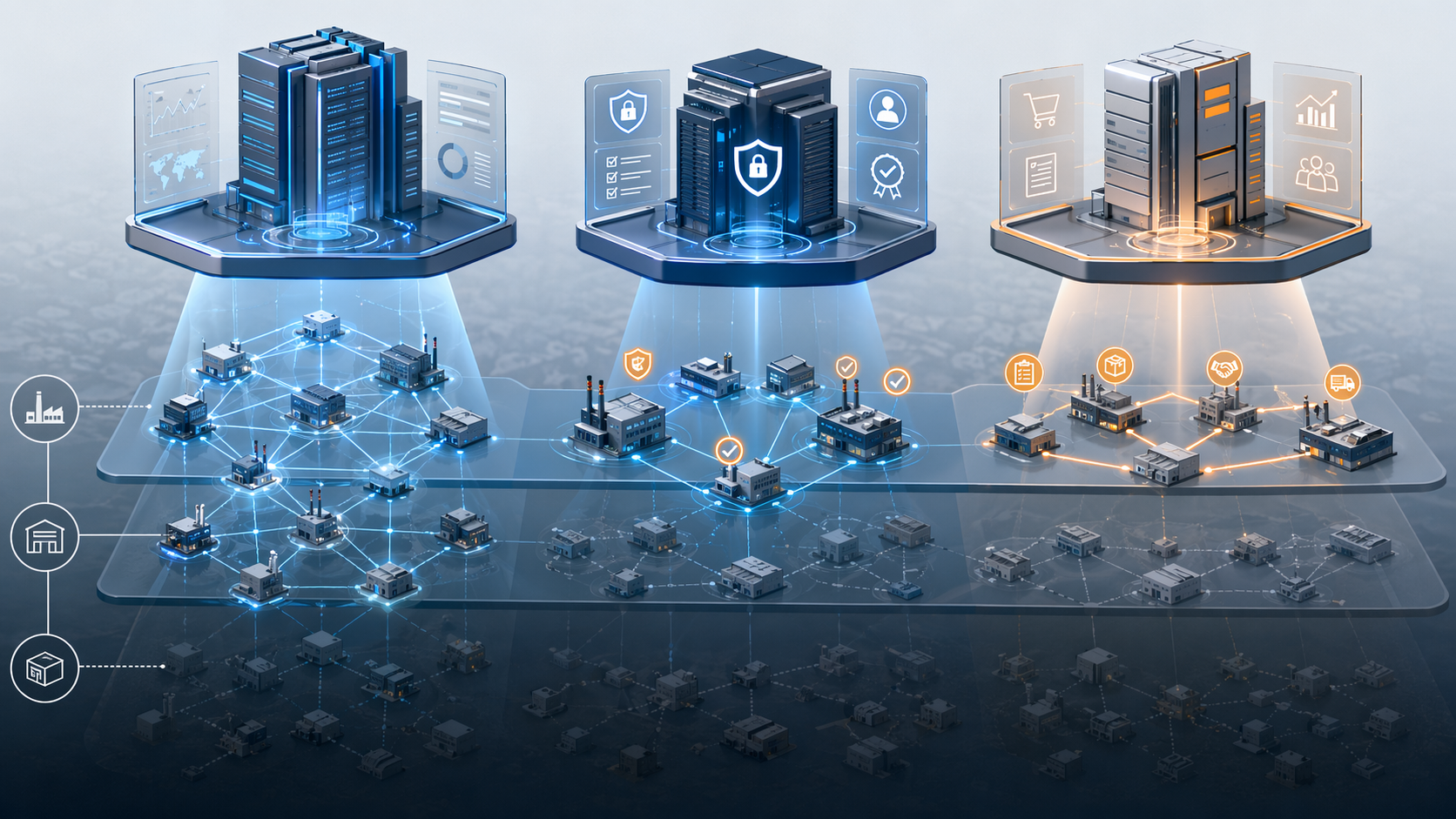
The 2026 Category Map
| Platform category | Best fit | Typical architecture | Visibility strength | Common blind spot |
|---|---|---|---|---|
| Dedicated SCRM platforms | Operational disruption, multi-tier supplier exposure, component risk, ESG or event monitoring | External signal ingestion, supplier graph mapping, event monitoring, predictive analytics | Deepest fit for upstream supply chain visibility | May need integration work to land alerts inside procurement execution |
| VRM/TPRM suites | Cyber risk, third-party governance, compliance, questionnaires, enterprise risk workflows | Security ratings, assessment automation, control evidence, workflow management | Strong fit for cyber and third-party governance | May not map tier-n operational dependencies in enough depth |
| Procurement-embedded risk modules | Risk signals inside sourcing, supplier management, contracts, or source-to-pay workflows | Procurement-suite data model plus risk scoring, supplier intelligence, workflow triggers | Best fit for operational adoption by procurement users | External signal depth varies by suite and partner ecosystem |
The demand signal behind all three categories is real, but it points to different gaps. GEP cites procurement research in which 70% of procurement leaders identify insufficient visibility into tier-3 suppliers as the primary cause of supply chain risks.[1] Onspring cites Marsh Sentrisk data that 65% of organizations have at least one hidden single point of failure in their upstream supply chain.[2] Those figures are about supply chain visibility, not vendor questionnaire completion.
The maturity picture is also uneven. JAGGAER cites Inspectorio’s 2025 finding that only 27% of companies have introduced AI into procurement or supply chain.[3] Panorays cites Deloitte’s 2025 third-party risk management survey finding that 93% of third-party risk leaders report low maturity in AI-enabled risk management.[4] These are adoption and maturity indicators, not proof that any one platform category already solves the full problem.
Dedicated SCRM Platforms: Built for the Visibility Gap
Dedicated supply chain risk management platforms deserve the first look when the buyer’s missing risk is upstream, operational, or product-specific. This is the lane for platforms trying to answer questions such as: Which sub-tier suppliers feed a critical part? Which plants, ports, or regions are exposed to an emerging disruption? Which supplier relationships create a single point of failure? Which events matter before a purchase order is already late?
Z2Data’s 2026 SCRM software overview frames this market as approaching roughly $3 billion and projected to reach roughly $8 billion by the early 2030s at about 10% CAGR.[5] That number should not be mixed casually with broader VRM estimates, because SCRM platforms are usually aimed at supply chain continuity, supplier mapping, regulatory exposure, and component risk rather than the full enterprise universe of third-party governance.
Everstream Analytics sits squarely in this dedicated SCRM lane. Its public positioning emphasizes multi-tier supplier visibility, AI-based disruption prediction, and external-event intelligence for supply chain risk teams.[6] The relevant question for a buyer is not whether Everstream “uses AI,” but whether its event feeds, supplier-network mapping, and predictive models cover the categories of disruption the company actually misses today.
Resilinc is another dedicated SCRM platform, commonly described around event-based monitoring and mapping intelligence.[5] Its fit is strongest where a company needs to understand supplier sites, dependencies, and disruption exposure rather than only evaluate a vendor’s control environment. In a sourcing context, that difference changes the RFP: the buyer should ask about mapped supplier sites, sub-tier relationships, event taxonomy, and alert-to-action workflows, not just dashboard views.
Interos is usually discussed through the language of supplier graph mapping and continuous supply chain risk intelligence, with Bitsight’s guide also noting financial risk signals in its coverage.[7] That graph orientation matters when the problem is dependency discovery. A flat supplier list can tell procurement who it pays. A useful supply chain graph tries to show which organizations, locations, and relationships sit behind that direct supplier.
Z2Data is more specialized. Its 2026 SCRM overview presents the platform around component and supplier risk for electronics, including regulatory and supply chain exposure.[5] That makes it a different kind of shortlist candidate from a general third-party risk suite. A manufacturer worried about electronic components, lifecycle status, supplier geography, and regulatory flags may need that granularity more than a broad questionnaire workflow.
Prewave, included in Optro’s 2026 supplier risk management tool list, is positioned around AI-driven social, ESG, and disruption monitoring.[8] That does not make it interchangeable with an electronics component risk platform or a cyber-rating provider. It belongs in evaluations where external signals from news, social sources, ESG controversies, or disruption events are central to the monitoring requirement.
For this category, the hard evaluation questions are architectural. How does the platform ingest external signals? How does it map tier-2, tier-3, and deeper relationships? Does it identify supplier sites, parent-child entities, products, parts, or only companies? Does an alert explain the affected dependency, or does it merely say that a supplier has risk? The answers determine whether the system is useful before a disruption reaches the buyer’s own supplier.
VRM and TPRM Suites: The Right Lane for Cyber, Compliance, and Governance
Vendor risk management and third-party risk management suites are not weaker SCRM platforms. They are often built for a different owner and a different control problem. Their natural home is cyber risk, security posture, compliance, assessments, privacy, ESG governance, and enterprise third-party oversight.
Panorays’ 2026 vendor risk management comparison cites a broader VRM market estimate of $14.43 billion from Fortune Business Insights.[4] That larger figure is useful context only if the definition stays intact: VRM includes financial, cyber, compliance, and governance risk across third parties. It is not the same measurement as SCRM software focused on operational supply chain disruption.
Panorays is positioned around third-party security posture, automated questionnaires, and vendor security risk management.[4] That makes it a logical candidate when the buyer’s pain is assessment scale: too many vendors, too many questionnaires, too much manual follow-up, and too little continuous view of security posture between annual reviews.
Bitsight belongs in the same broad lane, but with a strong emphasis on security ratings and cyber risk monitoring.[7] For a CISO-led or joint procurement-security program, that can be the core requirement. If the board question is whether critical vendors have deteriorating external cyber posture, a security-rating platform may be closer to the need than a multi-tier operational disruption system.
OneTrust and ProcessUnity extend the VRM/TPRM category in a workflow and governance direction. Panorays’ comparison includes OneTrust across vendor risk, privacy, and ESG use cases, while Bitsight’s guide discusses ProcessUnity around TPRM workflow and assessments.[4][7] These tools matter where the work after a risk signal is as important as the signal itself: assigning owners, collecting evidence, escalating exceptions, and documenting treatment decisions.
The mistake is not buying a VRM suite. The mistake is buying one because the phrase “supplier risk” appeared in the demo, then expecting it to discover a hidden tier-3 dependency for a critical component. If the risk owner is security, privacy, compliance, or enterprise risk, VRM/TPRM may be exactly the right architecture. If the owner is trying to map operational supply chain exposure beyond direct suppliers, it may not be enough on its own.
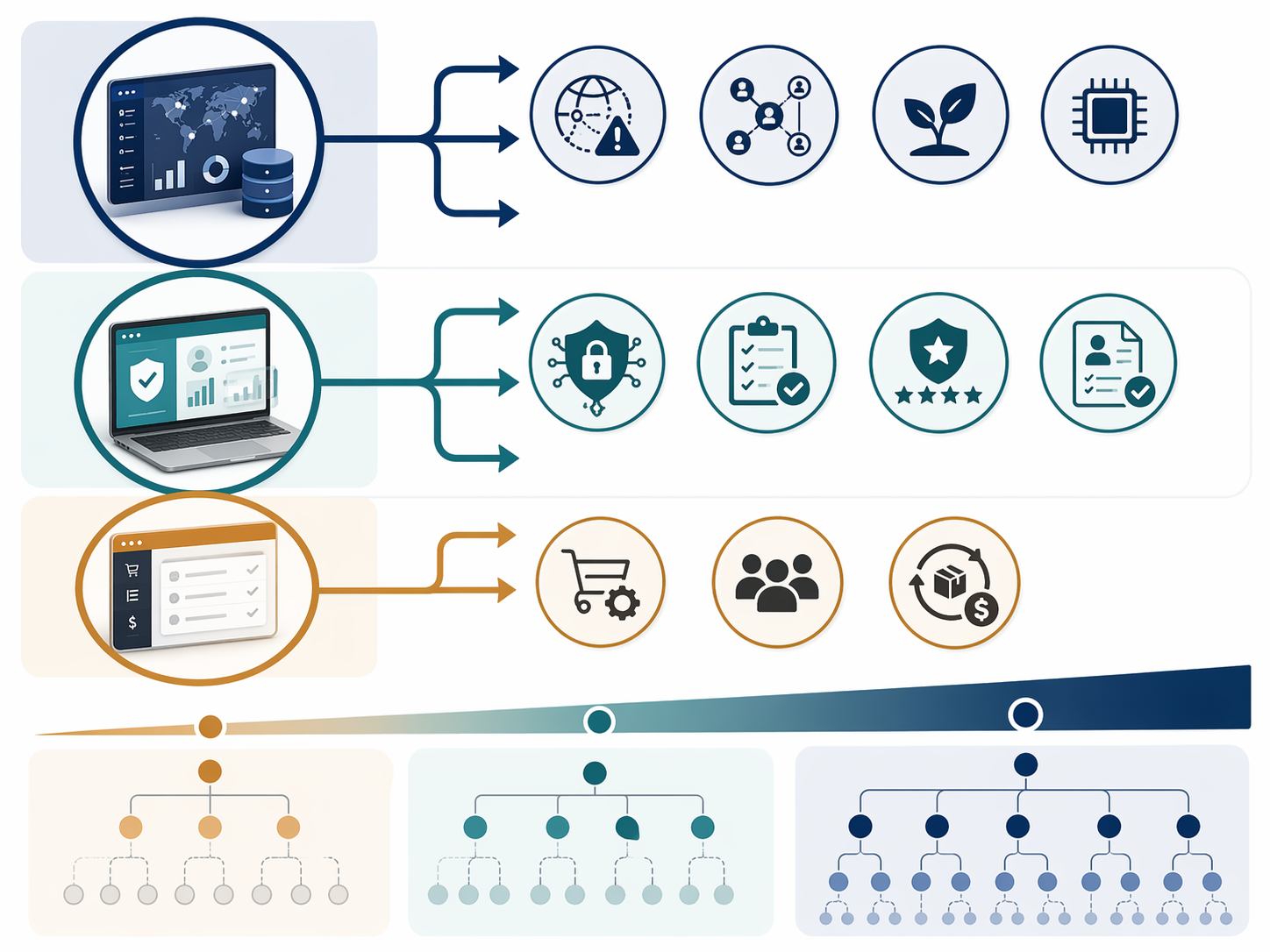
Procurement-Embedded Modules: Where the Signal Meets the Work
The third category is less about standing up a separate intelligence platform and more about putting risk signals where sourcing and supplier management decisions already happen. Procurement-embedded risk modules are attractive because they reduce the distance between monitoring and action. A sourcing manager does not have to leave the suite to see a supplier risk flag. A supplier manager can route follow-up through an existing workflow. A category team can make risk part of award decisions instead of a late-stage review.
JAGGAER’s 2026 procurement risk content presents AI-enabled risk management as part of a broader move from reactive to predictive procurement, including continuous supplier intelligence and source-to-pay context.[3] That architecture is valuable when the organization’s biggest failure mode is not lack of data alone, but lack of operational handoff. A warning that never reaches sourcing, contracting, or supplier management is just another dashboard tile.
GEP’s supplier risk management article similarly frames AI risk capabilities in relation to procurement and supply chain decision-making, including supplier monitoring and risk intelligence within its broader platform environment.[1] Coupa is also commonly referenced across supplier risk software comparisons as a procurement-suite option with supplier risk capabilities.[5] In this lane, the buyer should examine how risk scores affect approvals, sourcing events, supplier segmentation, performance reviews, and mitigation tasks.
The tradeoff is usually depth versus adoption. Procurement-suite modules can be easier to operationalize because users already work there. But they may not always provide the deepest external signal coverage, multi-tier graph intelligence, or specialist component data. Some will rely on partners, integrations, or narrower data models. That is not automatically a flaw; it depends on whether the organization needs embedded execution more than independent intelligence depth.
What “AI” Should Mean in This Market
In supplier risk monitoring, AI can mean several different things: classifying external events, predicting disruption probability, linking suppliers into a graph, scoring financial fragility, detecting ESG controversy, summarizing regulatory exposure, or routing follow-up tasks. A vendor can be AI-enabled in one of those areas and still be thin in another. The label does not tell the buyer which risk is being seen.
The strongest claims should be handled carefully. JAGGAER cites a 2025 academic study by Huang reporting 89% accuracy in predicting high-impact disruptions two to four weeks in advance, along with 35% loss reduction and 28% fewer disruptions.[3] That is promising evidence, but from the materials available here it should be treated as an emerging single-study result rather than a market-wide benchmark.
Buyer sentiment is ahead of validated operating maturity. Panorays cites Deloitte’s finding that 42% of risk leaders believe AI could reduce third-party financial exposure by at least 20%.[4] That is an attitude about potential impact, not proof that implemented systems are delivering that reduction consistently. The practical evaluation question remains: which signals does the model observe, how are they validated, and what happens after the alert?
The Evaluation Dimensions That Actually Separate Vendors
A useful comparison grid for AI supplier risk monitoring tools should start with architecture, not feature adjectives. The same vendor can sound comprehensive in a demo and still be optimized for a risk category that does not match the buyer’s exposure.
| Evaluation dimension | What to inspect | Why it changes the shortlist |
|---|---|---|
| Data ingestion | News, sanctions, financial data, cyber telemetry, ESG signals, supplier disclosures, questionnaires, internal procurement data | Reveals whether the platform monitors live external risk, internal supplier records, or both |
| Supplier graph depth | Tier-1 only, tier-2, tier-3, site-level, component-level, parent-child entity mapping | Determines whether the platform can address upstream visibility and hidden dependency problems |
| Signal coverage | Cyber, financial, operational disruption, ESG, regulatory, geopolitical, component, logistics, weather, compliance | Prevents a cyber-strong tool from being mistaken for a disruption-strong tool |
| Workflow landing point | Standalone dashboard, risk queue, sourcing event, supplier profile, contract workflow, issue management system | Shows whether alerts become procurement action or remain separate intelligence |
| Evidence and explainability | Source links, confidence indicators, affected supplier relationships, model rationale, audit history | Helps teams decide whether to escalate, monitor, override, or ignore a signal |
The workflow landing point is often underweighted. Supplier risk monitoring is not finished when the platform detects a problem. Someone has to decide whether to pause an award, qualify an alternate source, contact a supplier, notify legal, escalate to security, or accept the risk. A tool that makes that handoff explicit may be more valuable than a tool with a prettier map and no accountable next step.
A Practical Vendor Directory by Category
| Vendor | Category | Primary fit based on available materials |
|---|---|---|
| Everstream Analytics | Dedicated SCRM | Multi-tier supplier visibility, disruption prediction, external event intelligence.[6] |
| Resilinc | Dedicated SCRM | Event-based monitoring and supplier mapping intelligence for supply chain disruption exposure.[5] |
| Interos | Dedicated SCRM | Supplier graph mapping, continuous supply chain intelligence, and financial risk signals.[7] |
| Z2Data | Dedicated SCRM | Electronics component, supplier, regulatory, and supply chain risk monitoring.[5] |
| Prewave | Dedicated SCRM | AI-driven social, ESG, and disruption monitoring for supplier risk.[8] |
| Panorays | VRM/TPRM | Third-party security posture, automated questionnaires, and vendor security risk management.[4] |
| Bitsight | VRM/TPRM | Security ratings and cyber risk monitoring for third-party risk programs.[7] |
| OneTrust | VRM/TPRM | Vendor risk, privacy, ESG, and governance-oriented third-party risk workflows.[4] |
| ProcessUnity | VRM/TPRM | TPRM workflow, assessments, and third-party risk process management.[7] |
| JAGGAER | Procurement-embedded | AI-enabled supplier intelligence and risk monitoring within procurement and source-to-pay context.[3] |
| GEP | Procurement-embedded | Supplier risk AI and risk intelligence connected to procurement and supply chain decision-making.[1] |
| Coupa | Procurement-embedded | Supplier risk capabilities within a broader procurement-suite environment.[5] |
This is not a ranking. A manufacturer with a fragile electronics bill of materials may shortlist differently from a bank trying to scale third-party cyber assessments. A procurement organization with low tool adoption may value embedded workflows more than a standalone intelligence layer. The directory is only useful if the first cut is category fit.
Market Tailwinds Should Not Decide the Shortlist
Market growth, regulatory attention, and AI adoption pressure explain why supplier risk monitoring budgets are active in 2026. They do not tell a buyer which architecture to choose. The SCRM and VRM market-size numbers are not interchangeable because they measure different scopes. Regulatory references such as cyber rules or operational resilience requirements may strengthen the business case, but the available source material does not support treating regulation as the central driver across all supplier risk tools.
The better starting point is narrower: name the visibility gap. If the missing view is tier-3 operational disruption, hidden single points of failure, supplier-site exposure, or component dependency, start with dedicated SCRM platforms. If the missing view is cyber posture, control evidence, questionnaires, compliance, and enterprise third-party governance, start with VRM/TPRM suites. If the missing step is getting risk intelligence into sourcing, supplier management, and source-to-pay execution, start with procurement-embedded modules.
In 2026, the danger is not that buyers lack AI supplier risk monitoring tools. It is that the label is broad enough to hide three different products pretending to solve the same operating problem.
References
- AI-Powered Supplier Risk Management: A Game Changer, GEP.
- What to Look for in an AI-Powered Supply Chain Risk Management Solution, Onspring.
- How Procurement Is Moving from Reactive to Predictive Risk Management in 2026, JAGGAER.
- Best Vendor Risk Management Software 2026: Platforms Compared, Panorays.
- Top 7 Supply Chain Risk Management Software Tools for 2026, Z2Data.
- How AI transforms supplier risk management, Everstream Analytics.
- Top 7 Vendor Risk Management Platforms for Global Enterprises, Bitsight.
- Best supplier risk management tools for 2026, Optro.
Comments
Join the discussion with an anonymous comment.