
AI for supply chain flood disruption planning is worth evaluating for one practical reason: a warning that arrives five to seven days before impact can change decisions that a same-day weather alert cannot. A logistics team can move inventory out of a threatened node, build safety stock closer to demand, shift a lane before capacity disappears, or call a supplier while alternatives still exist. The test is not whether the model sees rain. The test is whether it identifies the exposed facility, material, route, supplier, or customer commitment early enough for someone to act.
The pressure behind the use case is no longer abstract. Flooding accounted for 70% of weather-related supply chain disruptions in 2024, according to Everstream Analytics data cited by DOXA.[1] Resilinc reported that flood events monitored by EventWatchAI rose 82% year over year in Q3 2025, from 93 events to 169.[2] A 2025 Journal of Environmental Management study estimated annual global riverine flood losses at about $41.1 billion, a figure that excludes other flood types such as coastal surge and flash flooding.[3]
What the use case actually does
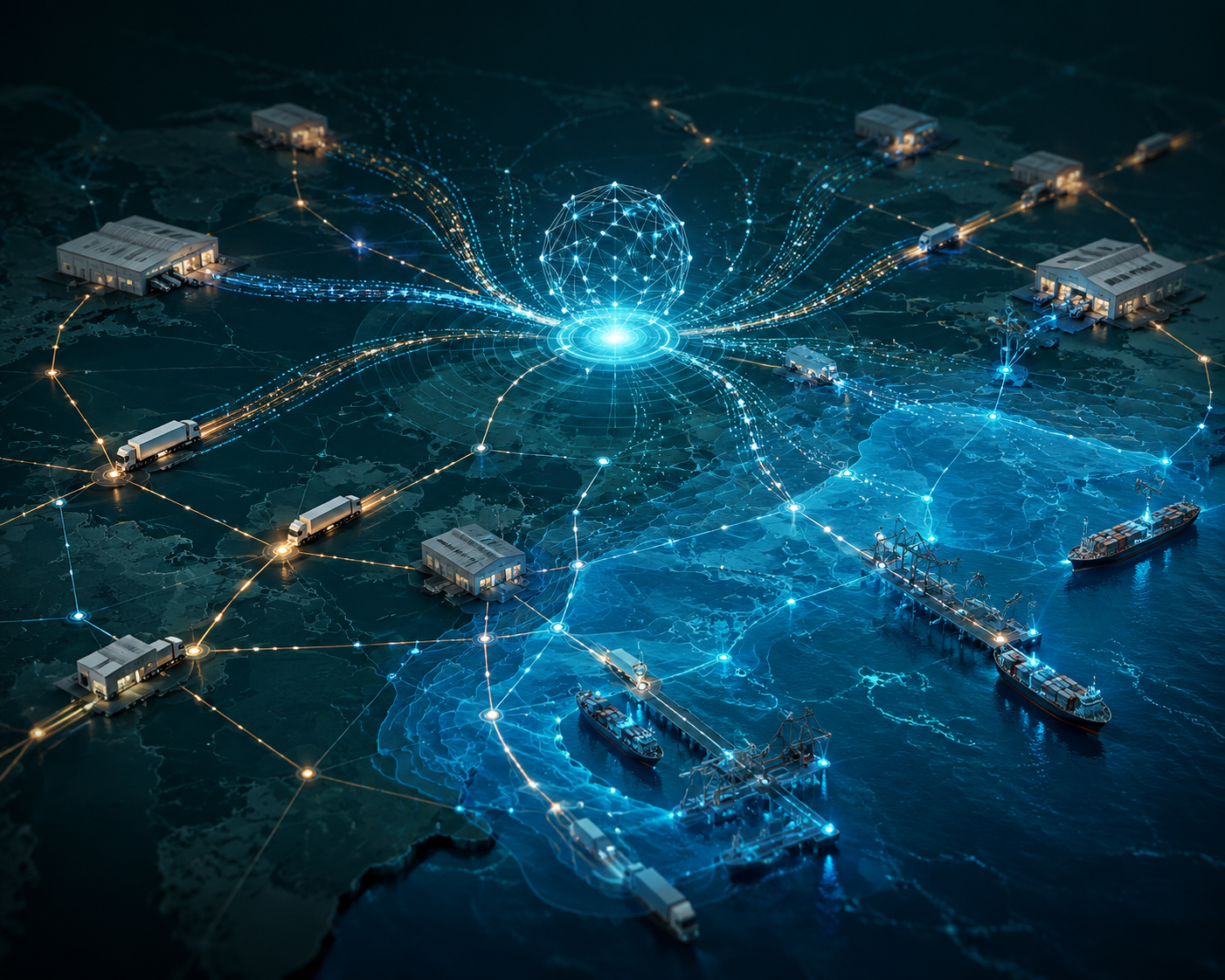
Flood disruption planning sits inside supply chain visibility and risk management. It combines external hazard signals with internal supply chain data, then turns those signals into operational warnings: which sites are likely to be affected, which lanes may fail, which suppliers need attention, which orders could miss service commitments, and which mitigation options are still available.
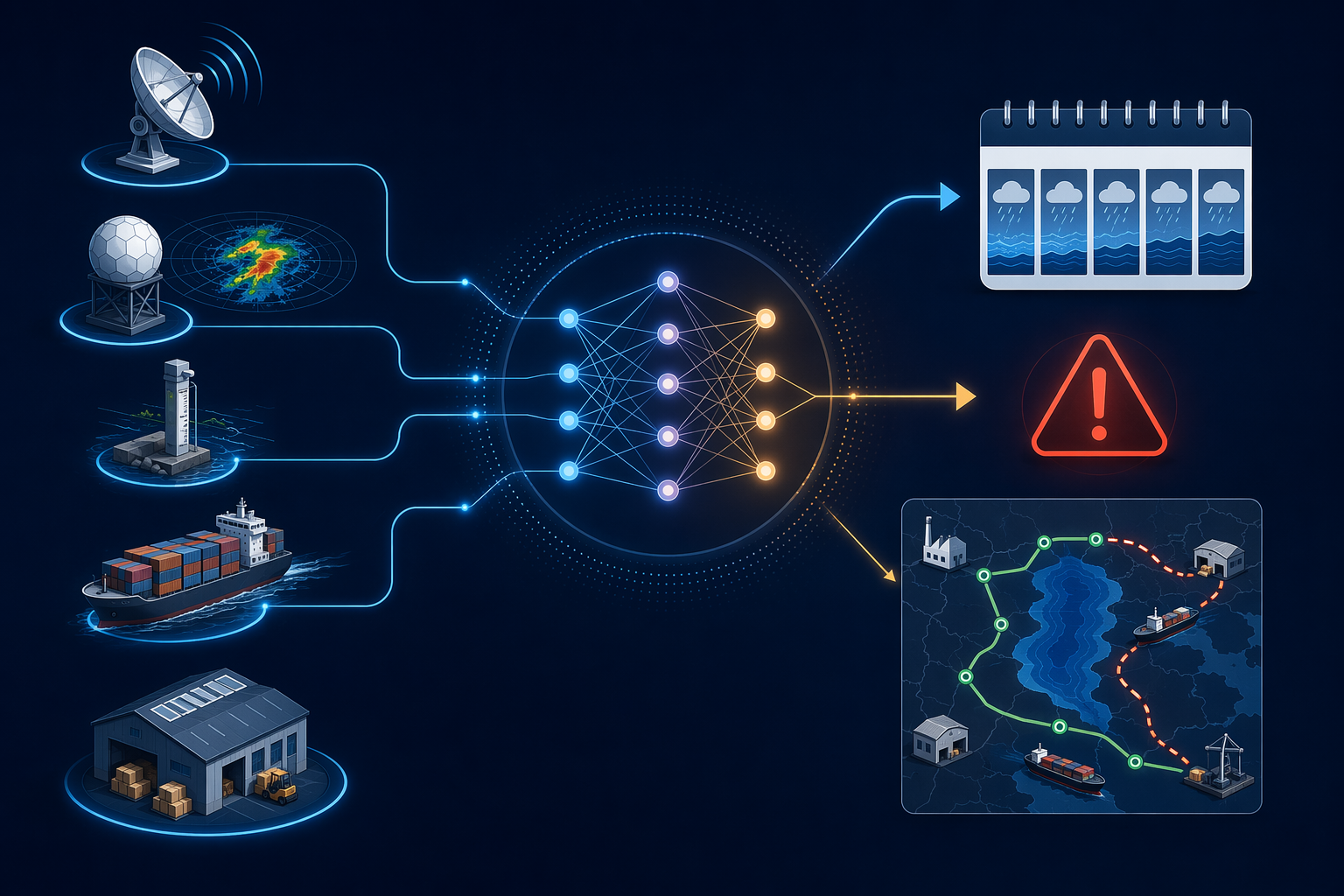
The useful version is multi-source. It does not stop at a weather forecast. A working system may combine meteorological forecasts, river-gauge readings, hydrological models, satellite imagery, facility locations, supplier master data, purchase orders, inventory positions, transport lanes, carrier status, and event reports. Natural language processing can help detect unstructured disruption signals; predictive analytics can score exposure and likely impact; a digital twin supply chain can test recovery scenarios before planners commit inventory or capacity.
| Planning question | AI-supported output | Decision it should trigger |
|---|---|---|
| Which locations are exposed? | Facility, supplier, warehouse, and port risk scores | Prioritize sites for review and escalation |
| Which flows may be interrupted? | Affected lanes, expected transit delays, and route alternatives | Reroute freight before congestion or closures peak |
| Which products or customers are at risk? | Order, SKU, and service-level exposure | Pre-position inventory or adjust allocations |
| Which suppliers need attention? | Supplier risk ranking by geography, dependency, and material criticality | Contact suppliers and qualify backup options |
That last column is where many early-warning tools fail. If the output is only a red polygon on a map, it creates attention but not necessarily action. Flood disruption planning becomes operational when the warning is connected to inventory, lanes, suppliers, orders, and accountable teams.
The performance evidence is promising, but uneven
The strongest headline claim in the available evidence is the Johnson & Johnson example cited by the World Certification Institute: an AI system reportedly identified 85% of major supply disruptions an average of seven days before impact.[4] That is exactly the kind of lead time supply chain teams need. Seven days can mean the difference between buying emergency freight after a closure and shifting product before the affected node is overwhelmed.
It should still be treated as an attributed industry claim rather than an independently verified benchmark. The figure is useful for framing what good performance can look like, but a risk manager should ask what counted as a “major supply disruption,” how false positives were handled, whether missed sub-tier events were visible to the system, and what baseline the 85% detection rate was measured against.
The modeling literature gives a narrower but more transparent signal. A 2024 Supply Chain Analytics study of a digital twin framework for supply chain flood recovery reported 73% recall, 75% accuracy, and 84% AUC.[5] Those are not the same as proven business impact, but they matter because recall is the metric planners worry about when a missed flood exposure can shut down a material flow. A model with elegant precision and poor recall may look clean in a dashboard while still missing the event that matters.
Decision-quality evidence is more relevant than model elegance. World Certification Institute also cites McKinsey estimates that AI-enabled supply chain systems can reduce errors in disruption-related decisions by 20–50% and mitigate up to 65% of lost-sales risk.[4] Those are broad estimates, not flood-specific guarantees. They are best read as a signal that earlier, data-supported decisions can reduce avoidable loss when the organization is prepared to act.
Where prediction becomes mitigation
The most useful flood-warning workflow is not a single alert. It is a sequence that starts with hazard detection and ends with a changed plan. A system flags the flood risk, overlays the hazard on the supply chain map, estimates affected nodes and lanes, ranks customer and revenue exposure, and gives planners a short list of actions: move inventory, advance shipments, switch origin points, shift carriers, pull from alternate stock, or contact suppliers.
Everstream Analytics reports client outcomes including a 5% reduction in expedited freight costs, a 10% improvement in on-time performance, a 30% reduction in revenue losses from disruptions, and 50–70% faster impact assessment time.[6] These are vendor-reported results and may reflect selected client outcomes rather than an industry average. Still, the measures are the right ones. Faster impact assessment matters because flood response often stalls while teams are still arguing about which orders, suppliers, and lanes are actually exposed.
The ClimateAi Hurricane Ian case is the clearest example of prediction changing the commercial outcome. Ahead of Hurricane Ian, ClimateAi says its forecast helped a building materials company pre-position Florida-code-compliant inventory, enabling $15 million in additional sales as demand surged after landfall.[7] This is a single vendor-reported case, not a typical ROI number. Its value is in showing the operating mechanism: the company did not merely know a storm was coming; it moved the right inventory into the right market before the disruption and demand spike fully arrived.
That is the difference between a forecast and a mitigation plan. A forecast says water may rise. A mitigation plan says which compliant products should move, from which origin, to which destination, before which transport window closes, and who approves the cost.
The operating rhythm changes when the warning window is real
A credible five-to-seven-day warning window changes meeting cadence. Instead of a daily firefight after disruption, the risk team can convene procurement, logistics, customer service, inventory planning, and finance while choices still exist. Procurement can verify supplier status. Logistics can test alternate lanes. Customer service can protect priority accounts. Finance can approve incremental freight or inventory moves against a quantified revenue-at-risk estimate.
For teams already using control towers, flood disruption planning often becomes another decision layer in the broader alerting environment. The important integration question is whether the control tower can connect alerts to orders, shipments, inventory, and exception workflows, not simply whether it can display an external hazard feed. That is why flood planning belongs next to adjacent supply chain control tower AI use cases rather than being treated as a standalone weather tool.
Free tools help, but they do not replace supply chain context
Risk teams do not need to begin with a large AI procurement. Google Flood Hub provides AI-driven riverine flood forecasts up to seven days in advance across more than 80 countries.[8] FM Global’s Global Flood Map offers 90-meter-resolution flood hazard data for facility addresses.[9] These tools can help a team identify obvious exposure around plants, warehouses, and supplier sites before committing to a broader platform.
Their limits are important. Google Flood Hub is a riverine flood forecasting tool; it does not, by itself, solve coastal surge or pluvial flash-flood exposure at the same level of supply chain specificity. A public flood map can show that a facility sits in a hazard zone, but it cannot tell whether a critical resin, component, packaging material, or lane dependency flows through that location unless the company has mapped those dependencies internally.
A practical starting sequence is usually modest: screen known facilities and Tier 1 suppliers against flood maps, overlay major inbound and outbound lanes, identify products with single-source or low-inventory exposure, then decide whether a commercial risk platform is justified. The investment case gets stronger when the team can connect flood exposure to revenue, service levels, expedite cost, or contractual penalties.
Implementation constraints that decide whether planners act
The implementation problem is rarely just the AI model. It is the supply chain memory around the model: supplier locations, sub-tier relationships, part-to-product mappings, lane data, inventory positions, alternate sources, and escalation rules. If those records are stale or shallow, the model may produce a correct flood warning and still fail to identify the affected material flow.
- Supply chain mapping depth: the system needs facility, supplier, lane, material, and customer links, not just company names and country-level addresses.
- Data quality: duplicate supplier records, missing coordinates, outdated lanes, and incomplete bills of material can turn a strong external forecast into a weak operational alert.
- Model transparency: planners need to understand why a node is flagged, which evidence drove the score, and how much uncertainty remains.
- Workflow ownership: someone must be assigned to review the alert, approve the mitigation cost, and document the decision.
- False-positive tolerance: a system that cries flood too often will be ignored, but a system tuned too tightly may miss the disruption that matters.
The transparency issue deserves more attention than it often gets in vendor demos. A planner does not need a machine-learning lecture, but she does need enough explanation to defend a decision: river levels are forecast to exceed a threshold, a supplier site and outbound lane are within the exposed zone, inventory cover is low, and no qualified alternate source exists within the required lead time. That kind of explanation is more likely to trigger action than a severity score with no audit trail.
Supplier risk scoring can be useful here when it is tied to real dependencies. Flood exposure should not be scored only by geography. A small supplier in an exposed area may be low priority if the part is easily substituted; a sub-tier material origin may be high priority if it feeds multiple finished products and has long requalification times. This is where flood planning overlaps with autonomous procurement AI supplier risk scoring and broader predictive analytics in supply chain programs.
Historical floods show the cost of being late
Historical flood disruptions are not proof that AI would have solved the problem. They do show why late recognition is expensive. During the 2021 floods in Belgium, Germany, and the Netherlands, FourKites reported late-shipment spikes of 26–32% in the affected countries.[10] That kind of service degradation is exactly what flood planning tries to reduce by identifying exposed lanes and nodes before transportation networks are already constrained.
The lesson for investment evaluation is narrow but useful: flood exposure is not confined to a facility’s walls. It moves through ports, roads, rail links, cross-docks, suppliers, customers, and local labor availability. A model that only scores owned assets will miss a large share of the operational consequence.
Vendor landscape: shortlist by decision coverage, not map quality alone
The vendor landscape breaks into a few capability categories. Risk-intelligence platforms monitor hazard and supplier events. Control towers connect disruption alerts to shipments, orders, and inventory. Digital twin tools simulate recovery options. Supplier-risk platforms score exposure across companies, sites, and materials. Insurance and climate-risk tools can add asset-level flood exposure and financial-risk views. Floodbase, for example, describes parametric insurance products using 17 satellite sources, which is relevant for risk transfer but not the same as operational mitigation planning.[11]
A shortlist should start with the decision the company needs to improve. If the issue is weak event monitoring, a risk-intelligence platform may be enough. If the issue is slow impact assessment, the buyer needs integration with orders, lanes, and inventory. If the issue is sub-tier opacity, the priority shifts toward knowledge graphs and multi-tier mapping. A broader vendor scan belongs in a supplier risk monitoring vendor directory; the flood-planning question is whether the tool can turn water risk into a defended operating decision.
The sub-tier visibility gap is the main blind spot
The hardest flood exposure may not sit at a known warehouse or Tier 1 supplier. It may sit at a sub-tier source that supplies a resin, chip, additive, packaging input, or raw material origin that procurement has not mapped. Tradeverifyd’s 2026 survey reports that only 56% of organizations trace material origins to Tier 3/4 sources.[12] That gap is not a data-management nuisance; it is a direct limit on what flood AI can see.
This is where knowledge-graph approaches can matter. A flood model needs relationships, not just records: supplier to site, site to part, part to product, product to customer, lane to facility, alternate source to qualification status. Without that structure, the alert may identify a flooded district while missing the business dependency buried two tiers down. For teams building that layer, multi-tier supply chain visibility with knowledge graphs is often the enabling capability rather than a separate analytics project.
A food manufacturer case reported by SupplyChainToday shows the more grounded version of success: the company applied AI to climate and weather data to identify seasonal flood and heat risks, adjusted sourcing and inventory positioning, and maintained service levels during extreme weather.[13] The case is less dramatic than a $15 million hurricane revenue story, but it points to the routine value of flood planning: fewer surprises, earlier supplier conversations, and inventory moves that happen before the expedite queue forms.
Investment judgment
AI-powered flood disruption planning is now a credible use case for supply chain visibility and risk management. The evidence supports investment when the organization can use a five-to-seven-day warning window to change inventory, logistics, sourcing, or customer-service decisions. The best-supported value measures are disruption detection, faster impact assessment, reduced expedited freight, improved on-time performance, and revenue-loss mitigation.
The buying case should not rest on a generic promise of resilience. It should rest on a specific operating claim: this system will detect flood exposure early, identify the affected nodes and lanes, quantify service or revenue risk, explain the confidence behind the alert, and route the decision to people who can act. The more mapped the supply chain is, the more credible that claim becomes.
A seven-day flood warning has limited value if the company cannot see which sub-tier supplier, facility, lane, or material origin is actually exposed.
References
- Flooding Tops the List of Supply Chain Risks in 2025: What Businesses Need to Know, DOXA
- Top 5 Manufacturing Supply Chain Disruptions Q3 2025, Resilinc
- ScienceDirect article S0301479725030178, Journal of Environmental Management, 2025
- From Reactive to Proactive: How AI-Driven Supply Chains Weather Every Storm, World Certification Institute
- ScienceDirect article S2949863524000347, Supply Chain Analytics, 2024
- Artificial Intelligence Role in Supply Chain Risk Management, Everstream Analytics
- Three Ways AI Can Help Companies De-Risk Supply Chains and Capture New Opportunities During Hurricane Season, ClimateAi
- Google AI global flood forecasting, Google Blog
- New Global Flood Map Illustrates Supply Chain Risk, Supply Chain Management Review
- Flooding in Belgium, Germany and Netherlands Impacts Global Supply Chains, FourKites
- Floodbase, Floodbase
- Supply Chain Statistics, Tradeverifyd
- AI for Supply Chain Risk, Resilience & ESG: From Reactive to Proactive Risk Management, SupplyChainToday
Comments
Join the discussion with an anonymous comment.