
The first useful question after an earthquake alert is not whether the quake was large. It is which supplier sites, parts, and products are actually exposed. For AI earthquake supply chain risk monitoring, that distinction matters because the alert itself rarely tells procurement whether a Tier-3 plant, a subcontracted plating line, or a single qualified component now sits inside the disruption radius.
Taiwan’s April 2024 magnitude 7.4 earthquake made the problem concrete. Resilinc said its clients tracked potential impacts to more than 13,000 sites and 5,800 parts across 21,000 products, while Interos reported that G7 companies held about 315,000 tier-2 connections to Taiwanese firms.[1][2] Those are not dashboard decorations. They are the difference between calling ten familiar Tier-1 account managers and discovering, too late, that the constrained part is two or three tiers below the contract.
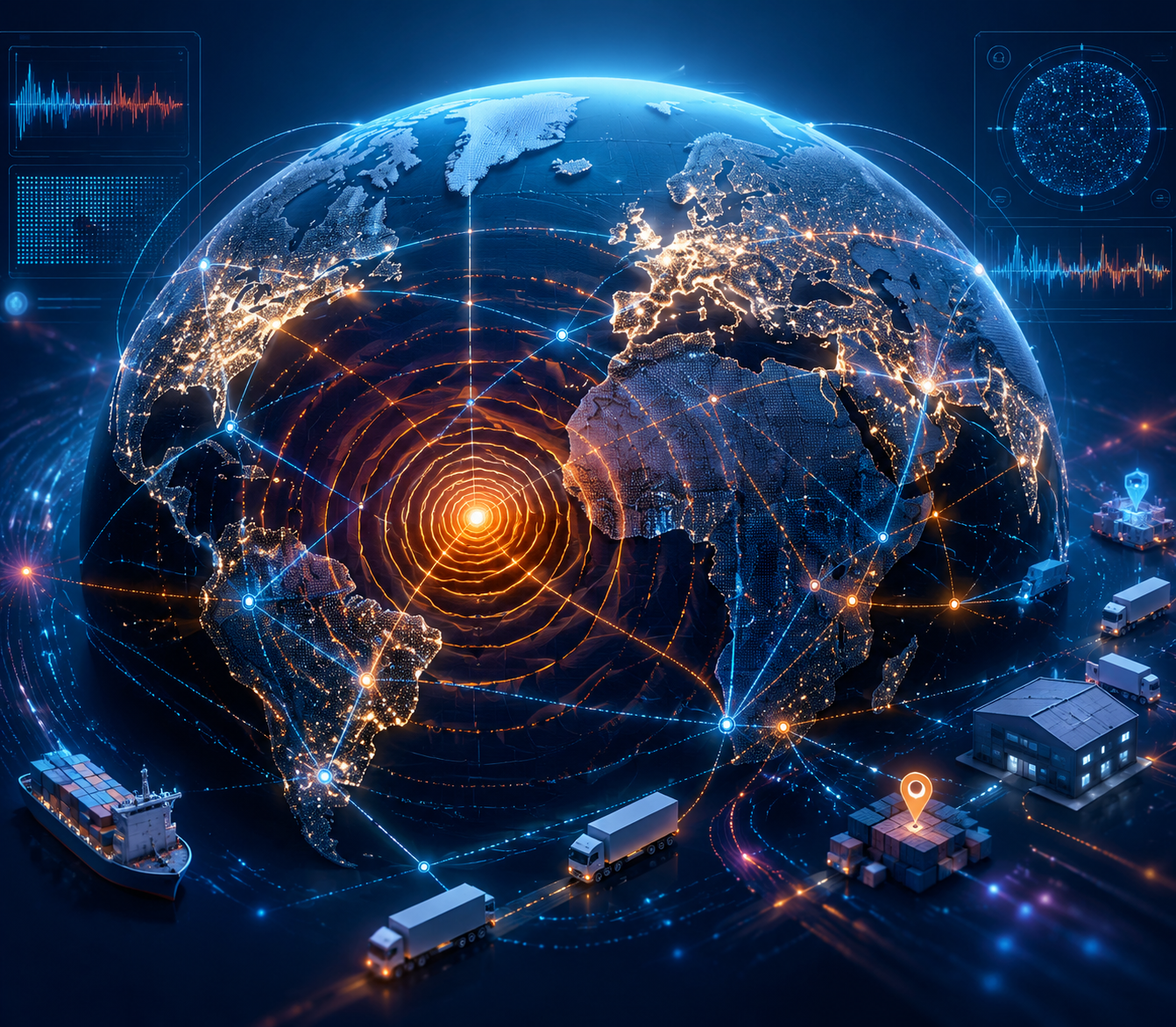
Earthquake monitoring becomes a supply chain problem when geography meets dependency. A facility 60 kilometers from the epicenter may be irrelevant if it makes a low-volume substitute. A facility farther away may matter more if it is the only qualified source for a component currently feeding production. The work is not simply detecting the event. It is translating the event into exposure, then into decisions someone can defend.
Why ordinary alerts fail below Tier 1
A news alert can say an earthquake happened. A supplier portal can list direct suppliers. Neither one, by itself, answers whether a sub-tier site in the affected region produces a material, die, board, sensor, casing, or process step embedded in products scheduled this week.
The visibility gap is where earthquake risk gets mispriced. AlMahri et al. describe the common operating reality plainly: most companies lack visibility below Tier 1, even though disruption analysis often requires tracing multi-tier dependencies rather than checking direct vendors only.[3] In a seismic event, that missing map produces two opposite errors: teams either call too many suppliers and burn the day on false positives, or they miss the lower-tier dependency that actually blocks shipment.
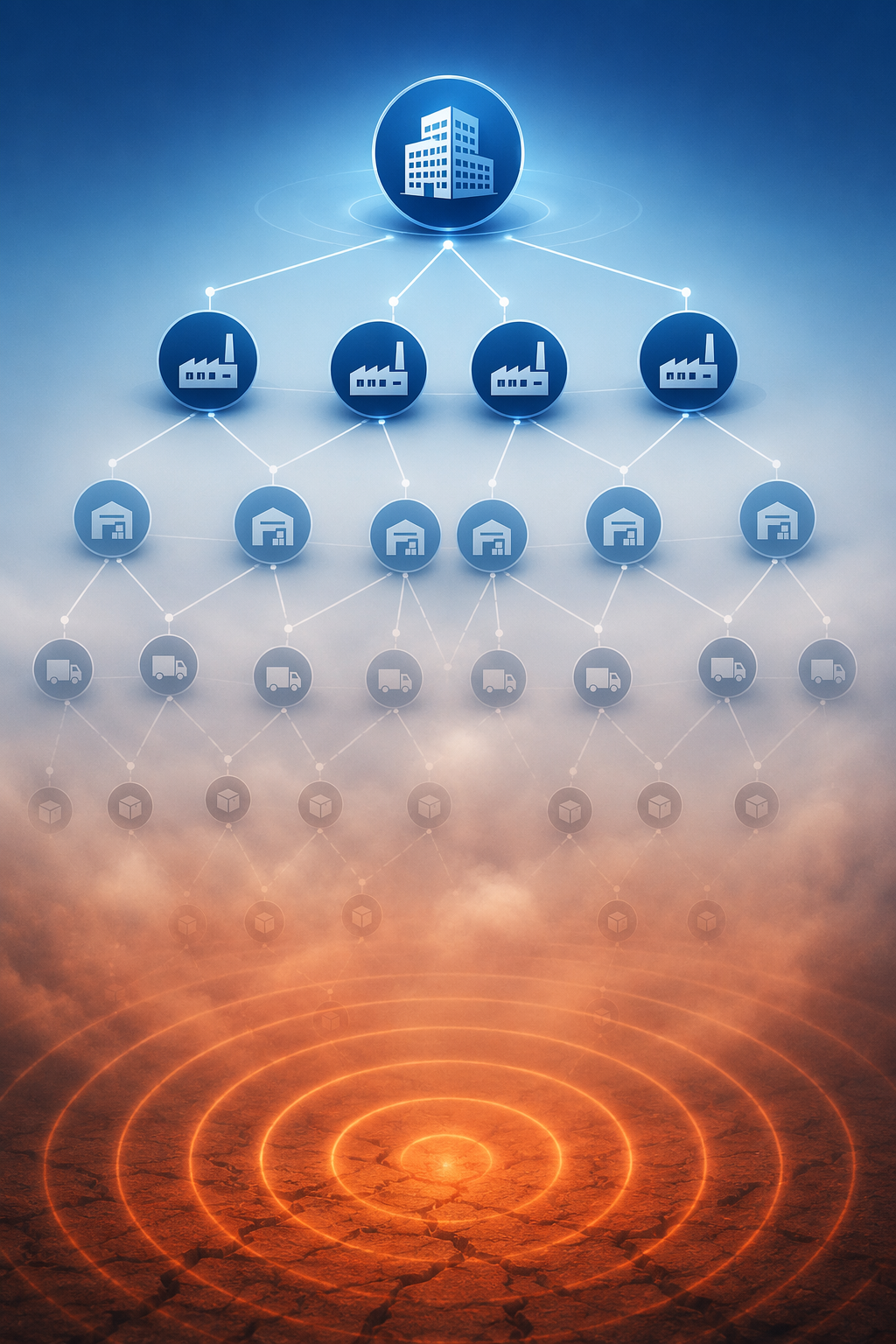
This is why “multi-tier” should be treated as an operational claim, not a label. It means the system can move from an event location to named sites, from those sites to parts, from parts to products, and from products to revenue, inventory, or customer commitments. If it cannot do that traversal, it may still be useful for awareness, but it is not yet impact assessment.
The workflow: from quake signal to supplier action
A credible AI monitoring workflow has six jobs. They do not all require generative AI, and they should not all be left to probabilistic reasoning. The strongest systems combine broad event detection, supplier graph data, geospatial matching, deterministic scoring, and human-controlled escalation.
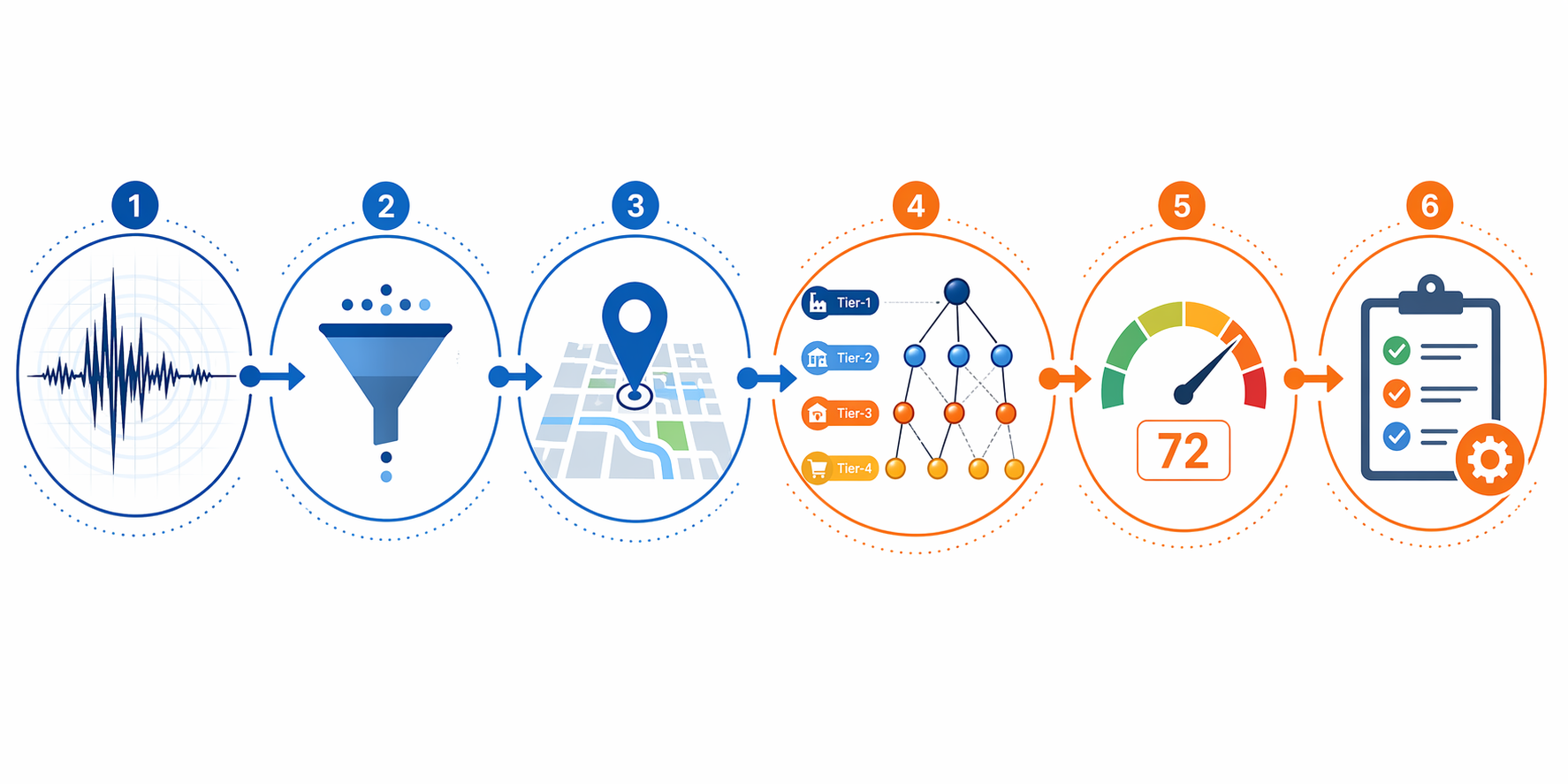
| Workflow stage | What the system must decide | What a buyer needs from it |
|---|---|---|
| Event detection | Has a seismic event occurred, and what is its location, magnitude, and likely affected area? | A fast alert with enough source confidence to begin triage |
| Relevance filtering | Does the event intersect with any supplier footprint, logistics route, or critical region? | Suppression of noise before teams start calling suppliers |
| Geospatial supplier-site matching | Which named facilities fall inside or near the event path? | Site-level exposure, not only supplier headquarters exposure |
| Knowledge graph traversal | Which Tier-1 through Tier-4 relationships connect those sites to parts and products? | A dependency path that explains why the site matters |
| Risk scoring | How severe is the likely business impact after considering criticality, inventory, qualification status, and alternatives? | A ranked queue that separates urgent calls from watch-list items |
| Mitigation recommendation | Which supplier contact, alternate site, inventory check, or engineering review should happen next? | An action owner and audit trail, not a vague warning |
1. Detect the event, but do not stop there
Detection is the visible part of the system because it is easy to demonstrate: an earthquake appears, an alert fires, a map lights up. Resilinc says EventWatchAI scans more than 104 million sources in more than 100 languages across 200 countries and classifies risks into more than 50 disruption types.[4] That breadth matters because early disruption evidence may appear in seismic feeds, local media, port notices, government updates, social channels, or supplier communications.
But broad detection can create its own problem. If every regional tremor becomes a procurement escalation, the team learns to ignore the feed. The monitoring layer has to filter for relevance: Is the event close enough to a mapped facility? Is the facility active? Does it make anything currently used? Is there finished-goods or component inventory that changes the response clock? Without those filters, AI only accelerates the wrong queue.
2. Match the event to real supplier sites
Earthquake exposure should be mapped to facilities, not corporate names. A supplier may have headquarters in one city, production in another, and a subcontracted process somewhere else entirely. The system has to place actual manufacturing, warehouse, test, and sub-tier sites against the earthquake’s affected geography.
This is where sub-tier discovery data becomes useful. Everstream describes using billions of trade records and shipping data to uncover hidden supplier relationships and sub-tier dependencies.[5] That kind of evidence is not the same as a supplier-validated bill of materials, but it can point the system toward relationships that ordinary vendor master data misses.
For earthquakes, the site match also needs uncertainty handling. A facility just outside the modeled impact area may still face power, labor, road, port, or aftershock effects. A facility inside the area may resume quickly if it has redundant utilities and no critical damage. The score can begin with geography, but it should not end there.
3. Traverse the supplier graph across tiers
Once exposed sites are identified, the useful question becomes dependency. Which parts come from those sites? Which products use those parts? Which customers, programs, or plants are waiting? This is the point where a knowledge graph is more than an analytics buzzword. It gives the system a structure for moving from facility to part to product to business consequence.
Z2Data describes an AI agent that maps every part manufactured in the path of a climate event before the event makes landfall.[6] Earthquakes do not offer the same lead time as hurricanes, but the mapping requirement is similar after the first alert: connect the hazard path to part-level exposure quickly enough for procurement, engineering, and planning teams to act before the supplier survey cycle drags on.
The graph also needs to preserve the path, not just the final score. If the system says Product A is high risk because Supplier B depends on Tier-2 Site C for Part D, the reviewer can challenge the assumption, check the last sourcing update, or override the result. If it only says “high risk,” the team still has to reconstruct the reasoning manually.
4. Score risk deterministically where judgment needs stability
LLMs can help interpret messy event text, summarize supplier notices, and coordinate agent tasks. They should not be the only mechanism deciding impact severity. Risk scoring needs stable inputs and repeatable logic: site proximity, part criticality, approved alternates, available inventory, sole-source status, production schedule, recovery history, and confidence in the underlying supplier relationship.
A deterministic score does not remove judgment. It gives reviewers something to inspect. A buyer can see whether a site was ranked high because it is geographically exposed, because the part has no approved alternate, because current inventory is thin, or because the relationship is inferred rather than supplier-confirmed. Those are different problems and they call for different next moves.
5. Recommend mitigation with an owner attached
The output should not be a beautiful map that leaves everyone wondering who owns the next call. Good monitoring turns exposure into a queue: contact these suppliers first, validate these alternate sites, check these inventory buffers, ask engineering about these substitutions, and watch these lower-confidence relationships until better evidence arrives.
The action list should also record what the system knew at the time. Earthquake response changes by the hour: utilities are restored, aftershocks alter damage assumptions, suppliers revise status, ports reopen, and customers change priorities. An audit trail lets teams understand why a decision looked reasonable at midafternoon even if the facts changed by evening.
What the agentic AI benchmark proves, and what it does not
The strongest technical evidence for autonomous monitoring comes from AlMahri et al. 2026. The paper tested a seven-agent architecture using GPT-4o across 30 disruption scenarios for three automotive manufacturers. It reported F1 scores from 0.962 to 0.991, a mean end-to-end completion time of 3.83 minutes, and a cost of $0.08 per disruption, compared with a five-day manual baseline.[3]
Those numbers matter because they describe more than a chatbot reading headlines. The architecture separated tasks across agents, including monitoring, impact assessment, reasoning, and reporting, while using deterministic computation where the process required stable results.[3] In supply chain terms, it tested whether a system could detect a disruption, traverse multi-tier dependencies, calculate impact, and produce an actionable assessment fast enough to change the response window.
The limits matter just as much. The scenarios were synthesized, the architecture was based on GPT-4o, and the evaluation covered three automotive manufacturers rather than every industry or production network shape.[3] That makes the benchmark evidence of technical plausibility, not a guarantee that an enterprise with stale supplier records and partial bill-of-material coverage will reproduce the same performance on Monday morning.
Still, the direction is important. A five-day manual baseline is not unusual when teams rely on spreadsheets, phone trees, supplier surveys, and regional managers to identify what is exposed. If an autonomous system can narrow the first-pass impact assessment to minutes, the value is not just speed. It changes which mitigation options are still available when the team starts acting.
How current platforms show the pattern
The market already contains pieces of this workflow, though buyers should treat vendor examples as capability signals rather than neutral proof of guaranteed return. Resilinc’s public materials emphasize broad multilingual event detection and disruption classification.[4] Everstream emphasizes AI-supported supplier risk management using trade and shipping data for hidden relationship discovery.[5] Z2Data emphasizes part-level exposure mapping in event paths.[6]
Those are different strengths along the same chain. Event detection answers “what happened?” Sub-tier discovery answers “who might be connected?” Part-level mapping answers “what could stop production?” A buyer evaluating platforms should avoid collapsing those into one generic AI claim. The difficult proof is whether the platform can connect them in the company’s own network.
Vendor-published outcome metrics can help frame the business case, but they should not carry it alone. Everstream reports a 30% reduction in revenue losses from disruptions, 50–70% faster impact assessment, and about 14% excess buffer stock carrying costs for companies not monitoring supplier risk.[7] Those figures are useful as reported outcomes, not as independently audited guarantees for every deployment.
The same caution applies to large disruption-value estimates. Interos wrote that a major semiconductor disruption in Taiwan could affect up to $1.6 trillion, or about 8% of annual U.S. GDP, citing a U.S.-Taiwan Business Council report.[1] That number is a useful reminder of concentration risk, but it should not be used as a substitute for a company-specific exposure model.
A brief reminder from Japan
The December 2025 Japan earthquake is a smaller piece of the evidence base here, but it reinforces the cascade problem. Accio AI described a magnitude 7.5 quake that left 2,700 homes without power, led to 90,000 evacuations, and created ripple risks across electronics, automotive, and precision machinery supply chains.[8] The source is a commercial blog, so the example should be read as a directional case rather than a comprehensive independent loss study.
The useful lesson is not that every earthquake becomes a global supply crisis. Many do not. The lesson is that power, labor access, roads, ports, inspections, and aftershocks can matter as much as direct facility damage. A monitoring system that only checks whether a named supplier is inside the epicenter radius will miss too much.
What to test before trusting the score
The practical evaluation standard is simple to state and hard to satisfy. A platform should be able to prove that it can find the event, match it to real sites, traverse the network, explain the score, and leave a human with authority to intervene. If any one of those links is weak, the system may still be useful, but the response team needs to know where the weakness sits.
- Multi-tier network coverage: Can the system show Tier-1 through lower-tier relationships, and can it distinguish supplier-confirmed links from inferred ones?
- Source freshness: When were supplier sites, part mappings, ownership records, and alternate-source data last updated?
- Event-to-site matching logic: Does the platform use actual facility locations, or does it rely on headquarters, billing addresses, or broad regional tags?
- Risk-score explainability: Can reviewers see which inputs drove a high, medium, or low rating?
- Escalation workflow: Does the output assign supplier calls, inventory checks, engineering reviews, and customer-impact reviews to accountable owners?
- Human override: Can a buyer, planner, or risk lead correct the system when local knowledge beats the model?
The uncomfortable part is that AI cannot compensate for a supplier network the company has never bothered to map. It can infer, enrich, and prioritize, but it still needs enough validated structure to know where to look. If the only reliable data is a Tier-1 vendor list, the system will behave like a faster Tier-1 alerting tool.
AI earthquake monitoring is now a real supply chain use case, not just an alert feed. The deciding factor is whether the enterprise can supply the network data, governance discipline, and review process that make minute-level risk scores trustworthy when the first alert arrives.
References
- Navigating Semiconductor Supply Chain Disruptions: Insights from Taiwan's Earthquake, Interos
- Supply chain shockwaves from the Taiwan earthquake, Resilinc
- Automating Supply Chain Disruption Monitoring via an Agentic AI Approach, arXiv
- Resilinc homepage, Resilinc
- How AI transforms supplier risk management, Everstream Analytics
- How to use AI to monitor supply chain exposure to climate events, Z2Data
- The benefits of AI in supplier risk management, Everstream Analytics
- Japan's 7.5 Quake Teaches Global Supply Chain Resilience Lessons, Accio AI
Comments
Join the discussion with an anonymous comment.