
Air quality becomes a supply chain problem at the point where the skyline stops being scenery and starts changing appointment windows. During the June 2023 Canadian wildfires, Everstream Analytics reported that deliveries in Chicago and New York City were delayed by up to two days, with shipment decreases of 50% to 75% in the cited windows: June 26–28 for Chicago and June 5–7 for New York City.[1] That is the kind of evidence transportation teams can work with because it connects smoke to missed freight movement, not just to an environmental alert.
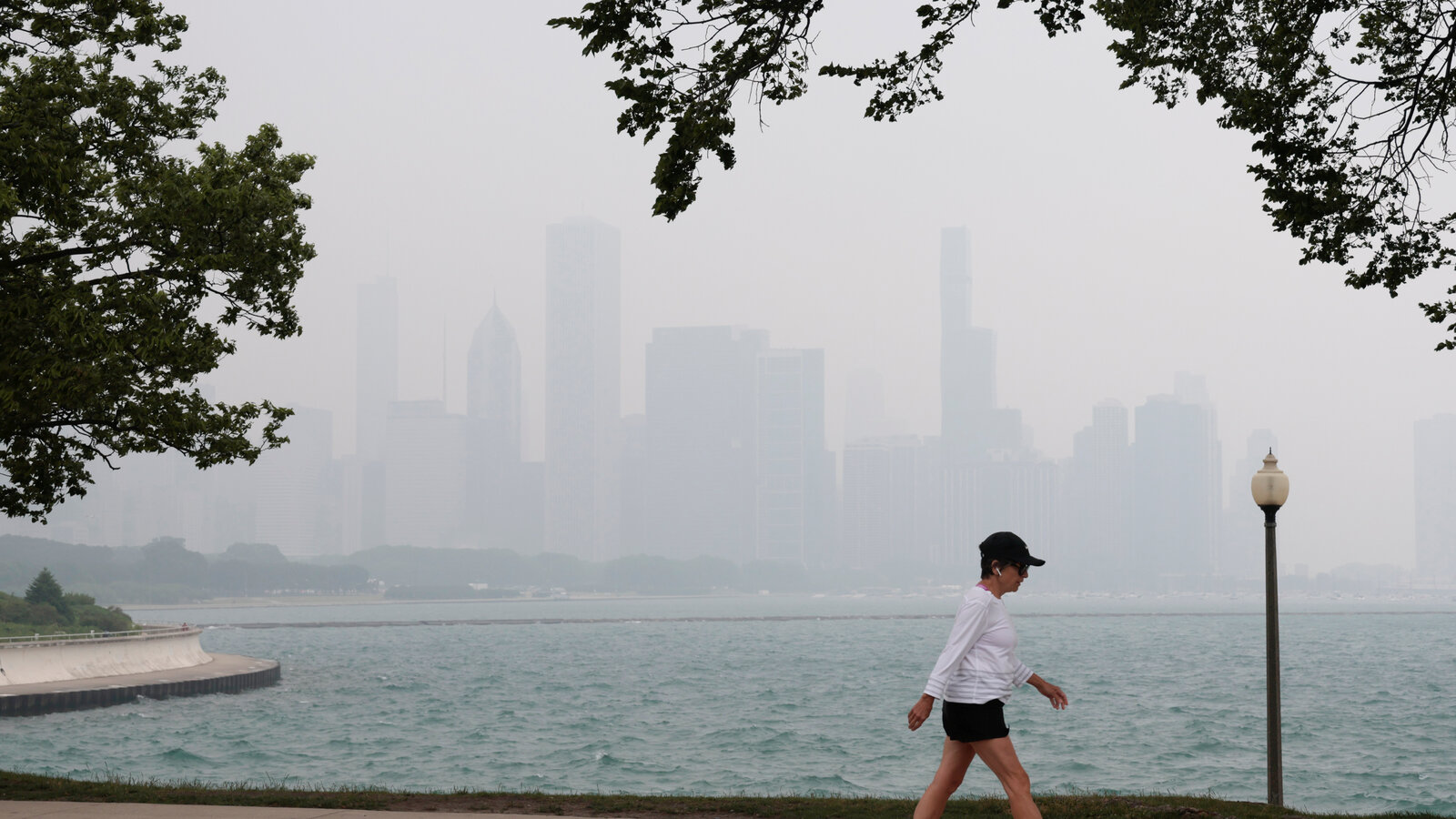
The numbers should not be stretched into a rule that every smoke event cuts shipments by the same amount. They come from a specific event, specific markets, and source-attested shipment analysis rather than a universal benchmark. Still, the operational pattern is familiar: visibility falls, drivers slow down or refuse exposed routes, customers tighten receiving windows, dispatchers lose confidence in lane timing, and carriers start repricing or withholding capacity on corridors that suddenly look unreliable.
That is why AI for supply chain air quality risk is not really about producing a prettier AQI map. The useful question is narrower: what changes if a transportation team sees an air-quality-driven disruption seven to fourteen days before it starts constraining practical route choices?
Why Smoke Behaves Like a Transportation Constraint
A bad air day does not have to close a highway to damage a freight plan. It can do enough by changing the speed, reliability, and willingness behind the plan. A lane that normally has a workable delivery range becomes uncertain. A same-day recovery option becomes less credible. A driver who is willing to run through rain may not accept dense smoke or particulate exposure. A receiver that can absorb a late truck on a normal day may reject one when dozens of deliveries are already sliding.
The June 2023 wildfire case matters because the disruption showed up in logistics terms: delays and shipment volume contraction. Chicago and New York were not just places with poor air quality; they were major freight demand centers where transportation execution slowed enough to appear in shipment data.[1] For a planner, that is a different class of signal than a general weather advisory.
Weather already consumes a meaningful share of road reliability. Everstream, citing Economist Impact, states that weather is responsible for 23% of all U.S. road delays and costs trucking companies $2 billion to $3.5 billion annually.[2] That cost figure includes weather broadly, not air quality alone, so it should not be used as a smoke-specific loss estimate. Its value is to show why transportation organizations already have an economic reason to treat environmental disruptions as planning inputs rather than after-the-fact explanations.
The pressure is not standing still. Sphera cites McKinsey Global Institute analysis indicating that supply chains are now six times more likely than in 2010 to experience a climate-related disruption lasting a month or more.[3] That does not mean every air quality event lasts a month, and it does not isolate smoke from other climate hazards. It does suggest that the old habit of treating environmental shocks as rare exceptions is becoming a weaker operating assumption.
What AI Adds Before Capacity Tightens
The practical advantage of an AI-enabled air quality warning is lead time. A same-day alert gives dispatchers another exception to triage. A seven- to fourteen-day view gives transportation managers a chance to protect appointment windows, move non-urgent freight earlier, pre-book alternate capacity, or shift to a lower-variance lane before the rest of the market is trying to solve the same problem.
The underlying workflow usually combines several signals that are individually useful but operationally incomplete. AQI feeds describe observed local conditions. Satellite imagery helps identify smoke plumes and their movement. Particulate forecasts estimate how concentrations may change. Weather models add wind, temperature, pressure, precipitation, and boundary-layer behavior that influence where smoke travels and settles. AI and machine learning models can then score which lanes, nodes, and appointment windows are likely to face elevated disruption risk.
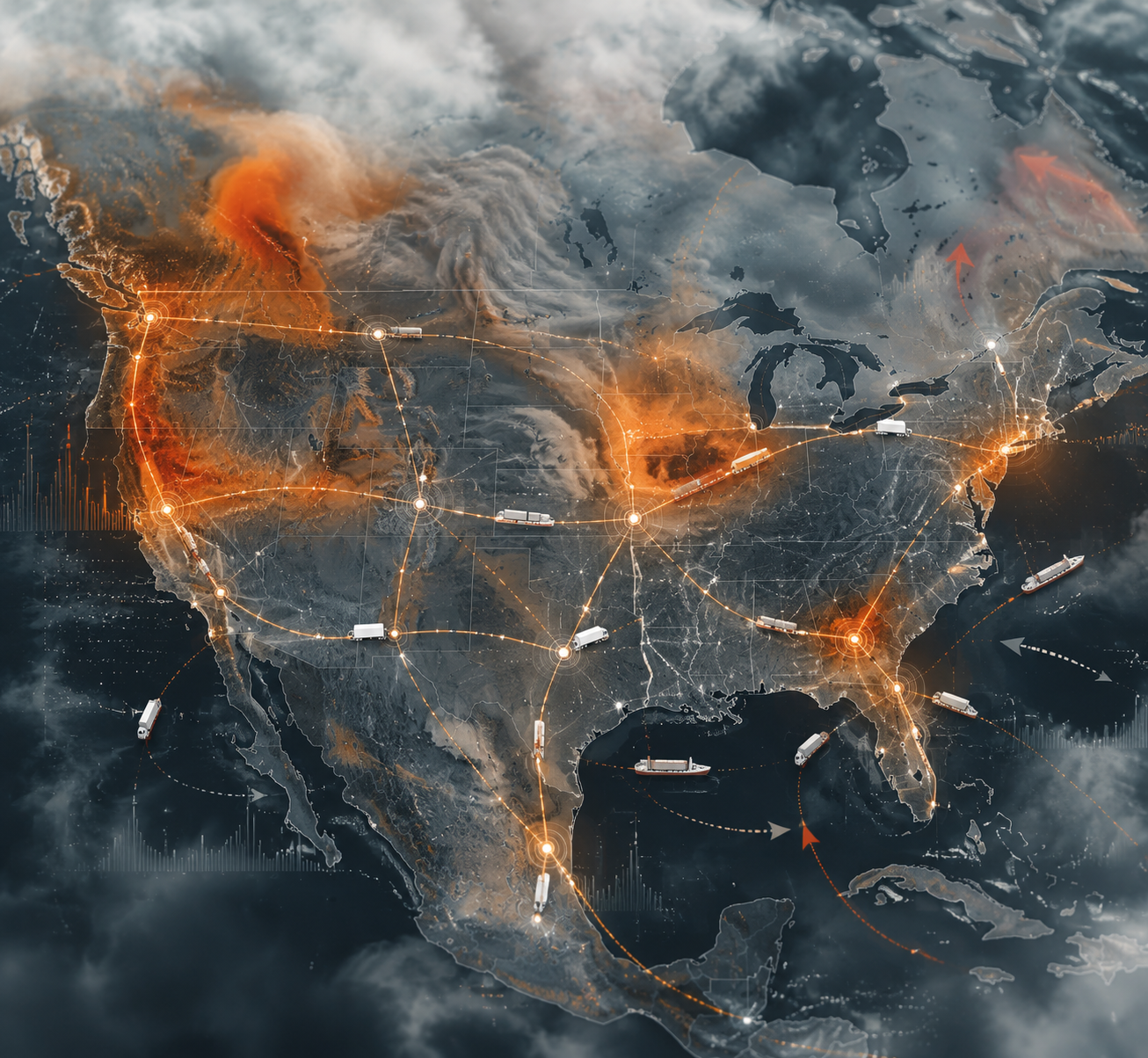
Everstream describes a capability that combines AI and machine learning weather models with human meteorologist validation to provide forecasts of air-quality-related disruptions more than 14 days ahead.[2] The human validation point is not decorative. Smoke behavior can be local, and a model confidence score is not the same thing as a transportation decision. Someone has to decide whether the forecast is strong enough to justify paying for a longer route, changing tender timing, or asking a customer to accept a revised appointment.
| Signal | What it tells logistics teams | Where judgment still matters |
|---|---|---|
| AQI and particulate data | Whether current air conditions are already unsafe or deteriorating near a facility, city, or corridor | Whether the metric reflects the exact operating location and time window |
| Satellite and plume imagery | Where smoke or airborne particulate matter appears to be moving | Whether the plume will affect a freight lane or stay outside the operating corridor |
| Weather models | How wind and atmospheric conditions may carry or clear smoke | Whether model uncertainty is too high for a costly reroute |
| AI/ML risk scoring | Which lanes, nodes, and delivery windows should be prioritized for review | Whether the score should trigger action, monitoring, or no change |
| Meteorologist validation | Whether the forecast is credible enough to enter transportation execution | How to translate atmospheric risk into an operational severity level |
The distinction between forecast and execution is where many disruption programs either become useful or become another dashboard. An alert that says smoke may affect a region next week is interesting. An alert that identifies exposed lanes, affected origin and destination pairs, customer delivery windows, available alternate routes, and expected service variance is usable.
From Alert to TMS Action
For a transportation team, the handoff should look less like a weather bulletin and more like an exception workflow. The forecast needs to enter the same operating environment where planners tender loads, compare routes, manage carrier commitments, and escalate service risk.
- Identify the exposed freight: open orders, planned loads, committed appointments, and high-service shipments on lanes likely to be affected.
- Classify the disruption window: monitor, prepare, or act, based on forecast confidence and operational exposure.
- Compare route variance, not just route cost: a cheaper lane with high smoke exposure may become expensive once detention, missed delivery, and recovery capacity are included.
- Pre-negotiate carrier response: decide which carriers can accept reroutes, which require rate approval, and which lanes need backup coverage.
- Push decisions into the TMS: update routing guides, tender rules, appointment notes, and escalation thresholds before the event becomes a control-room scramble.
Everstream’s analysis of more than 5 million shipments found that the top 3% of supply chain operations shifted toward lower-variance routes even when those routes carried higher costs, in order to avoid weather disruption.[2] That finding should be read as behavioral evidence, not as a blanket instruction to always buy the lower-variance route. It suggests that stronger operations may be more willing to pay for predictability when the service risk is real.
Air quality risk makes that tradeoff sharper because the market reaction can be uneven. One corridor may remain drivable but slower. Another may become undesirable because visibility and driver health concerns make it harder to secure acceptance. A destination metro may keep warehouses open but lose receiving efficiency. The right answer may be to reroute, pull freight forward, delay non-critical moves, split volume across carriers, or simply warn customers earlier with a better explanation than “weather.”
A Plausible Operating Sequence
A practical workflow might start when the risk platform flags a particulate-driven disruption probability for a group of lanes expected to move next week. The alert is validated by a meteorologist, then mapped against planned loads in the TMS. The planner sees that several customer-critical shipments are scheduled through the affected corridor during the highest-risk window. The system compares route alternatives and highlights one option with higher linehaul cost but lower predicted variance.
At that point, the work becomes familiar transportation management rather than abstract AI. The carrier manager checks which providers can accept the alternate routing. The planner updates tenders and appointment assumptions. Customer service receives a reasoned risk note before the delay occurs. Finance can see why the higher-cost route was selected. If the forecast weakens, the team can hold the original plan. If it strengthens, they are not trying to buy capacity after everyone else has reached the same conclusion.
Scenario Simulation Helps, but It Is Not the Same as Air Quality Prediction
The best adjacent evidence for fast rerouting comes from outside air quality. Council Fire cites a Procter & Gamble supply chain digital twin that simulated more than 15,000 rerouting scenarios in 45 minutes during the 2023 Suez blockage, with disruption costs reported at $18 million versus a $42 million industry average.[4] That was a maritime blockage case, not a smoke or AQI deployment, so it should not be presented as proof that digital twins solve air-quality disruption.
Its relevance is narrower and still useful: when a disruption compresses decision time, the ability to test many routing options quickly can change the quality of the response. For air quality risk, that same simulation discipline can help compare whether a shipment should move early, move around a corridor, switch modes, change destination sequencing, or remain on plan with an escalation note.
This is also where automation needs a boundary. Predictive AI can surface exposed lanes and rank likely alternatives. It should not silently rewrite routing strategy without business rules, carrier constraints, service commitments, and human review. A model can estimate risk; the transportation organization still owns the tradeoff.
What Has to Be in Place Before the Forecast Matters
An air quality alert becomes operational only when the team has already decided how to use it. If every forecast requires a new meeting, the lead time disappears. The better pattern is to define thresholds, owners, and actions before the next smoke event appears on the map.
- Data scope: connect AQI, particulate, satellite, weather, shipment, lane, appointment, and carrier data closely enough to see exposure by load, not just by geography.
- Validation: require meteorological review for higher-impact alerts, especially when action would add cost or change customer commitments.
- TMS integration: make the alert visible inside routing, tendering, appointment, and exception workflows rather than isolating it in a risk portal.
- Carrier playbooks: define which carriers can support alternate corridors, what approvals are needed, and when spot coverage becomes acceptable.
- Service rules: separate freight that must be protected from freight that can tolerate delay, consolidation, or later movement.
The implementation mistake is to treat air quality as a special case that sits outside normal transportation governance. It should have its own signal inputs, but the response should use existing operating muscles: routing guides, escalation levels, carrier scorecards, customer priority tiers, and cost-to-serve rules.
There is also a measurement problem worth handling early. Teams should not only ask whether the model predicted poor air quality. They should ask whether the warning changed tender acceptance, reduced late deliveries, preserved appointment compliance, avoided high-variance corridors, or gave customer-facing teams enough time to reset expectations. Forecast accuracy matters, but logistics value shows up in execution metrics.
The Point Where the Signal Becomes Useful
Poor air quality has been easy to underplan because it feels local, temporary, and atmospheric until it starts pushing loads out of sequence. The June 2023 wildfire evidence showed that, in acute events, the effect can appear in shipment volumes and delivery delays, not just in public health alerts.[1]
AI can help supply chains anticipate that risk earlier by combining AQI feeds, satellite observations, plume movement, particulate forecasts, and weather modeling into lane-level warnings. The forecast becomes credible when meteorologists validate it. It becomes valuable when the TMS turns it into affected shipments, lower-variance alternatives, carrier instructions, and escalation rules.
The useful end state is not autonomous logistics making opaque routing decisions. It is a planner receiving a validated alert, seeing the lanes and appointments at risk, comparing alternatives before the market tightens, and acting while there is still capacity to choose from.
References
- Climate Proofing Your Supply Chain, Everstream Analytics
- Weather-Proof Your Logistics Operations, Everstream Analytics
- Weathering the Storm: How Climate Hazards Are Disrupting Global Supply Chains, Sphera
- Adapting Supply Chains to Climate Disruptions, Council Fire
Comments
Join the discussion with an anonymous comment.