

AI use in inventory management decisions is moving faster in budget conversations than in operating models. One recent survey found that 94% of companies plan to deploy AI in supply chain operations within two years, based on responses from 490 supply chain professionals across four countries. A separate Gartner-cited survey found that only 23% of supply chain leaders who had deployed AI in the prior 12 months had a formal AI strategy.[1] Those figures should not be treated as a matched numerator and denominator; they come from different surveys, with different samples and definitions. But placed side by side, they expose the right problem: intent is broad, while execution discipline is still thin.
That gap matters because inventory AI does not become real when a vendor is selected. It becomes real when item-level data can be trusted, when planners know which recommendations they are expected to accept or challenge, when replenishment parameters actually change, and when finance can see whether working capital, service levels, expediting, and markdowns are improving for reasons the business can explain.

The P&L case is real, but it is not a shortcut
There is enough evidence to take AI inventory management seriously. Accenture’s 2024 study of 1,148 companies across 10 industries and 15 countries found that companies with AI-mature supply chains were 23% more profitable than peers and six times as likely to use AI and generative AI widely.[2]
The important word is “with.” The finding is correlational, not proof that AI alone caused the profitability difference. AI-mature companies may also have cleaner data, stronger planning processes, better executive alignment, more disciplined capital allocation, or larger digital teams. In inventory work, those distinctions are not academic. A company can buy the same forecasting or optimization platform as a leader and still fail if its item master is inconsistent, lead-time history is unusable, or planners are measured in ways that discourage the system’s recommendations.
The practical conclusion is narrower and more useful: AI maturity appears alongside stronger performance, and wide use of AI is more common among stronger operators. That makes AI inventory management worth funding, but it also raises the standard for what “funding” must include.
Before scaling, ask what must be true
Most stalled inventory AI programs do not fail in the demo. They fail after the pilot forecast looks promising and the organization cannot decide whether to change safety stock, purchase quantities, transfer rules, or planner authority. The readiness test should therefore start before model selection.
| Readiness condition | What executives should test | What failure usually looks like |
|---|---|---|
| Data foundation | Can demand, inventory, item, location, supplier, lead-time, ERP, and WMS data be reconciled at the decision level? | The model produces plausible outputs, but teams spend review meetings debating which source of truth is correct. |
| Use-case-specific implementation | Has the company named the inventory decisions AI is meant to improve? | The organization buys a platform, then searches for a business case broad enough to justify it. |
| Multi-year ROI expectation | Does the business case match the time required to clean data, govern decisions, train users, and change policy? | Finance expects payback before the operating model has changed. |
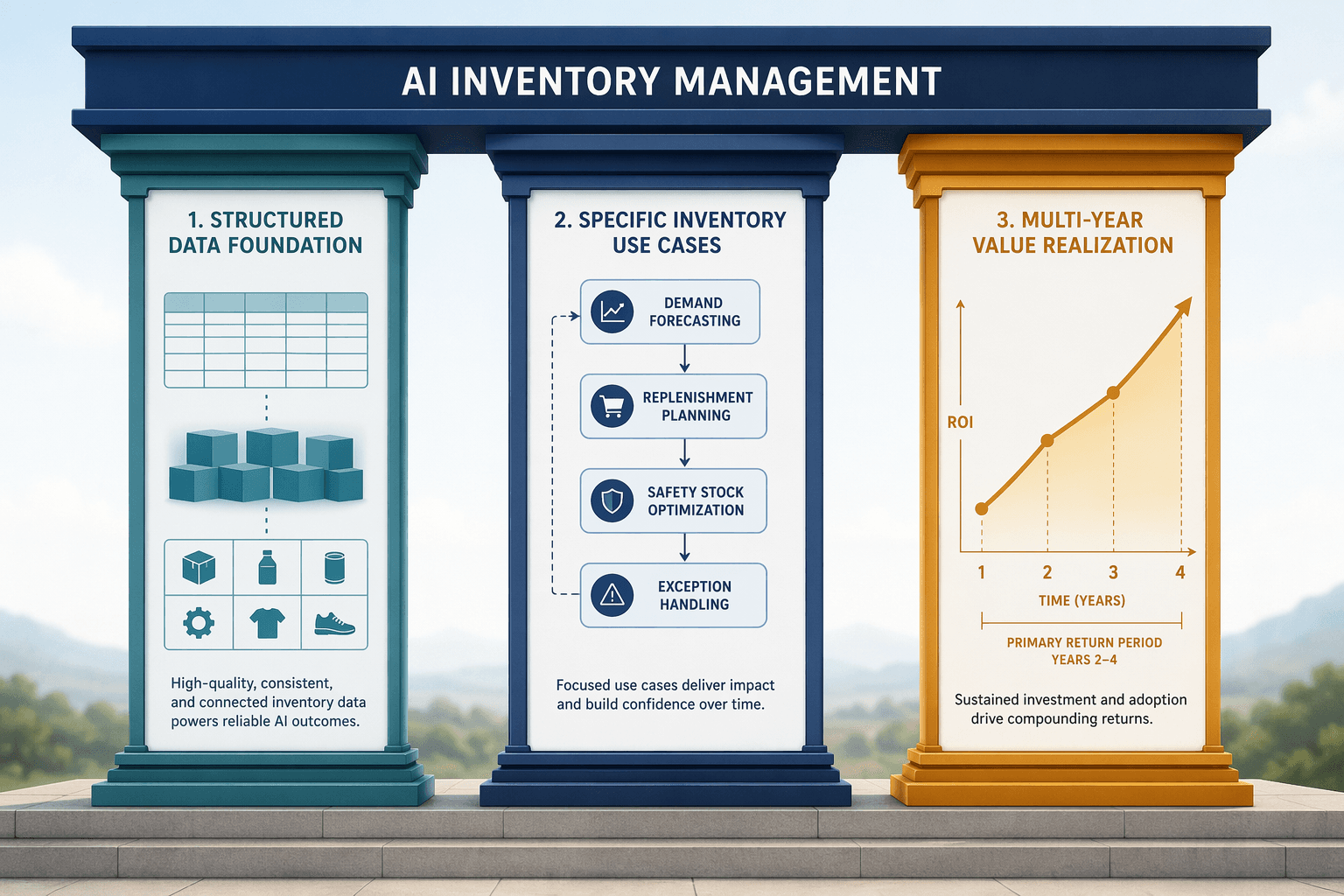
Data foundation: the unglamorous gating item
Inventory management is unusually unforgiving of weak data because the decision unit is so granular. A model may need to reason across SKU, location, customer segment, supplier, purchase order, shipment, on-hand balance, reserved inventory, lead-time variability, substitution rules, minimum order quantities, pack sizes, and service-level targets. If those fields live in different systems with different refresh cycles and ownership, AI does not remove the reconciliation problem. It makes the unresolved conflict visible.
The first executive question is not whether the company has enough data in the abstract. It is whether the data can support the decision being automated or augmented. Forecasting lost sales requires different data discipline from optimizing safety stock. Multi-echelon inventory optimization requires different location and transfer logic from a reorder-point recommendation. Supplier-risk-aware replenishment requires lead-time and fulfillment performance history that many organizations do not maintain cleanly enough for automated use.
A useful data review should end with named defects and named owners: duplicate items, obsolete codes still appearing in demand history, missing supplier minimums, overridden lead times with no audit trail, warehouse balances that do not match ERP inventory, demand signals distorted by stockouts, or promotions captured outside the planning system. The answer cannot be “data is not perfect,” because it never will be. The question is whether the defects are material to the inventory decision AI is expected to support.
For teams that need a structured starting point, a data readiness assessment for AI inventory optimization should be completed before vendor scoring becomes the center of the program.
Use case first, platform second
An AI inventory program needs a narrower sentence than “improve inventory management.” It should name the decision, the current failure mode, the decision owner, the expected intervention, and the metric that will be used to judge progress.
- If the issue is excess inventory, the decision may be buy quantity, replenishment frequency, transfer timing, or markdown risk detection.
- If the issue is stockouts, the decision may be safety stock, service-level segmentation, supplier expediting, substitution, or allocation.
- If planner workload is the constraint, the decision may be exception prioritization rather than forecast accuracy.
- If volatility is the issue, the decision may be how quickly demand signals override historical averages.
Those are different operating problems. They may share a platform, but they do not share the same data requirements, governance rules, or ROI logic. A company that treats them as one AI initiative will usually overpromise at the steering committee and underdeliver at the planner desk.
This is where a practical AI inventory management overview is useful, but the next level of work is selecting from specific AI inventory management use cases. The selection should not be based only on which use case sounds most advanced. It should be based on whether the decision is frequent enough, valuable enough, and governed enough to change.
A bounded pilot can be a good choice when the organization has one high-friction inventory decision and enough data to test it. A platform-wide deployment is harder to justify if leaders cannot yet say whether AI is expected to reduce working capital, improve service, cut planner effort, reduce expediting, improve supplier ordering, or rebalance inventory across nodes. “All of the above” is not a strategy; it is usually a sign that the business case has not been forced through operations review.
ROI: finance needs a timeline the operating model can survive
The spending environment is aggressive. A 2026 SupplyChainBrain report on Accenture and MHI survey findings said 85% of executives plan to increase AI spending in 2026, with one in five expecting increases of more than 20%.[3] That pressure will push inventory teams to produce business cases quickly.
The payback evidence argues for more patience than many approval decks allow. Deloitte findings cited in the RELEX 2026 State of Supply Chain material indicate that only 6% of companies saw AI ROI in under a year, while most satisfactory returns arrived over a two- to four-year period.[1] That does not mean every inventory AI project must take four years to show value. A focused use case with clean data and a receptive planning organization may move faster. A program starting from fragmented spreadsheets, inconsistent item data, and unclear decision rights may take longer or fail before benefits are measurable.
The mistake is building a one-year payback story around a multi-year operating change. Finance leaders do not need optimism; they need the benefit logic separated into stages. Early benefits may come from planner productivity, better exception ranking, or reduced manual reconciliation. Later benefits may come from inventory policy changes, lower safety stock in stable segments, fewer expedites, better allocation, or improved service at the same working-capital level.
A credible business case should make clear which benefits require policy change and which can be achieved through decision support alone. If the model recommends lower safety stock but the organization never changes the service policy, the forecast improvement does not become a balance-sheet improvement. If AI identifies slow-moving inventory but commercial teams do not act on disposition, the insight does not become cash.
Executives preparing funding requests should compare assumptions against AI inventory management ROI benchmarks and translate the operating case into a CFO-ready AI inventory management business case. The strongest cases are usually explicit about uncertainty: which savings are near-term, which require adoption, and which should remain outside the committed case until the pilot proves them.
The workforce is already moving; governance has to catch up
AI adoption is not waiting politely for formal strategy. ActivTrak data cited in 2025 found that 72% of logistics employees had adopted AI tools in 2024, the highest adoption rate across industries in that analysis.[2] That figure covers logistics broadly, not inventory management teams specifically, so it should not be stretched into a claim about planners. It still matters because inventory decisions sit inside the same operating environment: people are experimenting with AI tools before governance has caught up.
That can be useful. Analysts may automate repetitive data checks. Planners may summarize exceptions faster. Managers may use AI to prepare scenario narratives. But unmanaged adoption also creates predictable problems: sensitive data in unapproved tools, inconsistent calculations, undocumented overrides, and recommendations that cannot be audited after the fact.
The trust data points in the same direction. RELEX reported that 67% of supply chain leaders were more confident in AI than they were in 2025, but only 10% trusted AI for critical decisions without human review.[1] That is not resistance; it is a reasonable operating preference. Inventory decisions carry service, cash, and customer consequences. The goal is not to remove humans from the process wherever possible. The goal is to decide which decisions AI can recommend, which decisions humans approve, and which exceptions require escalation.
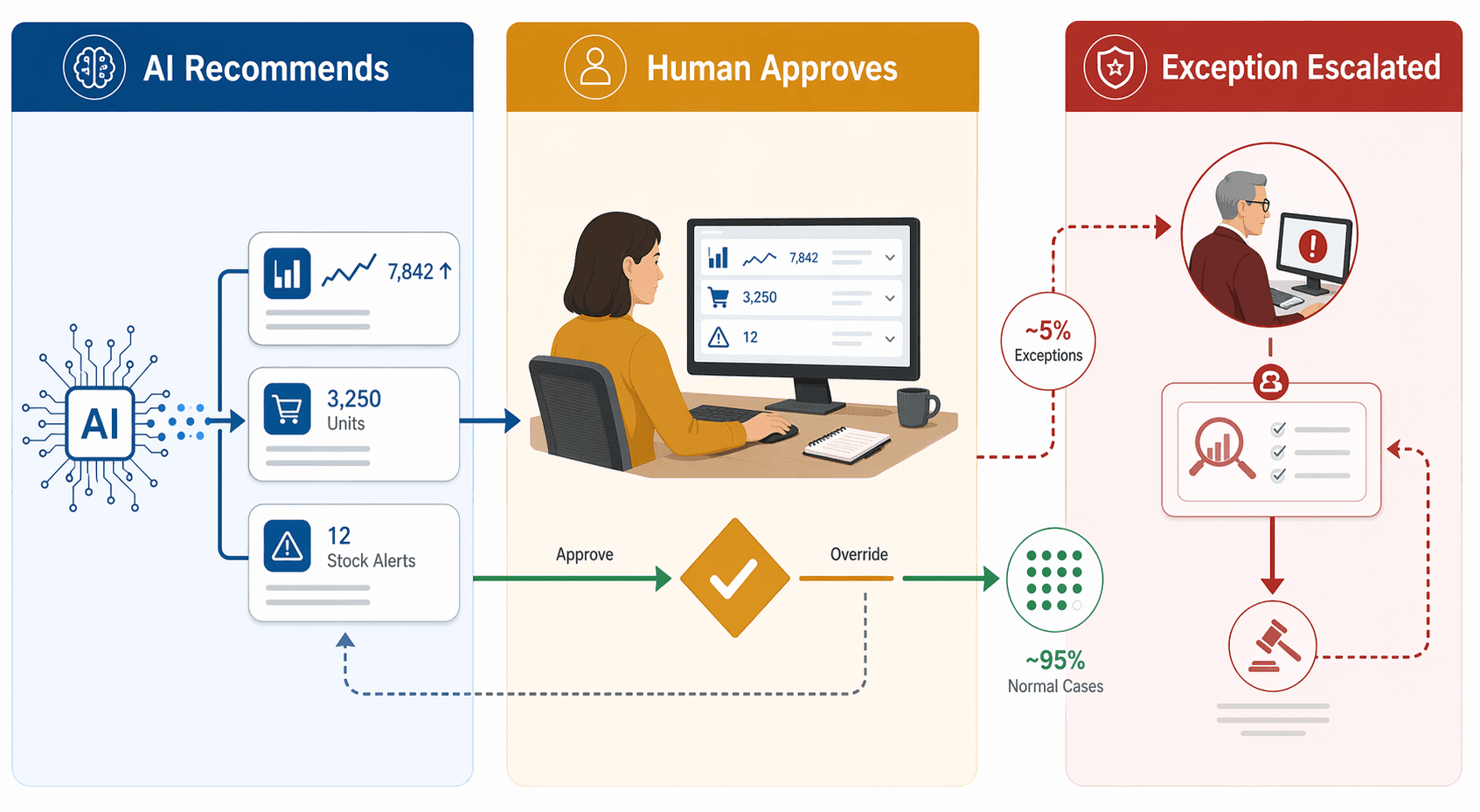
A workable governance model usually separates decisions by risk and reversibility. Low-risk recommendations, such as prioritizing exception queues or flagging duplicate items for review, can move quickly. Medium-risk recommendations, such as replenishment quantity changes within approved tolerances, may need planner approval. High-risk decisions, such as service-level changes for strategic customers, large safety-stock reductions, or constrained allocation during shortages, should have explicit escalation rules.
The review process also has to be designed for learning. If planners override AI recommendations, the system should capture why: supplier relationship knowledge, promotion intelligence, customer commitment, minimum order constraint, suspected data error, or genuine model weakness. Without that feedback loop, the organization cannot tell whether low adoption reflects poor training, poor model quality, misaligned incentives, or valid human judgment.
For teams formalizing this operating design, an AI-based inventory management workflow should make the human-in-the-loop points visible rather than burying them in change-management slides.
A practical readiness judgment
Executives do not need another abstract maturity label. They need to know what kind of commitment the organization is actually ready to make.
| If this is true | Your likely position | Best next move |
|---|---|---|
| Core inventory, demand, supplier, lead-time, ERP, and WMS data can be reconciled for a named decision; use cases are prioritized; finance accepts staged ROI; planner review rules are defined. | Ready to scale selectively | Expand from one or two governed use cases into adjacent inventory decisions, with adoption and financial metrics reviewed together. |
| One valuable decision is clear, but data quality or workflow governance is uneven. | Ready for a bounded pilot | Limit scope, document decision rights, measure override behavior, and avoid claiming enterprise-wide ROI too early. |
| The company is shopping for platforms before naming decisions, data owners, or benefit logic. | Missing prerequisites | Run a data and use-case diagnostic before committing to broad deployment. |
The most useful maturity discussion is not whether the organization is “AI-ready” in general. It is whether the next inventory decision targeted for AI has a clean enough data trail, a clear enough owner, a narrow enough use case, and a credible enough ROI horizon. A broader supply chain AI maturity diagnostic can help place that answer in context, especially for companies coordinating inventory with planning, procurement, logistics, and finance. Executives who want the cross-functional version of the same issue can also use the companion analysis on the AI strategy gap in supply chain.
The organizations most likely to move from intent to measurable execution will be the ones that treat AI inventory management as a multi-year operating capability, not a short-term software initiative.
References
- Supply Chain AI, RELEX Solutions, 2026.
- Supply Chain AI Statistics, Open Sky Group.
- Accenture, MHI Survey Finds Companies Increasing AI Spending Despite ROI Concerns, SupplyChainBrain.
Comments
Join the discussion with an anonymous comment.