

The most common supply chain AI maturity problem is not inactivity. It is the opposite: too many pilots, dashboards, forecasting experiments, copilot trials, and vendor demos to tell whether the organization is actually becoming more capable. In artificial intelligence driven supply chain management, maturity has to answer a harder operating question: what decision can the organization now make better, faster, or with less human intervention than it could last quarter?
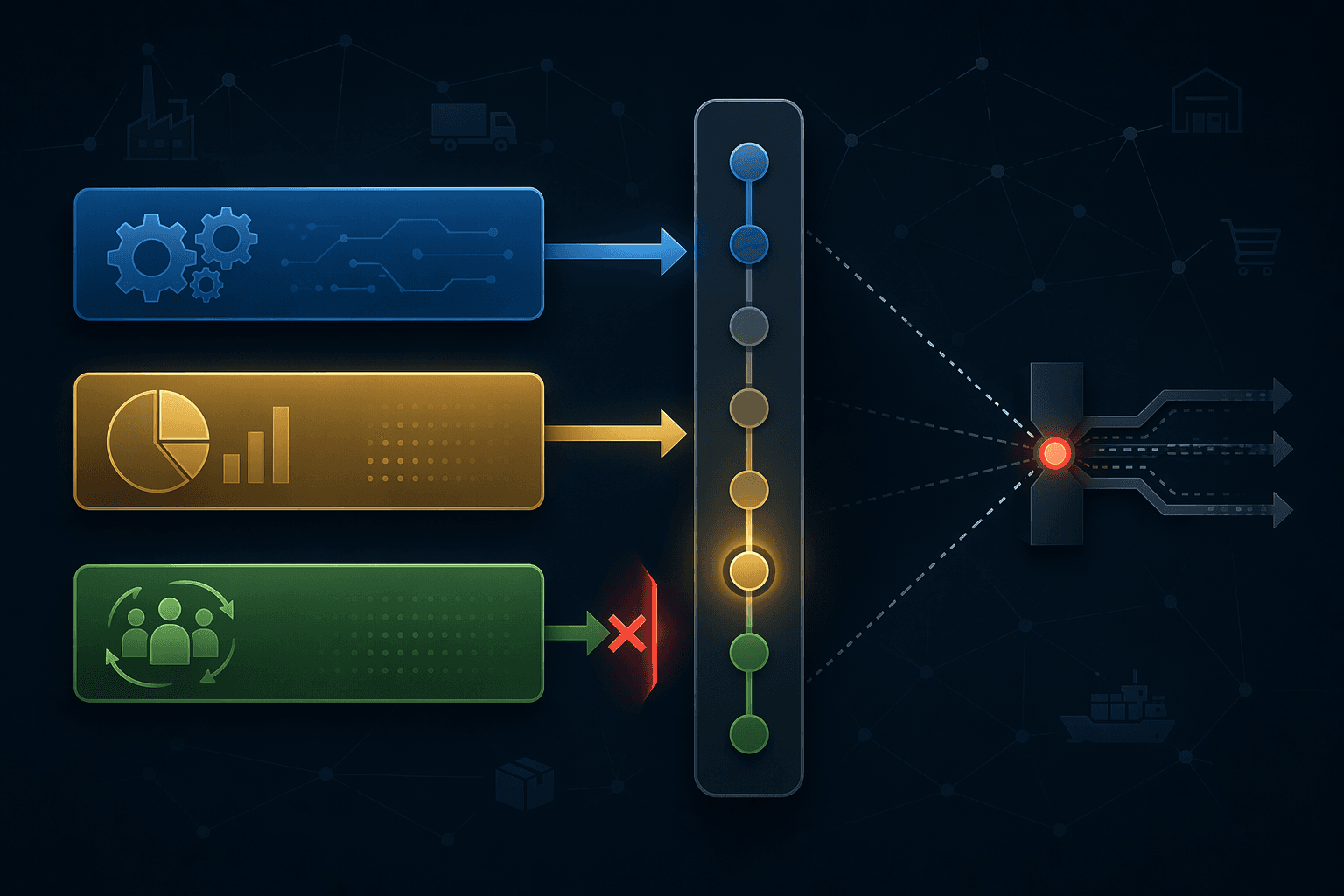
A useful diagnostic should not start by asking whether the company has AI. It should ask three things at once: how far the technology has progressed, whether investment is being allocated with intent, and whether the organization has redesigned the work around the new capability. The lowest-scoring dimension is usually the bottleneck. It may be the model. More often, it is master data ownership, planning cadence, decision rights, governance, or the fact that planners are still expected to run yesterday’s process with one more screen open.

Why one maturity model is not enough
RELEX’s supply-chain-specific maturity model is useful because it describes a real technical progression: Stage 1 is rigid rule-based planning, Stage 2 is foundational specialized AI, Stage 3 adds assistive and agentic AI, and Stage 4 moves toward multi-agent orchestration. The same framework says measurable ROI first appears at Stage 2 and uses a five-dimension assessment to locate the bottleneck before prescribing a 30-day, 90-day, and 12-month roadmap.[1]
That technical ladder matters. A planner moving from static reorder parameters to machine-learning demand sensing is in a different operating world from a team experimenting with agents that recommend exception actions. But a technical ladder alone can flatter the organization. It can make a deployment look mature because the algorithm is modern, while the data steward is unresolved, the S&OP meeting still overrides the system without feedback capture, and portfolio funding is scattered across departmental experiments.
Gartner’s contribution is allocation discipline. Its 2025 survey found that only 23% of supply chain organizations had a formal AI strategy, which explains why so much activity never becomes a portfolio.[2] The related CSCO roadmap emphasizes starting actions such as assessing AI maturity, securing master data ownership, and implementing hybrid governance.[3] Those are not decorative governance steps. They determine whether the next dollar goes to running the current operation better, growing cross-functional capability, or transforming the business model.
Deloitte sees a different failure mode: organizations can automate tasks and still fail to redesign work. Its Automators versus Transformers research found that Transformers at Levels 3–4 achieve 72% strong AI and generative AI ROI, while Automators at Levels 1–2 remain more focused on cost reduction and lower-return use cases. The same research found that Transformers invest 5 percentage points more in cloud and immersive technologies than Automators, are 7–8 percentage points more likely to track growth measures such as NPS, and allocate 21–50% of digital budgets to monetization.[4]
The uncomfortable statistic is the job-design one: Deloitte’s State of AI 2026 reported that 84% of organizations had not redesigned jobs around AI.[5] That is the quiet reason many Stage 2 supply chain deployments stall. The model works; the operating model does not know what to do with the output.
| Framework | What it sees well | What it can miss if used alone | Decision it should change |
|---|---|---|---|
| RELEX technical maturity | Progression from rules to specialized AI, assistive agents, and multi-agent orchestration | Whether the organization has funded, governed, and staffed the work to absorb the capability | What stage the technology has earned, and what must be proven before higher autonomy |
| Gartner Run-Grow-Transform | Whether AI investment is spread across operational efficiency, capability expansion, and strategic bets | The detailed supply chain planning workflow changes needed to make AI usable | Where the next portfolio dollar belongs |
| Deloitte Automators vs. Transformers | Whether AI is changing jobs, value measures, and business outcomes | The supply-chain-specific technical sequence from planning automation to orchestration | Whether the organization is automating old work or redesigning how decisions happen |
The five-dimension diagnostic
The practical assessment is not a maturity score averaged across everything. Averages hide blockers. If technology is at Stage 3 but governance is at Stage 1, the organization is not ready for Stage 3 decisions. It is ready for Stage 1 governance work with a Stage 3 tool sitting on top.
| Dimension | What to test | Typical evidence of maturity | Bottleneck signal |
|---|---|---|---|
| Data foundation | Whether planning data is owned, trusted, refreshed, and exception-managed | Named owners for master data, measurable data-quality routines, clear hierarchy and attribute governance | Planners export, cleanse, and reconcile data outside the platform before trusting recommendations |
| Planning processes | Whether AI outputs are embedded in demand, supply, inventory, replenishment, and S&OP cadence | Exception thresholds, escalation paths, feedback capture, and decision logs are part of the operating rhythm | The model produces recommendations, but the meeting process still runs on manual overrides and slide preparation |
| Technology platforms | Whether architecture supports the current stage without creating brittle point solutions | Integrated planning workflows, model monitoring, scenario support, and traceable recommendations | Pilots work in isolation but cannot scale across categories, regions, channels, or planning horizons |
| People and change leadership | Whether roles, skills, incentives, and managerial routines have changed | Updated planner roles, training paths, adoption measures, and explicit accountability for AI-assisted decisions | Users are trained on screens, but their jobs, KPIs, and decision rights remain unchanged |
| Governance | Whether investment, risk, responsible AI, and autonomy decisions are governed together | Hybrid governance across supply chain, IT, data, finance, and risk; clear stage gates for autonomy | No one can say who approved the use case, who owns model drift, or what level of automation is allowed |
The diagnostic rule is simple: the lowest dimension sets the next management agenda. If data is weak, do not buy a more advanced forecasting layer to compensate. If jobs are unchanged, do not call an assistive workflow mature because the interface looks conversational. If governance is immature, do not expand autonomy merely because a pilot has a positive business case.
Stage gates: what must be proven before moving on
The maturity stages should not become a prestige ranking. Stage 4 is not inherently better if the organization has not earned the right to automate higher-risk decisions. The relevant question is what proof is required before the next stage receives funding.

| Current stage | Do not advance until you can prove | Main constraint to look for | Risk if skipped |
|---|---|---|---|
| Stage 1: rigid rule-based planning | Rules, parameters, and overrides are visible enough to identify where AI would improve decisions | Data ownership and process transparency | The first AI use case automates a broken rule base without fixing the underlying decision logic |
| Stage 2: foundational specialized AI | The model produces measurable planning or operational improvement, and users can explain when they accept or reject recommendations | Job redesign, feedback capture, and ROI validation | The deployment becomes a better forecast engine feeding the same manual exception process |
| Stage 3: assistive and agentic AI | AI-assisted workflows are embedded in cadence, monitored for calibration, and governed by decision-risk tier | Trust, explainability, autonomy rules, and cross-functional accountability | Agents recommend actions faster than the organization can review, learn from, or responsibly control them |
| Stage 4: multi-agent orchestration | Multiple agents can coordinate across planning domains within approved limits, with escalation paths and outcome monitoring | Enterprise governance, risk tolerance, and end-to-end process design | High-speed orchestration amplifies bad data, misaligned incentives, or unresolved trade-offs |
MIT CISR’s 2022 survey is a useful reminder that true AI future-readiness was not common: 7% of surveyed enterprises reached Stage 4, while 28% were at Stage 1, 34% at Stage 2, and 31% at Stage 3. Those percentages may have shifted by 2026, but the distribution is still a useful caution against assuming that advanced examples describe the median organization.[6]
Umbrex’s AI-driven planning maturity model names several transition pitfalls that match what tends to go wrong in steering committees: technology-first sequencing, over-automation too soon, lack of calibration monitoring, and neglect of responsible AI among them.[7] These are not generic risks to park in an appendix. They belong at the gates between stages.
Use the 30/90/12-month spine to turn diagnosis into work
RELEX’s maturity framework is strongest when its 30-day, 90-day, and 12-month roadmap is treated as an operating spine rather than a slide sequence.[1] The first 30 days are not for proving that AI is exciting. They are for identifying the weakest dimension and stopping the organization from funding around it.
First 30 days: locate the constraint
Start with one planning domain where the organization already has enough activity to inspect: demand planning, replenishment, inventory optimization, allocation, or integrated business planning. Do not start with the cleanest demo environment. Start where decisions are consequential and recurring.
- Score the five dimensions separately rather than averaging them.
- Map every active AI use case to Run, Grow, or Transform funding logic.
- Name the decision each use case is supposed to improve.
- Identify who owns the input data, who reviews the recommendation, who can override it, and who learns from the override.
- Separate vendor-reported capability from internally observed adoption and outcome data.
This is also where a CSCO should confront the strategy gap. If the company cannot state why one use case is Run, another is Grow, and another is Transform, then the portfolio is probably a collection of pilots. For a deeper treatment of that failure mode, see why AI in supply chain fails.
By 90 days: prove the operating change
By 90 days, the organization should have more than a model performance readout. It should be able to show that the planning process changed. If the AI recommendation is accepted, the system should capture that. If it is rejected, the reason should become learning material, not private planner memory. If an exception threshold is changed, the change should have an owner and a review date.
This is where Deloitte’s job-redesign warning becomes operational. Training users on a new planning screen is not the same as redesigning work. A Stage 2 organization trying to reach Stage 3 should be able to show which tasks decreased, which judgment tasks increased, which decisions moved closer to the system, and which approvals remained human because risk is still too high.
The ROI discussion also has to mature here. Cost reduction can justify early automation, but Transformers measure broader value. If a supply chain team wants to move beyond Automator behavior, it should decide whether the next use case is expected to improve service, revenue capture, customer experience, planner productivity, or resilience—not merely reduce manual effort. For related ROI pacing, see realistic supply chain AI ROI timelines.
By 12 months: fund the next stage only if the gate is cleared
At 12 months, the question is not whether the pilot was liked. The question is whether the organization has earned the next degree of autonomy. A Stage 2 deployment should not be scaled as Stage 3 unless users are working from AI-assisted recommendations inside the cadence, exception handling is visible, model calibration is monitored, and governance has defined which decisions can be automated or suggested.
Gartner’s 2026 prediction that 60% of supply chain disruptions will be resolved without human intervention by 2031 is directionally important, but its current caveat matters more for today’s roadmap: immaturity restricts full automation to low-risk decisions.[8] That should temper enthusiasm for agentic orchestration. The near-term management discipline is to classify decision risk before expanding automation.
| If the bottleneck is... | The next 12-month funding should prioritize... | Do not fund first... |
|---|---|---|
| Data foundation | Master data ownership, hierarchy cleanup, data-quality routines, exception visibility | A more advanced AI layer that depends on the same unstable inputs |
| Planning processes | Workflow redesign, exception thresholds, meeting cadence changes, override capture | A pilot that produces recommendations outside the operating rhythm |
| Technology platforms | Architecture integration, monitoring, scenario support, workflow embedding | Another point solution that cannot scale across the planning landscape |
| People and change leadership | Role redesign, capability building, planner-manager routines, incentive alignment | A rollout plan that measures logins instead of changed decisions |
| Governance | Portfolio allocation, responsible AI controls, autonomy tiers, risk ownership | High-autonomy use cases without decision rights and escalation paths |
How to read vendor case outcomes without misusing them
Vendor-reported cases can be useful, but they should not be treated as independent benchmarks. RELEX reports that KICKS achieved a 34% reduction in lost sales value and reduced late deliveries from 5.2% to 3.4% in a Stage 4 deployment.[9] That is worth attention because the outcome is operationally specific. It should still be read as vendor-reported evidence from a particular context, not as a conversion rate for every company considering multi-agent orchestration.
The right use of a case like that is diagnostic comparison. Ask what had to be true underneath the result: Was the product and location hierarchy stable? Were replenishment decisions already governed? Did planners trust the recommendations enough to change behavior? Were late-delivery causes visible to the system? If those conditions are absent internally, the gap is not ambition. It is readiness.
A compact maturity assessment for the next steering meeting
For a steering committee, the diagnostic can fit on one page if the conversation is disciplined. Each planning domain gets a technical stage, a portfolio category, and a five-dimension bottleneck. The answer should be uncomfortable enough to change funding.
| Assessment question | Acceptable answer | Weak answer |
|---|---|---|
| What technical stage are we actually operating at? | Stage is tied to live decision behavior, not tool features | Stage is inferred from the vendor roadmap or demo capability |
| Is the use case Run, Grow, or Transform? | Funding logic is explicit and reviewed as a portfolio | Every use case is called strategic after approval |
| Which dimension is lowest? | One bottleneck is named with an owner and checkpoint | All dimensions are averaged into a reassuring score |
| What changed in the planner’s job? | Tasks, decisions, review points, and escalation paths changed | Users received training but still run the old process |
| What gate must be cleared before more autonomy? | Risk tier, monitoring, override learning, and governance are defined | The next step is broader rollout because the pilot performed well |
A mature answer sounds specific: “Demand planning for category A is at Stage 2 technically. It is funded as Grow, not Transform. The bottleneck is people and change leadership because planners still review recommendations outside the cadence and override reasons are not captured. The next 90 days are role redesign, override taxonomy, and adoption-by-decision tracking. No Stage 3 agent workflow funding until that gate is cleared.”
That kind of statement is less glamorous than a board-slide maturity score. It is also more useful. It tells the CSCO where the constraint is, which stage the organization has actually earned, and what must be fixed before the next investment.
References
- From AI to ROI: An AI maturity framework for supply chain leaders, RELEX Solutions.
- Gartner Survey Shows Just 23% of Supply Chain Organizations Have a Formal AI Strategy, Gartner, June 2025.
- CSCO Roadmap: Building a Supply Chain AI Foundation, Gartner.
- AI maturity and digital value, Deloitte Insights.
- State of AI 2026, Deloitte.
- What's your company's AI maturity level?, MIT Sloan.
- AI-Driven Planning Maturity Model, Umbrex.
- Gartner Predicts 60% of Supply Chain Disruptions Will Be Resolved Without Human Intervention by 2031, Gartner, March 2026.
- KICKS case study, RELEX Solutions.
Comments
Join the discussion with an anonymous comment.