

The number a supply chain VP can responsibly put in front of finance is narrower than the sales deck version, but still worth attention: AI inventory management software is commonly positioned around 15–30% inventory reduction, 20–50% fewer stockouts, and a 6–12 month payback window when the implementation starts from usable data and a scoped problem rather than a vague transformation mandate.[1] Those are not guaranteed savings. They are benchmark ranges that need to be converted into cash, cost avoidance, service impact, and implementation burden before they become a business case.
That distinction matters because inventory ROI is easy to double count. A lower inventory balance can release working capital, reduce holding cost, and lower obsolescence exposure, but it is still the same inventory movement viewed through different finance lenses. A stockout reduction can protect revenue and improve service levels, but only the lost margin that would otherwise have occurred belongs in the ROI model. The useful question is not whether AI inventory management software can optimize replenishment, forecast demand, or flag exceptions. It is where the benefit lands on the P&L, balance sheet, and planner workload.

Start With the Benchmark, Then Make It Earn Its Place
A defensible benchmark starts by naming what it measures. The 15–30% inventory reduction range is meaningful only if the baseline is defined: average on-hand inventory, excess and obsolete inventory, safety stock, cycle stock, or inventory value across a specific network. A 20–50% stockout reduction needs the same discipline. It should be tied to a measured stockout event, lost sales estimate, backorder rate, fill-rate gap, or service-level penalty, not a general complaint that planners are firefighting too often.[1]
The attraction of AI inventory management software is that it can improve several operating levers at once. IBM describes AI inventory management as using data, machine learning, and automation to improve demand forecasting, replenishment, inventory placement, and exception handling; it also emphasizes that these systems depend on accurate, integrated, and timely data.[2] That second half is the part that should travel into the finance deck. If item-location history, supplier lead times, substitutions, minimum order quantities, and service policies are not reliable enough for the model, the project may still be valuable, but part of the first-year budget is a data remediation program.
Market growth does not prove ROI, but it explains why finance teams are seeing more of these proposals. ResearchAndMarkets placed the AI inventory management market at $12.36 billion in 2026 and projected it to reach $30.01 billion by 2030.[3] That is context, not evidence that a specific distributor, manufacturer, or retailer will earn back its implementation in two quarters. The operating economics still have to be built from the company’s own baseline.
The ROI Model Finance Will Actually Read
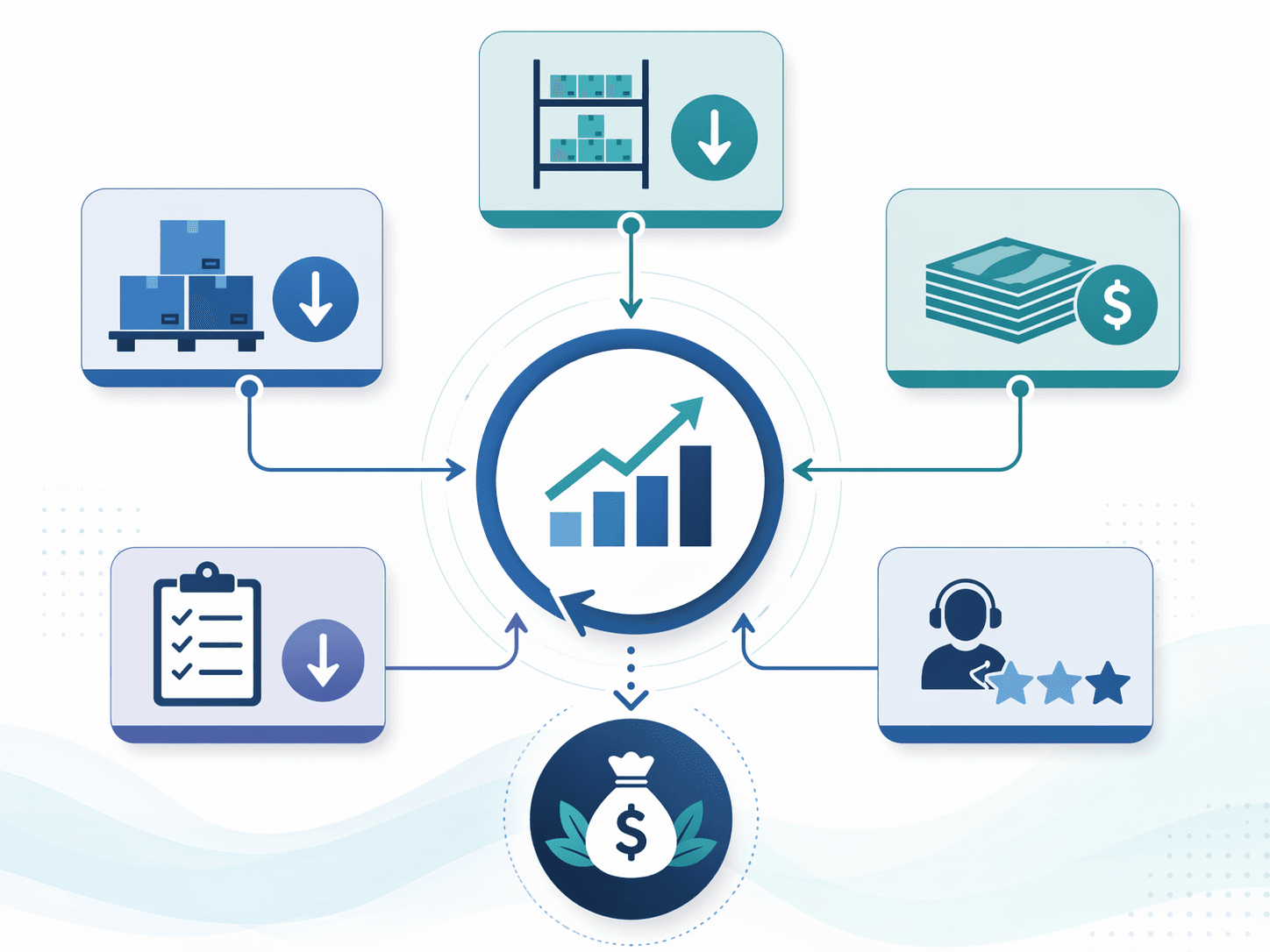
The clearest way to structure the business case is to separate recurring benefits from one-time release of cash, then subtract the real cost of getting the system into daily planning. ToolsGroup’s ROI framework is useful because it lays out the levers rather than treating ROI as one blended claim: holding costs, stockout costs, working capital, write-offs, and service levels all have to be calculated with different assumptions.[1]
| ROI lever | What to measure | Finance treatment |
|---|---|---|
| Inventory reduction | Baseline inventory value, target reduction range, affected SKUs and locations | Working-capital release plus lower carrying cost, without counting the same dollar twice |
| Holding cost reduction | Storage, insurance, handling, shrink, capital cost, and inventory administration | Recurring operating benefit if the inventory reduction is sustained |
| Stockout reduction | Lost margin, backorders, expedited freight, service penalties, and customer churn exposure | Recurring benefit, but only where the company can support the lost-sales or penalty assumption |
| Write-off reduction | Obsolete, expired, damaged, or slow-moving inventory by product family | Recurring cost avoidance, strongest where shelf life or lifecycle risk is high |
| Service-level improvement | Fill rate, on-time availability, planner exceptions, and customer promise performance | Often a mixed case: some measurable margin protection, some strategic service value |
| Implementation cost | Software, integration, data cleanup, training, testing, and change management | Cash outflow and internal effort that determines whether the payback window is credible |
The working-capital line is usually where the story gets too neat. If a company reduces inventory by a material amount, cash may be released as purchasing slows or replenishment policies reset. But that cash release is not the same as annual profit. Finance will usually distinguish a balance-sheet improvement from recurring P&L savings. The recurring benefit is more likely to come from carrying-cost reduction, lower write-offs, fewer emergency moves, better service protection, and less manual exception handling.
Cost belongs in the same model, not in a separate implementation appendix. CMARIX and SolidBrain both identify cost categories that affect the investment case, including software licensing, integration, data preparation, training, and organizational change management.[4][5] Those costs do not behave the same way. Subscription fees continue. Integration and data migration may be front-loaded. Training takes planner capacity out of the system before it gives time back. Change management shows up when buyers, planners, and operations managers do not trust new reorder recommendations and keep shadow spreadsheets alive.
Why One Company Sees Payback in Six Months and Another Does Not
The 6–12 month payback range is plausible when scope is controlled and the baseline contains enough waste to remove.[1] A retail or distribution environment with frequent replenishment, visible demand signals, and high SKU movement can show measurable change quickly because policy adjustments cycle through the network faster. A long-lead industrial manufacturer may need more time before forecast improvements translate into purchase-order changes, safety-stock resets, and actual inventory reductions. In pharma or other regulated environments, expiry, compliance, batch constraints, and service-risk tolerance can make the upside real but slower to recognize.

Starting point also changes the result. A company carrying excessive safety stock because planners distrust forecasts has more inventory to release than a company that already runs tight policies. A business with chronic stockouts may find a larger service benefit than one that already protects availability at high cost. A company with fragmented ERP instances, inconsistent units of measure, poor supplier lead-time history, or weak item-location governance may still reach the same destination, but the first phase will absorb more integration work and planner validation.
Deployment scope is the other payback gate. A focused rollout on a product family, region, or replenishment process can prove the economics quickly because the baseline, owners, and policy changes are visible. A broad global deployment may produce a larger total benefit, but the early months are consumed by integration, process alignment, role design, and exception governance. Larger scope can improve enterprise value while making first-year payback less tidy.
Build the Business Case as Three Cases, Not One ROI Number
A single ROI number invites the wrong argument. Finance will test the assumption that makes the project look best, and the supply chain team will spend the meeting defending a forecast instead of explaining the operating levers. A stronger proposal presents a base case, an upside case, and a delayed-payback case using the same structure.
- Base case: use conservative inventory reduction and stockout improvement assumptions, include full implementation cost, and show when recurring benefits begin.
- Upside case: show the value if the company reaches the higher end of benchmark ranges, but identify which data, adoption, and policy conditions must be true.
- Delayed-payback case: assume data cleanup, integration, or planner adoption takes longer, then show whether the project still clears the company’s investment threshold.
The base case should begin with the current inventory position and service problem, not with the software price. For example, a company can identify the inventory categories in scope, the average on-hand value, the carrying-cost assumption finance already uses, the annual write-off history, the cost of expedited freight, and the margin exposure from stockouts. Only then should it apply a reduction range. If the model uses a 15–30% inventory reduction benchmark, it should show the cash impact at the low end before it shows the attractive upside.[1]
The cost side needs the same honesty. Software licensing is only one part of total cost. Integration to ERP, warehouse management, procurement, demand planning, and supplier data can determine whether planners receive recommendations they can act on. Training is not a courtesy session after go-live; it is where buyers and planners learn when to accept a recommendation, when to override it, and how overrides feed the model. IBM’s emphasis on data quality is directly relevant here because weak input data reduces trust, and low trust reduces adoption.[2]
What to Put in Front of Finance
A finance-ready proposal for AI inventory management software should be compact enough to audit. It should show the current baseline, the operational lever, the financial translation, the implementation cost, the timing of benefits, and the owner accountable for each assumption. The owner matters. If procurement owns supplier lead-time accuracy, planning owns safety-stock policy, IT owns integration, and operations owns service-level exceptions, the ROI model should not pretend that software alone controls every variable.
| Finance question | Business-case answer |
|---|---|
| Where does the cash show up? | Working-capital release, lower carrying cost, lower write-offs, margin protection, or reduced expedite and service costs |
| When does it show up? | By benefit type: some policy savings can appear after replenishment cycles reset; integration-heavy benefits may lag |
| What has to be true? | Clean item-location data, credible demand history, usable supplier lead times, adoption by planners, and clear override rules |
| What is the downside case? | Longer data cleanup, narrower initial scope, slower planner adoption, or industry constraints that delay inventory release |
| Who validates the result? | Finance, supply chain planning, procurement, operations, and IT using agreed baseline metrics |
The proposal should also avoid using vendor-adjacent three-year ROI claims as the main proof point. They may be directionally useful, but they are not the same as an audited outcome in the reader’s network. Transparent methodology is more useful than a larger percentage. If the calculation shows how inventory reduction, stockout reduction, write-off avoidance, service improvement, software cost, integration cost, training, and change management interact, finance can challenge the assumptions without dismissing the project.
AI inventory management software can justify investment on measurable recurring returns. The credible version of the case does not promise that every benefit arrives in the same quarter. It shows a base case, an upside case, and a delayed-payback case, then ties each one to baseline inventory, service losses, data maturity, deployment scope, and the actual cost of getting planners to use the system.
References
- Inventory Optimization ROI Guide, ToolsGroup.
- AI Inventory Management, IBM.
- AI Inventory Management Market Report, ResearchAndMarkets, February 2026.
- AI Inventory Management: Strategies, Benefits, Use Cases, CMARIX.
- Challenges of Implementing AI in Inventory Management, SolidBrain.
Comments
Join the discussion with an anonymous comment.