
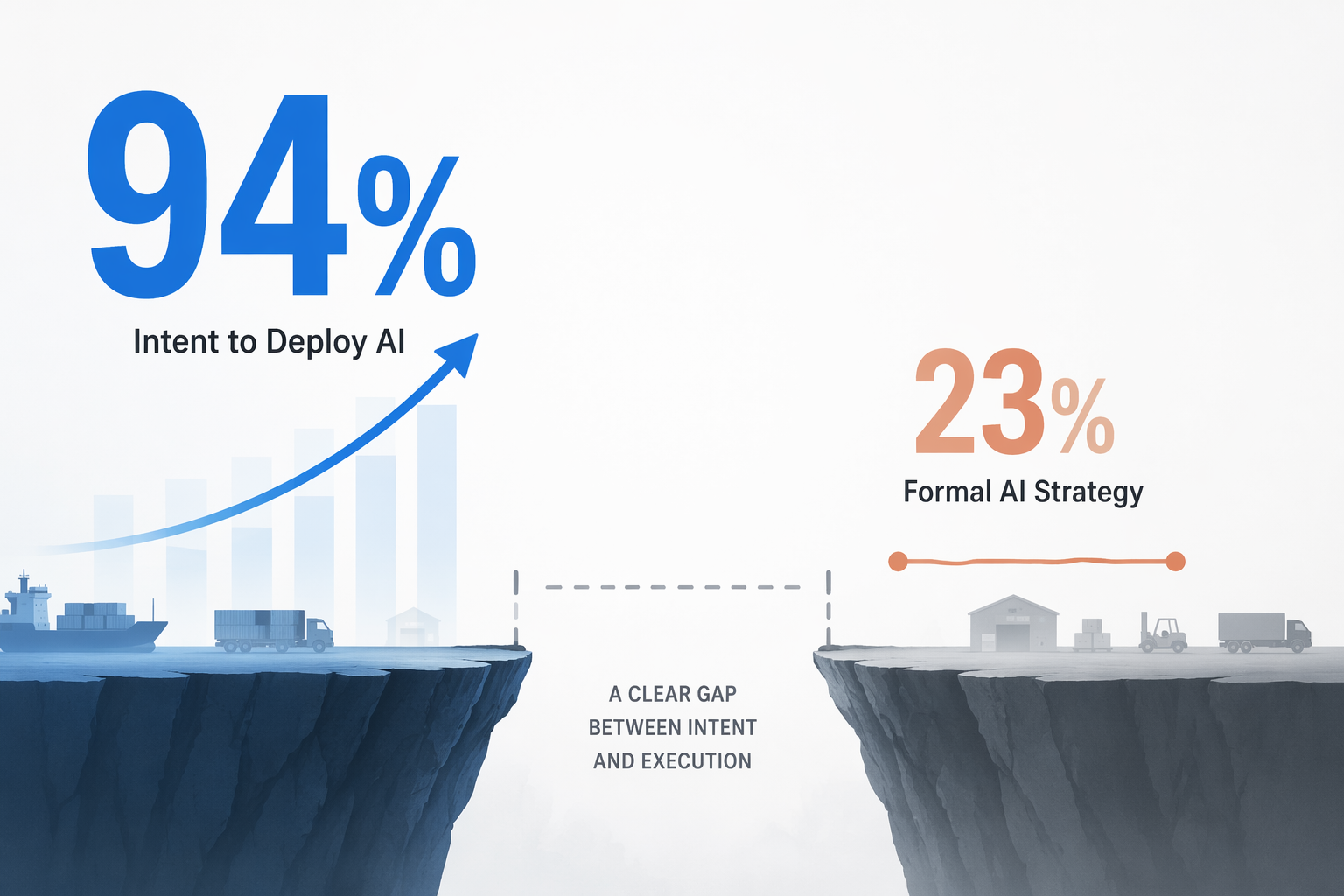
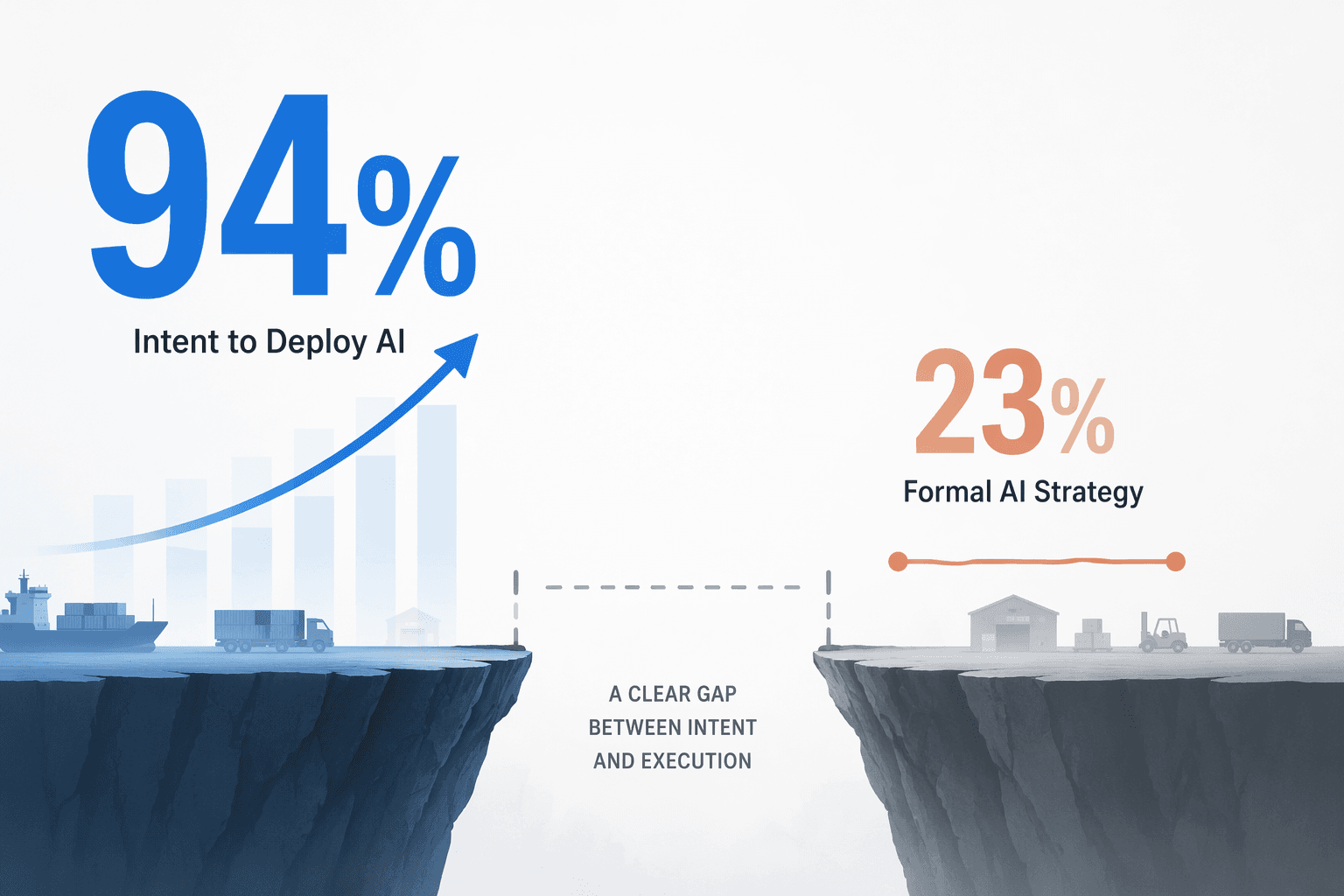
The uncomfortable number in artificial intelligence in logistics and supply chain management is not adoption intent. It is the gap between intent and operating readiness: 94% of supply chain companies plan to deploy AI for decision support within two years, while only 23% of supply chain leaders report having a formal AI strategy in place.[1][2]
That mismatch explains why so many AI programs feel busy without becoming durable. The demo works. The pilot gets funded. A vendor can show demand sensing, transport optimization, inventory recommendations, exception management, or warehouse labor planning in a controlled environment. Then the work slows down in the places that were never glamorous enough for the steering deck: master data, ERP and TMS integration, planner adoption, governance rights, baseline metrics, and ownership after the implementation team leaves.
The risk in 2026 is not that supply chain organizations will ignore AI. Most will not. The risk is that they will keep deploying it before deciding what kind of operating model AI is supposed to support. That is how pilots stall, ROI becomes negotiable after the fact, and competitors with less noise but clearer sequencing move faster.
Pilot activity is not the same as strategy maturity
The 94% adoption-intent figure matters because it removes the old excuse. Supply chain AI is no longer a question of whether leaders have heard enough about machine learning, generative AI, or decision intelligence. The market has largely accepted that AI will influence planning, logistics, procurement, warehousing, and customer fulfillment decisions.
The 23% formal-strategy figure matters more. It says many organizations are entering AI deployment with unclear rules about which decisions AI may influence, what data it is allowed to use, what systems it must connect to, and how value will be measured. In supply chain, those omissions are not administrative details. They are the work.
This is visible in logistics. A BCG and Alpega survey of more than 180 logistics leaders, conducted in January 2026 across logistics service providers and shippers primarily in Europe, North America, and Asia-Pacific, found that only 13% of logistics service providers reported measurable financial impact from AI, while most remained in exploration or pilot mode.[3] The regional scope should keep the finding from being stretched into a universal global claim. It is still a useful warning: AI activity can spread widely before financial impact is measurable.
The difference between those two states is rarely the model alone. A routing model can recommend a better plan, but if dispatchers do not trust it, if carrier commitments sit in a disconnected TMS, if customer service overrides are unmanaged, or if the baseline cost-to-serve was never agreed, the organization will struggle to prove what changed. That is not an algorithm problem. It is an operating-design problem.
What the absence of strategy actually breaks
A weak AI strategy usually does not announce itself as weak strategy. It arrives as a plausible sequence of decisions.
- A use case is chosen because it is visible, vendor-ready, or easy to explain to executives.
- The pilot team discovers that the required data sits across planning spreadsheets, ERP fields, TMS records, WMS events, procurement files, and local workarounds.
- Integration becomes more expensive and slower than the pilot charter assumed.
- Frontline users receive recommendations without a clear role in accepting, rejecting, or improving them.
- Governance questions appear late: who can override the model, who audits the output, who owns errors, and who decides when autonomy should increase?
- ROI is debated because the team did not define a baseline, decision metric, adoption metric, and financial metric before the pilot began.
That chain is familiar because supply chain technology often fails at the handoff from implementation theater to operating routine. PwC’s 2026 Digital Trends in Operations Survey, based on 767 operations leaders, found that 89% said their technology investments had not fully delivered expected results; integration complexity was the top cited reason.[4]

Integration complexity is easy to underestimate because AI use cases are usually presented at the decision layer. The recommendation appears simple: expedite this order, shift this inventory, adjust this forecast, consolidate this route, rebalance this labor plan. Underneath that recommendation, the system needs clean item, location, order, supplier, carrier, inventory, lead-time, cost, capacity, and service data. It also needs to send the decision somewhere useful. A recommendation that lives outside the planning, execution, or workflow system becomes another dashboard someone has to remember to check.
This is where vague pilot language becomes expensive. “Improve planning accuracy” is not enough. Which planning decision is changing? Demand forecast adjustment, safety stock calculation, allocation, production sequencing, replenishment timing, expedite approval, or supplier-risk escalation? Which system is the system of record? Which system triggers the workflow? Which human role remains accountable? A formal strategy forces those questions before the pilot becomes a political success and an operational burden.
PwC’s small leader cohort shows how rare full alignment is. Only 4% of surveyed organizations reported success across four dimensions at once: AI fully embedded, no scaling barriers, a horizontal structure, and technology investments delivering expected results.[4] The point is not that every company should copy an abstract “leader” profile. The point is that embedding, scalability, organizational structure, and investment return are linked. Treat one as optional, and the others suffer.
A useful AI strategy starts with decisions, not tools
A supply chain AI strategy should not start as a catalog of vendor features. It should start with the decisions the organization wants to improve and the operating constraints around those decisions. Gartner’s CSCO roadmap frames the work around data readiness, talent, governance, and use-case prioritization.[2] Those are often listed as separate workstreams. In practice, they have to be designed together.
| Strategy decision | What it should settle | Why it matters in supply chain AI |
|---|---|---|
| Use-case prioritization | Which decisions AI will influence first, and why | Prevents visible but low-leverage pilots from consuming scarce data, integration, and change capacity |
| Data readiness | Which data sources are trusted, owned, governed, and available for model use | Determines whether AI can move beyond a controlled pilot into repeatable operations |
| Technology capability mapping | Which AI capabilities need to connect with ERP, TMS, WMS, planning, procurement, and workflow systems | Turns an AI concept into an executable architecture |
| Talent and workforce design | Which roles need new skills, which decisions remain human-owned, and how users will learn to work with recommendations | Protects adoption from becoming a training afterthought |
| Governance | Who approves, monitors, overrides, audits, and scales AI-supported decisions | Creates trust boundaries before autonomy increases |
| Value measurement | Which baseline, operational metric, adoption metric, and financial metric will be used | Reduces post-pilot arguments about whether the program worked |
This is also why an enterprise AI strategy is not enough by itself. Supply chain has function-level realities that corporate AI governance will not automatically resolve. A network-planning use case, a warehouse slotting use case, and a procurement risk use case may share broad governance principles, but they differ in data latency, system dependencies, operational cadence, and tolerance for automation. The same strategy gap shows up sharply in warehousing, where facility-level execution and labor planning require translation from enterprise ambition into local operating design; that issue is covered more specifically in the warehousing AI strategy gap analysis.
Use-case sequencing has to account for integration drag
The easiest AI use case to demo is not always the right first use case to scale. A strategy should rank opportunities by more than expected value. It should also consider data availability, integration burden, process stability, user readiness, governance risk, and the organization’s ability to measure impact.
A hypothetical example makes the trade-off plain. A company may want AI-driven dynamic transport optimization because the savings story is compelling. But if carrier rate data, appointment schedules, order priorities, warehouse cutoffs, and customer delivery constraints live in disconnected systems, a narrower exception-prioritization use case may be a better starting point. It can still improve decisions, while exposing the data and workflow gaps that must be fixed before broader optimization is credible.
That is not a recommendation to aim small forever. It is a recommendation to sequence honestly. The best first use case is often the one that creates reusable data, integration, governance, and adoption assets for the next use case. If every pilot requires a custom data pull, a one-off workflow, and a special exception from IT, the portfolio is not scaling. It is accumulating demonstrations.
Data readiness is an ownership problem before it is a model problem
Data readiness is often reduced to data quality, but the harder question is ownership. Who owns supplier lead-time data when procurement negotiates it, planning depends on it, and operations experiences the consequences when it is wrong? Who owns carrier performance data when logistics records the event, finance sees the invoice, and customer service absorbs the complaint? Who has authority to standardize item, location, and order attributes across business units?
AI intensifies these old disputes because it turns quiet data compromises into visible recommendations. If the model recommends moving inventory based on stale lead times, the planner will blame the model. If the model predicts a late shipment from incomplete milestone data, transportation may blame the feed. If nobody owns the upstream defect, the AI team becomes the complaint desk for problems the organization never governed.
A formal strategy should therefore name the data domains required for each priority use case, the owners of those domains, the minimum quality thresholds for deployment, and the remediation path when data is not ready. This is where the PwC integration finding becomes practical: integration complexity is not just an IT obstacle; it is a sign that operating ownership has not caught up with AI ambition.[4]
Capability mapping keeps AI from floating above the systems that run the business
Supply chain leaders do not need to become model engineers, but they do need a clear map of which AI and machine learning capabilities belong where. Forecasting, optimization, anomaly detection, natural-language interfaces, simulation, and autonomous agents do different jobs. They also require different integration patterns and controls.
That mapping should connect capabilities to existing operational architecture: ERP for master and transactional records, TMS for transportation execution, WMS for facility execution, advanced planning systems for planning logic, procurement platforms for supplier workflows, and analytics layers for performance management. A deeper reference on this architecture question is available in the AI/ML technologies supply chain capability reference.
The practical test is simple: if a proposed AI capability cannot be mapped to the decision it improves, the data it requires, the system it reads from, the system or workflow it writes to, and the human role accountable for the outcome, it is not ready to scale.
Talent planning should assume reskilling, not just automation
The workforce question is often framed too narrowly as headcount reduction. The research base supports a more cautious reading. In the BCG logistics survey, about half of logistics service providers anticipated workforce reskilling, while less than 30% expected headcount reductions. A related Gartner-attributed February 2026 figure appears through a secondary source, so it should be verified against the original Gartner publication before being used as a standalone benchmark.[3][1]
For supply chain operations, reskilling is not a soft add-on. AI changes the work of planners, buyers, dispatchers, inventory analysts, warehouse supervisors, and customer-facing teams. Some roles will need to interpret probabilistic recommendations. Some will need to manage exceptions rather than generate routine plans. Some will need to understand when a model is outside its reliable operating range. Supervisors will need to coach teams through a new rhythm: when to accept, challenge, override, or escalate an AI recommendation.
A strategy that treats users as recipients of AI output will struggle. A better strategy defines the future decision routine. It states which tasks will be automated, which will be augmented, which will remain human-led, and how feedback from users will improve the model or the process. That design work belongs before scale-up, not after go-live frustration.
Governance is where trust becomes operational
AI governance in supply chain should not be limited to model approval. It has to define authority in the daily flow of work. Who can approve an AI-generated supplier substitution? Who can override a transportation recommendation that protects cost but risks service? When does an inventory recommendation require planner review? What exception history is retained? Who investigates systematic bias in recommendations across suppliers, carriers, customers, or locations?
Trust is not built by asking people to believe the model. It is built by setting the right level of autonomy for the decision, showing the evidence behind recommendations where users need it, and creating a visible path for override and review. The distinction between confidence and autonomy is developed further in the Confidence–Autonomy Gap article.
This matters because supply chain decisions carry operational consequences quickly. A bad forecast may distort replenishment. A poor routing recommendation may miss delivery windows. A procurement-risk signal may trigger unnecessary supplier escalation. Governance does not remove those risks, but it makes clear who reviews them, who bears the consequence, and how the system learns.
Value has to be measured before the pilot starts
Unclear ROI is usually designed into the pilot at the beginning. If the team does not agree on the baseline, the comparison period, the decision metric, the adoption metric, and the financial translation, the post-pilot review becomes a negotiation.
For a demand-planning use case, forecast accuracy alone may not prove value if service levels, inventory, expedite costs, and planner workload move in different directions. For transportation optimization, cost per shipment may improve while customer-service exceptions rise. For warehouse labor planning, productivity may improve in one shift while overtime or cross-training constraints worsen elsewhere. A useful strategy names the trade-offs before the pilot, not after the sponsor asks for the result.
Accenture’s analysis of 1,148 companies, cited through Open Sky Group, found that companies with AI-mature supply chains were 23% more profitable and six times more likely to use AI or generative AI widely.[1] That is a business-case signal, not a guarantee that any individual AI pilot will produce a specific return. The stronger lesson is that maturity and broad usage appear together. Organizations that want the profitability side of the story need to build the management system that lets AI move from isolated use case to operating capability.
For leaders building an investment portfolio, the question is not only which use case has the highest modeled value. It is how to balance near-term operational improvements, growth-enabling capabilities, and more transformative bets. The Run-Grow-Transform AI portfolio framework is the better place for that deeper investment-planning view.
The executive test: can the organization answer these before funding scale?
A formal AI strategy does not need to be a long document. It does need to answer questions that determine whether supply chain AI will become part of the operating model or remain a sequence of pilots.
- Which specific supply chain decisions will AI influence in the next planning horizon?
- Why are those decisions sequenced first: value, feasibility, urgency, reusable capability, or competitive pressure?
- Which data domains are required, who owns them, and what readiness threshold must be met?
- Which systems must the AI capability read from and write to?
- Which roles will use, review, override, or be affected by the output?
- What level of autonomy is allowed at pilot, controlled rollout, and scale?
- Which governance body owns model performance, process performance, risk review, and escalation?
- What baseline will be used to measure operational and financial impact?
- Who owns the capability after the vendor, consultant, or central AI team steps back?
If those questions cannot be answered, the organization may still run a pilot. It should just be honest about what the pilot is testing. It may be testing vendor fit, data availability, user acceptance, or executive appetite. It is not yet testing whether AI can scale as a supply chain capability.
Adoption intent is now table stakes. Strategy maturity is the differentiator. A formal strategy will not guarantee returns, but without one, supply chain organizations are likely to keep mistaking AI activity for progress.
References
- Supply Chain AI Statistics, Open Sky Group, https://openskygroup.com/supply-chain-ai-statistics/
- Supply Chain AI Roadmap, Gartner, https://www.gartner.com/en/articles/supply-chain-ai-roadmap
- AI Is Already Moving the Logistics Industry Forward, BCG, 2026, https://www.bcg.com/publications/2026/ai-is-already-moving-the-logistics-industry-forward
- Digital Trends in Operations Survey, PwC, 2026, https://www.pwc.com/us/en/services/consulting/supply-chain-operations/library/digital-trends-operations-survey.html
Comments
Join the discussion with an anonymous comment.