

The useful question about AI in logistics and supply chain in 2026 is not whether the software can generate a clean recommendation in a demo. It is whether the organization is willing to let that recommendation change a purchase order, rebalance inventory, explain a service failure, or resolve a disruption before a planner, buyer, or transport lead has reviewed it.
That is where the numbers become uncomfortable. In RELEX’s 2026 State of the Supply Chain research, based on a sample of 500 organizations, only 10% said they trust AI to make critical supply chain decisions without human review, while 54% still prefer keeping humans in the loop. At the same time, 67% of leaders said they are more confident in AI than they were a year earlier.[1]
That is not an anti-AI finding. It is the operating reality. Confidence is rising, but permission to act remains constrained. Anyone evaluating agentic AI should treat that gap as the starting point, because it explains why the best current deployments look less like full autonomy and more like tightly bounded decision support with faster diagnosis, better recommendations, and clear escalation paths.

Forecasts point toward autonomy; production evidence still points toward boundaries
Gartner’s direction of travel is clear: it forecasts that 15% of daily logistics decisions will be made autonomously by AI agents by 2028, and that 60% of supply chain disruptions will be resolved without human intervention by 2031.[2] Those are serious forecasts, not throwaway hype lines. They show where the market wants to go.
They are still forecasts. They do not prove that most teams are ready to hand over disruption management, procurement exceptions, allocation choices, or customer-impacting decisions today. Gartner’s separate warning that more than 40% of current agentic AI projects are expected to be scrapped by 2027 because of cost, integration drag, and unclear business value should keep the conversation grounded.[2]
The practical dividing line is not “AI versus no AI.” It is the boundary around the decision. A system that detects a recurring delivery failure, ranks likely causes, and drafts an action for review is operating in a different risk class from a system that changes supplier commitments or customer promises without review. The first can remove hours from an exception queue. The second can create a new exception queue that nobody trusts.
Where agentic AI is actually earning its keep
The strongest current evidence clusters around three bounded use cases: purchase optimization, always-on integrated business planning, and autonomous root cause analysis. They share an important trait. The AI is not being asked to own the whole supply chain. It is being asked to reduce the search space, keep plans updated, or explain why something broke.
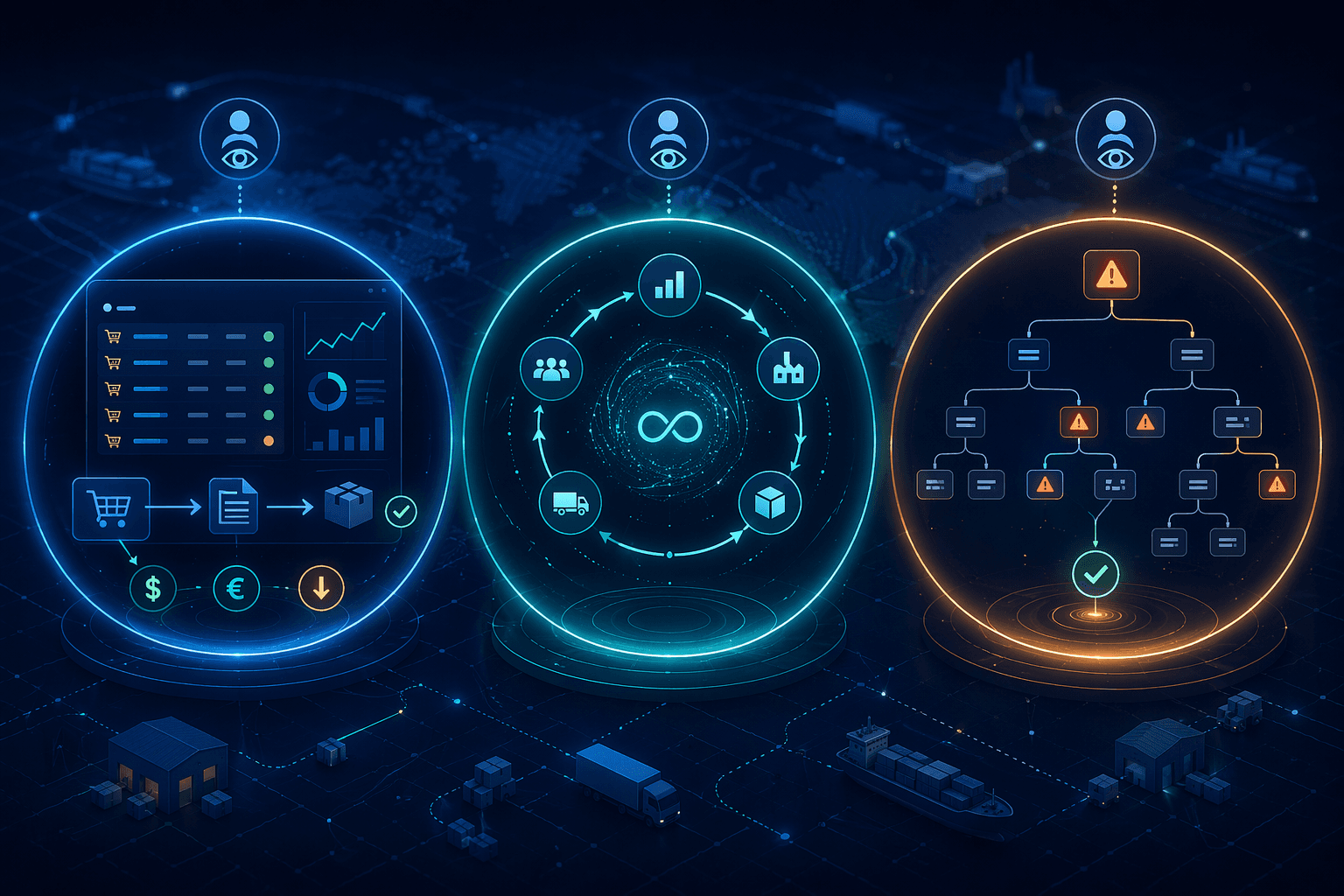
| Use case | What the AI can reasonably automate | What should stay human-reviewed |
|---|---|---|
| Purchase optimization | Analyze demand signals, inventory positions, supplier constraints, and order recommendations | Final approval for material commitments, supplier changes, and high-impact exceptions |
| Always-on integrated business planning | Continuously refresh planning signals and surface conflicts across functions | Trade-off decisions involving service, margin, capacity, and customer commitments |
| Autonomous root cause analysis | Detect anomalies, connect symptoms to likely causes, and suggest corrective actions | Accountability for remediation, customer communication, and policy changes |
Purchase optimization: useful when the system narrows the decision, not when it hides it
Purchase optimization is one of the more plausible homes for agentic AI because the work already contains a high volume of repeatable judgment calls. Buyers are constantly weighing projected demand, shelf or warehouse inventory, supplier lead times, minimum order quantities, service risk, and cash tied up in stock. A well-designed agent can monitor those inputs and propose order changes faster than a human team can manually review every SKU-location combination.
The trap is pretending that the recommendation is the same as the decision. A proposed order increase may be mathematically sensible and still wrong if a supplier is under commercial review, a promotion was entered incorrectly, or finance has imposed a working-capital constraint that is not visible in the planning model. Purchase optimization works best when the agent handles the tedious comparison work and routes exceptions with enough explanation for a buyer to approve, override, or investigate.
That explanation layer matters. If the agent says only “increase order quantity,” the planner has to recreate the reasoning. If it says demand rose, current inventory will breach the service threshold, the supplier lead time is unchanged, and the recommendation remains inside agreed buying rules, the human review becomes faster without becoming ceremonial.
Always-on integrated business planning: less meeting theater, more live conflict detection
Integrated business planning has always struggled with timing. Demand, supply, finance, sales, procurement, and operations rarely discover problems at the same moment. By the time a monthly or weekly planning cycle reaches alignment, the assumptions that fed it may already be stale.
Agentic AI is useful here when it runs in the background and watches for conflicts that should not wait for the next planning meeting: a demand change that consumes constrained capacity, a supplier delay that threatens a promotion, or an inventory imbalance that shifts service risk from one channel to another. The value is not a prettier dashboard. It is earlier escalation to the people who can make the trade-off.
ICRON cites a McKinsey survey in which 78% of executives reported improved cross-functional collaboration after adopting intelligent automation.[3] That does not prove that agentic AI alone caused the improvement, and “intelligent automation” is broader than agentic planning. It does, however, support the narrower point that automation can improve coordination when it makes exceptions visible across functions instead of trapping them inside departmental workflows.
The human role does not disappear in this model. It becomes more explicit. The agent can identify the collision; humans still decide whether service, cost, margin, or customer priority wins. That is not a weakness in the design. It is how planning decisions stay accountable.
Autonomous root cause analysis: the strongest current case
Root cause analysis is where agentic AI looks most convincing today because the task is bounded and painful. Something has gone wrong: late deliveries, lost sales, forecast misses, inventory gaps, allocation failures. The team needs to know why, and the answer usually lives across several systems and handoffs.
The RELEX-published KICKS case study is the most concrete evidence in the available material. RELEX reports that KICKS reduced lost sales by 34% and brought late deliveries down from 5.2% to 3.4% after applying its AI capabilities.[1] Because this is a vendor-published success story, it should be read with the usual selection bias in mind. Vendors publish the cases that worked. They rarely publish the integrations that stalled or the pilots that could not show value.
Even with that caveat, the case is useful because the claimed improvement fits the shape of a credible deployment. The AI did not need to become the chief supply chain officer. It needed to detect patterns, identify likely drivers of lost sales and delivery misses, and help teams act sooner. That is the sort of automation that can survive contact with operations because it is tied to a visible failure mode and a measurable outcome.
Root cause analysis also has a natural review point. If an agent identifies that a delivery issue is tied to a specific supplier pattern, warehouse process, or replenishment setting, a human can test the explanation before changing policy. The output is diagnostic, not blindly executive. That distinction matters when the recommendation could affect stock allocation, supplier conversations, or customer service commitments.
What separates a serious deployment from a dressed-up demo
A serious agentic AI deployment has an exception design before it has a launch announcement. It defines what the agent can do, when it must ask for approval, which signals it is allowed to use, who reviews the recommendation, and how overrides are captured. Without that scaffolding, “agentic” becomes a vague label attached to workflow automation, analytics, or a chatbot that can call APIs.
For teams moving from evaluation to implementation, the useful frame is graduated autonomy: start with recommendations, move to constrained execution only where trust and evidence justify it, and preserve human review for decisions with material customer, financial, or operational consequences. ChainSignal’s practitioner guide to graduated autonomy in agentic AI supply chain deployment goes deeper into that operating model.
The readiness checklist does not need to be exotic. ICRON’s 2026 playbook organizes it around five dimensions: technology, data, talent, governance, and culture.[3] Those categories are broad, but they are the right ones to pressure-test before anyone gives an agent more authority.

- Technology: Can the agent read from and write to the systems that actually run planning, ordering, inventory, and logistics execution, or is it stranded in a presentation layer?
- Data: Are master data, demand signals, supplier constraints, and exception codes reliable enough that the agent will not spend its time optimizing noise?
- Talent: Do planners, buyers, analysts, and operations leads know how to challenge the recommendation instead of either accepting it blindly or ignoring it by habit?
- Governance: Are approval thresholds, audit trails, override rules, and accountability clear before the first automated action is allowed?
- Culture: Will teams report bad recommendations and edge cases honestly, or will they work around the tool until the pilot quietly loses credibility?
This is where many projects become less glamorous and more real. Integration costs arrive. Data exceptions multiply. A business owner asks which metric will improve and by when. A planner asks whether the agent understands the promotion calendar. Finance asks who approved the inventory increase. These are not blockers to be waved away; they are the conditions under which trust is either built or lost.
Augmentation is the operating model for 2026
There is a lazy version of the AI debate that treats human-in-the-loop design as a failure of ambition. In supply chain, that view is detached from how consequences show up. A wrong answer can become excess stock, missed sales, angry customers, premium freight, supplier tension, or an awkward call with finance. The person absorbing the consequence is rarely the person who approved the roadmap slide.
The credible use cases in 2026 are narrower and more useful than the hype suggests. Let agents optimize purchase recommendations inside defined guardrails. Let them keep planning conflicts visible between formal cycles. Let them diagnose recurring failures faster than a team can assemble the evidence manually. Then measure whether lost sales, late deliveries, planning latency, exception workload, or collaboration actually improves.
Full autonomy may become more common as systems mature and organizational trust catches up. It is not the baseline most supply chain teams should assume today. The current evidence supports bounded autonomy with human review: enough agency to remove repetitive and diagnostic work, enough governance to keep critical decisions accountable, and enough humility to stop before the system starts making promises the organization is not ready to keep.
References
- State of the Supply Chain 2026, RELEX Solutions.
- Supply Chain AI Roadmap, Gartner.
- How Agentic AI is Shaping Supply Chain Planning in 2026, ICRON.
Comments
Join the discussion with an anonymous comment.