

In 2026, AI supply chain management has reached the awkward middle: too real to dismiss, too loosely defined to buy on faith. BCG reports that 44% of companies are deploying AI in supply chain management, while Deloitte says more than half of surveyed supply chain executives are deploying AI agents to automate workflows.[1][2] Those two numbers do not quite line up, and they do not need to. They likely reflect different survey populations and different definitions of what counts as an “agent.” The useful signal is narrower: deployment is happening, budgets are moving, but much of what is being called agentic still behaves like a governed copilot.
That distinction matters because “agentic AI” now covers a wide span of products. In one sales deck, it means a recommendation engine that drafts a supply plan and waits for approval. In another, it means a workflow that can identify a stock risk, evaluate supplier options, adjust an order proposal, route the exception, and record the decision logic. Both may be useful. Only one is beginning to change the operating loop.

RELEX’s 2026 survey captures the practical brake on the story: 54% of supply chain leaders prefer a hybrid human-in-the-loop model where AI recommends and humans decide, while only 10% are comfortable with fully autonomous decisions.[3] That is not proof that autonomy will remain marginal. It is proof that, right now, most buyers still want the system close enough to the decision to be useful and far enough from the final action to be governable.
The better question is not whether agentic AI is hype. It is where the decision domain is bounded enough, the data is usable enough, and the workflow is explicit enough for an agent to do more than decorate an existing planning process.
Where agentic AI is actually useful now
The strongest current cases are not the dramatic ones. They are not end-to-end autonomous supply chains running without planners, buyers, logistics teams, or finance signoff. The most credible 2026 use cases sit inside decision loops that companies already understand: purchase optimization, always-on integrated business planning, and disruption root cause analysis.
| Domain | 2026 maturity | What the agent changes | What still needs human control |
|---|---|---|---|
| Purchase optimization | Most concrete | Evaluates replenishment, purchasing, and order trade-offs inside defined constraints | Commercial policy, supplier exceptions, overrides, and accountability |
| Always-on IBP | Useful when workflows change | Keeps planning signals moving between formal cycles | Scenario ownership, executive trade-offs, and financial commitment |
| Disruption root cause analysis | Promising but more pilot-heavy | Connects symptoms to likely causes faster across logistics and planning data | Causal validation, response approval, and cross-functional escalation |
Purchase optimization has the cleanest path to bounded autonomy
Purchase optimization is the least glamorous of the three, which is one reason it is more believable. The decision is frequent, bounded, measurable, and already rule-heavy. A system can compare demand signals, inventory position, supplier constraints, order quantities, service goals, and purchasing policies without pretending to understand the whole enterprise.
RELEX identifies purchase optimization as a domain where agentic AI is already delivering value.[3] The important word is not “autonomous”; it is “optimization.” In a credible deployment, the agent is not simply telling a buyer that an item may stock out. It is working through the next action: whether to buy now, defer, consolidate, change quantity, surface a supplier constraint, or ask for approval because the recommendation crosses a policy boundary.
That is where agentic behavior starts to matter. A dashboard exposes a variance. A copilot explains the variance. A bounded agent proposes the purchasing move, checks it against constraints, and routes only the exceptions that need judgment. The planner or buyer still owns the override, but the queue they review is no longer every possible issue. It is the smaller set of decisions the system cannot responsibly close.
This is also why autonomous reorder point optimization is a sensible on-ramp for many companies. It gives the organization a narrow place to test whether data quality, approval thresholds, exception handling, and audit trails are strong enough before expanding the scope. Readers who want the implementation mechanics can go deeper in Autonomous Reorder Point Optimization.
Always-on IBP only works if the meeting cycle stops being the system
Always-on IBP is attractive because every planning leader knows the lag built into the traditional cadence. Demand changes on Monday, supply constraints become visible on Tuesday, finance wants an answer by Wednesday, and the formal review cycle is still waiting for the next meeting pack. An agentic workflow can help if it keeps those signals moving between meetings rather than simply generating better slides for the same meeting.
BCG’s claim is ambitious but conditional: agentic AI can reduce working capital by up to 30% and lift EBITDA by 2 to 4 percentage points, but only when workflows are redesigned end to end.[1] That condition is the part worth underlining. The gains are not attached to adding a conversational layer to a brittle monthly planning process. They depend on changing how decisions move across demand, supply, procurement, inventory, logistics, and finance.
In practice, an always-on IBP agent is useful when it can watch for a material planning signal, understand which scenario is affected, identify who must decide, and preserve the link between operational action and financial implication. If a supplier delay changes a production plan, the question is not only whether the supply planner saw the delay. It is whether the commercial team sees the service risk, procurement sees the alternative, finance sees the working-capital effect, and the decision record survives longer than a chat thread.
This is where many deployments are still less agentic than advertised. The tool may summarize demand changes beautifully, but if the operating model still waits for a weekly reconciliation meeting, the agent is trapped inside the old cadence. The technology can accelerate analysis; it cannot, by itself, decide who has authority to trade off service, cost, inventory, and margin.
Disruption root cause analysis is promising, but still easier to pilot than industrialize
Disruption response is where agentic AI sounds most impressive in a demo. A port delay appears, the agent traces affected purchase orders, flags customer commitments, evaluates alternate lanes, explains the root cause, and drafts a response plan. That is not fantasy. BCG identifies logistics coordination and disruption response as areas where early agentic deployments show particular promise, while noting that many remain in pilot.[1]
The pilot-heavy status is not a small caveat. Root cause analysis needs data from transportation, supplier performance, production, inventory, customer orders, and often external event feeds. It also needs to distinguish a symptom from a cause. A late shipment may be the visible problem; the root cause may sit in supplier capacity, customs clearance, carrier performance, incorrect master data, or an allocation decision made upstream.
An agent can shorten the diagnostic path by assembling the likely chain of events and showing which downstream commitments are exposed. That is valuable even before full autonomy. But the response still crosses organizational boundaries quickly. Expedite freight, change allocation, substitute materials, notify customers, or move production: each action has a cost owner, a service consequence, and a relationship risk. The agent can prepare the decision faster; it should not quietly absorb accountability that the organization has not assigned.
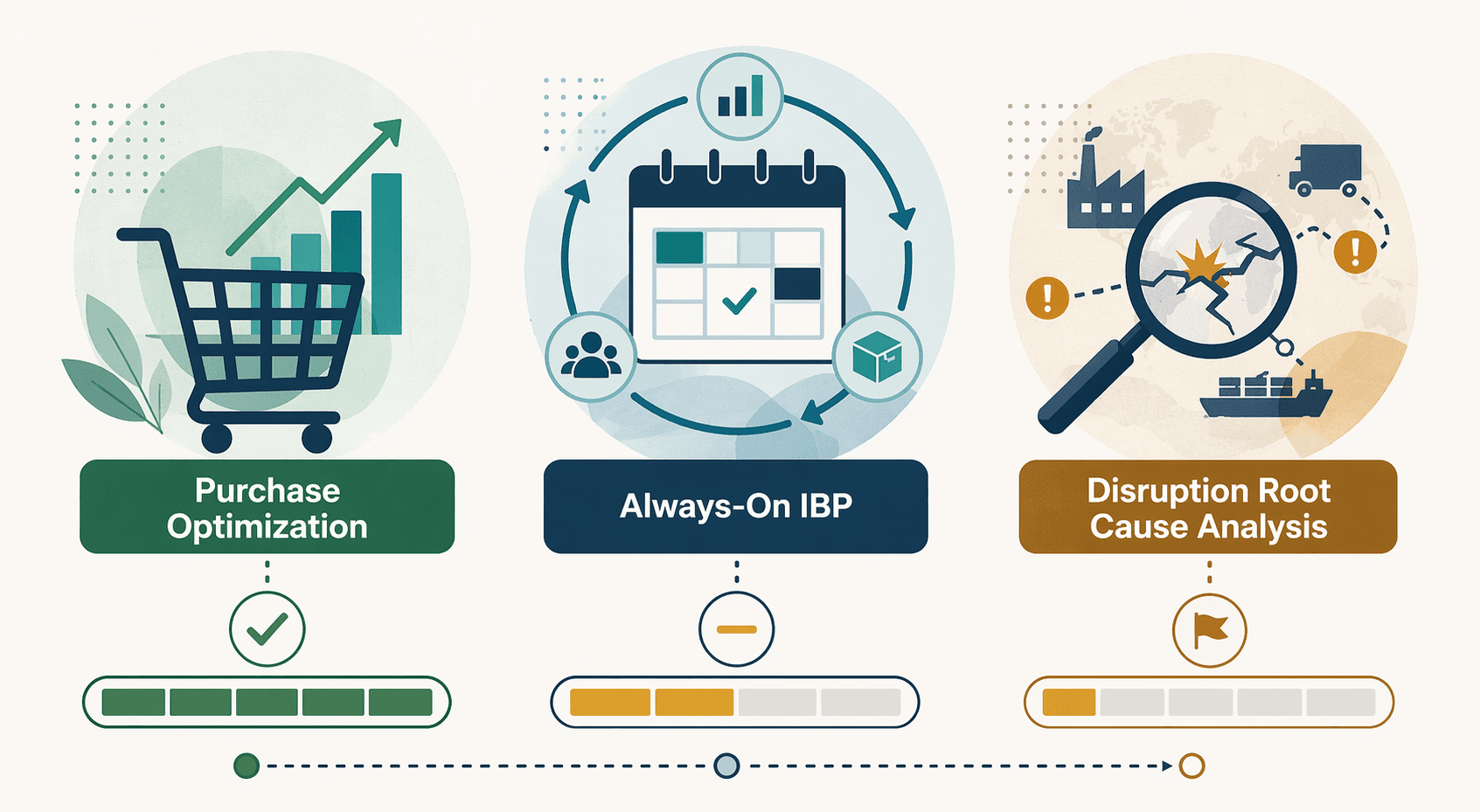
For a deeper treatment of these three deployment hotspots, see The Trust Paradox in Agentic AI. The pattern is consistent: the more bounded the decision and the clearer the escalation path, the more plausible agentic execution becomes.
The readiness gap: recommending is not the same as acting
The biggest mistake in 2026 evaluations is treating recommendation quality as proof of operational readiness. A system can produce a good answer in a pilot and still be unsafe to let loose in production. Acting requires more than model performance. It requires data architecture, permissions, workflow integration, governance, and a human escalation path that people actually use.
Deloitte identifies four foundations for agentic supply chains: data architecture built around data fabric and ontology, tech stack modernization through a hybrid legacy-to-cloud strategy, workforce upskilling, and security-by-design governance.[2] These are not background IT chores. They decide whether an agent can understand the same item, supplier, order, facility, and constraint consistently across systems.

A recommendation can tolerate ambiguity. An action cannot. If supplier lead times are maintained differently in ERP, planning, procurement, and transportation systems, an agent may still draft a plausible explanation. But approving a purchase order, changing an allocation, or triggering an expedite based on that ambiguity is a different standard of care.
The practical dividing line looks like this:
- Agentic enough to recommend: the system can gather context, explain options, draft scenarios, rank actions, and ask for approval.
- Agentic enough to act: the system can execute within defined limits, prove which data it used, respect policy constraints, create an audit trail, and escalate exceptions to named owners.
That second category is where many companies discover the work hidden behind the pilot. Someone has to define which products, suppliers, locations, spend thresholds, customer segments, and disruption types are inside the agent’s authority. Someone has to decide what happens when the agent conflicts with a planner, a supplier agreement, or a finance constraint. Someone has to monitor drift after the vendor team leaves.
The RELEX preference for human-in-the-loop decisioning is not merely a cultural hesitation; it is a rational response to incomplete operating conditions.[3] If governance is explicit, humans can supervise exceptions rather than rubber-stamp every recommendation. If governance is vague, human-in-the-loop becomes a phrase that means “the planner will be blamed later.”
The architecture question is just as decisive. Companies with cleaner data models, more modern platforms, and better integration between planning and execution can move faster than companies running agentic pilots over fragmented legacy workflows. That does not make the legacy environment hopeless, but it does make the autonomy claim more expensive. For the platform-level trade-offs, see AI-Native vs. Incumbent Supply Chain Platforms.
How to judge a 2026 pilot without being dazzled by the demo
A useful pilot should not start with the broad claim that agents will transform the supply chain. It should start with a decision loop that is currently slow, expensive, or exception-heavy. The test is whether the system reduces the number of handoffs, shortens the time to a defensible action, or improves the quality of the decision record.
For purchase optimization, that may mean fewer low-value replenishment reviews and better escalation of policy exceptions. For always-on IBP, it may mean that material plan changes no longer wait for a meeting before finance and commercial teams see the trade-off. For disruption root cause analysis, it may mean that planners receive a causal explanation and affected-order view fast enough to act before the disruption becomes a customer-service firefight.
The pilot design should answer four operating questions before anyone argues about autonomy level:
- What decision is the agent allowed to influence or execute?
- Which systems provide the required data, and which source wins when records conflict?
- What thresholds trigger human review, and who is the named owner?
- How will overrides, exceptions, recommendations, and executed actions be audited?
This is also where the Deloitte and BCG findings meet. Deloitte’s surveyed executives are already deploying agents, but Deloitte emphasizes the foundations required to make those agents resilient.[2] BCG reports meaningful AI deployment and large potential financial gains, but ties the upside to end-to-end workflow redesign rather than isolated tooling.[1] The evidence points in the same direction: agentic AI is not waiting for a distant future, but the production version is narrower and more conditional than the marketing version.
For teams ready to structure autonomy in stages, Agentic AI in Supply Chain: A Practitioner’s Guide to Graduated Autonomy in 2026 is the more practical companion. It is usually safer to move from recommendation, to constrained execution, to broader autonomy than to pretend the organization can jump directly from spreadsheet review to self-running workflows.
What is still hype
The hype is not that agents can act. They can, in the right conditions. The hype is the casual suggestion that full autonomy is simply a licensing decision. In most supply chains, autonomy runs straight into master data inconsistencies, brittle integrations, unclear process ownership, and unresolved accountability between planning, procurement, logistics, finance, and commercial teams.
Planner replacement is the weakest version of the story. The better version changes the planner’s work. Instead of manually collecting signals, reconciling records, and chasing approvals, planners review higher-quality exceptions, challenge recommendations, and own trade-offs the system is not authorized to make. That is still a major operating change, and it deserves more serious treatment than “freeing people up.”
Black-box autonomy is also a poor fit for most supply chain decisions. The organization needs to know why the agent recommended a supplier switch, changed an order quantity, prioritized one customer over another, or escalated a disruption. Without that record, the system may be efficient in the moment and indefensible afterward.
The more interesting dividing line is not large enterprise versus mid-market, or incumbent platform versus AI-native platform. It is operating readiness. A company with a modern stack, clean data relationships, and clear decision rights may find some agentic workflows production-ready. A company with fragmented data and unresolved ownership may get more value from copilots while it fixes the foundations. For a broader view of why confidence and autonomy are not moving at the same speed, see The Confidence–Autonomy Gap.
A usable stance for 2026
Pilot agentic AI where the decision is bounded, the data is connected, the workflow already has clear owners, and the governance model says exactly when the system can act. Purchase optimization is the strongest starting point for many organizations. Always-on IBP is worth pursuing when the company is willing to redesign how decisions move between planning cycles. Disruption root cause analysis is promising, especially for diagnosis and response preparation, but it still needs careful containment before execution authority expands.
Use copilots, not autonomous agents, where the system depends on fragmented data, informal approvals, or planner heroics to keep the process intact. Wait on autonomy where no one can say who owns a bad recommendation, who approves an override, or how the decision will be audited.
The companies that get value from agentic AI in supply chain management will not be the ones with the boldest autonomy language. They will be the ones that choose the right decision loop, narrow the authority boundary, fix enough of the architecture, and make accountability visible before the agent starts acting.
References
- How AI Agents Are Transforming Supply Chains, BCG, 2026.
- Resilient by Design: The Agentic Supply Chain, Deloitte, March 2026.
- Supply Chain AI in 2026: The Numbers Behind the Hype, RELEX Solutions.
Comments
Join the discussion with an anonymous comment.