Executive Summary: The State of AI in Procurement in 2026
The conversation around AI in procurement has shifted from "should we explore this?" to "where do we deploy first?" The data from the past 18 months makes the direction clear. According to research from AI at Wharton and The Hackett Group, 94% of procurement executives now use generative AI at least weekly — a jump of 44 percentage points between 2023 and 2024. The intent to scale is equally pronounced: 80% of CPOs plan to deploy generative AI over the next three years, per EY's 2025 Global CPO Survey.
Yet the gap between aspiration and production remains the defining challenge of this era. The Hackett Group's 2025 CPO Agenda Report found that 49% of procurement teams ran a generative AI pilot in 2024, but only 4% achieved large-scale deployment. That 45-point delta between pilot and production is not a failure of technology — it is a failure of prioritization, data readiness, and organizational change management.
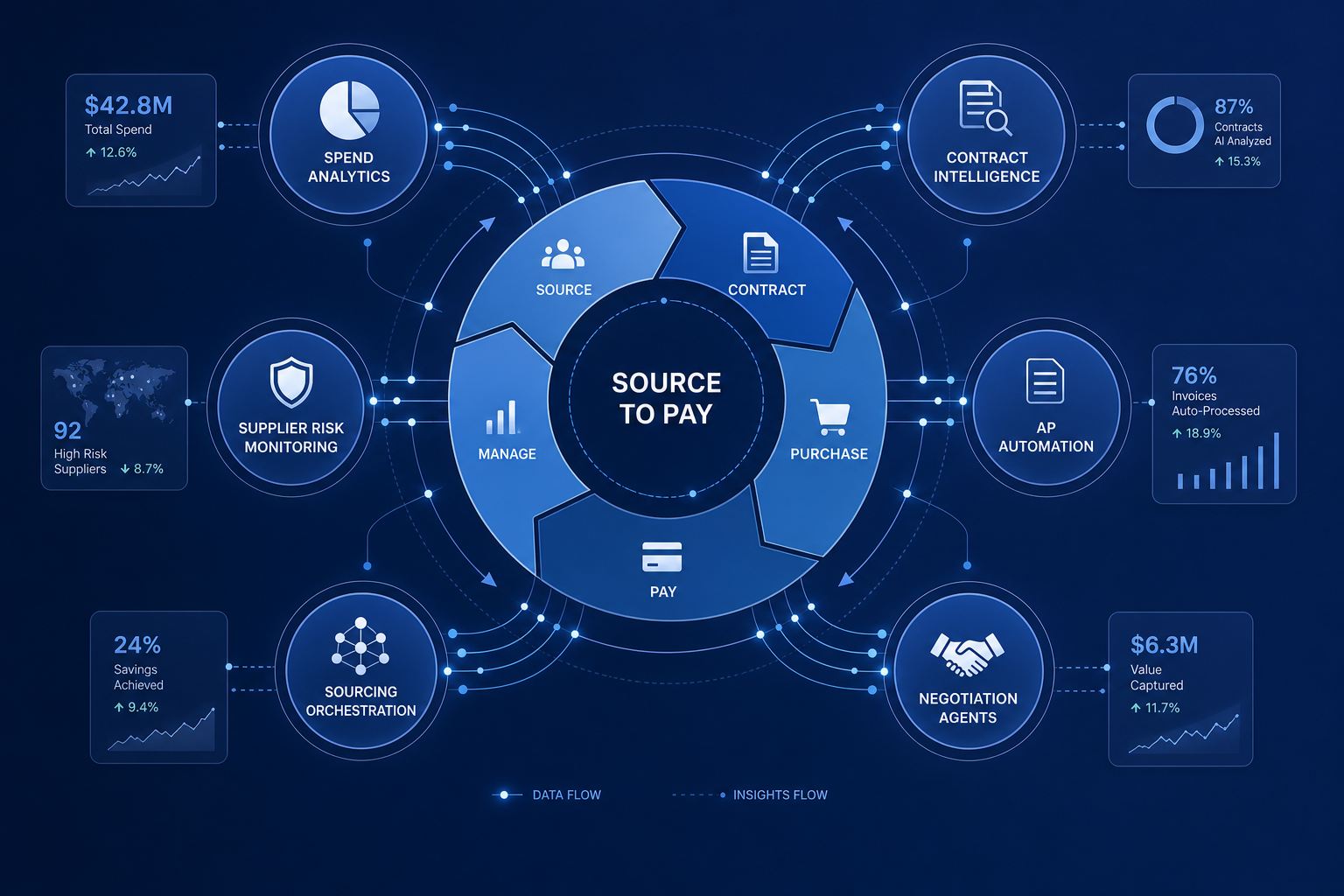
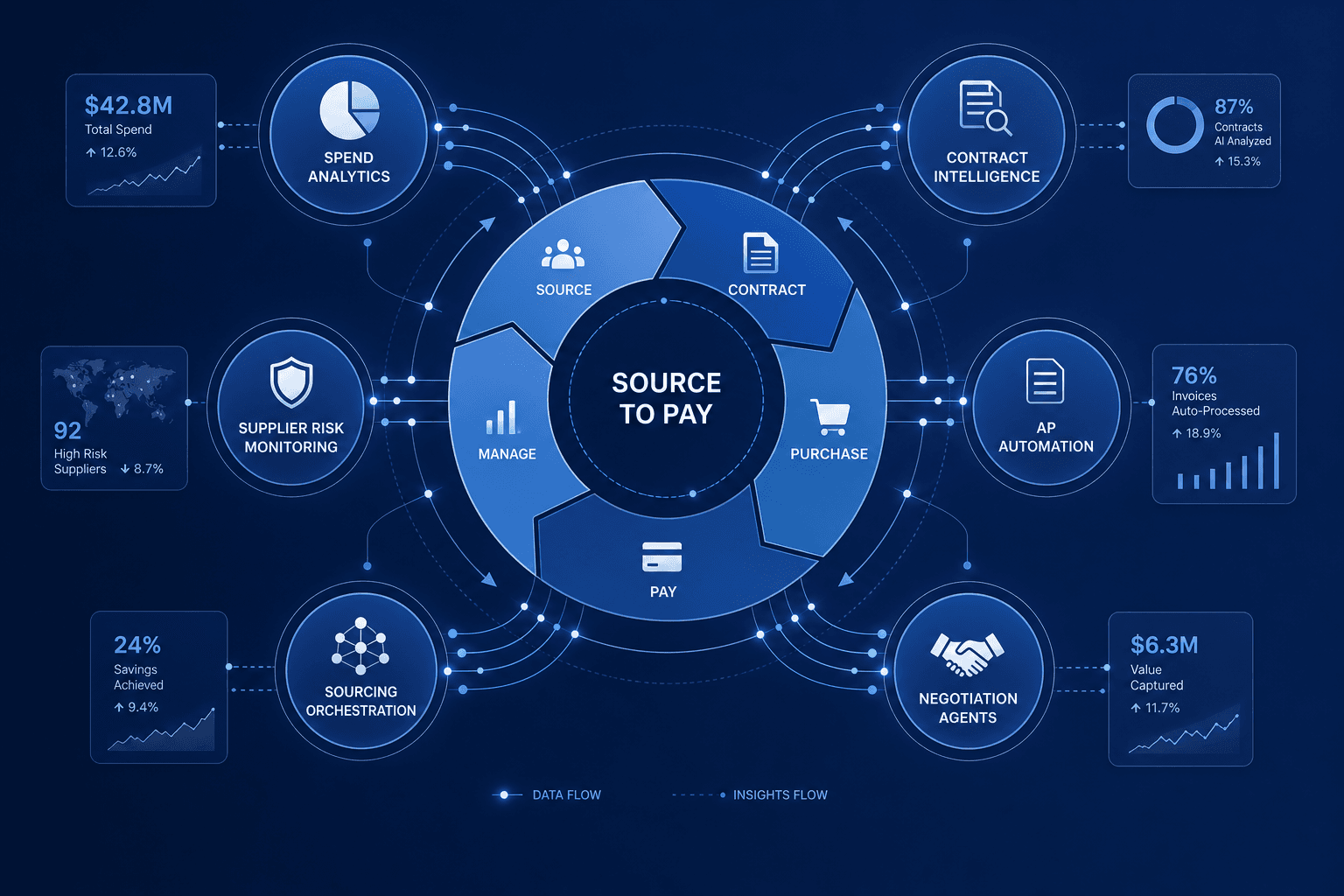
This catalog is designed to close that gap. It covers 10+ proven AI use cases across the full source-to-pay lifecycle, organized by procurement function. Each entry includes what the application does, where it delivers measurable value, real-world deployment examples with source-attributed ROI data, relevant vendors, and — critically — the implementation constraints that separate successful deployments from stalled pilots.
Use Case Catalog: 10+ AI Applications Across the Source-to-Pay Lifecycle
The following catalog covers the procurement functions where AI is delivering measurable outcomes today. Each use case is scoped to a specific operational problem, supported by source-attributed data, and accompanied by a candid assessment of implementation risk. The catalog is organized roughly in order of maturity — starting with applications that have the deepest production track record and moving toward those still in active experimentation.
1. Spend Analytics and Classification
Spend analytics is the most widely adopted AI use case in procurement, and for good reason: it addresses a universal pain point. Most organizations have fragmented spend data spread across multiple ERP systems, procurement platforms, and payment tools. AI-powered classification engines ingest this data, normalize it, and assign accurate category codes — turning a manual process that takes weeks into an automated pipeline that runs in hours.
Deloitte reports that AI-powered spend classification now achieves approximately 97% accuracy. The remaining ~20% of transactions typically require human review, following what the industry calls the 80/20 rule for procurement AI: the model handles the bulk of classification autonomously, while edge cases are flagged for human judgment.
A well-documented case is Pentair, which implemented AI spend classification through Sievo. The company achieved over 90% accuracy in classification and unlocked a $15 million working capital improvement — all within a two-month global rollout. For a deeper treatment of this specific application, see our dedicated article on AI Supplier Risk Scoring and Spend Analysis.
2. Strategic Sourcing and E-Sourcing
AI is transforming strategic sourcing by moving beyond simple e-auction platforms toward intelligent systems that simulate sourcing scenarios, evaluate trade-offs across cost, risk, and lead time, and recommend optimal award allocations. McKinsey documented a case where a Fortune 500 oil and gas company increased e-sourcing adoption by 20% and improved procurement ROI by 15% through an AI-powered sourcing system.
In the MRO category specifically, McKinsey found that one company achieved a 20% cost reduction using AI-enabled e-sourcing tools. The same research notes that a global industrials OEM realized $370 million in cost savings in year one through a combination of operating model changes and AI deployment — though it is important to note that this figure includes broader transformation beyond just sourcing technology.
3. Contract Management and Intelligence
Contract management is one of the highest-priority AI applications among procurement leaders. The Hackett Group's 2026 Key Issues Study found that 63% of procurement leaders are actively piloting or investigating generative AI for contract lifecycle management — the highest percentage of any use case surveyed. Gartner predicts that 50% of organizations will use AI-enabled contract negotiation tools by 2027.
Current AI capabilities in this domain include: automated clause extraction and risk flagging, obligation tracking against performance, mass communication tools for supplier contract amendments, and natural-language query interfaces that let procurement professionals ask questions about contract terms without reading every document. Ivalua's generative AI assistant, IVA, supports over 25 use cases across contract management and sourcing, and Ivalua customers reported an average Net Present Value of $25.5 million over three years in a Forrester Total Economic Impact study.
4. Supplier Risk Management
Supplier risk management has one of the highest production deployment rates among procurement AI use cases. ISG's 2025 research found that supplier risk assessment has a 58% production rate, with an average investment of $2.0 million per organization. This relatively high maturity reflects the clear regulatory and financial consequences of supplier failure — financial health deterioration, geopolitical exposure, ESG compliance gaps, and delivery performance degradation all have direct bottom-line impact.
AI systems in this space continuously monitor supplier data from internal and external sources — financial filings, news feeds, ESG ratings, and performance metrics — and generate risk scores that update in near real-time. Zycus and other platforms offer supplier risk management modules that evaluate suppliers across financial health, geopolitical exposure, ESG metrics, and delivery performance simultaneously.
5. Accounts Payable Automation
AP automation is where the ROI math is most straightforward. NeoChain's analysis shows that the cost per invoice processed drops from $12.88 in a manual environment to $2.78 with AI automation — a 78% reduction. Procurement cycle times compress from 30–45 days to 10–14 days, a 65–70% improvement. Spend under management typically rises from 40–55% to 75–90%, and contract compliance rates improve from 60–70% to 85–95%.
These improvements are not theoretical. Organizations implementing AI-powered procurement platforms consistently report 5X or greater returns within 18 months, according to NeoChain's industry benchmarks. The savings come from multiple sources: reduced manual processing labor, early payment discount capture, error reduction (manual error rates of 1–3% with average correction costs of $50–$500 per error), and maverick spend reduction (typically 15–25% of addressable spend without strong controls).
6. Invoice Anomaly Detection
Invoice fraud and payment errors represent a persistent leakage point in procurement operations. AI-based anomaly detection systems analyze invoice patterns against contract terms, historical payment data, and supplier profiles to flag discrepancies that would be invisible to manual review.
A global pharmaceutical company used AI-based invoice-to-contract reconciliation that identified more than $10 million in value leakage within four weeks, according to McKinsey. In another case documented by SpendFlo, a healthcare provider thwarted $150,000 of fraudulent payments within three months of deploying AI-based anomaly detection. These systems are particularly effective at detecting duplicate invoices, pricing discrepancies, and payments to unapproved suppliers.
7. Procurement Intake Orchestration
Procurement intake orchestration uses AI to triage, route, and partially fulfill purchase requests before they reach a human buyer. A mid-sized company cited in Supply Chain Management Review used an AI assistant to triage routine purchase requests, dropping cycle time by 40%. Raindrop Systems reports that AI intake orchestration saves 20–30% in processing costs by automating the classification and routing of incoming requests.
This use case is particularly valuable for organizations with high volumes of low-complexity purchases. The AI handles the 80% of requests that follow standard patterns — catalog items, pre-approved suppliers, fixed-price contracts — while escalating exceptions to procurement professionals who can focus on strategic negotiations.
8. Demand Forecasting for Procurement
AI-driven demand forecasting in procurement extends beyond the traditional demand planning function by incorporating external signals — commodity prices, supplier lead time variability, geopolitical events, and weather patterns — into purchase timing and quantity recommendations. Gartner projects that 70% of large-scale organizations will adopt AI-based forecasting by 2030.
A retail giant decreased overstock by 15% annually using AI forecasting, per SpendFlo's case documentation. Predictive analytics also helped one manufacturer identify potential supply disruptions and adjust sourcing plans before operations were affected, reducing the risk of downtime, as reported in Supply Chain Management Review. For a deeper treatment of this specific application, see our dedicated article on The Measurable ROI of AI in Demand Forecasting.
9. Supplier Negotiation and Communication
AI is beginning to handle direct supplier negotiations, particularly for tail-end spend where the cost of human negotiation exceeds the potential savings. Walmart deployed an AI-powered chatbot for supplier negotiations with tail-end suppliers, achieving mutually beneficial agreements, as documented by AIMultiple. Kärcher implemented an autonomous operations solution that achieved substantial discounts and time savings and is now scaling the approach organization-wide.
These systems use reinforcement learning and game theory to optimize negotiation outcomes within predefined parameters. They are not replacing strategic negotiations with top-tier suppliers — they are automating the long tail of low-value negotiations that procurement teams have historically under-resourced.
10. Agentic Sourcing and Multi-Agent Workflows
Agentic AI represents the frontier of procurement automation. Unlike single-purpose models that classify spend or generate text, agentic systems can reason across multiple steps — designing a sourcing strategy, launching supplier searches, drafting RFPs, evaluating responses, and recommending awards — with minimal human intervention. McKinsey estimates that agentic AI could increase procurement efficiency by 25 to 40%.
Mercanis describes a multi-agent procurement workflow where specialized agents work across sourcing, supplier management, contracts, and intake on a shared data foundation. The "10x Buyer" model envisions a procurement professional whose output is multiplied because AI agents handle operational execution under their oversight. However, this use case remains in the Emerging stage — few organizations have deployed agentic systems in production, and governance frameworks for autonomous procurement decisions are still being developed. For a forward-looking perspective, see our article on From Dashboards to Decisions: How Agentic AI Is Shifting Machine Learning from Prediction to Autonomous Execution.
ROI Benchmarks: What Returns Are Procurement Teams Actually Seeing?
The following table consolidates source-attributed ROI ranges for the key procurement AI use cases. These figures are representative ranges drawn from published research and vendor case studies — they are not guaranteed outcomes. Every organization's results will vary based on data quality, implementation scope, category complexity, and change management effectiveness.
| Use Case | Reported ROI / Impact | Source | Notes |
|---|---|---|---|
| Spend analytics / classification | $15M working capital improvement; ~97% accuracy | Sievo / Pentair case study; Deloitte | Pentair achieved >90% accuracy in 2-month global rollout |
| Strategic sourcing (MRO) | 20% cost reduction; 20% e-sourcing adoption increase | McKinsey | Fortune 500 oil & gas company case |
| Contract management | $25.5M avg NPV over 3 years (Ivalua customers) | Forrester TEI study (Ivalua-commissioned) | Vendor-commissioned; treat as indicative |
| AP automation | 78% cost reduction per invoice ($12.88 → $2.78) | NeoChain | 5X+ ROI within 18 months reported across multiple implementations |
| Invoice anomaly detection | $10M+ value leakage identified in 4 weeks | McKinsey | Global pharma company case |
| Procurement intake orchestration | 40% cycle time reduction; 20–30% cost savings | SCMR; Raindrop Systems | Mid-sized company case study |
| Demand forecasting | 15% overstock reduction annually | SpendFlo | Retail giant case |
| Agentic AI (overall efficiency) | 25–40% efficiency improvement potential | McKinsey | Estimated potential, not measured production outcome |
| Cross-use case (GenAI) | 2.6X ROI; 2X savings; 58% faster cycle times | Hackett Group | Organizations using GenAI in procurement |
| Cross-use case (overall) | 2X–5X ROI | Raindrop Systems; Deloitte | Range across multiple procurement AI deployments |
For a more detailed treatment of ROI data and business case construction, see our dedicated article: The Business Case for AI in Procurement: ROI Data, the Pilot Trap, and a Disciplined Adoption Sequence.
Implementation Maturity Heat Map: Which Use Cases Are Production-Ready?
Not all procurement AI use cases are equally ready for production deployment. The following heat map categorizes each application by adoption maturity, based on deployment data from analyst sources and published case studies. Use this to calibrate risk and readiness expectations when building your investment roadmap.
| Maturity Level | Use Cases | Characteristics | Typical Timeline to Value |
|---|---|---|---|
| Established | Spend analytics/classification, AP automation, invoice anomaly detection | Multiple production deployments documented; clear ROI benchmarks; mature vendor ecosystem; well-understood failure modes | 3–6 months |
| Growing | Contract management, supplier risk management, strategic sourcing, procurement intake orchestration | Growing production adoption; ROI data available but varies by scope; vendor capabilities evolving rapidly; integration complexity moderate | 6–12 months |
| Emerging | Agentic sourcing, multi-agent workflows, autonomous negotiation, voice-enabled procurement | Few production deployments; ROI estimates based on pilots and projections; governance frameworks still developing; high integration complexity | 12–24+ months |
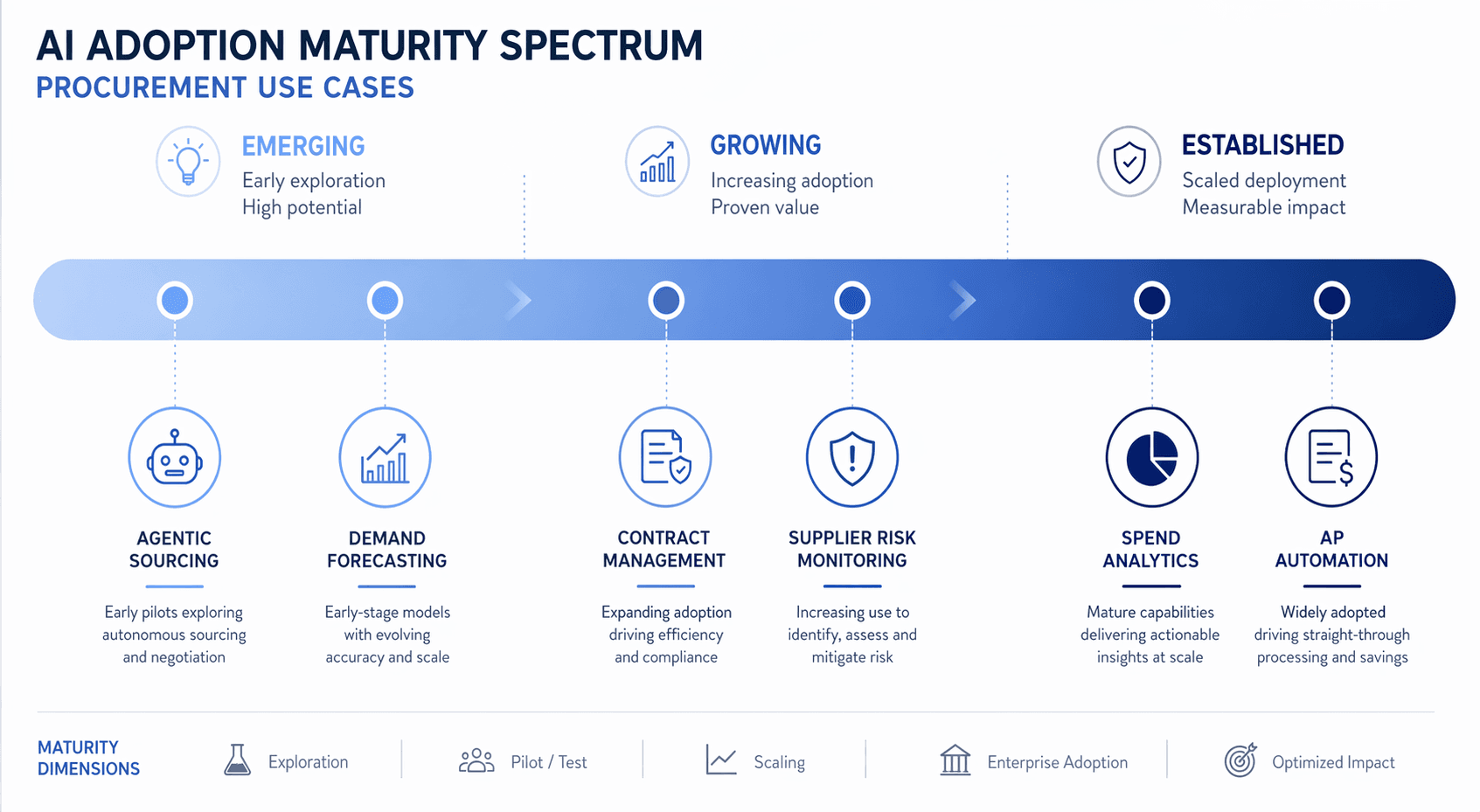
The maturity distribution matters for sequencing your investments. Starting with Established use cases builds organizational confidence, data infrastructure, and change management muscle before tackling the higher-risk, higher-potential Emerging applications. The data supports this staged approach: ISG's 2025 research found that procurement represents just 6% of enterprise AI use cases overall, and supplier management accounts for only 4% with just 8% in production — suggesting that even the Growing category has significant room for expansion.
Common Failure Modes and How to Avoid Them
The gap between pilot and production — 49% piloted versus 4% deployed at scale — is not random. It follows predictable patterns. The following failure modes appear repeatedly across procurement AI initiatives, and each has a corresponding mitigation strategy.
- Poor data readiness. Gartner reports that 74% of procurement leaders say their data isn't AI-ready. Fragmented master data, inconsistent category codes, and incomplete supplier records are the most common blockers. Mitigation: conduct a structured data readiness assessment before selecting a vendor. Our Data Readiness Assessment for AI Procurement Automation guide provides a practical framework for this step.
- No clear business outcome defined. CASME's research with procurement leaders found that pilots fail most often when teams cannot articulate what success looks like in operational terms — cycle time reduction, visibility improvement, compliance rate increase — before deploying technology. Mitigation: define 2–3 measurable outcomes per use case before writing an RFP.
- No structured change management. AI changes how procurement professionals spend their time — shifting them from transactional processing to strategic analysis. Without intentional change management, teams resist the new tools or bypass them entirely. The Hackett Group notes that AI projects built with external partnerships are approximately 2X more successful than internal builds, suggesting that organizational change benefits from structured support.
- Over-reliance on vendor demos. Vendor demonstrations use curated data sets and ideal conditions. Real-world performance depends on your data quality, category complexity, and integration landscape. CASME's research emphasizes learning from peers before investing. Mitigation: require proof-of-concept deployments on your own data before committing to enterprise licenses.
- Governance gaps. AI systems that make or influence procurement decisions — particularly in autonomous negotiation and agentic sourcing — require governance frameworks for model accountability, explainability, and audit trails. Most organizations lack these frameworks. For a deeper look at this failure mode, see our article on The AI Readiness Gap in Procurement: Why 83% of Teams Lack Governance and What It Costs.
Vendor Ecosystem Overview: Navigating the Procurement AI Landscape
The procurement AI vendor landscape can be organized into three tiers. Understanding the distinction between them is critical for making an informed architecture decision.
- Full S2P suites with embedded AI. Coupa, GEP, Ivalua, Zycus, and Jaggaer offer end-to-end source-to-pay platforms with AI capabilities embedded across spend analytics, sourcing, contract management, and AP automation. These are best suited for organizations that want a unified data model and single-vendor accountability, but they may lag behind specialized AI platforms in specific capabilities.
- Specialized AI platforms. Sievo (spend analytics), Mercanis (multi-agent procurement orchestration), Pactum (autonomous negotiation), Scoutbee (supplier discovery), and Tipalti (AP automation) focus on specific use cases with deep functionality. These are often best-of-breed solutions that integrate with existing S2P suites. They are appropriate for organizations that want to augment rather than replace their current infrastructure.
- Orchestration and agentic layers. A new category of platforms — including IBM's watsonx Orchestrate and The Hackett Group's ZBrain — provides agentic orchestration layers that coordinate multiple AI agents across existing systems. These are designed for organizations that have already invested in S2P infrastructure and want to add an intelligent coordination layer without rip-and-replace. For a detailed evaluation framework, see our architectural decision guide: Procurement AI Tools in 2026: Orchestration Layers vs. Full S2P Suites.
The representative vendors listed here are illustrative, not exhaustive. The procurement AI market is evolving rapidly, with new entrants and capability expansions occurring quarterly. Any vendor shortlist should be developed based on your specific use case priorities, data environment, and integration requirements.
Prioritization Framework: Where Should You Start?
The following staged roadmap is designed to help procurement leaders sequence AI investments based on organizational readiness, not vendor hype. The logic is simple: start with use cases that deliver quick wins with low complexity, build data and change management infrastructure, then scale to more complex applications.
- Phase 1 — Quick wins (months 1–6). Deploy AI-powered spend analytics to get your data foundation in order. Simultaneously, introduce generative AI as a drafting co-pilot for RFPs, RFIs, SOWs, and supplier notices. These use cases require minimal integration, deliver visible results quickly, and build organizational confidence. The Hackett Group found that 57% of procurement leaders are already piloting or investigating advanced analytics, and 52% are doing the same for e-sourcing — these are the easiest entry points.
- Phase 2 — Scale and integrate (months 6–12). With clean data and organizational buy-in, expand to contract intelligence (clause extraction, obligation tracking, risk flagging), supplier risk monitoring (continuous scoring from internal and external signals), and AP automation (invoice matching, payment optimization). These use cases require deeper integration with existing systems but deliver the highest ROI multiples.
- Phase 3 — Autonomous agents (months 12–24+). Once governance frameworks, data pipelines, and change management processes are mature, introduce agentic AI for autonomous sourcing, supplier negotiation, and multi-agent procurement workflows. This phase requires the highest organizational readiness but also offers the largest potential efficiency gains — McKinsey's estimate of 25–40% efficiency improvement from agentic AI is the prize at the end of this roadmap.
Comments
Join the discussion with an anonymous comment.