The Architectural Fork in Procurement AI
Procurement technology buyers entering 2026 face a decision that is less about vendor logos and more about architectural philosophy. The question is no longer "which procurement AI tool should we buy?" but rather "what kind of system should we build our procurement function on?" Two fundamentally different approaches dominate the market: lightweight orchestration layers that sit atop existing systems and deploy in weeks, and full source-to-pay (S2P) suites that replace the entire technology stack over 6 to 18 months. A third category — specialized point solutions — fills gaps in either approach.
The stakes are high. Gartner forecasts that agentic AI in supply chain and procurement software will grow from $2 billion in 2025 to $53 billion by 2030, a five-year CAGR of 93.5%. Meanwhile, 72% of procurement leaders say they prioritize integrating generative AI into their strategies, according to Gartner. Yet 74% of those same leaders admit their data is not AI-ready. The architectural choice determines how fast an organization can move, how deeply AI can integrate, and how much organizational change is required.
This guide provides a structured decision framework for procurement technology evaluators and IT architecture leads. It covers the three architectural categories, compares them across six decision dimensions, offers a diagnostic matrix for self-qualification, and explains the emerging "blend" strategy that combines elements of both approaches.
Category 1: Procurement Orchestration Layers
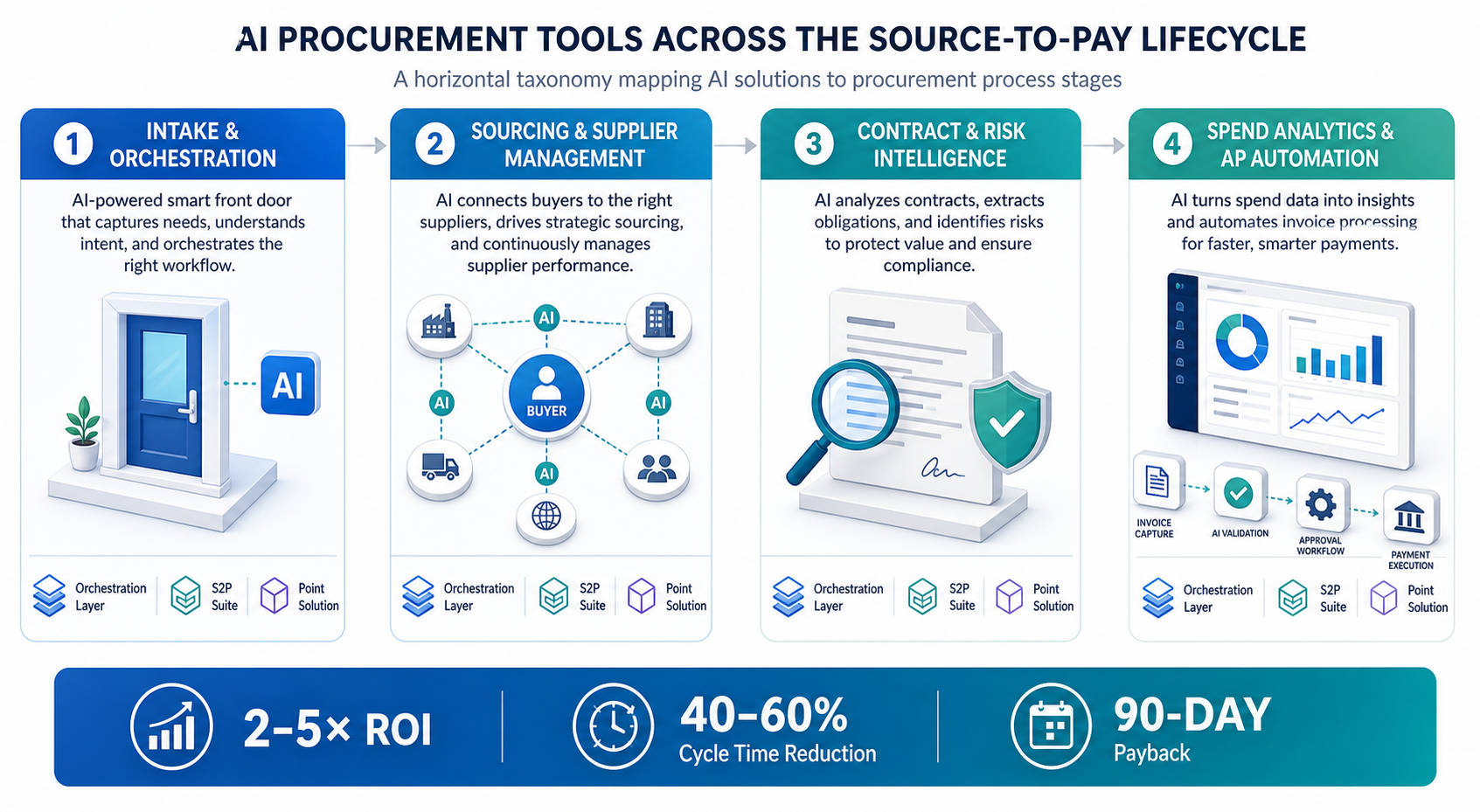
Orchestration layers act as a smart front door for procurement. They sit on top of existing enterprise resource planning (ERP) systems, procure-to-pay (P2P) platforms, and supplier databases, coordinating workflows across them without replacing any underlying system. Representative platforms include Zip, Opstream, Levelpath, Oro Labs, and — until its acquisition by Coupa in May 2026 — Tonkean.
The defining characteristic of this category is speed. Suplari, an AI-native procurement intelligence platform, reports deployment timelines of 45 to 90 days compared to 6 to 12 months for legacy S2P suites — a 4 to 10 times difference in time-to-value. Zip states that most teams can prove a 90-day return on investment by targeting cycle-time reduction and increases in spend under management. This rapid deployment is possible because orchestration layers do not require data migration, process reengineering, or the retirement of existing systems.
The AI focus in orchestration layers centers on intake routing, workflow automation, and agentic task execution. Zip was named a Visionary in the 2026 Gartner Magic Quadrant for agentic procurement orchestration; customers report processing requests five times faster. These platforms use AI to interpret natural-language requests, route them to the correct approval workflow, and execute routine procurement tasks without human intervention.
Key Platforms in This Category
- Zip: Purpose-built as a front-door orchestration layer. AI handles intake, approval routing, and supplier onboarding. Customers report 5× faster request processing and 40–60% cycle time reduction.
- Opstream: AI-native orchestration with a focus on governance and compliance. Designed to connect to existing ERPs and P2P tools without data migration.
- Levelpath: An AI-native procurement platform built from the ground up with AI as its foundation. Features a platform-wide AI assistant and AI agents for contract and supplier management.
- Oro Labs: Provides a flexible orchestration layer with strong workflow customization capabilities, often used by organizations with complex approval hierarchies.
Category 2: Full Source-to-Pay Suites
Full S2P suites provide end-to-end coverage of the procurement lifecycle — from strategic sourcing and supplier management through contract lifecycle management, procurement operations, invoicing, and payment. The dominant platforms in this category are Coupa, SAP Ariba, Ivalua, Zycus, and Jaggaer. These systems replace the entire procurement technology stack, which is both their strength and their primary drawback.
Deployment timelines for full S2P suites typically range from 6 to 18 months, depending on the complexity of the existing environment, the number of modules being implemented, and the extent of data migration required. Suplari's comparison of 45–90 days versus 6–12 months for legacy suites is consistent with industry experience. The payoff for this longer implementation is deeper integration: a unified data model across sourcing, procurement, and finance, with AI models that can draw on the full breadth of transactional data.
The AI capabilities in S2P suites are substantial. Coupa's community intelligence dataset is powered by trillions of dollars in aggregated spend data; customers commonly cite 2–5% hard savings on managed spend categories. Coupa Navi, the platform's AI agent, provides predictive spend analytics, guided buying, and supplier risk indicators. SAP Ariba offers generative AI-enabled category management and the Joule AI copilot. Zycus's Merlin GenAI Suite provides cognitive spend analysis, sourcing optimization, and contract lifecycle management. Ivalua's Intelligent Virtual Assistant supports over 25 use cases across supplier management, sourcing, contract management, and procure-to-pay.
Key Platforms in This Category
- Coupa: Full S2P suite with community intelligence (trillions of dollars in aggregated spend data), Coupa Navi AI agent, Contract Intelligence, and Purchase Order Collaboration Intelligence. Acquired Tonkean in May 2026 to add orchestration capabilities.
- SAP Ariba: Deep integration with SAP ERP. AI enhancements include generative AI-enabled category management and the Joule AI copilot for guided buying and supplier matching.
- Ivalua: AI capabilities across supplier management, contract management, and procurement analytics. Intelligent Virtual Assistant supports 25+ use cases.
- Zycus: Merlin GenAI Suite provides cognitive spend analysis, sourcing optimization, supplier management, contract lifecycle management, and procure-to-pay automation.
Category 3: Point Solutions and Intelligence Layers
Between the orchestration layer and the full S2P suite sits a third category: specialized AI tools that address specific procurement functions without replacing the broader technology stack. These point solutions are designed to complement either architectural approach, filling capability gaps with deep functional expertise.
Suplari is an AI-native procurement intelligence platform that deploys in 45–90 days and sits on top of existing ERPs like Coupa, SAP Ariba, and Oracle. It provides 175+ prebuilt insights and autonomous AI agents that interpret natural-language questions. It is not a full S2P suite — it is an analytics and intelligence layer that augments whatever procurement system an organization already has.
Keelvar specializes in autonomous sourcing optimization. Its bots are in production at Coca-Cola, Mars, and Siemens, delivering 2–8% additional savings and reducing event cycle times by 50–70%. Pactum focuses on autonomous negotiation for tail spend, delivering 2–5% average savings. Sievo processes spend data equivalent to 2% of the world's GDP annually and provides spend analysis and classification, achieving approximately 80% automation in spend categorization.
Key Platforms in This Category
- Suplari: AI-native procurement intelligence with 175+ prebuilt insights. Deploys in 45–90 days. Sits on top of existing ERPs.
- Keelvar: Autonomous sourcing optimization. 2–8% additional savings. 50–70% reduction in event cycle times. Deployed at Coca-Cola, Mars, Siemens.
- Pactum: Autonomous negotiation for tail spend. 2–5% average savings. Kärcher reported substantial discounts and time savings.
- Sievo: Spend analysis and classification. Processes data equivalent to 2% of global GDP. Approximately 80% automation in spend categorization.
Head-to-Head Comparison: Orchestration vs. S2P Suite
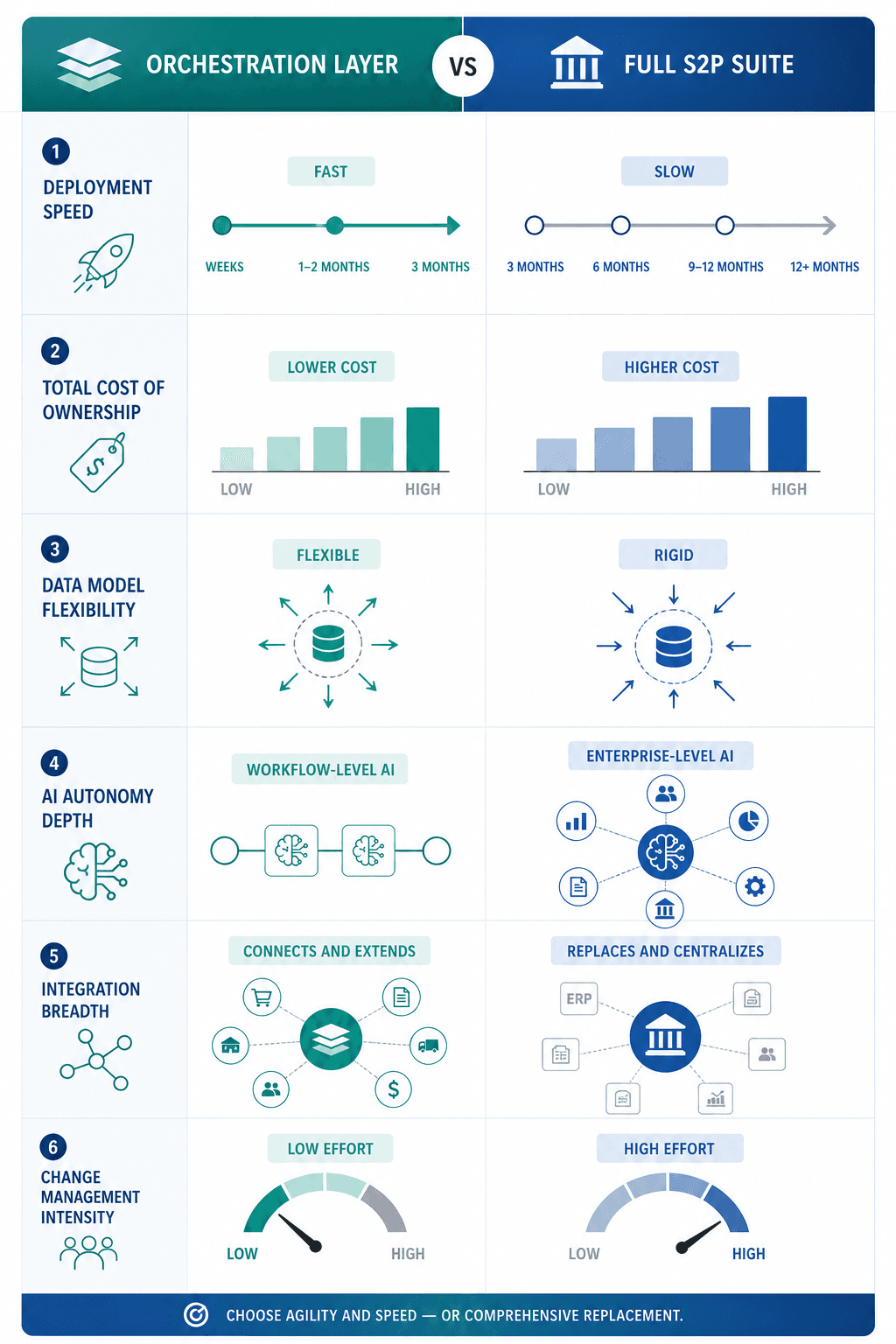
The following table compares orchestration layers and full S2P suites across six decision dimensions that matter most to procurement technology evaluators. These dimensions are drawn from the architectural differences that determine deployment success, not from feature lists.
| Dimension | Orchestration Layer | Full S2P Suite |
|---|---|---|
| Deployment Speed | Weeks (45–90 days typical). No data migration required. Works with existing systems. | 6–18 months. Requires data migration, process reengineering, and system retirement. |
| Total Cost of Ownership | Lower upfront cost. Subscription-based. No infrastructure or migration costs. | Higher upfront cost. Implementation services, data migration, and change management add 30–50% to license costs. |
| Data Model Flexibility | High. Connects to multiple data sources without forcing a single schema. Can adapt to existing data structures. | Low to medium. Requires data standardization and migration to the suite's data model. Rigid schema may require process changes. |
| AI Autonomy Depth | Process-level. AI handles intake routing, approval workflows, and routine tasks. Limited to orchestration scope. | Enterprise-level. AI models have access to full transactional data across sourcing, procurement, and finance. Deeper predictive and prescriptive capabilities. |
| Integration Breadth | Broad but shallow. Connects to existing ERPs, P2P tools, and supplier databases via APIs. No deep data integration. | Deep but narrow. Replaces existing systems. Integration is internal to the suite. External integration requires additional effort. |
| Change Management Intensity | Low. Users continue using existing systems for most tasks. Orchestration layer adds a new front-end but does not disrupt back-end processes. | High. Every procurement process is redefined. Users must learn new systems. Organizational resistance is a common failure mode. |
Decision Matrix: Which Approach Fits Your Organization?
The right architectural choice depends on four organizational factors: existing system complexity, speed-to-value requirements, change capacity, and AI maturity. The following matrix maps each approach to specific organizational profiles.
| Organizational Profile | Recommended Approach | Rationale |
|---|---|---|
| Complex ERP landscape (SAP, Oracle, multiple legacy systems). Low tolerance for disruption. | Orchestration Layer | Avoids rip-and-replace. Deploys in weeks. Connects existing systems without data migration. Low change management burden. |
| Greenfield procurement function or simple existing stack. High change capacity. Willing to invest 12–18 months. | Full S2P Suite | Deeper AI integration. Unified data model. Higher long-term value. Organization can absorb the implementation effort. |
| Urgent need for AI value (90-day ROI target). Limited budget for implementation services. | Orchestration Layer + Point Solutions | Fastest path to AI value. Low upfront cost. Can add point solutions for specific gaps (sourcing optimization, spend analytics). |
| Mature procurement function with existing S2P suite. Looking to add AI capabilities without replacing the stack. | Point Solutions / Intelligence Layers | Augments existing investment. Suplari, Keelvar, or Pactum can add AI without disrupting the current system. |
| High AI maturity. Data is AI-ready. Organization wants maximum AI autonomy across the full procurement lifecycle. | Full S2P Suite with AI Modules | Enterprise-level AI models can draw on full transactional data. Coupa Navi, SAP Joule, or Zycus Merlin provide deep AI capabilities. |
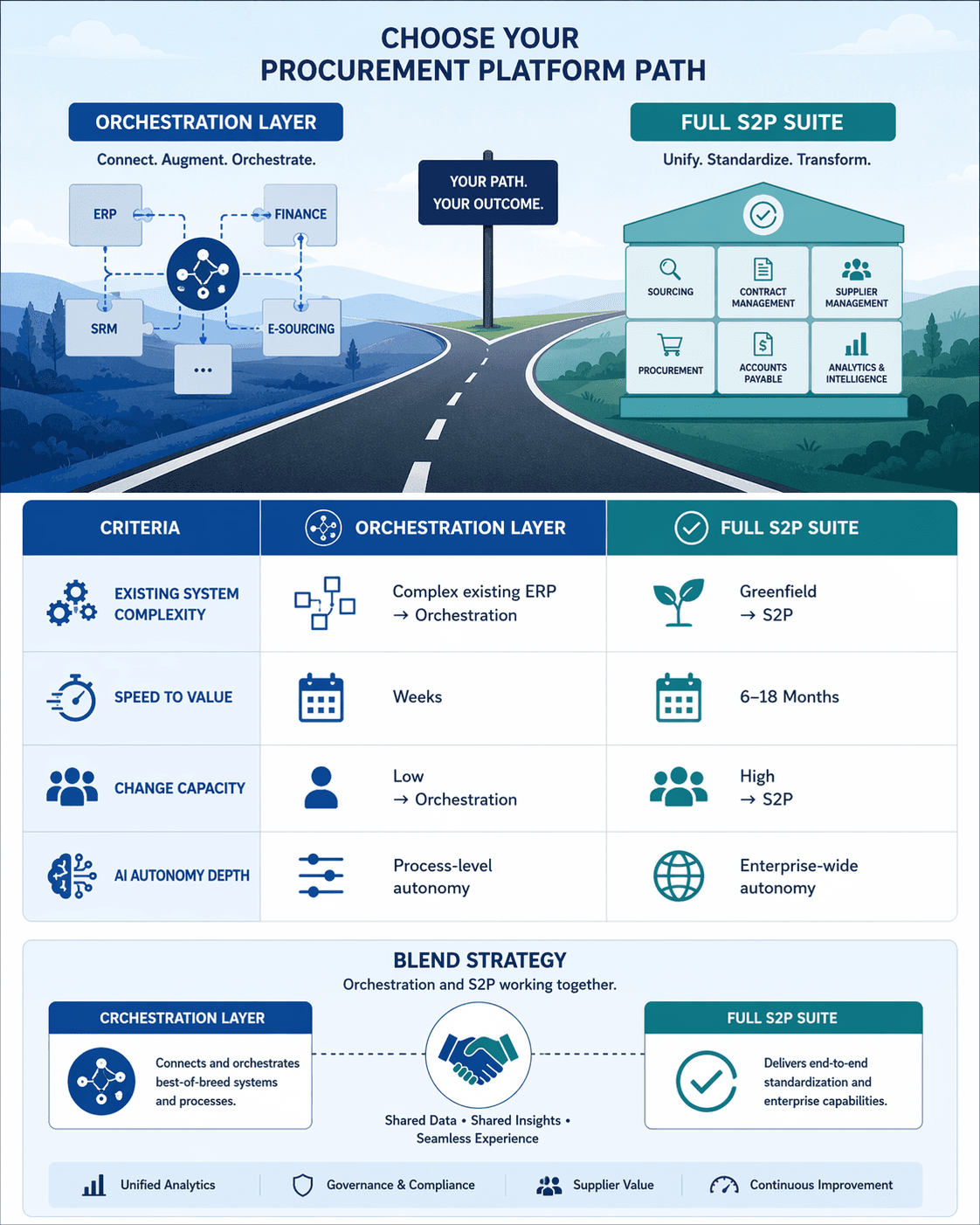
The Blend Strategy: Combining Orchestration and Suite Capabilities
The most sophisticated procurement organizations are not choosing between orchestration and S2P suites. They are combining both. Gartner recommends a "blend" approach: buying embedded AI capabilities within procurement platforms and augmenting them with contextual data from orchestration or point solutions. This strategy provides quicker access to value while preserving the option for deeper integration over time.
The clearest signal that the market is moving in this direction is Coupa's acquisition of Tonkean in May 2026. Tonkean was a leading procurement orchestration platform. By acquiring it, Coupa acknowledged that even the largest S2P suite vendor sees orchestration as the emerging standard for how procurement AI tools will be deployed. The acquisition allows Coupa to offer an orchestration layer that connects to non-Coupa systems while also providing deep integration with its own S2P suite.
A practical blend strategy might look like this: deploy an orchestration layer (Zip, Opstream, or Levelpath) as the front door for procurement intake and routing, connecting to an existing SAP or Oracle ERP. Simultaneously, implement a point solution like Keelvar for sourcing optimization or Pactum for autonomous negotiation. Over 12 to 18 months, migrate to a full S2P suite (Coupa, SAP Ariba, or Ivalua) while keeping the orchestration layer as the user-facing front end. The result is a system that delivers AI value in weeks while building toward deeper integration.
5 Questions to Ask During Any AI Procurement Platform Demo
The architectural differences between orchestration layers, S2P suites, and point solutions are not always visible in vendor demos. Vendors tend to emphasize AI capabilities and user experience while glossing over integration complexity, data model requirements, and change management. The following five questions are designed to surface the architectural trade-offs that determine whether a platform will succeed in your specific environment.
- "What is the typical deployment timeline for an organization with our existing system landscape, and what are the top three factors that cause delays?" Orchestration vendors should answer in weeks. S2P suite vendors should answer in months and should be transparent about data migration and process reengineering risks.
- "How does your platform handle data that does not conform to your data model?" Orchestration layers should be flexible. S2P suites may require data standardization. If the vendor says "our platform handles any data," ask for a specific example of a customer with a non-standard ERP.
- "What percentage of procurement tasks can your AI handle autonomously today, and what is the governance model for exceptions?" Sievo reports approximately 80% automation in spend classification, with 20% requiring human review. Ask for similar benchmarks for the specific use cases you are evaluating. The governance model — human-in-the-loop, human-on-the-loop, or fully autonomous — should be clearly defined.
- "What is your integration approach for connecting to our existing ERP and P2P systems, and what is the ongoing maintenance burden?" Orchestration layers should offer prebuilt connectors and APIs. S2P suites may require custom integration for non-native systems. Ask about API versioning, rate limits, and support for real-time vs. batch data synchronization.
- "What change management resources do you provide, and what is the typical time to user adoption?" Orchestration layers should report adoption in weeks because the user interface is additive, not disruptive. S2P suites should report adoption in months and should provide dedicated change management support. If the vendor cannot provide adoption metrics, that is a red flag.
Comments
Join the discussion with an anonymous comment.