
Gartner’s Three Building Blocks for the Autonomous Supply Chain
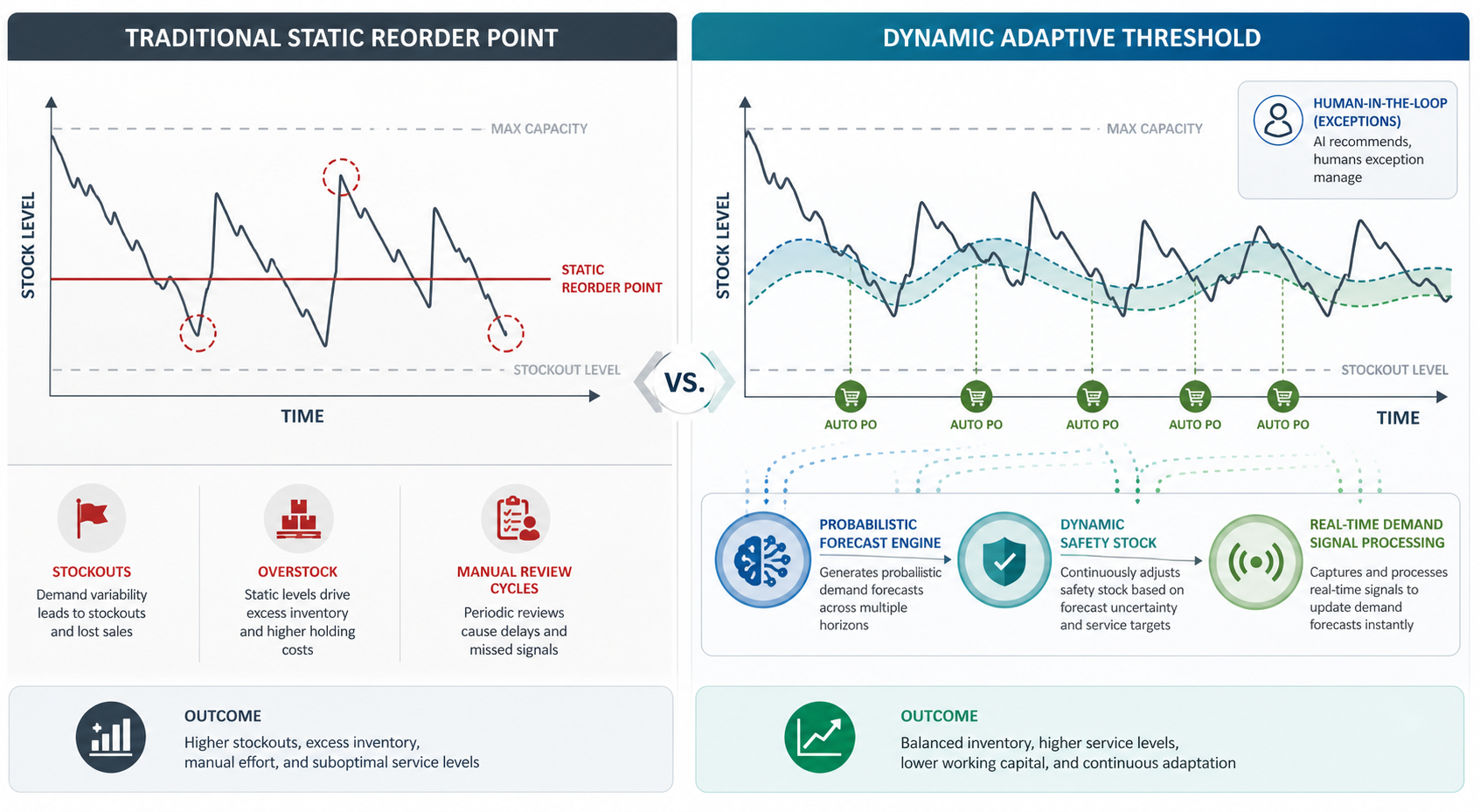
At the May 2026 Gartner Supply Chain Symposium in Orlando, the firm unveiled a framework that reframes the conversation around AI adoption. Instead of treating autonomy as a single end state, Gartner defined three interconnected building blocks that supply chain organizations must develop in parallel: autonomous-ready operations, autonomous-ready intelligence, and an autonomous-ready workforce. The press release from May 4, 2026, defines an autonomous business as “a strategy that uses self-improving, adaptable technology to make decisions, take action and create new types of value by increasing both people autonomy and machine autonomy.”
The three blocks are not sequential; they must advance together. Autonomous-ready operations means moving from siloed functional automation to outcome-based decision-making that spans procurement, inventory, logistics, and planning. Autonomous-ready intelligence is Gartner’s “decision stack” — a layered architecture of data, workflows, governance policies, and human context that makes automated decisions explainable and auditable. Autonomous-ready workforce addresses the human side: only 1% of layoffs in the second half of 2025 were attributed to AI, per Gartner, and the firm predicts net job gains in asset-intensive industries starting in 2026. The role of the planner shifts from executing repetitive decisions to supervising exceptions and improving model performance.
Why Reorder Point Optimization Is the Natural On-Ramp
For supply chain executives building a multi-year autonomous strategy, the critical question is: where to start? The answer lies in selecting a use case that is bounded, high-frequency, and directly measurable — and reorder point optimization fits all three criteria.
Consider the broader landscape: According to ABI Research data cited by OpenSky Group, 94% of supply chain companies plan to use AI or generative AI for decision support within two years. Yet Gartner found that only 23% of supply chain organizations have a formal AI strategy in place. The gap between intent and structured execution is enormous. Meanwhile, a Forbes article referenced by Synkrato notes that 85% of AI projects fail to deliver expected results — often due to data quality, integration complexity, and organizational readiness issues. An autonomous reorder point system sidesteps many of these failure modes because it operates within a well-defined decision boundary: a single SKU, a predetermined service level, and a measurable fill rate.
- Bounded scope: Reorder decisions are confined to individual item-location combinations. The input variables (demand, lead time, service level) are well understood, making it feasible to model probabilistically without touching the entire supply chain.
- High frequency: Many SKUs are replenished weekly, daily, or even intraday. A high-volume decision loop generates rapid feedback on model accuracy — accelerating the learning cycle for both the AI and the planning team.
- Directly measurable: Inventory turns, stockout rates, and service levels are lagging indicators that move visibly within weeks of deployment. Unlike broader strategic AI initiatives, ROI can be calculated at SKU level within a quarter.
John Galt Solutions’ recap of the Gartner Symposium noted that 8 in 10 executives expect autonomous business to be the dominant form of business by 2030, and 77% of CEOs believe their current operating models are insufficient for an AI-driven world. Starting with reorder point optimization does not just deliver immediate inventory benefits — it builds the decision infrastructure and cross-functional trust needed before scaling to broader autonomous planning.
How Autonomous Reorder Systems Embody Each Building Block
Gartner’s three building blocks may sound abstract until mapped to the concrete layers of an autonomous reorder system. The table below translates the framework into operational components, showing how a dynamic replenishment engine operationalizes each block at SKU level.
| Gartner Building Block | What It Means in Reorder Context | System Component Example |
|---|---|---|
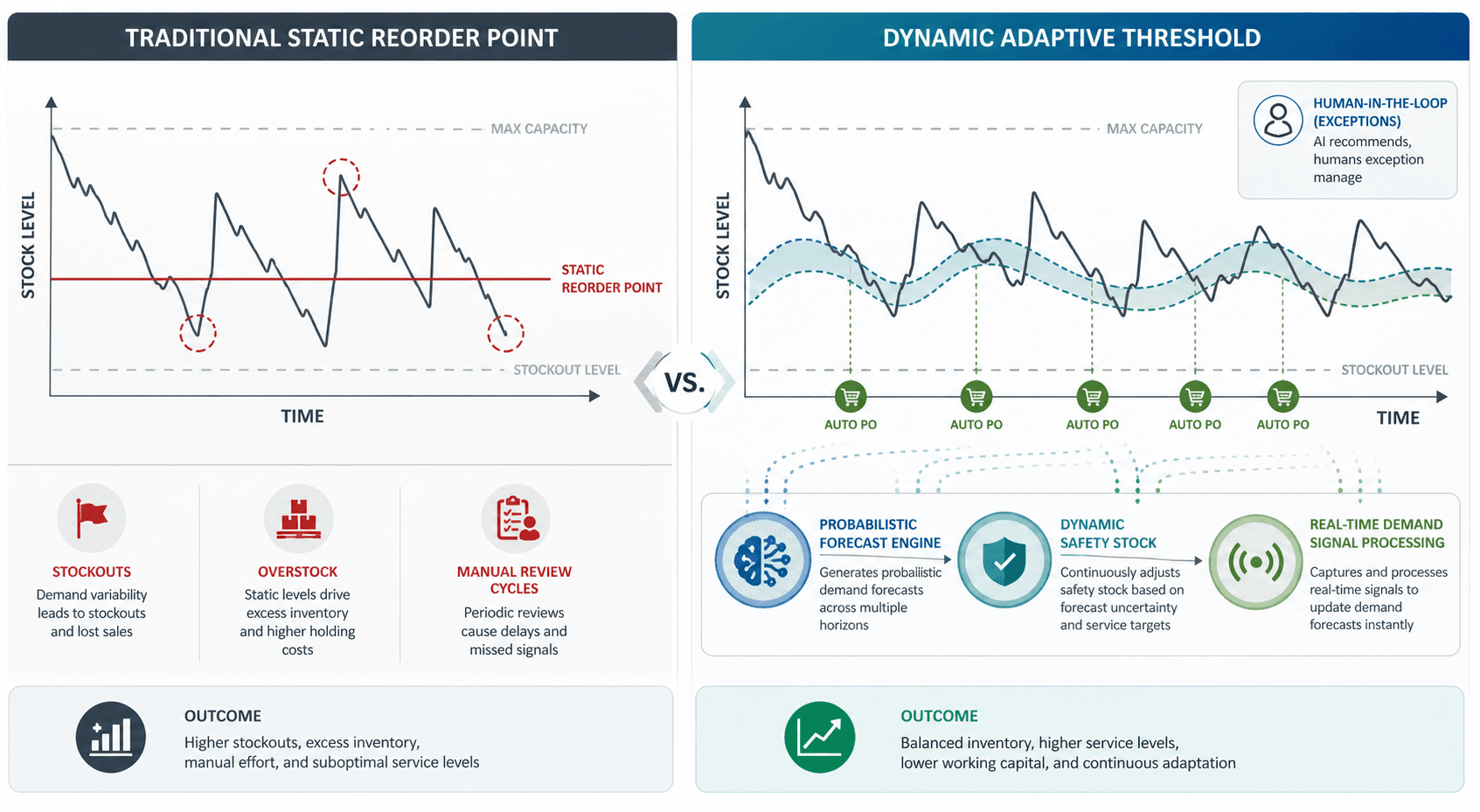
| Autonomous-ready operations | Move from fixed min-max or periodic review to continuous, outcome-driven replenishment decisions that balance inventory cost, service level, and network constraints. | Real-time demand signal processing; dynamic safety stock that adjusts with lead-time variability; automated purchase order generation for routine replenishment. |
| Autonomous-ready intelligence | A decision stack that combines probabilistic forecasting, guardrails (min/max override), and governance policies so that every automated decision can be traced and audited. | Probabilistic forecast engine (e.g., quantile regression, Monte Carlo simulation); policy rules for exception handling; model drift monitoring alerts. |
| Autonomous-ready workforce | Planners shift from manually calculating reorder points to supervising system performance, approving exceptions, and training models — not executing routine tasks. | Exception dashboard with human-in-the-loop workflows; planner roles redefined as “decision supervisors”; performance analytics for continuous improvement. |
This mapping is not theoretical. Synkrato describes AI in inventory management as a “continuous decision layer” that recalibrates forecasts, reorder points, and exception responses in real time. Instead of a monthly planning cycle, the system evaluates demand variability distributions, lead time fluctuations, service level targets, and network-wide inventory dependencies on a daily or hourly basis. The operations block is served by the transition from static thresholds to dynamic ones. The intelligence block is embodied by the probabilistic model and its guardrails — decisions are not black boxes but configurable policies. The workforce block is realized as planners move from keying in reorder quantities to analyzing exception logs and tuning model parameters.
A critical point: the decision stack (intelligence) must include guardrails. Without them, an autonomous reorder system could overreact to a demand spike and create excess inventory downstream. Gartner’s framework explicitly includes “governance” and “human context” in the intelligence layer — a distinction that separates mature autonomous systems from simple automation.
Gartner’s Predictions: What They Mean for Inventory Decision-Making
Gartner has made two specific predictions that directly contextualize the role of autonomous reorder optimization:
- By 2028, 15% of daily logistics decisions will be made autonomously by AI agents. Reorder decisions are a subset of logistics decisions — often the highest-volume, lowest-complexity tier. Starting with reorder autonomy creates the data pipelines and trust patterns that enable later expansion into freight routing, warehouse slotting, and procurement negotiation.
- By 2031, 60% of supply chain disruptions will be resolved without human intervention. That means the AI must already be capable of adjusting inventory buffers and reorder triggers in real time as disruptions occur. Autonomous reorder systems are the foundational layer for that capability — they provide the dynamic safety stock and network-aware replenishment logic that can absorb variability without escalating to human planners.
These predictions were cited in the John Galt symposium recap and in OpenSky Group’s statistics roundup. They have not been independently verified against the primary Gartner press release, which does not contain the specific 60% figure. However, the consistency across secondary sources gives reasonable confidence in their directional accuracy.
For supply chain leaders, these predictions reinforce the urgency of building the decision infrastructure now. An autonomous reorder system is not a future-state ambition — it is the operational foundation that turns these predictions from aspirations into achievable milestones.
The Adoption Gap: Opportunity for First-Movers
The gap between AI intent and formal strategy creates a clear opening for early adopters. Only 23% of supply chain organizations have a formal AI strategy, per Gartner data, despite 94% planning to use AI within two years. That means the majority are moving ahead tactically without a strategic framework — exactly the situation that leads to fragmented deployments, integration headaches, and stalled initiatives.
Companies that have achieved AI maturity in their supply chains report a 23% profitability advantage over peers, according to Accenture research cited by OpenSky Group. It is essential to note that this is a correlational finding, not a causal guarantee — AI-mature organizations may already possess operational excellence that drives profitability. Nonetheless, the figure serves as a powerful benchmark for the potential upside of closing the adoption gap.
| Metric | Reported Range | Source & Context |
|---|---|---|
| Inventory cost reduction | 20–35% (AI Strategy Path); 15–30% (ToolsGroup) | Vendor-adjacent benchmarks; may reflect successful implementation bias |
| Stock availability improvement | 34% (AI Strategy Path); 5–10% (Forstock, Shopify-focused) | AI Strategy Path figure from Kovench; Forstock applies to SMB e-commerce |
| Payback period | 6–12 months (both AI Strategy Path and ToolsGroup) | Consistent across sources; typical for well-scoped reorder projects |
| Manual task reduction | 60% (Forstock, operations director reports) | SMB context; may not scale linearly to enterprise complexity |
Comments
Join the discussion with an anonymous comment.